


Lower Manhattan is where New York began and where much of the United States’ early story unfolded. Within a compact area at the island’s southern tip you can walk from colonial-era forts and Revolutionary War sites to the country’s first capital, Wall Street’s Gilded Age canyons and the memorials that define 21st-century New York. With a little planning, you can see the most important landmarks in a single, rewarding day without feeling rushed or missing the sites that matter most.
Get the latest updates straight to your inbox!
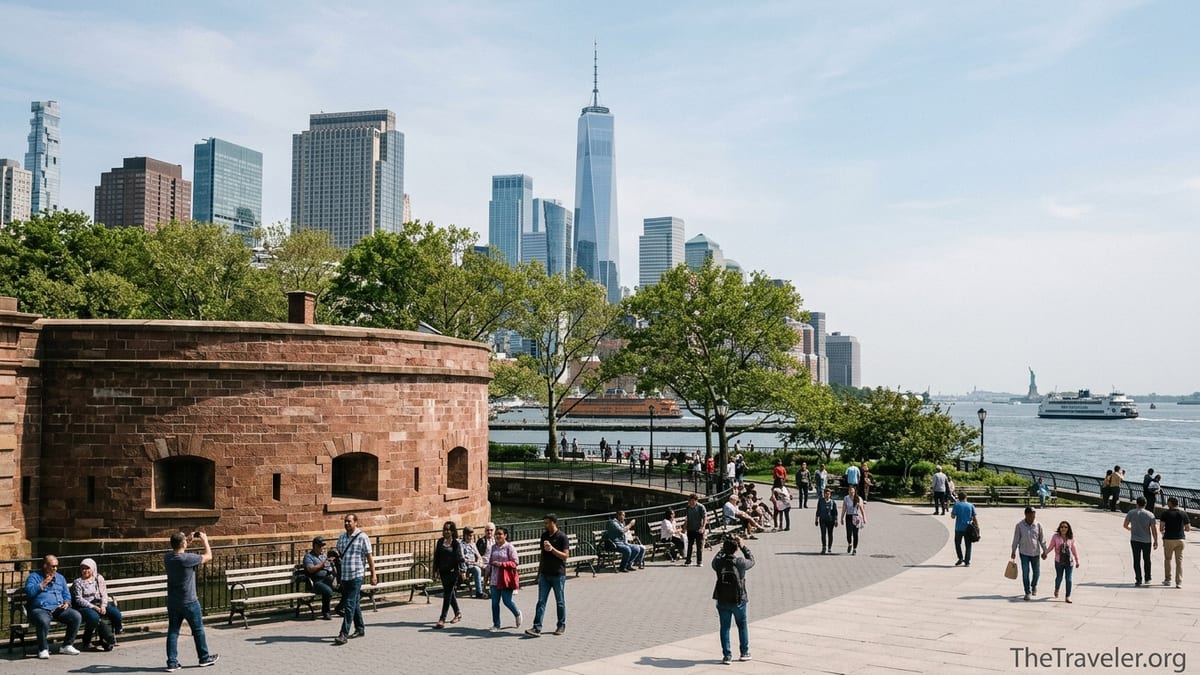
Start at the Harbor: The Battery, Castle Clinton and the Ferries
The best way to understand Lower Manhattan is to begin at its shoreline. The Battery, a waterfront park at the very southern tip of the island, has been New York’s front door for more than 300 years. Today it is a green pause between the skyscrapers and New York Harbor, where you can see the Statue of Liberty, Staten Island ferries gliding past and the outlines of Governors Island just offshore. Arriving early, ideally before 9 am, lets you experience the harbor in softer light and with fewer crowds, and sets you up well if you are continuing to Liberty Island or Ellis Island.
Inside the park is Castle Clinton, a circular stone fort built in the early 19th century. It has served as a theater, an immigrant landing depot and now functions as a National Park Service site and the main ticketing point for ferries to the Statue of Liberty and Ellis Island. The monument typically opens in the morning and closes in late afternoon, and there is no admission fee to enter its courtyard and exhibits. If the Statue of Liberty is a priority, book a morning ferry with Statue City Cruises in advance; same-day tickets are sometimes available but often sell out in busy seasons, especially pedestal or crown access.
Even if you do not sail to Liberty Island, the water is still central to a Lower Manhattan visit. A free round-trip ride on the Staten Island Ferry from the nearby Whitehall Terminal offers broad, open-air views of the Statue of Liberty and Lower Manhattan’s skyline without a ticket or reservation. The crossing takes about 25 minutes each way, and boats run frequently throughout the day, which makes it an easy add-on before you begin walking north into the Financial District.
Travelers who want more time on the harbor can consider a side trip to Governors Island, reached by a short ferry ride from the Battery Maritime Building on the east side of The Battery. Round-trip tickets are generally in the low single digits for adults, with discounts or free passage for children and some residents. Governors Island itself holds military-era forts and panoramic views back to Lower Manhattan, but even if you stay on the main island, standing at the Battery’s promenade with the statue to one side and Brooklyn to the other frames the geography that shaped early New York.
From Bowling Green to Wall Street: Tracing the Birth of American Finance
From the harborfront it is only a few minutes’ walk to Bowling Green, a small oval park at the foot of Broadway that is one of the oldest public spaces in the city. In colonial times it hosted a statue of King George III that was famously pulled down during the American Revolution. Today, the park is surrounded by grand Beaux-Arts buildings and the famous bronze Charging Bull sculpture at its northern tip. The area can be crowded with people taking photos, but it is worth pausing here to imagine this as the edge of the original Dutch and British settlement.
On the east side of Bowling Green stands the former U.S. Custom House, now home to the New York branch of the National Museum of the American Indian. The building’s lavish façade and interior reflect the era when New York’s harbor was a major source of federal customs revenue. Entry to the museum’s exhibits is typically free, making it a valuable historical stop even if you are traveling on a tight budget. You can easily spend 30 to 60 minutes here before continuing deeper into the Financial District.
From Bowling Green, walk north along Broadway or veer onto Broad Street and Wall Street to enter the heart of the Financial District. The streets narrow, the skyscrapers rise, and you will pass the New York Stock Exchange and Federal Hall. While access to the Stock Exchange interior is restricted, the exterior façade and its Corinthian columns are worth a photograph. This is also where you begin to feel the contrast between the area’s colonial history and its 19th and 20th century financial power.
Federal Hall National Memorial, across from the Stock Exchange, occupies the site where George Washington took the oath of office as the first president of the United States when New York briefly served as the nation’s capital. The current building dates from the 19th century, but the statue of Washington on the steps and the exhibits inside commemorate that founding moment. Federal Hall is operated by the National Park Service and typically offers free entry with rotating historical displays, making it one of the most important stops for travelers interested in early American government.
Sacred Ground: Trinity Church, St. Paul’s Chapel and Historic Cemeteries
Just a short walk from Wall Street, Trinity Church stands where Broadway meets the head of Wall Street. The current Gothic Revival structure dates from the mid-19th century, but a church has occupied this site since the late 1600s. Its dark stone spire, once among the tallest points in Manhattan, now stands in the shadow of office towers, but the churchyard remains a surprisingly peaceful pocket amid the traffic and noise.
The church’s graveyard is one of the key historic landmarks in Lower Manhattan. Here you will find the grave of Alexander Hamilton, the first U.S. Secretary of the Treasury, and nearby markers for his wife Eliza and his sister-in-law Angelica Schuyler Church. Visitors familiar with the Broadway musical “Hamilton” often make this a pilgrimage stop, and the straightforward signage makes it easy to locate the family plots. Walking the rows of headstones, you will also see names of Revolutionary War figures, merchants and early New Yorkers, which gives a tangible sense of the city’s 18th-century scale.
A few blocks to the north stands St. Paul’s Chapel, affiliated with Trinity Parish and completed in the 18th century. Remarkably, it survived the Great Fire of 1776 and later withstood the collapse of the nearby World Trade Center towers in 2001. The chapel served as a sanctuary and relief center in the months after the September 11 attacks, and its interior exhibits often highlight that role with artifacts and photographs. The churchyard here is smaller than Trinity’s but still rich in early gravestones and provides another quiet place to pause in the middle of downtown.
Both Trinity Church and St. Paul’s Chapel usually keep visitor hours during the day, and entry is free, though donations are welcome. Travelers pressed for time can still step inside each sanctuary for a few minutes to appreciate their architecture and to understand how central these spaces have been in New York’s civic and spiritual life. Combined, they form an essential chapter in any historic walk through Lower Manhattan.
Revolutionary Taverns, Cobblestone Streets and Hidden Corners
Lower Manhattan’s history is not only written in churches and government buildings; it lives in its side streets and taverns as well. Two of the most atmospheric areas are the blocks around Stone Street and Fraunces Tavern, roughly a 5 to 10 minute walk from Bowling Green and the harbor. These streets can be easy to miss if you follow only the main avenues, which is why plotting them on your map in advance is a good idea.
Fraunces Tavern, at the corner of Pearl and Broad Streets, is both a museum and an operating restaurant. The building has been heavily restored, but it occupies the site of an 18th-century tavern where the Sons of Liberty met and where George Washington famously bid farewell to his officers after the British evacuated New York. The museum upstairs usually charges a modest admission fee, while the restaurant downstairs serves hearty pub-style meals and drinks. Even if you do not dine here, walking past and reading the plaques outside connects you directly to the city’s Revolutionary War history.
Stone Street, a short walk away, is one of the oldest streets in New York and part of a designated historic district. Its low-rise brick buildings and narrow cobblestone roadway feel completely different from the glass towers a block away. In good weather, the street often fills with outdoor tables from the surrounding bars and restaurants, which makes it an appealing place to stop for lunch or an early evening drink. For every high-end cocktail bar here, there is usually a more casual spot offering burgers, seafood or simple sandwiches, so travelers at different budget levels can all enjoy the setting.
Explorers who enjoy spotting remnants of the past should pay attention to details along these streets. Some building basements and courtyards reveal old wells or foundations through glass panels at sidewalk level, and informational plaques describe which structures date back to the early 1800s. Setting aside an unstructured half-hour to wander these few blocks without a rigid agenda often yields memorable finds and photographs that do not appear in every guidebook.
Remembering the Recent Past: The 9/11 Memorial and Museum
Any historical exploration of Lower Manhattan today is incomplete without acknowledging the events of September 11, 2001. The 9/11 Memorial and the National September 11 Memorial & Museum occupy the former World Trade Center site just west of Church Street, a short walk from St. Paul’s Chapel. The outdoor memorial plaza, with its two reflecting pools set in the footprints of the Twin Towers, is free to visit and open to the public, typically from morning until late evening.
The surrounding plaza is landscaped with trees and offers places to sit, but many visitors experience it primarily as a space of reflection. The bronze parapets around each pool are inscribed with the names of those who died in the attacks, and you will often see white roses placed in individual names to mark birthdays or anniversaries. Travelers should be prepared for a more somber atmosphere here than at other Lower Manhattan landmarks, and it is worth allowing at least 30 minutes if you wish to walk the perimeter of both pools.
The 9/11 Museum, located beneath the plaza, requires a timed ticket. Standard adult admission at the time of writing is typically in the range of several tens of dollars, with reduced prices for children, students and seniors, and there are some designated free or pay-what-you-wish hours on certain days. Because entry slots can sell out during peak travel weeks, booking tickets online in advance is strongly recommended, especially if you are planning a tightly scheduled day that also includes the harbor ferries or guided tours.
Inside the museum, exhibits include artifacts from the towers, oral histories, photographs and detailed timelines of the attacks and their aftermath. Many visitors spend 90 minutes to two hours here, and the emotional intensity can be high, particularly in the historical exhibition. If you are combining the museum with other sites, consider placing it in the middle or toward the end of your day and allow some quieter time afterward, whether that means sitting in the memorial plaza or walking north toward City Hall Park.
City Hall, Brooklyn Bridge Views and Historic Neighborhood Edges
North of the Financial District, the character of Lower Manhattan shifts again around City Hall Park. New York City Hall itself, facing the park, is one of the oldest continuously used city halls in the United States, with a design that blends French-inspired and American Federal elements. While casual visitors usually see it only from the outside due to security and tour limitations, the building’s pale stone façade and the placement of the surrounding park make this a pleasant transition zone between dense downtown offices and the neighborhoods beyond.
From City Hall Park, it is only a short stroll to the Manhattan entrance of the Brooklyn Bridge. Even if you are not planning to walk the entire span, climbing the initial ramp provides sweeping views back toward Lower Manhattan’s skyline and down to the East River. This is a good option if you have already spent time inside museums and churches and want a broader sense of how the historic core fits within the modern city. Early morning and late afternoon provide the most flattering light and slightly fewer crowds on the bridge’s pedestrian path.
Just to the west of City Hall Park lies the Civic Center, with courthouses and municipal buildings that reflect early 20th-century governmental architecture. To the north and east, you quickly reach Chinatown and the Lower East Side, where layers of immigrant history unfold in tenement buildings, storefronts and markets. While not always grouped with the classic “Lower Manhattan landmarks,” these neighborhoods show how the city evolved beyond its colonial core. Travelers with a full day can easily add a simple meal in Chinatown or a walk down a historic side street before circling back south toward the harbor on the subway.
For those intent on capturing the full story of Lower Manhattan in one day, City Hall Park serves as a natural upper boundary. From here, it is easy to descend back through the Financial District, revisiting sites like Trinity Church or Stone Street in a different light, or to end the day on the water by timing your return for sunset at The Battery. Planning your route in a loose loop, rather than crisscrossing the same blocks, keeps walking distances reasonable and ensures you encounter each of the area’s historic layers in a coherent order.
Practical Tips to See the Highlights in a Single Day
Lower Manhattan is compact, but its landmarks span several centuries and emotional tones. To avoid missing key sites, begin by mapping a simple sequence: The Battery and Castle Clinton in the morning, Bowling Green and the Financial District late morning, Trinity Church and St. Paul’s Chapel midday, the 9/11 Memorial and Museum in the afternoon, and City Hall Park or a short Brooklyn Bridge walk toward the end of the day. This kind of south-to-north route minimizes backtracking and makes it easier to adjust on the fly if a line or crowd is larger than expected.
Comfortable walking shoes are essential. The area’s older streets can include cobblestones, uneven pavement and narrow sidewalks, especially around Stone Street and near some churchyards. While the distances between major stops are often only a few blocks, the cumulative walking adds up quickly when you are also standing in museum galleries or waiting for ferries. Packing a light bag with water, a compact umbrella in changeable seasons and a portable phone charger will make the day smoother, especially if you rely on digital tickets for ferry rides and museum entry.
Tickets and security procedures deserve advance thought. Ferries to Liberty Island and Ellis Island require airport-style security screening, and the 9/11 Museum also has controlled entry. Bags may be inspected and certain items restricted, so checking official guidance the night before your visit can prevent surprises. Buying tickets ahead of time for Statue of Liberty ferries and the 9/11 Museum helps lock in your schedule, particularly during school holidays, summer weekends and major U.S. holiday periods when both attractions see heavy demand.
Food and rest breaks are easy to integrate near major landmarks. The Battery has casual kiosks and park benches with harbor views, Stone Street offers sit-down restaurants and pubs in a historic setting, and the shopping and dining centers at Brookfield Place and the World Trade Center complex provide quick-service options as well as indoor seating if the weather turns bad. Planning one longer sit-down meal and a couple of shorter coffee or snack stops will keep your energy up as you move through the area’s dense history.
The Takeaway
Exploring Lower Manhattan is less about checking sights off a list and more about understanding how layers of history overlap in a small piece of city. In a single day, you can watch ferries glide past former harbor forts, stand where a president took the first oath of office, trace the evolution of global finance and reflect at one of the most important memorials of the modern era. The walkable distances between sites mean you spend more time engaging with places and less time commuting between them.
With thoughtful planning, you do not have to choose between colonial taverns and contemporary memorials, between churchyards and skyline views. Starting at The Battery and moving north through Bowling Green, Wall Street, Trinity Church, the 9/11 Memorial and City Hall Park creates a narrative that makes sense on the ground. Each stop illuminates a different chapter of New York’s story, from its earliest European settlement through its role as a national capital, financial center and symbol of resilience.
Ultimately, what makes Lower Manhattan compelling is how tangible its history feels. Names from textbooks appear on gravestones, plaques and statues; events you may know only in outline take on physical form in forts, trading houses and rebuilt plazas. Whether you are a dedicated history traveler or a first-time visitor with just one free day, a well-planned walk through this compact district ensures you experience the landmarks that matter most without feeling that you missed the heart of New York’s past.
FAQ
Q1. Can I see Lower Manhattan’s major historic landmarks in one day?
Yes, most travelers can cover The Battery, Castle Clinton, Bowling Green, Wall Street, Trinity Church, the 9/11 Memorial and City Hall Park in a single full day on foot, especially if they start early and plan a logical walking route.
Q2. Do I need to book Statue of Liberty ferry tickets in advance?
Advance reservations are strongly recommended, particularly for pedestal or crown access and during busy seasons, because same-day tickets can sell out and lines at security screening can be long.
Q3. Is the 9/11 Memorial free to visit?
The outdoor 9/11 Memorial plaza with the reflecting pools is free and open to the public, but the National September 11 Memorial & Museum requires a paid, timed-entry ticket except during designated free or reduced-price hours.
Q4. Are Trinity Church and St. Paul’s Chapel open to visitors during the day?
In normal circumstances both churches keep daytime visiting hours and welcome the public without an admission fee, though specific opening times can vary by day and season, so it is wise to check shortly before your visit.
Q5. What is the best time of day to walk over the Brooklyn Bridge from Lower Manhattan?
Early morning and late afternoon typically offer the most comfortable temperatures, softer light for photos and slightly thinner crowds compared with midday, when the bridge can feel congested and exposed.
Q6. How much walking should I expect on a Lower Manhattan history day?
Even though individual landmarks are close together, it is common to walk several miles over the course of the day, including time spent wandering side streets, crossing parks and standing in museum exhibits and security lines.
Q7. Is Lower Manhattan’s historic area suitable for children?
Yes, but it helps to balance more serious stops like the 9/11 Museum with open-air sights such as The Battery, ferry rides on the harbor and shorter, focused visits to churches and museums rather than long, uninterrupted tours.
Q8. Can I visit Federal Hall and the New York Stock Exchange interior?
Federal Hall National Memorial is usually open to the public with free exhibits, but access inside the New York Stock Exchange is restricted, so most visitors experience it from the outside on Wall Street.
Q9. Are there good food options near the main historic sites?
Yes, you will find casual kiosks in The Battery, pubs and restaurants along Stone Street, and a wide range of cafés and food halls around the World Trade Center and Brookfield Place, all within easy walking distance of major landmarks.
Q10. Is it safe to walk around Lower Manhattan in the evening after sightseeing?
Lower Manhattan is generally busy and well-lit into the evening, particularly around transit hubs and major attractions, but as in any large city it is sensible to stay aware of your surroundings and use well-traveled streets when returning to your hotel.