


For Australian and New Zealand travellers, Webjet is often the first stop when searching for flights. Its matrix of fares across multiple airlines makes it easy to see options at a glance. But once you have found a good deal, a key question remains: is it actually cheaper to book that ticket on Webjet, or should you click away and purchase directly from the airline instead?
Get the latest updates straight to your inbox!
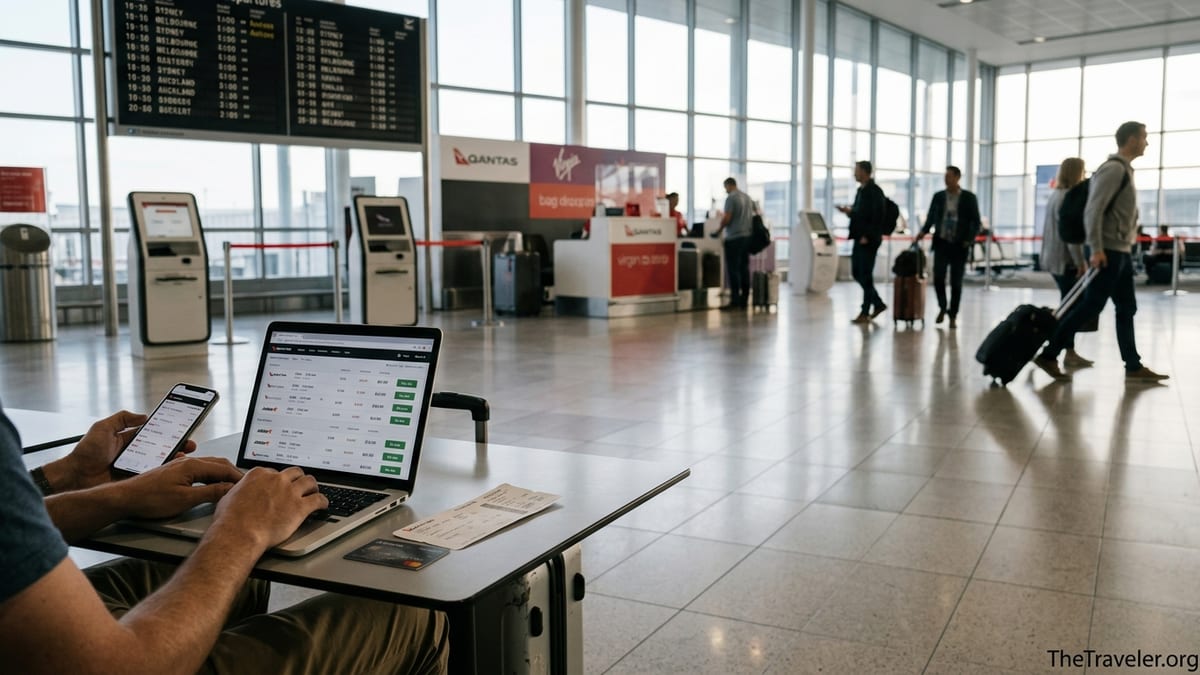
How Webjet Makes Money Compared With Airlines
To understand which option is cheaper, it helps to know how each side earns revenue. When you book directly with an airline like Qantas, Virgin Australia or Singapore Airlines, most of what you pay is the base fare plus taxes and carrier charges. Airlines sometimes add modest payment surcharges or optional extras, but they typically do not charge a separate “booking fee” for buying on their own website.
Webjet, by contrast, operates as an online travel agency. According to its own disclosures, Webjet’s business model relies heavily on service and booking fees that sit on top of the airfare you see when you first search. These fees are core revenue, not small incidental charges. That means a fare that initially appears similar to the airline’s price can end up noticeably higher once Webjet’s extra costs and payment fees are added at checkout.
This difference in how revenue is generated is central to why Webjet is rarely the outright cheapest way to buy a simple point to point ticket, even when the base fare shown looks competitive. The site’s value is in comparison, convenience and sometimes packaging, rather than in undercutting the airlines on final price for straightforward itineraries.
In practice, the key for travellers is to separate the “headline” airfare that first appears on Webjet from the “all in” amount you will actually be charged once service and payment fees are included, then compare that total directly with the airline’s final price.
Real Fee Examples: How Much More Can Webjet Cost?
Webjet publishes a servicing fee that applies per booking, on top of the airfare and taxes. As of mid 2026, the listed servicing fee is approximately 21 to 22 Australian dollars for domestic Australian itineraries, around 25 dollars for New Zealand and nearby Pacific routes, and roughly 33 dollars for other international bookings. These amounts are charged per booking, not per passenger, but they are compulsory whenever you complete a flight purchase through the platform.
Payment processing fees are additional. Webjet’s current schedule shows percentage based surcharges that can run from under half a percent for debit card or some digital wallet options up to around 1 percent or more for standard credit cards such as Visa or Mastercard, with certain “buy now, pay later” or specialist finance products attracting even higher percentages. On a 1,000 dollar fare, a 1 percent payment fee alone would add another 10 dollars to the cost, and that is before the servicing fee is counted.
On top of that, Webjet has in the past charged a separate “booking price guarantee” fee on some transactions. Regulatory filings and recent legal actions in Australia describe combined compulsory Webjet fees in the range of roughly 35 to 55 dollars per booking, varying by whether the trip is domestic, trans Tasman or long haul international. When these extra charges are layered on to a fare that already matches the airline’s own price, the total paid on Webjet can easily end up 10 to 20 percent higher for a modest short haul trip, and still noticeably higher for an expensive long haul itinerary.
By contrast, major airlines selling tickets directly on their own websites may add low payment surcharges, but they usually do not tack on a separate 20 to 30 dollar booking fee for a simple online purchase. That structural difference is why, once you work through to the last step of the checkout process on both sites, the airline’s own total is often lower than Webjet’s for the identical flights.
Side by Side Price Comparisons in the Real World
Consider a typical domestic scenario: a return flight from Sydney to Melbourne on a full service carrier during a non peak week. A traveller using Webjet might see an economy return fare around 260 Australian dollars including taxes at the search results stage. Clicking through to payment, the site then adds about 22 dollars in servicing fees and, assuming the traveller pays by standard credit card, perhaps another 2 to 3 dollars in payment surcharges. The final amount charged to the card comes out close to 285 dollars.
Now compare that with going directly to the same airline’s website after spotting the flight on Webjet. The airline search often shows the same base fare of about 260 dollars. At checkout, there might be a small card surcharge of a couple of dollars, but no 20 dollar plus booking fee. The final total may land around 262 to 265 dollars. In this very common case, booking with Webjet costs roughly 20 dollars more for the same seats, schedule and fare rules.
For trans Tasman flights, the gap can be larger. A Brisbane to Auckland return economy ticket priced at approximately 720 dollars on Webjet might incur a servicing fee of about 25 dollars plus a payment fee in the region of 7 dollars, taking the total close to 752 dollars. Booking the same flights directly with the airline at the same base fare would still generate roughly 720 dollars plus a small surcharge, keeping the total only a few dollars above the advertised amount. On a family booking with four passengers on one Webjet reservation, that single servicing fee is spread across multiple tickets, which narrows the per person difference, but it usually does not erase the gap completely.
Long haul international itineraries can produce a more mixed picture. A multi airline route, for example Cairns to Paris with one carrier to Singapore and another to Europe, may be difficult or impossible to reproduce exactly on a single airline’s website. In that case Webjet’s ability to combine carriers can create a unique itinerary or connection that is not easily bought direct. Even so, once the 33 dollar or higher international servicing fee and payment surcharges are added, the final Webjet total is often similar to, or higher than, the best combination you can find by searching the same dates via a metasearch tool and then buying from each airline directly.
When Webjet Can Still Offer Better Value
Although Webjet is often more expensive than booking straight with an airline for simple return trips, there are situations where its overall value proposition can come out ahead, especially for travellers who value convenience and flexibility over absolute lowest price. The platform’s most obvious advantage is its ability to display and filter fares from many carriers at once, including low cost airlines that may not appear on some global comparison tools. For people planning complex journeys who would otherwise spend hours hopping between airline sites, the time saved can be considerable.
One clear use case is multi city itineraries within the same journey. A traveller planning Sydney to Tokyo, then Tokyo to Seoul, and finally Seoul back to Sydney, might find that arranging separate tickets on three airlines directly is both confusing and time consuming, especially if the carriers are not part of the same alliance. Webjet can bundle such a trip into a single booking where all the segments are visible at once, making it easier to visualise the route and compare timing and price trade offs. In some circumstances, the ability to stitch together low cost and full service carriers into one itinerary can offset at least part of the extra fees.
Another instance is where Webjet surfaces promotional fares or combinations that are not immediately obvious on airline sites. While Webjet’s own fees remain, the underlying base fares that it draws from can sometimes be temporarily lower because of airline sales, opaque inventory or negotiated rates. For example, during a short flash sale to destinations such as Bali, Fiji or Queenstown, the cheapest seats may show up across several booking engines before travellers notice them on the airlines’ own homepages. A traveller who values grabbing the last seat on an attractive departure over saving 20 or 30 dollars in fees might reasonably choose to complete the booking on Webjet.
Finally, some travellers find it useful that Webjet offers a single interface for customer support across different airlines. For people who are less confident managing their own changes and cancellations, having one point of contact, reachable via chat or phone, can be worth a modest price premium, especially where multiple carriers are involved or where language barriers make dealing directly with an overseas airline more stressful.
Risks, Complaints and Recent Legal Scrutiny
Regulators in Australia have recently taken a close interest in how Webjet presents its prices and handles bookings. In late 2024, the national competition authority commenced Federal Court proceedings alleging that the company had misled consumers by advertising flight prices that did not include compulsory fees such as its servicing fee and booking price guarantee. Those legal documents describe domestic and international fees in the tens of dollars per booking and argue that consumers were attracted by unrealistically low initial prices that could never be obtained without paying additional charges.
The same proceedings raise separate concerns about Webjet allegedly issuing confirmation pages and emails for some bookings where flights were in fact never ticketed with airlines, leaving passengers without valid reservations. Although such cases appear to involve a small fraction of overall bookings compared with the volume handled by the site, they highlight the structural risk of adding an intermediary between traveller and airline: when something goes wrong, it can be harder to resolve.
Beyond the courtroom, traveller reports on forums and social platforms commonly mention two types of issues with third party booking sites including Webjet. The first is difficulty changing or cancelling tickets after purchase, with each side sometimes pointing the finger at the other. Airlines may insist that any alterations must go through the agency that sold the ticket, while the agency sometimes cites airline fare rules and processing delays. The second is frustration with additional charges that appear late in the checkout flow, particularly for payment types or services that consumers consider standard.
To be fair, airlines themselves are not immune from criticism. Many now sell basic economy style fares that restrict changes, seat selection and checked baggage. However, in a disruption or overbooking scenario, passengers who have booked direct usually find it easier to be reprotected on alternative flights or to obtain refunds, because there is no intermediary controlling the ticket. That advantage becomes especially clear during irregular operations such as weather events or industrial action.
Practical Strategies: How to Use Webjet Without Overpaying
The most effective way to get the best of both worlds is to use Webjet as a research tool rather than as the final point of purchase for straightforward trips. A common strategy among experienced travellers is to search for flights on Webjet to map out dates, airlines and schedules, then open a new tab for the airline that operates the chosen flight and attempt to reproduce the same itinerary direct. In many domestic and trans Tasman cases, the airline website will display exactly the same flights at similar or identical base fares, but without Webjet’s 20 to 30 dollar servicing fee.
When comparing, always click right through to the last step of checkout on both Webjet and the airline site, where final totals including all fees are displayed before you enter payment details. It is not enough to compare initial “from” prices, because these often exclude compulsory extras on Webjet. If you do decide to complete a booking via Webjet, consider using one of the lower cost payment methods, such as supported debit cards or bank payment options, to minimise the percentage based surcharge on top of the fare and servicing fee.
Another practical tactic is to weigh up value rather than just price. For example, if Webjet is 20 dollars more expensive for a 1,000 dollar international fare but enables a multi carrier itinerary that is one or two hours shorter than booking only with a single airline, some travellers will gladly pay that difference. Conversely, if you are booking a series of simple domestic returns within Australia, the servicing fee can quickly erase any advantage of convenience, and booking direct will almost always save money across several trips.
Finally, consider combining Webjet with other tools. Metasearch engines such as Google’s flight search or airline alliance search tools can help you identify fare patterns and cheaper travel days, after which you can decide whether to purchase from Webjet, a different online agent, or directly from the airline that appears to offer the best combination of schedule, price and support.
Booking Direct With Airlines: Pros, Cons and Hidden Benefits
Booking directly with airlines carries its own set of advantages that are not always obvious when you first compare headline prices. One of the biggest benefits is control. When you buy a ticket from Qantas, Jetstar, Virgin Australia, Air New Zealand or another carrier on their own website, your contract is directly with the airline operating the flight. If a schedule change occurs, a flight is cancelled or a misconnection happens, you generally deal with the airline’s customer service teams and airport staff without needing a third party to modify the ticket.
Many airlines also offer loyalty program perks that apply only to direct bookings. Examples include the ability to earn bonus points on some sale fares, access to free seat selection for members of certain status tiers, and targeted upgrade offers that may not be extended to bookings made via external agencies. Over a year of frequent travel, these incremental benefits can translate into free flights, lounge access or extra checked bags that would otherwise cost significant money.
Price matching and flexibility are additional factors. Some airlines publicly commit to matching the price of tickets sold on reputable third party sites for identical flights, cabin classes and fare conditions, especially in their home markets. Even where no formal guarantee exists, customer service agents will sometimes manually adjust a fare to retain a direct booking when a traveller presents a clearly lower third party quote. This is more likely to succeed when the difference is modest and when the traveller is booking higher cabin classes or multiple tickets on one reservation.
On the downside, booking direct does limit you to one airline or alliance at a time. Crafting a complex itinerary that spans several non affiliated carriers often requires more manual work when you insist on buying each leg separately from the operating airline. If your priority is to minimise touchpoints and keep all tickets in one booking record, accepting Webjet’s service and payment fees may feel like a reasonable trade off, provided you understand what you are paying for.
The Takeaway
So, is Webjet cheaper than booking direct with airlines? For most straightforward itineraries, particularly domestic and trans Tasman returns, the answer is no once all compulsory fees are taken into account. The base fares you see on Webjet typically mirror what airlines sell on their own sites, but the addition of servicing fees in the range of about 20 to 30 Australian dollars per booking, plus payment surcharges, usually makes the final total higher than purchasing the same flights direct.
However, price is not the only factor. Webjet’s strengths lie in its ability to compare many airlines quickly, stitch together multi carrier or multi city journeys and provide a single point of contact for bookings that involve different operators. For complex trips or travellers who value convenience and consolidated customer support, paying a moderate premium can still represent fair value.
For most people, the smartest strategy is hybrid. Use Webjet for research and inspiration, then check airline websites to see if you can secure the same or better pricing without the extra fees. Reserve booking through Webjet for those cases where it unlocks routes or combinations that are difficult to assemble directly, or where the convenience is worth more to you than the marginal savings. With that approach, you gain the advantages of Webjet’s powerful search while keeping control over your travel budget.
FAQ
Q1. Is Webjet usually cheaper than booking directly with an airline?
In most simple cases, no. Once Webjet’s servicing and payment fees are added, the final price is often higher than buying the same flights on the airline’s own website.
Q2. Why do prices on Webjet look cheaper at first?
Initial search results on Webjet typically show the base fare and taxes, while compulsory servicing and payment fees are added later in the checkout, making early prices appear lower than the final total.
Q3. How much is Webjet’s servicing fee?
As of mid 2026, Webjet’s servicing fee is roughly in the low 20 dollar range for domestic Australian flights, about the mid 20s for New Zealand and Pacific routes, and around the low 30s for other international bookings per reservation.
Q4. Do airlines charge similar booking fees on their own websites?
Most major airlines do not charge a separate booking fee for standard online purchases on their own sites, although they may add smaller payment surcharges or fees for optional extras.
Q5. When might Webjet offer better value than booking direct?
Webjet can be attractive for complex or multi city itineraries, journeys involving several airlines on one ticket, or when the convenience of one booking and one support channel outweighs a modest fee premium.
Q6. Is it safe to book flights through Webjet?
Webjet is a large, established online travel agency, but like all intermediaries it adds a layer between you and the airline. This can occasionally complicate changes, cancellations and problem solving compared with booking direct.
Q7. What is the best way to use Webjet without overpaying?
A practical approach is to use Webjet to research routes, dates and airlines, then check the same flights on the airline’s website and compare final totals, including all fees, before deciding where to buy.
Q8. Do I still earn frequent flyer points if I book via Webjet?
Usually you can add your frequent flyer number to a Webjet booking and earn points, but some promotional fares and benefits may be reserved for tickets bought directly through the airline.
Q9. Can Webjet help if my flight is cancelled or changed?
Yes, Webjet offers customer support for changes and cancellations on tickets it sells, but airlines often require that modifications go through the original booking channel, which can add steps compared with dealing directly.
Q10. What is the smartest choice for most everyday trips?
For typical return flights on one airline, it is usually smartest to research on Webjet or other tools, then book directly with the carrier for a lower total cost and simpler after sales support.