


When you are planning flights from Sydney to Bali, a hotel in Queenstown or a car hire in Los Angeles, it is tempting to let an online travel agency like Webjet do the heavy lifting. In a few seconds you can compare dozens of airlines and room types on one screen. At the same time, airlines, hotel chains and car rental brands are pushing harder than ever for you to book directly with them, promising better support and, in some cases, better value. Deciding whether to use Webjet or go straight to the travel provider can have a real impact on what you pay, how easy it is to change plans and who helps you when things go wrong.
Get the latest updates straight to your inbox!
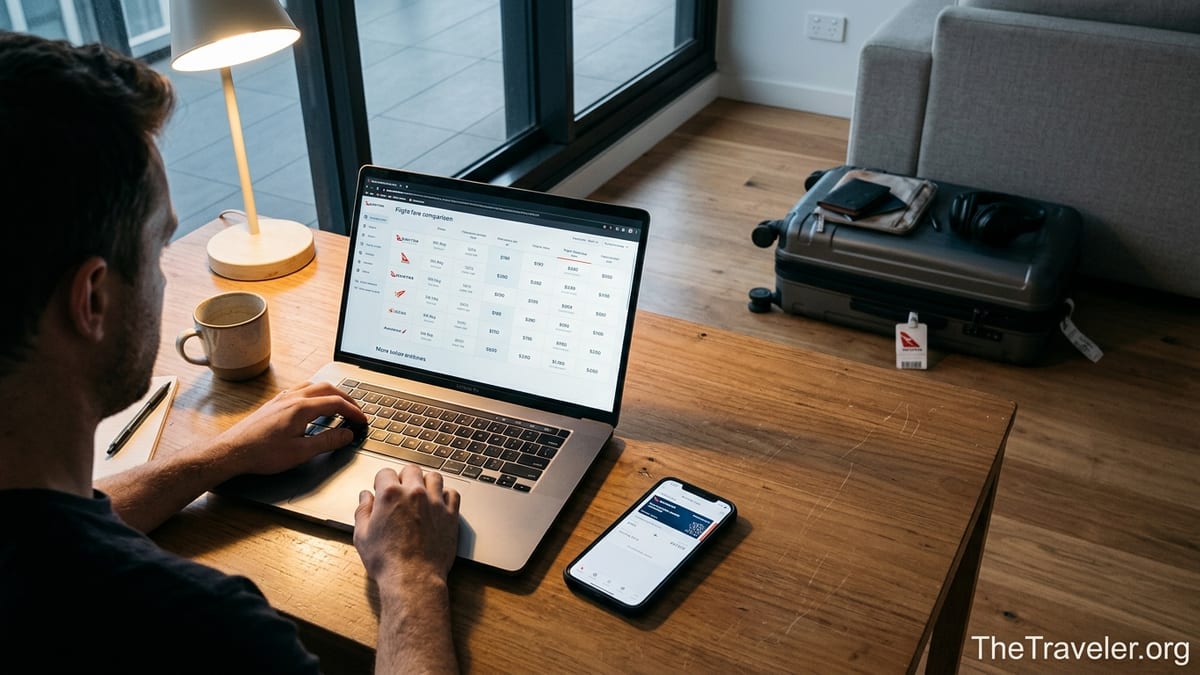
How Webjet Works Compared With Booking Direct
Webjet is a classic online travel agency, or OTA. Rather than operating flights or hotels itself, it connects you with airlines such as Qantas, Jetstar and Singapore Airlines, as well as thousands of hotels and car hire brands. You search on Webjet, pick an option and pay Webjet, which then issues tickets or passes your booking to the underlying provider. By contrast, booking direct means using the airline’s own website or app, the hotel’s site, or the car rental brand’s booking engine, and paying that provider without an intermediary in the middle.
On a practical level, the experience looks similar. If you search for a return flight from Melbourne to Auckland in October, Webjet might show a Jetstar fare at one price, an Air New Zealand fare at another and sometimes combinations of airlines on different legs. If you go to Jetstar’s website, you will see only Jetstar flights, and on Air New Zealand’s site only their services. Webjet’s value lies in putting most of these options on one page and letting you filter them by time of day, number of stops or airline.
Behind the scenes, though, the relationship is quite different. When you book on Webjet, you are entering into two sets of terms: Webjet’s own conditions, which often include booking and service fees and separate change rules, and the airline or hotel’s conditions. When you book directly with Qantas or Accor, you only agree to the airline or hotel’s conditions. That difference becomes much more important if you need to change or cancel your plans later.
Another subtle distinction is how your money flows. Webjet is compensated through commissions from airlines and hotels plus its own fees, including payment surcharges on many cards. Airlines and hotels that sell direct avoid paying those commissions, which is one reason they try so hard to steer you to their own websites and loyalty apps.
Price: Is Webjet Really Cheaper?
For many travellers, price is the first filter. It is common to find Webjet showing a Melbourne to Gold Coast return on Jetstar for a few dollars less than the airline’s own website on a given day, or packaging a Sydney to Fiji flight with a resort in Denarau for what appears to be a competitive package price. Those savings often come from Webjet’s ability to package a slightly discounted wholesale airfare with hotel inventory, or from negotiated bulk deals on certain routes.
You need to watch the fine print, however. Webjet’s advertised prices are typically inclusive of airline taxes and surcharges but exclude its own booking and payment fees, which are added at checkout. For example, Webjet’s own payment fee schedule in Australia shows that paying with a major credit card can attract a percentage fee on the entire booking amount, while Pay by Bank or specific gift cards carry no surcharge. A family of four booking return flights can easily add tens of dollars in card fees alone compared with paying the airline directly via its preferred no-fee method.
Regulators have also taken notice of how prices are presented. In late 2024, Australia’s competition regulator commenced legal action alleging that some Webjet promotions highlighted low “flights from” prices that did not include compulsory service fees, and that in a limited number of cases Webjet confirmed bookings it had not actually secured with the airline, later asking customers for more money or offering a refund instead. While those court proceedings are ongoing, they are a reminder to treat any OTA price as an estimate until you reach the final payment page and see the complete breakdown.
In practice, many experienced travellers use Webjet as a comparison engine rather than a final booking tool. They might find, for instance, a Virgin Australia fare from Brisbane to Adelaide on Webjet for around 260 Australian dollars, then check the same dates on Virgin’s own site. Sometimes the airline price matches or undercuts Webjet once all fees are considered. Other times Webjet’s combined fare remains slightly cheaper. Over the course of a long-haul trip for a couple or family, a difference of even 30 or 40 dollars per ticket can add up, but it must be weighed against the other trade-offs.
Changes, Cancellations and Who Helps When Things Go Wrong
The biggest functional difference between Webjet and booking direct shows up when plans change. Imagine you have booked a multi-city journey from Sydney to Singapore and then on to London with one airline, and a separate side trip to Lisbon with a European low-cost carrier. If a storm in Singapore causes your first flight to arrive a day late, you could miss your connection to London and your onward low-cost flight. If you booked the entire long-haul itinerary directly with the full-service airline on one ticket, its customer service team generally has clear responsibility to reroute you onto the next available flight under that ticket’s fare rules.
If instead you booked one leg through Webjet and another directly with a budget airline, or you pieced together two non-partner airlines on Webjet to save money, the situation becomes more complex. The long-haul carrier may only be responsible for its sector, and the low-cost carrier can treat you as a no-show on a non-refundable ticket. When you call for help, Webjet agents may need to liaise with the airlines on your behalf, adding delay at exactly the time you most need quick action at the airport gate.
Real-world customer stories illustrate this clearly. Travellers who have booked domestic routes within Australia through Webjet and then faced airline schedule changes sometimes report being told by the airline to speak to Webjet, and by Webjet to wait while it confirms options with the airline. In contrast, those who book the same Qantas or Jetstar flights directly via the airline’s app can often self-manage changes or accept alternative flights with a couple of taps, especially when disruptions are widespread and the airline has temporarily relaxed change fees.
Hotels and car rentals work similarly. If you arrive late at a hotel you booked on Webjet and find your room category oversold, the property might prioritise guests who booked directly with its own loyalty program before addressing bookings from third-party channels. A direct booking with a brand like Marriott or IHG often carries clearer status benefits, upgrade priority and direct access to in-house support teams if something has gone wrong with the reservation.
Loyalty Points, Perks and Status Recognition
Loyalty programs are another area where booking direct usually wins. Many full-service airlines, including large North American and European carriers, have shifted their frequent flyer rules so that you earn the most points and status credits when you book through their own channels. Some, such as American Airlines, have signalled that certain cheaper fares bought through non-preferred third parties may no longer accrue the same number of miles or loyalty points as equivalent fares purchased on the airline’s own site or app.
For a traveller flying just once a year from Perth to Bali, missing out on a modest points earn might not matter. For someone who travels regularly for work between Sydney and Melbourne, those extra status credits can be the difference between reaching a tier that offers lounge access, priority boarding and complimentary seat selection and falling slightly short. Over a full year of business travel, always booking direct with the airline can mean several additional upgrade opportunities or a higher luggage allowance on every trip.
Hotels are even more explicit. Major chains such as Hilton, Marriott and Hyatt generally state that elite benefits like late checkout, room upgrades and welcome amenities apply to members who book through direct channels. A four-night stay at an upscale Sydney CBD property that you book via Webjet might post only base points, with no recognition of your mid-tier status and no possibility to use a suite upgrade certificate. If you had booked the same dates through the hotel’s own website or app, you would likely earn full points, enjoy on-property benefits and be able to contact the hotel directly for any pre-arrival requests.
Webjet can still play a role for stays at independent hotels or small regional properties that do not run their own loyalty programs. In those cases, the value of consolidating all your bookings into one Webjet itinerary and app might outweigh the lost opportunity for points or perks, because there are none to claim in the first place.
Convenience and Complex Itineraries
Where Webjet shines is in planning and price discovery, particularly for complex itineraries. Suppose you are arranging a three-week trip from Auckland through Tokyo and onward to Europe, with a stopover in Bangkok on the return. Checking every possible airline combination and fare class on individual websites could take all afternoon. On Webjet you can quickly see which carriers operate on each leg, filter for one-stop options under a certain duration, and spot possible savings by mixing airlines that do not ordinarily code-share.
For travellers who value time as much as money, that overview has real value. A parent planning a school holiday trip from Brisbane to Los Angeles might sit down with Webjet, plug in flexible dates, and spot that flying out one day earlier with a different airline saves several hundred dollars per person. They can then either complete the booking on Webjet or use that information to approach the airline directly. Even if they ultimately choose to book direct, Webjet has served as a useful planning tool.
Webjet can also be handy for packaging flights and hotels when you do not want to manually match dates and check-in times. A couple booking a long weekend in Hobart, for example, might see a package on Webjet that bundles return flights from Melbourne with three nights in a boutique hotel on the waterfront. The total looks competitive compared with buying the flights and hotel separately. The trade-off is that changing one element later, such as dropping the final night or taking a later flight home, may not be as flexible under a package booking as it would be with separate direct reservations.
Conversely, if your trip is straightforward and involves a single airline or hotel brand, booking direct is often just as quick. A frequent flyer booking a simple Sydney to Singapore return on Singapore Airlines, staying at a chain hotel in Orchard Road and renting a car at Changi on arrival can complete all three direct bookings in 15 or 20 minutes using saved profiles and loyalty accounts, with the comfort of knowing exactly who to call for each component.
Fees, Fine Print and Consumer Protection
Service fees are one of the more contentious aspects of booking through Webjet. In addition to payment surcharges, Webjet applies its own booking and service fees on many flight reservations. These fees can be non-refundable even if the underlying airline fare is refundable, and additional Webjet charges can apply if you later need an agent to change dates, names or passenger details. When Webjet passes through an airline’s change fee and fare difference, you may also be paying a Webjet handling fee on top.
By contrast, booking directly with an airline generally means you pay only the airline’s change or cancellation fees as set out in the fare rules. During major disruptions or public health emergencies, many airlines have temporarily relaxed or waived their own change penalties, but OTAs like Webjet have sometimes continued charging their own processing fees to handle the rebooking, leading to frustration among customers who expected the same level of flexibility they saw advertised by the airline.
Consumer protection laws still apply regardless of how you book, but enforcing your rights can be smoother when there is a single party involved. If an airline cancels a flight and owes you a refund under local regulations, dealing directly with that airline avoids any delay in the funds passing through an intermediary. When a booking sits with Webjet, the airline typically refunds Webjet first, and then Webjet processes the refund back to you under its timelines and systems.
The same logic applies to disputes. If you believe you were charged more than the advertised total for a flight, it is simpler to raise that directly with the airline that set the price and collected your payment. When Webjet is involved, you may find that some parts of the charge come from the airline and others from Webjet’s own fees, and resolving which parts are refundable or negotiable takes more steps.
When Webjet Makes Sense and When to Book Direct
Taking all of this together, there are clear scenarios where Webjet can be genuinely useful. If you are at the early stages of planning and want to compare many airlines and routes at once, Webjet is an efficient research tool. It can also make sense when booking simple, non-flexible trips where the price difference is substantial and you are confident your plans will not change, such as a low-cost return from Melbourne to Hobart for a fixed long weekend.
Webjet can also be attractive for bundled holiday packages, particularly within Australia and to nearby destinations where airlines and hotels have provided the company with competitive wholesale rates. For example, a Gold Coast family might find a Webjet deal that combines school holiday flights to Queenstown with a self-contained apartment and lift passes at a price that is meaningfully lower than assembling each piece themselves. In those cases, the value comes from the package as a whole, as long as you read the conditions carefully.
On the other hand, booking directly with travel providers is usually better when flexibility, loyalty benefits and clear responsibility are important. If you are planning a once-in-a-decade trip to Europe involving multiple long-haul flights, or if you travel frequently enough that airline status and hotel points matter, booking through airline and hotel websites is safer. Business travellers whose meetings can move by a day at short notice, or families travelling during periods of airline disruption, will generally find it easier to change flights or claim assistance when they have booked direct.
A reasonable rule of thumb is to use Webjet to explore your options and get a sense of market prices, then check those exact flights or hotel dates on the provider’s own website. If the direct price is roughly the same and you value service and loyalty perks, book direct. If Webjet is significantly cheaper and you understand the fees and limits, it can be a fair trade-off for a simple trip.
The Takeaway
Choosing between Webjet and booking directly with airlines, hotels and car hire companies is less about one being universally better and more about matching the method to your trip. Webjet excels at comparison, discovery and occasionally at unlocking package savings, particularly for straightforward, fixed-date holidays where you are confident your plans will hold. It can be an excellent first step in figuring out which airlines fly your route, which days are cheapest and which hotels fit your budget.
Direct bookings, however, still tend to win on flexibility, loyalty rewards and clarity about who is responsible when flights are cancelled, rooms are overbooked or car rentals fall through. Airlines and hotel groups are increasingly designing their loyalty programs and customer service processes around the assumption that you will come to them directly, not through an intermediary. For many travellers, the peace of mind that comes from dealing with a single provider is worth a small difference in price.
In practice, the smartest strategy is a hybrid one. Use Webjet for inspiration and research, particularly early in the planning phase, and to identify any remarkable package deals. Then, whenever the price is similar, give preference to booking flights and major hotel stays directly with the provider. For smaller, low-risk bookings where savings are clear and your schedule is fixed, Webjet can still play a useful role.
By approaching each trip with these trade-offs in mind, you can make deliberate choices about when to rely on Webjet’s convenience and when to go straight to the source, protecting both your budget and your travel experience.
FAQ
Q1. Is Webjet usually cheaper than booking directly with the airline?
Webjet can sometimes appear cheaper on certain routes or dates, especially when packaging flights and hotels, but its own booking and payment fees can narrow or erase the saving. It is worth taking any fare you see on Webjet and checking the same flights on the airline’s website right up to the final payment page before deciding.
Q2. If my flight is cancelled and I booked on Webjet, who do I contact?
If you booked through Webjet, your contract is technically with Webjet as the agent, so they are normally your first point of contact for changes and refunds. In practice, airlines may still assist at the airport, but you can encounter delays while Webjet and the airline coordinate. Booking directly with the airline reduces those handoffs.
Q3. Do I earn frequent flyer points and status credits on Webjet bookings?
In many cases you can still add your frequent flyer number to a ticket booked through Webjet and earn base points, but some airlines limit status credit earning or special bonuses on discounted or non-preferred agency fares. If you are chasing airline status, booking directly through the airline’s own site or app is usually more reliable for maximising rewards.
Q4. Are Webjet’s service and payment fees refundable if I cancel?
Generally Webjet’s own booking and service fees, including many payment surcharges, are not refundable even if the airline or hotel offers a refund or credit. This is separate from any fare difference or airline-imposed change fee. Always review Webjet’s fee breakdown and terms before confirming your booking.
Q5. Is it safer from a consumer protection point of view to book direct?
Consumer laws apply in both cases, but dealing directly with the airline or hotel usually means there is only one party responsible for refunds and remedies. When an OTA sits in the middle, refunds often pass from the provider to the agent and then to you, which can add extra steps and time to the process.
Q6. When does it make the most sense to use Webjet?
Webjet is most useful at the planning stage, when you want to compare many airlines, routes and dates quickly, and for simple, non-flexible trips where the savings are clear. It can also be attractive for bundled package deals that combine flights and hotels at a genuinely lower overall price than booking each component separately.
Q7. When should I definitely book directly with the airline or hotel?
You should strongly consider booking direct for long-haul or complicated itineraries, trips where your dates may change, and whenever airline or hotel loyalty status and benefits matter to you. Direct booking also simplifies support in the event of cancellations, missed connections or schedule changes.
Q8. Can I use Webjet to search and then book directly with the provider?
Yes. Many travellers use Webjet purely as a comparison tool to see which airlines or hotels fit their budget on specific dates. Once they find a good option, they open the airline or hotel website in a separate tab and book the same flights or rooms directly, taking advantage of Webjet’s search convenience without paying its fees.
Q9. Do hotels treat Webjet guests differently from direct bookers?
Policies vary, but larger hotel chains often prioritise upgrades, room preferences and loyalty benefits for guests who book through their own channels. Guests who arrive with third-party bookings, including those from Webjet, are sometimes last in line for complimentary upgrades, late checkout or problem resolution when a property is fully booked.
Q10. Is Webjet a good choice for business travel?
For occasional business trips with fixed dates, Webjet can be serviceable, but frequent business travellers usually benefit more from booking directly with airlines and hotel chains to maximise loyalty rewards and simplify changes. Many companies also use dedicated corporate booking tools that integrate directly with preferred airlines and hotels rather than public OTAs.