


Italy is often perceived as a family-oriented country, yet objective indicators paint a more complex picture for relocating parents. This briefing explains Italy’s family suitability profile for expatriates, focusing on structural conditions that affect daily life with children, including demographic pressures, childcare availability, schooling rhythms, and work-life balance. The aim is to provide decision-grade context that helps expat families gauge how supportive Italy is likely to be for raising children.
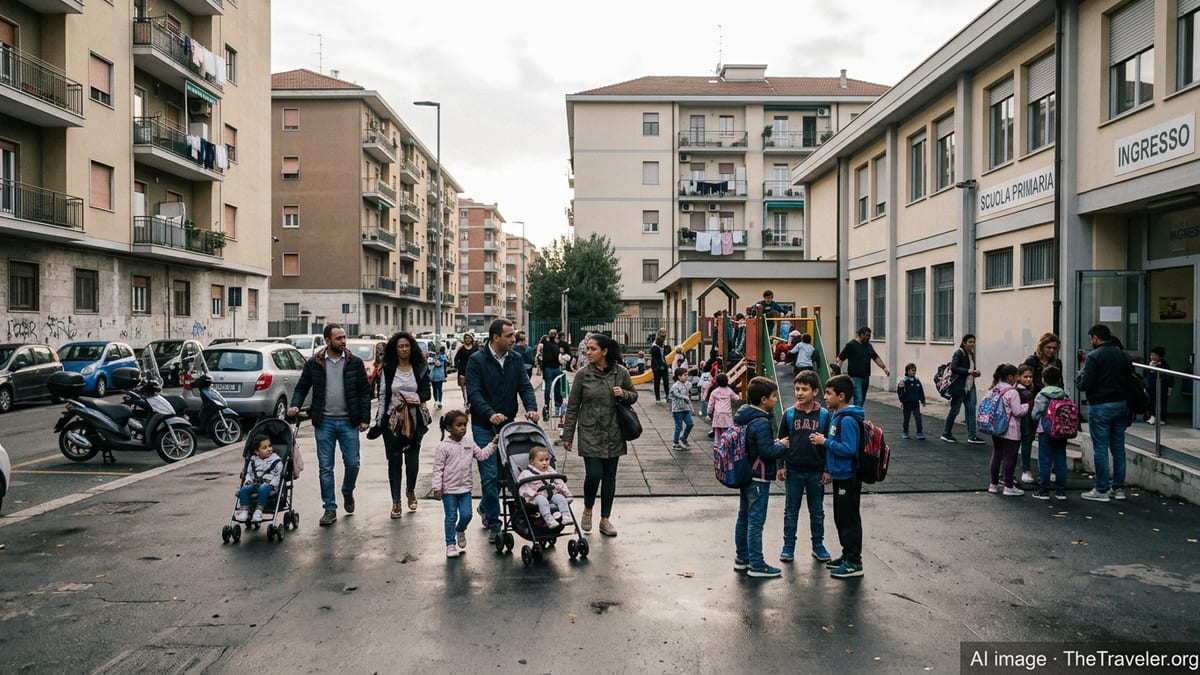
How a “Family Suitability Score” for Italy Can Be Understood
There is no single official “family suitability score” for Italy, but expat-focused assessments typically combine measurable inputs: fertility and demographic trends, childcare and school structures, parental leave and family benefits, work-hour patterns, and inclusivity for diverse family types. For relocation decisions, these elements can be treated as sub-scores that, taken together, approximate how supportive a country is for families.
Italy’s consistently very low fertility rate, which has hovered around 1.2 children per woman in recent years, signals that many resident families perceive structural obstacles to having more children. National statistics authorities have reported record-low births for multiple consecutive years, with further declines indicated in preliminary 2025 data. This does not automatically make Italy unsuitable for expat families, but it highlights gaps in childcare, housing and work-life balance that residents consider significant.
For relocating parents, a pragmatic way to interpret Italy’s family suitability is to separate “everyday functioning” of family life from long-term systemic risks. Everyday functioning looks at whether it is realistically possible to combine work and parenting given school timetables, local childcare, and leave policies. Systemic risks relate to the broader aging population and policy volatility that may influence future service levels and family incentives.
On this basis, Italy can be seen as mixed for families: generally strong in early education quality and family-centered social norms, but weaker in consistent childcare coverage, afternoon school hours for younger children, and flexibility in many workplaces. Outcomes for expat families vary sharply by region, municipality and employer.
Demographic Signals: What Italy’s Fertility Profile Reveals
Italy is one of the oldest societies in Europe, with an average age close to 50 and a persistently low birth rate. Recent analyses of OECD and national data place Italy among the lowest fertility levels in the OECD, at roughly 1.2 births per woman, well below the replacement level of 2.1. National statistics have recorded around 390,000–400,000 births annually in recent years, with a downward trend and 15 consecutive years of declining births reported up to 2023.
These demographic patterns matter for a family suitability assessment because they reflect the lived experience of local families. Research and policy commentary repeatedly highlight three perceived barriers to larger families in Italy: economic uncertainty, insufficient or unevenly distributed early childhood services, and difficulty reconciling full-time work with limited school and childcare hours. When large numbers of resident families delay or avoid having additional children, incoming expat families can expect to encounter some of the same structural constraints.
The aging profile also implies rising pressure on public budgets as the ratio of workers to retirees shrinks. Over time, this can influence how generously family benefits and services are financed, and whether reforms prioritize broad-based childcare expansion or more targeted incentives for larger families. Expats who plan to stay for a decade or longer should consider that Italy’s demographic imbalance is treated domestically as a “national emergency” and policy in this area is evolving.
At the same time, low fertility does not mean that children are unwelcome or marginal. On the contrary, policy debates and public messaging strongly emphasize the importance of families and birth rates. For expats, this can translate into positive social attitudes toward children, even where practical infrastructure is not yet fully aligned with dual-career parenting.
Early Childhood Education and Childcare Coverage
Access to childcare and early education is one of the most decisive components of a family suitability score. Italy operates a two-tier early childhood system: services for ages roughly 0–3 (nidi and similar services) and preschool (scuola dell’infanzia) for ages 3–6. Preschool is widespread, often with near-universal enrolment for 3–5 year olds, and is generally well-regarded for educational quality. However, coverage for children under 3 remains significantly lower and is highly uneven between northern and southern regions.
Studies on Italy’s early childhood education and care (ECEC) system underscore a gap between ambitious national principles of inclusivity and variable local implementation. Coverage rates for children under 3 in some northern cities approach or exceed EU targets, while many southern or smaller municipalities still offer limited places or rely on private, fee-based options. For expat families, this means that the practical chance of securing a full-time nursery place can range from relatively high in certain urban northern areas to quite constrained elsewhere.
Hours of operation are also critical. Public and accredited nurseries typically follow working-day schedules but may not fully match the hours of full-time employment, especially where commute times are long. Preschool (3–6) usually covers mornings and early afternoon, often ending around early to mid-afternoon, leaving a gap that must be covered by after-school programs, private care, or a non-working caregiver. Availability and affordability of extended hours and after-school services depend heavily on the municipality and local associations.
Policy initiatives launched over the last few budget cycles have aimed to expand nursery places and support families with birth-related measures, with new funding lines earmarked for family-friendly policies. While these measures are politically prominent, changes on the ground can be gradual. Relocating families should therefore treat early childhood provision in Italy as “location-sensitive”: strong in some municipalities and regions, partial in others, and rarely structured as a seamless, 8–6 wraparound solution by default.
School Schedules, After-School Care and Daily Rhythms
Once children enter primary school, the structure of the Italian school day becomes a defining element of family suitability. A key feature is that full-day school is not always automatic. Many primary schools still operate on schedules that end around early afternoon, particularly in the lower grades, with homework expectations starting early. Some schools offer a full-time model with lunch and afternoon classes, but capacity is limited and not guaranteed in every area.
This timetable design is rooted in historic social norms where one parent, often the mother, was not in full-time employment and could manage midday pickups and afternoon care. For dual-career expat couples, particularly those arriving from countries with standard full-day schooling, this can create significant logistical strain. Local after-school programs, sports clubs and parish or municipal services can partially fill the gap, but coverage is inconsistent and coordination can be complex.
Secondary schools, especially at the lower secondary level, may also run primarily in the morning, with early finishes and substantial homework loads. Teenagers often commute independently by public transport, which helps working parents, but the non-aligned hours between parents’ workdays and school timetables remain a recurring challenge cited in work-life balance discussions in Italy.
From a relocation assessment perspective, this means that an otherwise family-friendly neighborhood can score poorly on practical suitability if the local schools do not offer extended hours and if after-school infrastructure is thin. Conversely, some municipalities, particularly larger northern cities, have invested in integrated full-time school options and structured after-school programs, raising their effective family suitability for working expat parents.
Parental Leave, Family Benefits and Workplace Flexibility
Parental leave design, payment rates and workplace culture strongly influence Italy’s family suitability for expats planning or expecting children. Italy provides maternity leave at a duration around 5 months, commonly paid at 80 percent of salary, which exceeds the minimum standards of EU directives. Paternity leave has been expanded to around 10 days of mandatory leave for fathers or equivalent second parents, with recent Constitutional Court decisions confirming equal access for non-biological mothers in same-sex couples.
Beyond maternity and paternity leave, parents can access longer parental leave, shared between parents over several months, typically with a significantly reduced wage replacement rate close to 30 percent. Research comparing family policies across countries notes that Italy’s parental leave duration is moderate but the benefit levels are relatively modest, which can discourage extended absences from work except for higher-income or dual-income households that can absorb the loss.
Italy has also adapted its framework to implement the EU Work-Life Balance Directive, introducing or expanding entitlements to parental leave and flexible work for parents. In theory this improves the family suitability score, but workplace culture and sectoral differences limit the practical impact. Analyses of working conditions show that while statutory working hours are aligned with EU norms and there is legal emphasis on rest and leave, remote and hybrid work remain less common than in some northern European countries, except in larger or multinational employers.
The net result is that Italy offers relatively protective maternity leave and basic parental leave rights, but does not yet consistently deliver the high-flexibility environment that many dual-career expat families expect. For families with strong employer support and higher incomes, the system can function reasonably well. For those in smaller firms or with less leverage, taking full advantage of legal entitlements may be more challenging in practice.
Work-Life Balance and Practical Support for Dual-Career Families
Work-life balance is central to any family suitability assessment. Italy’s legal framework caps average weekly working time at 48 hours, in line with EU rules, with standard contracts often specifying around 40 hours per week. Paid annual leave entitlements are comparatively generous. On paper, these features should support family life. However, empirical accounts and comparative analyses point to a mismatch between formal rules and everyday practice in many sectors.
In practice, many employees report long days, limited autonomy over working hours, and a culture of presenteeism in certain white-collar and managerial roles. While “smart working” and telework expanded during the pandemic, Italy’s rate of regular remote work remains below the EU average. Commentators have described this as a structural lag that particularly affects parents, who may struggle to reconcile inflexible office-based roles with early-afternoon school pickups and limited childcare slots.
The structural interaction between school schedules, commuting times, and employer expectations is a key friction point. For example, a typical 9:00–18:00 office day combined with congested urban commuting can make it impossible for both parents to work full-time without additional private childcare or family support. This disproportionately affects mothers’ labor market participation and contributes to Italy’s high share of women with fewer or no children than they would ideally like, as highlighted in demographic research.
For expat families, the practical work-life balance will depend heavily on employer flexibility, sector, and location. International companies and some public-sector roles may offer remote work, flexitime or compressed hours that significantly raise the effective family suitability of an Italian posting. More traditional workplaces may expect physical presence and overtime, lowering the suitability score unless one parent scales back work or additional paid support is secured.
Inclusivity of Diverse Family Types and Regional Disparities
An increasingly important dimension of family suitability is how a country’s legal and social systems treat diverse family forms, including single parents, blended families and same-sex couples. Italy recognizes civil unions for same-sex couples and, through recent Constitutional Court judgments, has clarified that non-biological mothers in lesbian couples are entitled to parental leave on terms equivalent to fathers, emphasizing the child’s right to care from both parents. This marks gradual progress toward more inclusive treatment of different family structures.
At the same time, political debates around assisted reproduction and surrogacy remain contentious, and national rules are relatively restrictive compared with some other Western European countries. For expats whose family formation involves surrogacy or certain fertility treatments, this may require careful legal and practical planning, even though such topics lie somewhat beyond the narrow scope of a family suitability score.
Regional disparities cut across nearly all the dimensions discussed above. Northern and central regions generally have better childcare coverage, more after-school options, stronger municipal services and more employers accustomed to international norms. Southern regions may offer tight-knit community ties and strong informal family networks, but often with weaker public services and fewer formal supports for dual-career parenting.
For expat families, this means that “Italy’s family suitability score” is better understood as a band rather than a single value, with outcomes ranging from highly supportive in some metropolitan areas with robust services and flexible employers to considerably more challenging in regions where formal infrastructure lags and informal family care is culturally assumed but not available to newcomers.
The Takeaway
Italy’s reputation as a family-centered society is only partially matched by its structural support for modern, dual-career expat households. Low fertility rates and an aging population highlight the difficulties resident families face, especially in securing early childcare and aligning work with school schedules. These demographic signals, combined with variable childcare coverage, short school days, moderate parental leave pay, and a still-limited flexible work culture, all feed into a cautious assessment of Italy’s family suitability.
For relocating families with one highly flexible or non-working parent, or with strong employer backing for remote or hybrid work, Italy can offer a workable and sometimes very positive environment for raising children, especially in regions with strong public services. For two full-time working parents dependent on consistent full-day schooling and nursery provision, Italy requires careful, location-specific due diligence before relocation.
In practical terms, expat families considering Italy should treat childcare availability, local school hours, employer flexibility and municipal after-school offerings as core decision variables, at least as important as salary and housing. When these elements align favorably, Italy’s family suitability score rises. When they do not, the daily logistics of parenting can become a defining constraint.
FAQ
Q1. Is Italy generally considered a family-friendly country for expats?
Italy is socially very family-oriented, but structural supports such as childcare coverage, school hours and widespread flexible work are inconsistent, so suitability depends heavily on region and employer.
Q2. How does Italy’s low fertility rate affect expat families?
Italy’s very low fertility rate reflects the challenges resident families face in combining work and parenting, signaling potential pressures around childcare availability, work schedules and long-term service funding that expats will also encounter.
Q3. What should expat parents know about childcare for children under 3?
Public nursery coverage for children under 3 is strong in some northern cities but limited elsewhere; waitlists can be long and hours may not fully match a full-time workday, making early planning essential.
Q4. Are Italian primary schools full-day by default?
No, many primary schools still end in the early afternoon, and full-day programs with lunch are not guaranteed in every area, so parents often need after-school care or a flexible work arrangement.
Q5. How supportive is Italy’s parental leave system for working parents?
Italy offers relatively generous maternity leave and basic paternity and parental leave, but wage replacement for longer parental leave is modest, which can limit the practicality of extended time off for some families.
Q6. Is remote or flexible work common enough to help parents?
Remote and hybrid work expanded during the pandemic but remain less common than in some northern European countries; the actual flexibility expat parents experience is highly employer-specific.
Q7. Do expat families face regional differences in support?
Yes, northern and some central regions generally offer better childcare, after-school options and services, while many southern or smaller municipalities have fewer formal supports and rely more on informal family networks.
Q8. How inclusive is Italy toward same-sex parents in terms of family support?
Recent Constitutional Court rulings have improved equality in parental leave for same-sex couples, but broader policy debates around family formation remain sensitive, so legal advice is advisable for complex situations.
Q9. What are the biggest day-to-day challenges expat families report?
The most commonly cited challenges include early school finishing times, patchy after-school care, commuting times, and workplace cultures that expect long hours or limited flexibility.
Q10. How should families evaluate Italy’s suitability before relocating?
Families should investigate local nursery and school hours, after-school programs, employer flexibility and municipal services in the specific city or region, treating these factors as central to the relocation decision rather than secondary considerations.