


More news on this day
Italy is accelerating a sweeping modernization of its railways, ramping up investment in high speed links, digital signaling and EU backed projects in a bid to knit the peninsula into a faster, more resilient and more sustainable network by the early 2030s.
Get the latest news straight to your inbox!
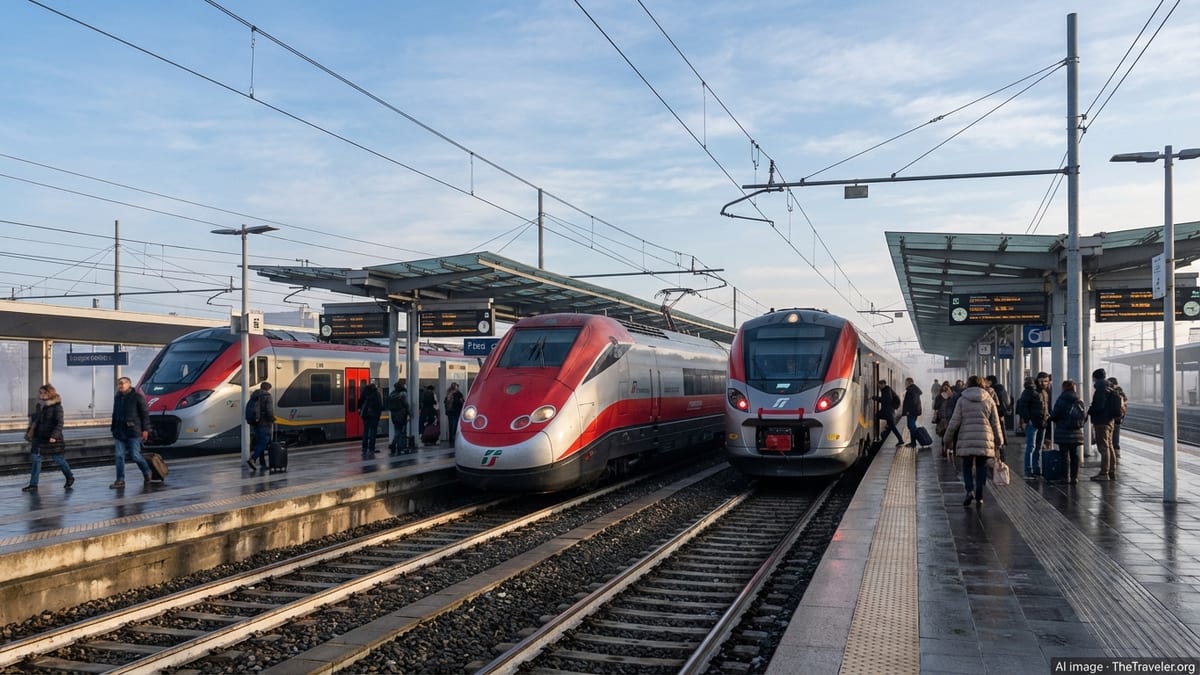
Record investment to upgrade tracks, stations and tunnels
Publicly available information from Ferrovie dello Stato Italiane, the state owned rail group, shows that capital expenditure on rail and road infrastructure reached about 17.6 billion euros in 2024, with nearly 15 billion devoted to railway and road works inside Italy. A large share is directed to new high speed and high capacity corridors, station upgrades and safety improvements on conventional lines.
The infrastructure arm Rete Ferroviaria Italiana has emerged as the main driver of this push. Company disclosures and sector coverage indicate that RFI alone has been investing around 10 to 12 billion euros a year recently, opening or advancing hundreds of work sites across the country and focusing on both new build projects and heavy maintenance on existing lines.
The current 2025 to 2029 strategic plan for the FS Group foresees roughly 100 billion euros of investment in that five year window, as part of a longer term pipeline running to 2034. The group’s plans emphasize resilience against climate impacts, better performance on crowded intercity axes and more reliable commuter services in metropolitan areas such as Rome, Milan and Naples.
Italian and European documents on the National Recovery and Resilience Plan highlight that rail is one of the main beneficiaries of Next Generation EU funding. Rail related projects supported by the plan and its later revisions are intended to be substantially implemented by 2026, which is one reason work sites have multiplied and schedules have tightened across the network.
High speed and high capacity links reshape long distance travel
Italy already operates one of Europe’s most extensive high speed networks, with dedicated lines connecting Turin, Milan, Bologna, Florence, Rome and Naples and extending south towards Salerno. Current projects are designed to extend this model to additional corridors and to integrate ports and inland regions that have historically been less connected to national and European flows.
On the southern axis, work on the Naples to Bari high speed and high capacity line is now in an advanced phase. Contractor updates and industry coverage describe tracklaying and civil engineering works progressing section by section, with complex engineering elements such as long tunnels and major viaducts approaching completion. Once fully operational, this corridor is expected to cut travel times between the Tyrrhenian and Adriatic coasts and support freight and passenger services across southern Italy.
In the northwest, the Terzo Valico dei Giovi, a new high capacity link between the port of Genoa and the Po Valley, has recently passed a symbolic milestone with the completion of tunnel excavations at the Novi Ligure rail junction. Italian government communications frame this node as a key connection that will allow faster freight and passenger movements between Ligurian ports and the logistics hubs of northern Italy and central Europe.
Further west, the cross border Turin to Lyon project continues to move forward inside the European Union’s trans European transport network framework. Italian and French documentation describes a revised cost envelope and updated design parameters, with the transalpine base tunnel conceived as a freight heavy corridor that will support a shift of long haul traffic from road to rail over the coming decades.
Digital signaling, safety and resilience after recent disruptions
The modernization push is not limited to concrete and steel. FS Group publications describe a technology plan worth tens of billions of euros through 2034, aimed at rolling out the European Rail Traffic Management System across core routes, digitizing infrastructure and enhancing real time monitoring of the network.
One element of this strategy is a multiyear program to equip around 2,000 passenger locomotives and multiple units with on board ERTMS equipment, with completion targeted around 2030 and extensions to freight vehicles to follow. Infrastructure upgrades funded in part through EU instruments are progressively bringing ERTMS to more route kilometers, with the ultimate objective of achieving full coverage of the extended core network around 2040.
Recent incidents, including a coordinated sabotage campaign that temporarily disrupted train movements in early 2026, have kept attention focused on the resilience and security of the rail system. Public reports on that episode highlighted the vulnerability of key junctions but also prompted renewed emphasis on redundancy, faster fault detection and more robust operating procedures for critical corridors.
Alongside signaling, RFI has been introducing new diagnostic technologies, such as unmanned inspection vehicles for high speed lines, to detect track and catenary issues before they affect service. The combination of predictive maintenance, digital traffic management and modern signaling is expected to raise capacity on constrained routes and reduce the number and duration of service interruptions.
EU funding and national plans shape tight construction timelines
Italy’s National Recovery and Resilience Plan is the largest in the European Union in absolute terms, and transport plays a prominent role within it. European Parliament analyses of the plan’s implementation underline that rail projects are central to achieving climate objectives and to improving the competitiveness of freight and passenger services.
Key schemes such as the Terzo Valico dei Giovi and several southern upgrades form part of the EU’s TEN T core network, which links major ports, cities and industrial regions. Funding from the Recovery and Resilience Facility and the Connecting Europe Facility is tied to strict milestones, encouraging Italian authorities and project sponsors to compress timelines and standardize project management across different regions and project types.
The deadline driven nature of this funding has already led to adjustments. Public discussions and parliamentary exchanges note that some smaller or more complex projects initially earmarked for EU recovery resources have been rescheduled or shifted to alternative financing when it became clear they could not be delivered within the 2026 horizon. In contrast, large corridor projects with clear European added value have been prioritized and, in several cases, expanded.
This coordination between national planning and EU instruments is reinforcing a north to south and east to west grid of high performance lines and upgraded conventional routes. For travelers, the result is expected to be a denser timetable of long distance and regional services, more direct connections between medium sized cities and major hubs, and a gradual rebalancing of traffic from highways and domestic flights to rail.
Implications for travelers, tourism and regional development
For international visitors and domestic travelers alike, Italy’s railway modernization has practical consequences that are starting to appear in timetables and ticketing systems. Faster journey times between major cities, more frequent regional services and better connections to airports and ports are all central aims of the current investment cycle.
Tourism is likely to be one of the main beneficiaries. As high speed and upgraded conventional lines extend further into the south and into secondary cities, destinations that once required long car journeys or multiple changes are expected to become easier to reach by train. This could spread visitor flows beyond traditional hotspots and support local economies in smaller towns and coastal areas.
At the same time, higher performance freight corridors serving ports such as Genoa and Trieste are designed to strengthen Italy’s role as a logistics gateway to central and eastern Europe. By shifting more containers and bulk goods from trucks to trains, these projects aim to reduce congestion on Alpine crossings and motorways and to lower emissions associated with long haul transport.
The coming decade is set to test how effectively Italy can translate record rail investment into better everyday journeys and more balanced territorial development. Construction work, service changes and temporary bottlenecks are likely to remain part of the travel landscape in the near term, but the scale and direction of current projects indicate that the country’s rail map will look markedly different by the late 2020s and early 2030s.