


More news on this day
Indian Railways is moving to deepen its budget long-distance offering with the planned rollout of seven new Amrit Bharat Express routes, extending the non air conditioned sleeper network into more corners of the country while keeping fares below comparable premium services.
Get the latest news straight to your inbox!
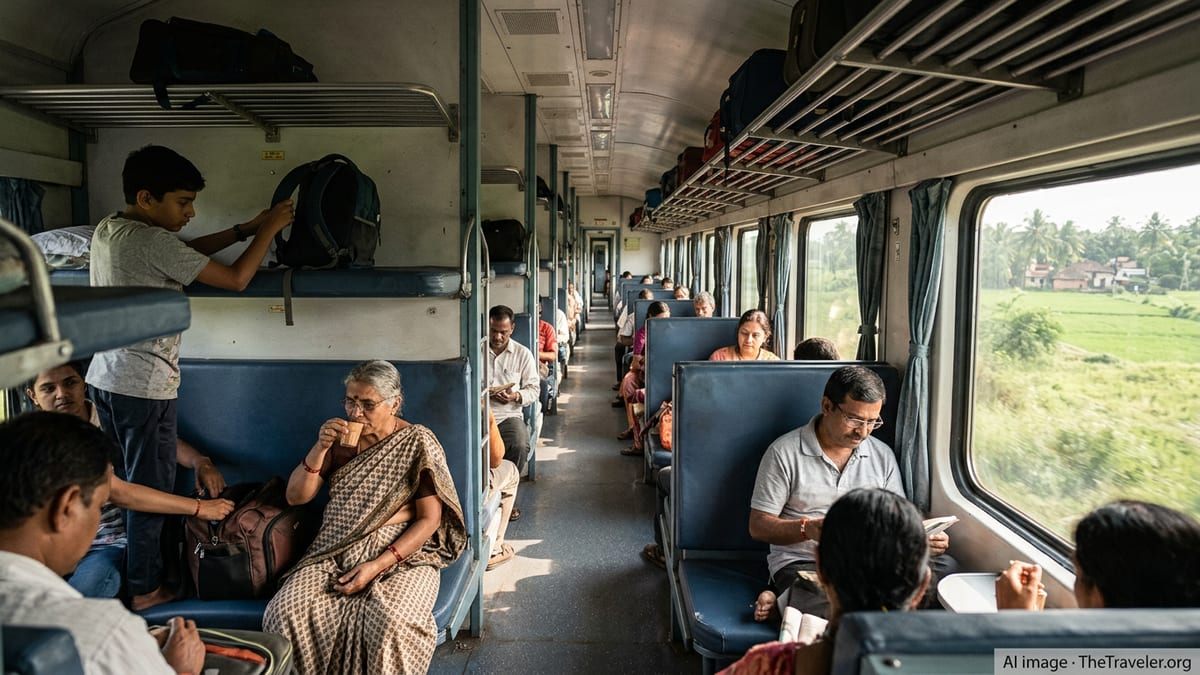
Amrit Bharat Express: Budget Long-Distance Backbone
Introduced in late 2023 as a non air conditioned, sleeper focused alternative to premium trains, the Amrit Bharat Express concept is designed to offer faster, reserved travel at prices closer to conventional mail and express services. Publicly available information describes the trains as long-distance, high-capacity rakes powered in push pull mode, targeting routes with heavy migrant and seasonal demand.
Government documents and railway yearbooks indicate that the network has expanded steadily since launch, with dozens of services either running or sanctioned across northern, eastern, southern and central India. The trains typically operate over distances of 900 to 3,000 kilometers, using upgraded LHB style coaches and higher permissible speeds to cut journey times without shifting to air conditioned stock.
The category is positioned to fill a gap between general express services and the more expensive Vande Bharat and Rajdhani offerings, particularly for passengers who prioritize reserved overnight berths over on board amenities such as air conditioning or catering packages.
The latest expansion, centered on seven additional long-distance routes, signals that Indian Railways is leaning more heavily on Amrit Bharat Express as a mass mobility tool rather than a niche experiment.
Seven New Routes Target High-Demand Corridors
Budget and policy documents for the 2026–27 financial year, along with regional railway communications, reference a new wave of Amrit Bharat services focused on long-distance connectivity between emerging industrial centers, state capitals and major metros. The seven new routes are planned to span multiple zones, linking eastern and northeastern states with northern and southern markets, and extending the concept deeper into central and peninsular India.
Based on route patterns already in operation and services described as “upcoming” in publicly available material, the new trains are expected to mirror earlier Amrit Bharat deployments that connect cities such as Rajendra Nagar in Bihar with New Delhi, or New Jalpaiguri and Tiruchirappalli across the breadth of the country. In practice, this means fresh links that can run across several states, typically over one or two nights, while focusing on non air conditioned sleeper accommodation.
The new services are anticipated to prioritize corridors where conventional express trains are heavily waitlisted and where passengers rely on long-distance buses or unreserved coaches. By using push pull operation and higher acceleration, the trains are designed to clear congested sections more quickly, which can help free up capacity on busy trunk routes for both passenger and freight operations.
Timetable details and exact originating and terminating stations are being refined at the zonal level, but rail watchers expect at least some of the new routes to tie into existing Amrit Bharat hubs in Bihar, Uttar Pradesh and the northeast, while others may originate in southern industrial belts to connect with northern markets.
Affordable Fares and Capacity at the Center of the Plan
Policy papers and budget commentary emphasize affordability as the core justification for expanding the Amrit Bharat Express network. Fares on existing services are generally positioned closer to conventional sleeper class pricing than to premium chair car or air conditioned classes, even though the trains run at relatively higher average speeds and often receive priority pathing.
The design of the Amrit Bharat rakes, which favors sleeper berths and large non air conditioned compartments, allows higher passenger density than typical long-distance trains. This approach is intended to accommodate heavy seasonal flows linked to festivals, education cycles and migrant labor movements, particularly from eastern and northern states toward major urban and industrial centers.
For long-distance travelers, the seven new routes could translate into more options to secure confirmed berths on dates that are frequently sold out on conventional services. For Indian Railways, higher capacity trains on dense routes can support better revenue per path while still meeting social service obligations to keep long-distance travel accessible.
Analysts of the sector note that the expanded network may also help gradually move some passengers away from unreserved coaches, which remain crowded on many popular corridors, toward safer, reserved options without imposing the cost burden of full air conditioning.
Network Effects Across Regions and Smaller Cities
The new routes are expected to deepen network effects already emerging from the first wave of Amrit Bharat Express services. By adding more origin and destination pairs, Indian Railways can create additional through connectivity for passengers making multi-leg journeys, especially in regions where interchange options are limited outside of a few major junctions.
Earlier services have already linked cities such as Sitamarhi and Gaya to Delhi, and Malda Town to Bengaluru and Gomti Nagar, according to public route summaries. The next set of routes is likely to extend similar connectivity to more mid-sized cities, giving them direct access to metros without requiring passengers to first travel to a state capital or a traditional superfast hub.
For smaller urban centers, a direct Amrit Bharat Express connection can be significant. It may reduce travel times for students and workers commuting over long distances, support domestic tourism flows, and encourage business travel from manufacturing belts to major ports and logistics hubs, all while keeping ticket prices within reach of lower and middle income travelers.
Railway planning documents suggest that these network gains are seen as complementary to, rather than competing with, planned high-speed rail corridors and premium services. While high-speed projects target limited city pairs at much higher fares, Amrit Bharat Express trains are aimed squarely at the country’s mass long-distance market.
Operational Challenges and Passenger Expectations
While the expansion of the Amrit Bharat network is being framed as a win for affordability, it also raises operational challenges. Running more long-distance trains on already busy trunk routes requires careful scheduling and infrastructure upgrades, from signaling systems to passing loops and maintenance facilities.
Some commentary from rail users highlights concerns over punctuality, on-board cleanliness and crowding near entry and exit points, particularly when trains serve both reserved and unreserved demand along the route. Managing these issues will be central to maintaining the appeal of the new services as a step up from conventional options.
Publicly available policy material indicates that capacity enhancements on key corridors, coupled with technology such as automatic train protection systems, are intended to support both safety and reliability as more high-capacity trains come online. The success of the seven new routes will likely be measured not only in terms of ridership and revenue, but also in their ability to deliver consistent journey times and basic comfort standards.
For now, the planned additions underline a broader shift in Indian Railways strategy: using purpose-built, budget-friendly trains like Amrit Bharat Express to knit together a rapidly growing economy, ensuring that long-distance mobility does not become the preserve of only those who can afford premium fares.