


More news on this day
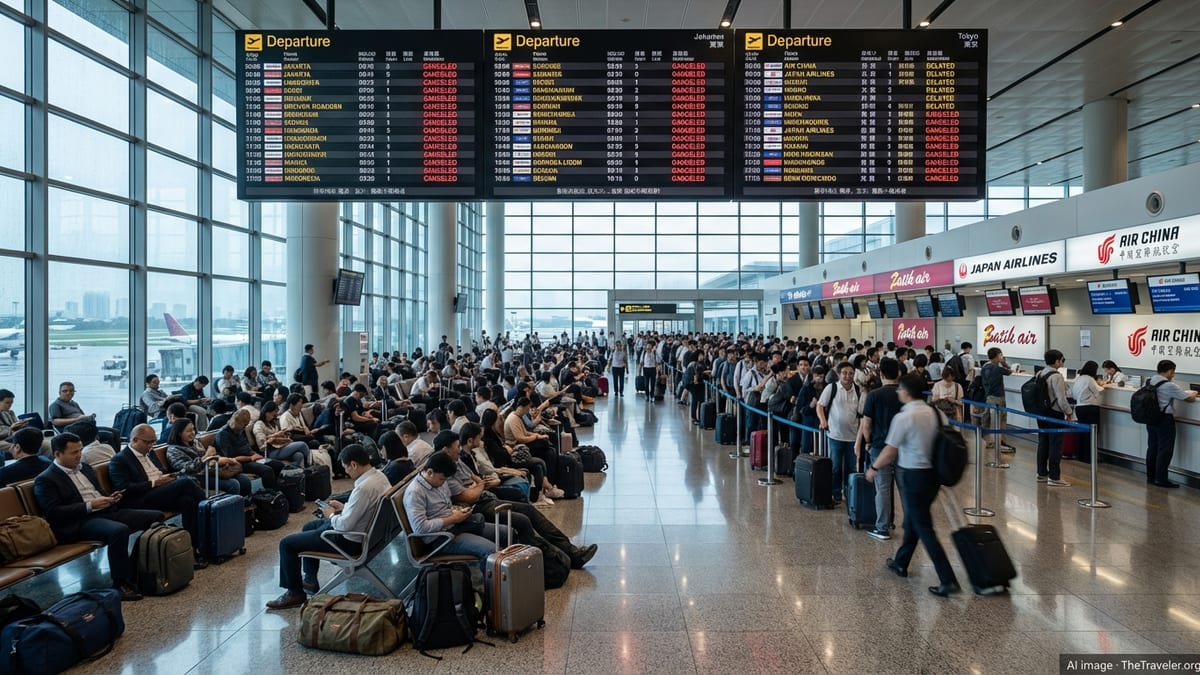
Hundreds of passengers were left scrambling for alternative travel on Tuesday after Jakarta’s Soekarno-Hatta International Airport recorded 17 flight withdrawals and 99 delays, disrupting operations across several Southeast Asian carriers and triggering knock-on impacts on regional routes.
Get the latest news straight to your inbox!
Wide Network of Airlines Hit by Disruptions
Published data from flight-tracking and aviation operations platforms indicates that the disruption at Soekarno-Hatta affected a mix of full-service and low-cost airlines operating dense regional schedules. Among those impacted were Batik Air, Malindo-branded Batik Air Malaysia, Citilink, Garuda Indonesia, Lion Air, Indonesia AirAsia and Malaysia Airlines, all of which rely heavily on Jakarta as a key hub or focus city.
The 17 withdrawals, which include outright cancellations and flights pulled from the day’s operating plan, combined with 99 delays to create a highly congested operating environment. Passengers on short-haul routes linking Jakarta with Kuala Lumpur, Singapore and domestic Indonesian destinations such as Surabaya, Denpasar and Medan reported missed connections, extended waits and repeated gate changes as airlines attempted to re-time and consolidate services.
Soekarno-Hatta is among the busiest airports in Southeast Asia and functions as a primary hub for Lion Air Group carriers and Garuda Indonesia. When disruption occurs at this scale, even for several hours, it can reverberate across the wider network, affecting onward flights to Malaysia, Thailand and beyond.
Publicly available schedule data shows that several of the affected airlines operate overlapping routes out of Jakarta, which can intensify congestion as carriers vie for scarce departure slots when operations are constrained.
Passenger Strain as Delays Stretch Across the Day
Reports from aviation analytics sites and social media postings by travelers describe long queues at check-in counters and transfer desks, as well as crowding in departure halls, particularly around peak evening bank departures. With nearly a hundred delayed flights, even moderate schedule changes translated into significant strain for passengers with tight connections or fixed onward plans.
Some travelers reported delays cascading from one leg of their journey to the next, especially on itineraries combining regional carriers such as Batik Air, Lion Air or AirAsia with long-haul services operated by other airlines out of Jakarta or Kuala Lumpur. In several cases, passengers described having to purchase last-minute replacement tickets on competing airlines when missed connections could not be reprotected in time.
Information management also emerged as a key source of frustration. While airline mobile apps and airport display boards reflected delays and cancellations, passengers reported gaps between schedule changes and notifications, increasing the risk of missed gate calls or abandoned connections. Travel forums and recent passenger accounts about the region’s carriers indicate that delayed and incomplete communication about schedule changes is a recurring issue, particularly during periods of high congestion.
For those already on board delayed aircraft, extended ground waits contributed to additional discomfort amid high load factors typical of the busy mid-year travel period in Southeast Asia.
Operational and Weather Pressures Behind the Gridlock
Preliminary information from operational feeds points to a combination of factors behind the spike in withdrawals and delays at Soekarno-Hatta. These include air traffic congestion around Jakarta’s airspace, knock-on effects from earlier disruptions elsewhere in the region, and localized weather that periodically restricted movements or required temporary spacing increases between arrivals and departures.
Soekarno-Hatta’s complex runway and taxiway layout, along with its role as a primary hub for multiple carriers, means any constraint in one part of the system can rapidly propagate. When a bank of arrivals experiences holding patterns or diversions, subsequent departures are often pushed back, prompting airlines to re-sequence flights and, in some cases, remove individual services from the schedule to recover overall punctuality.
Analysts who monitor Asian aviation reliability note that some of the airlines affected, particularly carriers in the Lion Air Group and certain low-cost operators, have historically recorded higher-than-average delay and cancellation rates compared with regional full-service rivals. On a day of heavy disruption, this existing fragility can leave airlines with limited slack in aircraft and crew rotations, magnifying the impact of any single operational issue.
The combined effect is a gridlocked schedule where each additional delay makes it harder to restore normal operations before the end of the daily operating window.
Knock-on Effects for Regional Connectivity
The impact of the Jakarta disruption was not limited to Indonesia’s domestic market. Flight-tracking summaries and timetable adjustments show that several affected services involved cross-border sectors linking Jakarta with Kuala Lumpur, Penang and other Malaysian cities, where Batik Air Malaysia, AirAsia and Malaysia Airlines all maintain strong presences.
Because many passengers use Jakarta as a connecting point between domestic Indonesian flights and international routes, schedule irregularities led to missed onward services into Malaysia and other neighboring countries. In some cases, delays departing Jakarta forced carriers to retime or substitute aircraft on subsequent legs, rippling the disruption into additional airports.
The situation highlights the vulnerability of Southeast Asia’s tightly interlinked route network, in which Jakarta, Kuala Lumpur, Singapore and Bangkok share overlapping traffic flows. When one hub suffers an operational shock, other airports can quickly feel the impact through late-arriving aircraft, crew duty-time limitations and compressed turnaround times.
Regional tourism and business travel, which rely heavily on predictable short-haul connections, are particularly exposed when a dominant hub such as Soekarno-Hatta records double-digit cancellations alongside dozens of delays in a single operating day.
What Travelers Can Do When Schedules Collapse
Travel industry advisories responding to the latest disruption at Soekarno-Hatta emphasize the importance for passengers of active itinerary management when flying through congested Asian hubs. Experts recommend monitoring airline apps and third-party flight status services well before departure, especially when traveling on carriers with dense but delay-prone schedules.
Passengers are also encouraged to build in longer connection windows when planning itineraries that rely on multiple regional airlines, particularly combinations of low-cost and full-service carriers that may not have interline or through-check agreements. In the event of a withdrawal or lengthy delay, having additional time between flights can be critical to preserving onward travel plans.
In circumstances similar to those seen in Jakarta, travelers may find it advantageous to approach airline transfer desks promptly to request rebooking options, including rerouting via alternative hubs when possible. Those holding travel insurance with disruption coverage are advised to keep documentation of delays, cancellations and extra expenses, as this may assist with subsequent claims.
While the underlying pressures of capacity, weather and airspace congestion around Jakarta are unlikely to disappear quickly, the latest episode at Soekarno-Hatta underlines the growing need for travelers to plan for irregular operations as a routine feature of air travel across the region.