


For affluent travelers shuttling between European cities, the choice is no longer simply whether to fly private. The real decision is how to access that aircraft: pay-as-you-go charters, deposit-based jet cards, or full memberships with global players like NetJets. At the same time, compact air-taxi specialists such as GlobeAir promise point-to-point convenience at a fraction of heavy-jet costs. Understanding how these two models compare in price, flexibility, and day-to-day experience is crucial before wiring six figures to any operator.
Get the latest updates straight to your inbox!
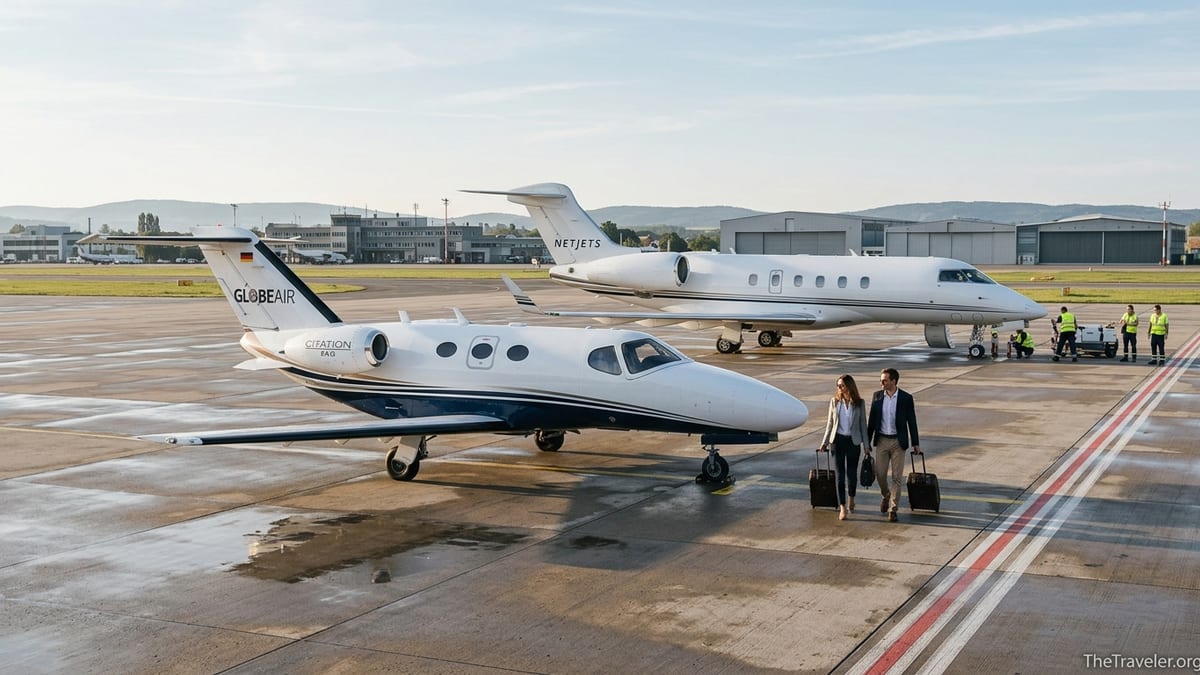
How GlobeAir and NetJets Fit Into the Private Aviation Landscape
GlobeAir and NetJets operate in the same broad market but fill very different niches. GlobeAir is an Austrian-based air-taxi specialist built almost entirely around the Cessna Citation Mustang, a very light jet with four passenger seats that is optimized for short European hops. Recent fleet information indicates GlobeAir operates close to 20 Mustangs, making it one of the largest single-type very light jet operators in Europe. The company focuses on high-frequency routes such as Paris to Milan, Zurich to Nice, or Vienna to Munich, where travelers prioritize speed, airport access, and cost-efficiency over space and range.
NetJets by contrast is the global heavyweight of private aviation. Backed by Berkshire Hathaway, it operates the world’s largest and most diverse business jet fleet, from light jets like the Phenom 300 and Citation Excel to ultra-long-range aircraft such as the Global 6000. In Europe, NetJets offers the same core structure as in the United States: fractional ownership, leasing, and several tiers of jet cards. This breadth allows NetJets to cover everything from a one-hour hop from London to Geneva to a non-stop New York to London crossing, but it also drives higher pricing and a more complex product menu than GlobeAir’s focused model.
For travelers who mostly fly within Europe on sectors of 90 minutes or less, GlobeAir positions itself as a nimble, cost-conscious alternative to the larger brands. Those who need cabin space, stand-up headroom, or long-range capability still tend to look first at NetJets and its competitors. The choice between the two frequently comes down to how often you fly, how far, and how important a fully branded, global service ecosystem is to you.
In practical terms, a family chartering a GlobeAir Mustang from Milan Linate to Olbia for a long weekend will have a very different experience, both in cabin feel and in cost structure, than a corporate team using a NetJets super-midsize jet from London to Riyadh. Understanding these structural differences is the starting point for deciding whether you are better served by ad hoc charter with a specialist like GlobeAir or by committing to a NetJets-style membership.
Jet Charter vs Membership: What You Are Actually Buying
Before weighing GlobeAir against NetJets, it helps to distinguish between on-demand charter and membership or jet cards. With ad hoc charter, you request a specific trip and receive a one-off quote that typically includes aircraft positioning, flight time, handling, and standard catering. Prices move with demand and availability. A last-minute mid-July flight from London to Ibiza on a light jet might be quoted at one rate on Monday and a meaningfully higher rate on Thursday if demand spikes.
Jet cards and membership programs were created to smooth that volatility. In essence, you prepay for a block of hours or for a spend commitment, and the provider offers a fixed or capped hourly rate within a defined service area. NetJets jet cards in Europe, for example, start around the high six figures in euros for a block of hours on a specific aircraft category, with fixed hourly rates that apply on most days of the year. GlobeAir’s DreamTeam JetCard also uses a prepaid model: the Classic tier requires just over €100,000 upfront for up to 25 flight hours on the Mustang, while higher tiers scale to hundreds of thousands of euros for 50, 100, or even 400 hours.
What you are really buying with a membership is predictability and priority access. Instead of phoning brokers for quotes every time you want to fly, you know that a London to Zurich sector of roughly 1.5 hours will be charged at a pre-agreed rate, provided you book within the notice window and accept the program’s peak-day rules. For executives who simply want a travel department to plug fixed numbers into budgets, this consistency can be worth a significant premium over the cheapest charter options available on the open market.
However, that premium only pays off if your flying pattern matches the structure of the card. If you take six or seven private flights a year, each two hours or less within Europe, your average cost per hour on a card could easily exceed that of on-demand charter, especially once membership fees, unused hours, and peak surcharges are factored in. Conversely, if you fly twice a month, often on peak dates such as Fridays and Sundays, and routinely book at short notice, the certainty of aircraft availability provided by NetJets or GlobeAir’s card can quickly become the decisive benefit.
GlobeAir: Air-Taxi Specialist With a Transparent Jet Card
GlobeAir positions its DreamTeam JetCard as a straightforward way to lock in pricing on its Citation Mustang fleet. Entry-level Classic membership requires an upfront investment a little above €100,000 and covers up to 25 flight hours, valid for 12 months. That works out to an effective hourly rate in the low to mid €4,000 range on straightforward itineraries, which is generally competitive with, and sometimes below, spot charter pricing for similar very light jets in Europe. Higher tiers, such as Gold and Platinum, increase the commitment to roughly €200,000 and €375,000 respectively for up to 50 and 100 hours, along with longer validity and slightly better availability guarantees.
An important detail for frequent travelers is that GlobeAir owns and operates its aircraft rather than acting as a broker. This means it can offer guaranteed aircraft availability within 24 to 72 hours depending on your card tier, without needing to source aircraft from third parties except in special cases. For a business owner who regularly flies between secondary airports such as Linz, Bolzano, and Cannes Mandelieu, this operator model can translate into fewer last-minute substitutions and a more uniform cabin experience than using a broker who taps multiple small operators.
GlobeAir’s card structure is tailored to short-haul European missions. A typical itinerary might be a Thursday evening flight from Geneva to Florence followed by a Sunday return. On a card, this round trip of perhaps two hours of flight time each way would simply deduct those hours from your balance at the fixed rate, with no repositioning charge from GlobeAir bases if you depart from certain core airports. By comparison, ad hoc charter brokers might quote the same trip including empty-leg positioning if no aircraft is already near Geneva, resulting in a noticeably higher total cost.
For travelers whose main concern is price discipline rather than cabin size, the Mustang’s four-seat layout can be an advantage. Couples, solo executives, and small families willing to sit close together can stretch their budget further with GlobeAir than with larger-cabin memberships. The trade-off is range and weather flexibility: very light jets are not designed for high crosswinds or very long missions. Flights such as London to Athens or Zurich to the Canary Islands may require fuel stops or a different aircraft altogether, in which case GlobeAir will use partner aircraft at different pricing.
NetJets: Global Scale, Broader Fleet, Higher Commitment
NetJets sits at the other end of the spectrum with a global network, multiple aircraft categories, and products that range from fractional shares to shorter-term jet cards. NetJets Europe jet cards and share programs are typically structured around a specific cabin class such as light, midsize, or super-midsize jets, and require minimum commitments that are noticeably higher than GlobeAir’s entry-level card. Publicly available guidance suggests that European jet cards with NetJets start from around the high €100,000s for a small block of hours during non-peak days, with more comprehensive access requiring larger deposits.
In return for this higher capital outlay, cardholders receive access to a large, multi-type fleet that can handle a wide variety of missions. A typical use case could be a law firm partner who regularly flies London to Frankfurt on a Phenom 300 one week and then needs to take a team of eight from Paris to New York on a super-midsize or large-cabin jet the next. With NetJets, both missions can be executed within a single program, albeit with different hourly rates and occasionally different access rules by region.
NetJets markets its consistency as a key advantage. The company emphasizes that aircraft are maintained and crewed to uniform standards across its network, with strong backup capacity when an aircraft goes tech. For high-stakes itineraries such as board meetings or investor roadshows, that redundancy is often seen as worth the premium over smaller operators. Even if an aircraft suffers a mechanical issue on the ramp at Geneva, NetJets typically has the scale to source a replacement within its fleet, minimizing delays.
However, this scale comes with constraints. European flyers often highlight that jet card holders face blackout or restricted periods during the peak summer season, particularly from mid-June through early September when demand for Mediterranean routes spikes. On those dates, NetJets may limit availability for new cardholders, impose longer booking windows, or require surcharges. Travelers who expect to use their membership primarily for school-holiday and August travel should pay close attention to these seasonal rules before signing a multi-year agreement.
Real-World Pricing Scenarios: GlobeAir vs NetJets
Comparing exact pricing between GlobeAir and NetJets is challenging because both tailor quotes to specific routes and service levels, and NetJets in particular does not publicly publish its full rate card. Nonetheless, real-world scenarios from European flyers offer useful benchmarks. On the GlobeAir side, a Classic JetCard member paying just over €100,000 for 25 hours might see an effective hourly cost in the region of €4,000 to €4,500 when using the hours efficiently, especially on simple out-and-back trips between central European cities.
Take an example: a CEO based in Zurich wants to fly to Rome for a client dinner, returning the next afternoon. The total flight time on a Mustang might be about 2 hours each way, for 4 hours deducted from the card. At an implied rate of around €4,200 per hour, the all-in cost would be roughly €16,800 before any extras such as de-icing or short-notice surcharges, which is broadly in line with, and at times below, what high-quality brokers quote for similar very light jets on that route during shoulder season.
By contrast, a NetJets light-jet cardholder in Europe might pay a significantly higher all-in hourly rate. While precise numbers vary, owner conversations and third-party analyses suggest that effective hourly costs on NetJets light jets in Europe can land above €8,000 once program fees, fuel surcharges, and catering are factored in, especially on smaller hour blocks. For our Zurich to Rome example, that could put the round trip nearer to €32,000. For travelers who value NetJets’ brand, global support, and cabin consistency, this premium is acceptable. For others, especially those focused strictly on intra-European hops with up to four passengers, the cost delta can be hard to justify.
A different picture emerges on longer missions or with larger groups. A seven-passenger team needing to fly London to Riyadh non-stop for an investment pitch cannot use a GlobeAir Mustang and would instead need a larger chartered jet via a broker or a membership provider. NetJets can provide that capacity within an existing program, often on a super-midsize jet with a higher hourly rate but no need to negotiate a new charter contract for each trip. In these cases, per-seat economics may actually favor the larger, more expensive aircraft, especially if every seat would otherwise have flown business class on a commercial carrier at several thousand euros per ticket.
Flexibility, Fine Print, and Service Experience
Beyond raw hourly rates, the everyday usability of a membership depends on flexibility rules. GlobeAir’s jet card is lean and centered on European operations. Members benefit from non-expiring balances within the contract validity, no positioning fees from selected hub airports, and modest guaranteed-availability windows ranging from 24 to 72 hours depending on tier. For a traveler based around key European business centers such as London, Paris, Geneva, or Vienna, this can mean relatively simple booking: request a flight a couple of days ahead, receive a confirmation at the fixed rate, and go.
NetJets programs involve more moving parts. Cardholders need to be aware of peak-day calendars, minimum booking notice, daily minimum flight times, and region-specific rules. In Europe, some members have reported that summer resort periods can be challenging, with earlier booking required to secure preferred slots to destinations like Ibiza, Palma, or Olbia. NetJets often compensates with stronger 24/7 customer service, concierge-style trip support, and the ability to re-accommodate passengers when schedules change or weather disrupts operations.
Service experience also differs in character. GlobeAir’s small fleet and single-aircraft focus foster a boutique feel. Regular flyers often get to know individual pilots and operations staff, and the cabin layout is identical across the Mustang fleet. The decor is functional and compact rather than opulent, with two pairs of facing seats and limited baggage capacity. For many short-haul business trips, this simplicity is perfectly adequate; laptops come out, documents are signed, and 90 minutes later you are landing at a regional airport close to your final destination.
NetJets aims for a more club-like brand experience, with carefully curated cabin finishes, consistent catering options, and a polished owner services team. The feeling is closer to a discreet, global members’ club than a point-to-point air taxi. For travelers who value that sense of belonging as much as the utility of the aircraft, the NetJets ecosystem can be a deciding factor even when they know that smaller operators might offer lower prices on equivalent routes.
Who Should Choose Jet Charter, GlobeAir’s Card, or NetJets Membership?
The right solution depends heavily on your travel pattern, tolerance for price variability, and capital allocation. For very occasional flyers, such as a family taking two or three private trips a year from London to the Alps and back, traditional on-demand charter remains the most sensible option. Booking each trip via a reputable broker lets you compare offers from multiple operators, choose aircraft size trip by trip, and avoid tying up six figures in a prepaid card that you may not fully use.
GlobeAir’s jet card is well suited to travelers who fly within Europe at least once a month, usually in small groups of up to four, and mainly on sectors of two hours or less. Think of a tech founder commuting between Berlin, Zurich, and Barcelona, or a private equity partner who alternates between Geneva, Milan, and Paris for portfolio meetings. For these travelers, the cost savings of a very light jet combined with fixed hourly rates and operator-owned aircraft can deliver good value relative to both NetJets and ad hoc charter.
NetJets membership typically makes most sense for high-frequency flyers who value brand, redundancy, and fleet diversity. A multinational CEO who needs to fly Paris to Madrid one week, New York to Los Angeles the next, and Geneva to Dubai after that is unlikely to find a single-type operator sufficient. For such profiles, the ability to call a dedicated service team, specify the cabin class required, and rely on a global safety and maintenance ecosystem can easily justify the higher hourly costs and longer contractual commitments.
In all cases, a sober financial analysis is essential. Prospective members should model a realistic year of travel, including number of trips, average stage length, seasonal peaks, and potential changes in lifestyle. Comparing that model against quotes for on-demand charter, GlobeAir’s card tiers, and indicative NetJets pricing will quickly reveal which approach offers the best blend of flexibility, certainty, and cost per hour.
The Takeaway
GlobeAir and NetJets do not simply compete as brands; they represent different philosophies of private aviation. GlobeAir’s air-taxi model and focused Mustang fleet deliver a straightforward proposition for intra-European travelers who prize efficiency and predictable pricing more than cabin space or long-range capability. Its jet card tiers allow frequent flyers to fix their costs without committing to the global infrastructure and higher price points associated with larger players.
NetJets, by contrast, is the archetype of the comprehensive membership model. Its jet cards and fractional programs offer broad aircraft choice, worldwide reach, and a deeply embedded service culture. This comes at a premium, but for many owners that premium is justified by the assurance that, wherever they are in the world, an aircraft and a support team stand ready to move them on relatively short notice.
For travelers trying to decide between ad hoc charter and a membership, the most important questions are practical: how many hours you expect to fly, where, with how many people, and on which dates. Occasional flyers may find that high-end on-demand charter meets their needs perfectly. Those who live in Europe and fly short routes often, especially in groups of up to four, should investigate GlobeAir’s jet card closely. Global executives who live on airplanes, and for whom reliability and fleet depth are non-negotiable, will continue to see NetJets as the benchmark.
Ultimately, the right answer is rarely one-size-fits-all. The smartest travelers treat private aviation like any other major investment: they solicit multiple quotes, read program documents carefully, stress-test assumptions about their travel, and only then decide whether to swipe their card for a single charter or wire funds for a full membership.
FAQ
Q1. Is a GlobeAir jet card cheaper than a NetJets membership for European flights?
For many short European hops with up to four passengers, a GlobeAir jet card will usually be meaningfully cheaper per flight hour than a comparable NetJets light-jet program. NetJets often charges higher effective hourly rates in exchange for brand strength, larger aircraft options, and global infrastructure.
Q2. How many hours do I need to fly each year before a jet card makes sense?
As a rough guideline, travelers who fly privately fewer than 20 to 25 hours per year often find on-demand charter more economical. Once your usage rises toward 30 to 50 hours annually, especially on similar routes, a jet card from GlobeAir or NetJets can begin to offer better predictability and potentially lower average costs.
Q3. Can GlobeAir or NetJets guarantee an aircraft during peak summer travel?
Both providers offer forms of guaranteed availability, but the details matter. GlobeAir’s guarantees depend on card tier and notice period, while NetJets publishes peak-day calendars that may restrict access or require surcharges. If you mainly fly during school holidays or August, review peak rules carefully before committing.
Q4. What happens if I do not use all my jet card hours within the term?
Policies differ. GlobeAir generally provides validity periods linked to each tier and may allow balances to be carried into a renewal. NetJets card hours usually expire after a defined term, with limited rollover options. Unused hours can significantly increase your effective hourly cost, so it is prudent to be conservative when estimating required hours.
Q5. Are there extra fees beyond the hourly rate on these programs?
Yes. Even with fixed hourly rates, travelers can face additional charges for fuel surcharges beyond a set baseline, de-icing, high-demand airport handling, catering upgrades, or overnight crew costs. When comparing GlobeAir to NetJets, ask each provider for example invoices on typical routes to understand the real all-in cost.
Q6. How do safety and pilot training compare between GlobeAir and NetJets?
Both companies emphasize safety as a core selling point, with structured training programs and standardized operating procedures. NetJets, due to its size, operates extensive in-house training and auditing. GlobeAir, as a focused operator of a single jet type, benefits from pilots who specialize in one aircraft. Travelers should request each operator’s safety certifications and audit history for reassurance.
Q7. Can I upgrade to a larger jet if my group size changes?
NetJets programs are designed to allow changes in cabin class, often at different hourly rates and with specific rules. This makes it easier to upsize for occasional long-haul or large-group trips. GlobeAir’s own fleet is limited to very light jets, so upgrading typically involves using partner operators at separate pricing. If your group size varies widely, NetJets-style memberships can provide more built-in flexibility.
Q8. How far in advance do I need to book with a jet card?
Booking windows vary by tier and provider. GlobeAir cardholders typically enjoy guaranteed availability with one to three days’ notice within its core network. NetJets usually requests more lead time on peak days and may offer shorter windows on standard days. Either way, booking earlier increases the odds of getting your preferred departure slot and airport.
Q9. Is private jet membership ever a good choice for leisure travelers only?
It can be, but only at higher annual usage. A family that regularly spends school holidays in different European cities and dislikes commercial air travel might find value in a GlobeAir card for repeated short hops. For long-haul leisure flying to destinations like the Caribbean or North America several times a year, a NetJets membership can provide comfort and convenience, but the total cost will be substantial.
Q10. What should I ask before signing any private jet membership contract?
Key questions include: exact hourly rates and what they include, peak-day rules, expiration and rollover of hours, minimum booking notice, cancellation penalties, and how disruptions are handled. Request sample invoices for real routes you are likely to fly, compare those with quotes from on-demand charter brokers, and consider independent legal or financial advice before making a commitment.