


Booking a private jet for the first time can feel like stepping into a different world. If you are considering GlobeAir for a European trip, understanding how the process works and what to expect on the day will make the experience smoother, more comfortable and far more enjoyable. This guide walks through the full journey with GlobeAir, using real examples of routes, prices and services so you can decide whether this style of travel fits your plans and budget.
Get the latest updates straight to your inbox!
Who GlobeAir Is and Where They Fly
GlobeAir is a European private jet operator based in Austria, specializing in short-haul business and leisure flights across the continent. The company launched its first flight in 2008 and has grown into one of Europe’s leading providers of very light jet charters, focusing on fast point-to-point connections between major cities and smaller regional airports that are often poorly served by commercial airlines.
The core of GlobeAir’s operation is its fleet of Cessna Citation Mustang jets, compact four-seat aircraft designed for short hops of roughly one to two hours. Industry reports list GlobeAir among Europe’s top business jet operators by fleet size, with around 20 very light jets dedicated primarily to the European market. That specialization means frequent service on popular corridors such as London to Geneva, Milan to Nice, or Zurich to Paris, as well as seasonal leisure routes linking city airports with Mediterranean hotspots.
GlobeAir’s network is tailored to Europe and nearby destinations rather than long-haul intercontinental flights. A typical client might be a small team flying from Vienna to Rome for a board meeting, a family heading from Munich to Olbia in Sardinia, or a couple combining several wine regions over a long weekend by routing through smaller airports that commercial carriers do not serve directly.
For first-time clients, it is important to understand this regional focus. If you are planning a trip within Europe, GlobeAir’s model works well: short sectors, fast turnarounds and easy access to secondary airports that often put you closer to your final destination than a large international hub would.
How Booking a GlobeAir Flight Actually Works
GlobeAir sells flights on an on-demand basis, which means you are chartering the entire aircraft for a specific route and time rather than buying individual seats. You can request a quote through their booking engine or by contacting their customer care team, which operates 24 hours a day. The basic information you will be asked for is straightforward: departure and arrival airports, preferred date and time, number of passengers and any special requirements such as pets, children, extra luggage or a particular catering preference.
Once you submit the request, GlobeAir responds with an offer that includes a proposed schedule, the aircraft type (almost always a Citation Mustang for up to four passengers) and an all-in price. First-time customers are often surprised by how quickly this happens; if you enquire on a Tuesday morning for a Friday trip from Zurich to Ibiza, for instance, you can typically receive a quote within an hour or less. During busy summer weekends, availability can be tighter, so it is wise to reach out several days ahead if your dates are not flexible.
To confirm a flight, GlobeAir requires a signed charter agreement and either proof of payment or a valid credit card as a payment guarantee. For many first-time private jet travelers, this feels more like booking a villa or a yacht than buying a commercial air ticket. You are entering into a contract for a custom flight, with conditions covering schedule changes, cancellations and possible operational disruptions such as air traffic control delays or weather diversions.
GlobeAir’s booking process is designed to be approachable for new clients. If you have never chartered before and feel uncertain about elements like runway suitability, slot restrictions at airports such as London City, or whether your golf bags will fit, the team will usually walk through each point on the phone or by email. First-time clients commonly test the service with a relatively simple route, for example Milan Linate to Nice for a long weekend, before booking more complex multi-leg itineraries.
What It Really Costs: Example Fares and Empty Legs
Pricing is one of the biggest unknowns for first-time clients. GlobeAir uses a model that factors in flight time, positioning of the aircraft, airport fees and demand. As a rough guide, chartering a very light jet in Europe typically works out to several thousand euros per hour of flight time, though exact figures depend on the day, route, and how early you book. Short city pairs such as Geneva to Zurich or Milan to Venice will be at the lower end of the spectrum, while longer sectors like London to Ibiza or Paris to Olbia can be noticeably more expensive.
Real-world examples give a clearer sense of scale. On GlobeAir’s empty leg calendar, it is not unusual to see deep discounts on repositioning flights that would otherwise operate without passengers. One recent example showed a Cessna Citation Mustang flying from Graz to Berlin with a published original price of about 9,100 euros and an empty leg offer of approximately 990 euros for the whole jet, accommodating up to four passengers. That works out to just under 250 euros per person if you fill all four seats, comparable to or cheaper than last-minute business class on many commercial airlines for the same route.
These empty leg opportunities are highly specific in timing and routing and can change at short notice, but they illustrate the range of what is possible. While you should not plan a critical business meeting around a discounted empty leg, they can be an appealing way for first-time clients to experience private aviation for a birthday trip, a spontaneous city break or a special occasion dinner in another country.
For travelers who intend to fly more regularly, GlobeAir also offers jet card products that bundle a certain number of flight hours at a fixed hourly rate. This can simplify budgeting by folding in typical surcharges and giving priority access during peak periods. However, for your very first experience, most people find a single on-demand charter or an opportunistic empty leg to be the most straightforward entry point.
From Home to Takeoff: What Happens on the Day
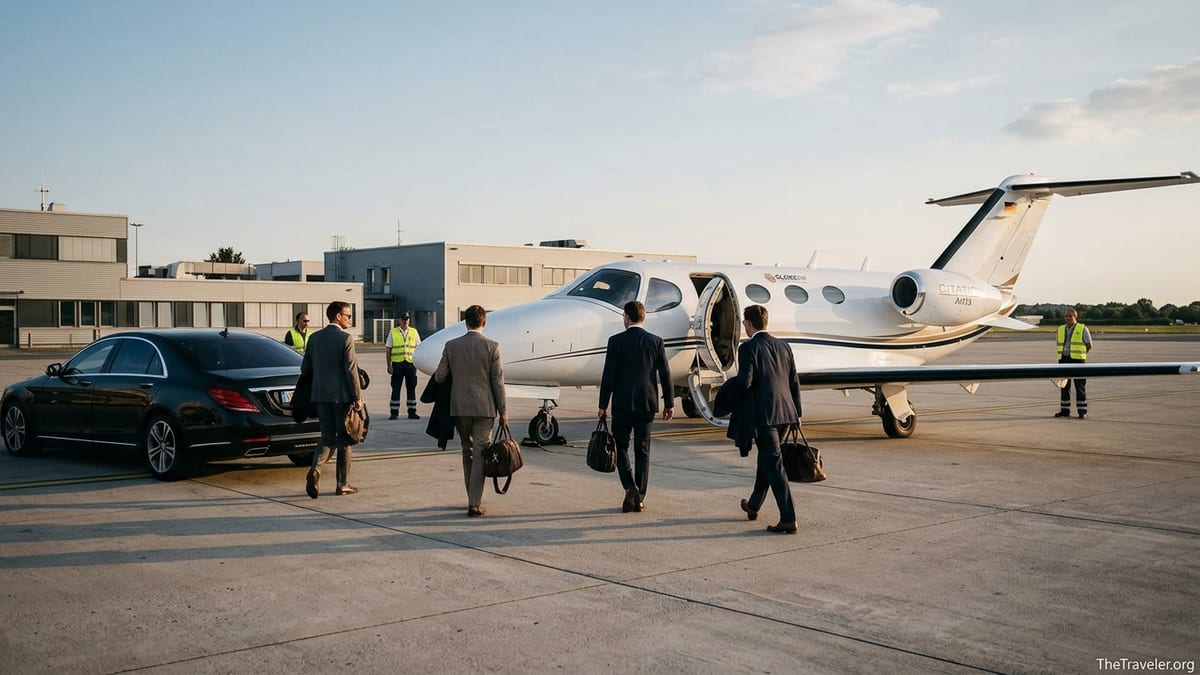
The biggest lifestyle difference when flying with GlobeAir appears on the day of travel. Rather than heading to a crowded terminal, you go directly to the fixed-base operator or general aviation terminal at your departure airport. These facilities are often located on the edge of the airfield, with their own parking, security check and lounge. GlobeAir markets a boarding time as short as 15 minutes in many cases, so arriving half an hour before departure is usually ample, even at airports that can be congested for commercial flights.
When you enter the private terminal, staff will match your name with the GlobeAir flight and assist with formalities. Security is present but typically far more discreet than the standard commercial experience; luggage is screened, but queues are rare and the entire process can take only a few minutes. If you are departing from a business aviation hub such as Geneva, Zurich or London Farnborough, you may find yourself walking straight from a quiet lounge to your jet waiting a few meters away on the apron.
For a first-time client, this efficiency can feel almost unreal. Consider a Friday evening business trip from Paris Le Bourget to Geneva. Instead of leaving central Paris three hours before departure to account for traffic and security lines, many GlobeAir passengers are comfortable leaving their office around 75 to 90 minutes before wheels up, knowing that the car pulls up directly outside the private terminal, that their pilot and handling agent are expecting them and that boarding will be ultra-fast. That time saved at both ends of the trip is one of the main reasons business travelers justify the cost.
On arrival at your destination, the pattern repeats in reverse. Ground handlers bring any checked luggage directly to the aircraft or the terminal, immigration formalities are completed quickly where applicable and you are usually seated in a waiting car or taxi within minutes of opening the cabin door. At smaller airports in Italy, Switzerland or the south of France, this can mean stepping from the jet onto the tarmac and being in a resort or meeting room less than half an hour later.
Inside the Cabin: Comfort, Service and Practical Details
A GlobeAir flight feels very different from even the best commercial business class because the cabin is intimate and the crew is focused entirely on your party. The Cessna Citation Mustang that dominates GlobeAir’s fleet has four club-style seats facing each other, plus a fifth optional seat in the cockpit jump seat on some flights, though the standard configuration for passengers is four. The cabin is compact, with limited stand-up room, but the seating is plush, there is space to work on a laptop and large windows make the interior feel bright.
On board, service is provided by the pilots rather than a dedicated cabin attendant, which is typical for very light jets. Before departure, you can usually specify simple catering such as sandwiches, fresh fruit, pastries or snacks, along with champagne, soft drinks or coffee. For a morning hop from London Biggin Hill to Zurich, many first-time GlobeAir clients opt for coffee, juice and a light breakfast. For an evening leisure flight from Munich to Olbia, it might be a chilled bottle of prosecco and antipasti to start the holiday as soon as you climb aboard.
Connectivity varies by aircraft and route. Very light jets often do not have the same always-on Wi-Fi solutions found on larger long-range aircraft, so it is wise for first-time travelers to download key documents and entertainment in advance and confirm connectivity options with GlobeAir when booking. Power outlets for devices are commonly available, and the flight durations are short enough that many passengers simply work offline or enjoy the view.
Luggage is one of the main practical points to clarify before you confirm a booking. The cargo compartment on a Citation Mustang is generous for short trips but not unlimited. A typical rule of thumb is a medium checked suitcase and a small carry-on per person if four passengers are on board, or more luggage if you are traveling as a couple. Golf bags and ski equipment are usually possible, but bulky items should always be discussed in advance so that the operator can confirm they fit safely.
Policies, Safety and What First-Timers Often Miss
Private aviation is governed by strict safety standards, and reputable operators like GlobeAir hold commercial air operator certificates that require professional pilots, regular maintenance and compliance audits. For first-time clients, it is reasonable to ask about pilot qualifications, training cycles and safety management systems. GlobeAir highlights the training of its crews and the standardized operation of a single primary aircraft type as part of its reliability pitch, which in practice can simplify procedures and maintenance.
Cancellation and change policies are another area where first-timers can be caught off guard. Because a private jet charter is a bespoke service, last-minute changes can be expensive. Moving a Friday afternoon flight from Geneva to London to a later departure, or switching destination to a different city, may require a new quote if airport slots, crew duty limits or aircraft positioning are affected. Operators generally specify penalty timelines in the contract, with more flexibility if changes are made several days in advance rather than on the day of departure.
Weather and air traffic control can still affect a private jet flight, especially at slot-controlled airports or during winter operations in the Alps. While GlobeAir can often re-time departures and route around congestion more flexibly than large airlines, delays are not entirely eliminated. A first-time client planning to connect directly from a private jet arriving at London to a long-haul commercial flight should allow a realistic buffer or consider booking the commercial sector for the following morning, especially in winter.
Finally, first-time travelers sometimes assume every request is feasible because they are paying for a private jet. In reality, the laws of physics and regulations still apply. A small runway in a remote Mediterranean island may not be suitable for jet operations on a hot afternoon, or a late-night landing might be prohibited by local curfews. GlobeAir’s team typically proposes the closest viable alternative airport and can often organize ground transfers, but it is important to approach planning as a conversation rather than a rigid demand.
Who GlobeAir Suits Best and How to Test the Waters
GlobeAir is particularly well suited to travelers who value time savings and access to smaller airports more than sheer onboard space. Frequent use cases include executives visiting multiple European cities in a single day, small teams attending trade fairs that are poorly served by direct commercial flights and leisure travelers heading to resorts in the Alps or along the Mediterranean coast where regional airports dramatically cut transfer times.
For example, a family from Frankfurt heading to a villa in Sardinia might choose a GlobeAir flight to Olbia Costa Smeralda instead of connecting through a major hub. The private jet could leave Frankfurt mid-morning, land in Olbia around lunchtime and have the family by the pool before mid-afternoon, avoiding the uncertainty of tight connections and crowded terminals during peak summer weekends. Similarly, a law firm might book a Zurich to Luxembourg round trip in a single day with flexible timing for a negotiation that could overrun, something very hard to achieve with fixed commercial schedules.
If you are unsure whether the model fits your travel pattern, consider starting with a single point-to-point charter on a route where commercial options are inconvenient, such as Geneva to Florence or London to Innsbruck in winter. Alternatively, monitor GlobeAir’s empty leg offers for a city pair that matches a leisure weekend you can plan flexibly around. Using an empty leg for a birthday or anniversary trip allows you to experience the full private jet process at a fraction of typical charter costs, with the understanding that timing may be less customizable.
For travelers who ultimately fly several times a year and appreciate a more predictable cost structure, GlobeAir’s jet card products can be explored after that first experience. Cards with guaranteed aircraft availability within 24 to 72 hours for booked trips and fixed hourly rates can make budgeting and planning easier, but it is generally wise to fly at least once or twice on a standard charter before committing to a higher minimum spend.
The Takeaway
For first-time clients, booking a private jet with GlobeAir is less mysterious than it might appear. You are essentially commissioning a tailor-made flight, with the company’s team handling everything from suitability of airports to pilot scheduling, and you trade the hassle of crowded terminals for quiet private lounges, quick security and the ability to leave much closer to your ideal time.
Understanding the realities of pricing, aircraft size, luggage capacity and schedule flexibility helps set realistic expectations. A short hop on a Cessna Citation Mustang will not resemble a wide-body first class suite, but it will get a small group from city center to resort or boardroom with extraordinary efficiency. Empty leg deals and single on-demand charters are useful ways to try the experience before considering more structured products such as jet cards.
If you go in with a clear sense of your route, timing, passenger count and must-have comforts, GlobeAir’s team can usually shape the flight around your needs. For travelers whose time is genuinely scarce or for those marking a special occasion, that blend of speed, privacy and personalization can make a first private jet trip with GlobeAir feel both practical and memorable.
FAQ
Q1. How far in advance should I book my first GlobeAir flight?
For popular routes in peak periods, aim to book at least several days in advance. In quieter seasons, GlobeAir can sometimes arrange flights on 24 to 48 hours notice, and in urgent situations same-day departures may be possible if aircraft and crew are available.
Q2. Can I really arrive only 15 minutes before departure?
At many airports using private terminals, arriving 20 to 30 minutes before departure is usually enough. GlobeAir often supports very fast boarding, but at large or slot-controlled airports you should still build in a little extra time for security checks and traffic.
Q3. How many people can travel on a typical GlobeAir jet?
GlobeAir primarily operates Cessna Citation Mustang very light jets configured for up to four passengers in the main cabin. If you need more seats, the company can arrange larger aircraft through partners, but that may involve different pricing and availability.
Q4. What kind of luggage allowance should I expect?
On a standard GlobeAir flight with four passengers, expect space for one medium suitcase and a small carry-on per person as a general guideline. Oversized items like golf bags or skis are often possible but must be discussed in advance so that the operator can confirm they fit safely.
Q5. Are pets allowed on GlobeAir flights?
Pets are usually welcome on private charters, and many GlobeAir clients travel with dogs or cats. You will need to advise the company in advance and ensure you meet the entry rules and vaccination requirements at your destination country.
Q6. Is there Wi-Fi on board GlobeAir aircraft?
Connectivity options vary by aircraft and route. Some very light jets may not have full in-flight Wi-Fi, so it is best to ask at the time of booking. Many travelers plan to work offline, download entertainment ahead of time and rely on ground connections at departure and arrival.
Q7. What happens if my meeting overruns and I am late for the flight?
One advantage of chartering is flexibility. If you are running late, GlobeAir will usually adjust departure time within the limits of crew duty rules, airport opening hours and air traffic slots. Major last-minute changes can incur extra costs, so good communication with the operations team is important.
Q8. How do GlobeAir’s empty leg flights work?
Empty legs are repositioning flights that would otherwise operate without passengers. GlobeAir sometimes offers these at heavily reduced rates on fixed routes and times. They can be an excellent value for flexible leisure trips, but because schedules can shift, they are less suitable for must-not-miss meetings.
Q9. Do I need travel insurance for a private jet charter?
It is still sensible to have comprehensive travel insurance, especially for international trips. While GlobeAir carries operational insurance as an airline, your own policy can cover issues like medical emergencies, missed connections with other transport and nonrefundable hotel bookings.
Q10. How does security screening work compared with commercial flights?
You still pass through security at the private terminal, but the process is usually much quicker and more discreet than in a main terminal. There are no long lines, screening is handled by dedicated staff and you typically move directly from security to a lounge and then to the aircraft waiting nearby.