


For travelers who want to skip crowded terminals and rigid schedules but are not ready to own an aircraft, operators like GlobeAir promise an efficient middle ground. Specializing in very light jets across Europe, GlobeAir sells itself as a fast, flexible and comparatively affordable entry point to private aviation. Yet, as with any niche travel product, there are meaningful trade-offs. Understanding how GlobeAir actually operates, what it costs and where it fits best in real itineraries is essential before you shift key business trips or weekend escapes onto their aircraft.
Get the latest updates straight to your inbox!
What GlobeAir Is and Where It Fits in the Market
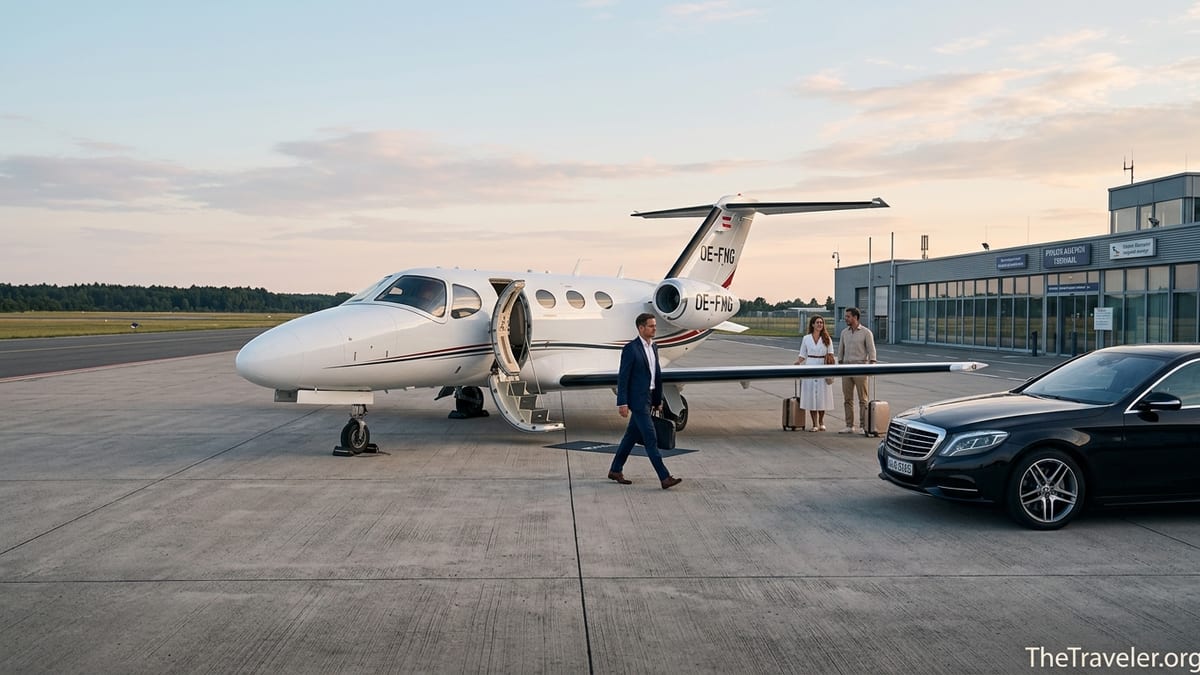
GlobeAir is a Linz-based Austrian operator focused on short-haul private jet travel within Europe using a single aircraft type: the Cessna Citation Mustang. As of spring 2026, its fleet consists of roughly 17 to 18 of these very light jets, making GlobeAir one of the largest Mustang operators in the world and a dominant player in the European entry-level private jet niche. The company targets routes of about one to two hours, such as Paris to Milan, Zurich to Nice or London to Frankfurt, where a small, efficient jet can compete with business class in both time and comfort terms.
Unlike global charter brokers that source aircraft from many operators, GlobeAir owns and operates its jets. Flights are crewed by GlobeAir pilots and maintained under its own operating certificate. For travelers, that can mean more consistent cabin layout, service standards and operational policies. Everything from the way baggage is handled to the onboard refreshments tends to follow one template rather than changing from trip to trip as it can with brokered charters.
The operator positions itself as the first step up from commercial business class. Its marketing emphasizes boarding in around 15 minutes at dedicated general aviation terminals, direct access to more than 900 European airports and a pricing structure that sits below midsize jets or ultra-long-range aircraft. Travelers considering GlobeAir are often weighing it against flexible economy or business on network carriers for regional routes, or against larger-jet operators for trips with more passengers or baggage.
In practice, GlobeAir tends to work best for small groups of up to four people traveling between secondary or mixed-use airports. A team connecting from Graz to Berlin or an executive traveling from Geneva to Ibiza for a long weekend will usually see the clearest benefits, especially when the itinerary does not line up neatly with commercial schedules.
Key Advantages for Business Travelers
The main advantage GlobeAir offers business travelers is time. With access to general aviation terminals and dedicated handling, you typically arrive at the airport 20 to 30 minutes before departure, clear security and passport checks in a few minutes and drive directly to the aircraft. For example, a legal firm shuttling two partners from Vienna to Zurich for a client meeting can cut total door-to-door travel time by several hours compared with an early-morning commercial departure plus buffer time in the main terminal.
Schedule flexibility is another meaningful benefit. GlobeAir sells on-demand charters and jet card hours that can be used across its network. If a board meeting in Milan finishes an hour late, the aircraft can often wait or the departure can be shifted within a reasonable window, something that is virtually impossible with a fixed-schedule airline. For executives whose schedules frequently slip, that flexibility can translate to fewer overnight stays and better use of working hours.
GlobeAir’s homogenous fleet of Cessna Citation Mustangs also plays in its favor. The Mustang is built for short hops, typically flying up to around two hours nonstop. Cabins are configured with four club-style seats and a small refreshment area, which is adequate for internal meetings, laptop work or confidential calls. Because every GlobeAir jet is essentially the same, a multinational traveling team from London to Frankfurt on one day and from Frankfurt to Geneva the next can rely on a similar onboard environment, which is useful if they need to replicate briefings or review materials in-flight.
Finally, the ability to reach smaller airports can reshape business itineraries. Instead of flying a commercial service into Paris Charles de Gaulle and driving for over an hour to an industrial site, a GlobeAir flight might take a team directly into Paris Le Bourget or even a closer regional field, cutting surface travel significantly. For companies that send small teams to factories, logistics hubs or regional offices across Central and Eastern Europe, that point-to-point access is often one of the strongest arguments for GlobeAir.
Appeal for Leisure: Weekend Escapes and Seasonal Trips
While GlobeAir is clearly business-focused, it actively markets to leisure travelers, especially for weekend escapes and seasonal trips. Popular routes include flights from London or Paris to Mediterranean destinations like Olbia, Nice, Ibiza and Palma during summer, and to Alpine airports such as Innsbruck or Sion during ski season. For a family of four heading from Zurich to Olbia for a three-day break, skipping commercial connections and security queues can make the entire trip feel more like a private retreat than a rushed getaway.
Leisure travelers often discover GlobeAir through its empty leg offers, where a repositioning flight is sold at a steep discount. It is not unusual to see a last-minute empty leg such as Graz to Berlin priced at under 1,000 euros for the entire jet, compared with an original charter price listed closer to 9,000 euros. These deals can make a private jet experience accessible for special occasions like milestone birthdays, surprise proposals or once-off luxury weekends, especially when the cost is split among four passengers.
The operator also promotes tailored experiences through partners, such as chalet stays in Kitzbühel, vineyard weekends in Franciacorta or luxury villa rentals on the French Riviera. In practice, that might look like a Friday afternoon flight from London Biggin Hill to Nice, with a chauffeured transfer directly to a rented villa in Cap d’Antibes, then a Sunday evening flight home. For travelers who value the overall door-to-door journey more than onboard frills like lie-flat seats, GlobeAir’s model can feel more exclusive and personal than even first class on a commercial airline.
For frequent leisure use, GlobeAir’s jet card options can appeal to families or couples who make regular short European trips. Pre-purchasing a block of hours typically brings a lower hourly rate than ad hoc charter and unlocks some extras such as priority availability or fixed cancellation terms. A couple who spends many weekends in Mallorca, for example, might use a card to fly directly between a small German regional airport and Palma without ever passing through a major hub.
Pricing, Jet Cards and Empty Legs: Where You Save and Where You Do Not
On a straightforward charter basis, GlobeAir’s pricing for a one-way hour of flight time commonly starts in the region of 4,000 to 5,000 euros for the whole aircraft, depending on the product and commitment level. Promotional materials and rate cards suggest that higher-volume jet card tiers can bring this down somewhat, particularly for customers locking in substantial prepaid balances. Because the Mustang seats four passengers, the per-person cost on a one-hour route might fall into the low four figures when fully occupied, which can be competitive with flexible business class fares booked at short notice.
GlobeAir’s jet card programs are designed around that logic. By depositing a six-figure amount into a card, frequent users secure fixed hourly rates across the network and priority access to the fleet. For a company that routinely flies teams from Munich to Milan or Paris to Geneva, this can simplify budgeting, especially when trips are often booked close to departure. However, the upfront commitment and potential expiration clauses mean the cards are sensible only if you have predictable private flying needs.
Empty legs are where GlobeAir can appear exceptionally good value, but they also come with the most caveats. Because these flights exist to reposition aircraft after a one-way charter, GlobeAir sometimes publishes them at discounts that can approach 80 to 90 percent off the original charter price. A calendar of deals might show, for example, a midweek Palma to Brussels flight or a Berlin to Milan repositioning priced under 1,000 euros for the entire jet. For a group willing to be flexible on dates, times and routes, those offers can undercut the cost of four last-minute business class tickets.
The drawback is that empty leg flights are highly contingent. They can be canceled or rescheduled if the primary customer changes their plans, and they rarely allow for much adjustment to departure times or routing. Travelers who lock in hotel suites and restaurant bookings around a bargain empty leg to Ibiza should have a backup plan, whether in the form of refundable accommodations or the willingness to shift onto a commercial airline ticket if the aircraft is no longer available. Empty legs are best treated as opportunistic upgrades, not as the backbone of time-critical itineraries.
Comfort, Aircraft Limitations and Route Constraints
Choosing GlobeAir means choosing the Cessna Citation Mustang every time. This very light jet is efficient and cost-effective on short hops, but it imposes real limits on comfort, range and baggage capacity compared with larger business jets. The cabin seats four in a club layout, with relatively limited headroom and no separate cabin for an assistant or bodyguard. For a two-person business trip from Vienna to Prague or a couple heading from Geneva to Florence, that space is usually sufficient. For four tall adults on a two-hour sector, it can begin to feel tight.
Baggage allowance is another constraint. The Mustang has external and internal storage suited to small suitcases and soft bags, but it is not designed for large hard-shell cases, golf bags for four people or extensive ski equipment for an entire family. A group flying from London to Innsbruck for a long ski week may need to send some of their gear by road or accept tighter packing than they would on a larger jet or a wide-body commercial flight. GlobeAir typically advises on baggage limits during the booking process, and travelers who ignore that guidance risk last-minute repacking at the hangar.
Range matters as well. The Mustang is generally optimized for sectors of around 500 to 1,000 nautical miles. That means routes such as Paris to Barcelona, Zurich to Rome or Vienna to Amsterdam are well within its sweet spot, but longer flights like London to Athens may require fuel stops or simply fall outside the operator’s standard offering. If your European travel routinely stretches from the Atlantic coast to the eastern Mediterranean in a single hop, you may find GlobeAir’s network more restrictive than a broker that can source larger jets on demand.
The single-type fleet also affects weather and airport performance. While the Mustang is capable of operating into smaller fields, runway length, altitude and hot weather can sometimes limit payload. A full aircraft attempting to depart a short, high-altitude runway on a hot summer afternoon may face weight restrictions, which can translate to stricter baggage limits or the need for passengers to adjust plans. Travelers considering GlobeAir should discuss specific seasonal and airport constraints with the booking team when planning critical itineraries.
Safety, Reliability and Service Trade-offs
From a safety perspective, GlobeAir operates under European commercial aviation regulations and positions itself as an operator adhering to high standards, including regular audits and standardized pilot training on the Cessna Citation Mustang. Its long-standing presence in the market and sizeable fleet suggest that safety and reliability are central to its business model, as repeat corporate customers are generally risk-averse. For travelers, that translates into structured maintenance programs and recurrent training requirements rather than ad hoc arrangements.
Reliability, however, is shaped by the realities of a compact, single-type fleet. While GlobeAir has enough aircraft to cover a network of routes across Europe, it does not have the redundancy of a global airline or a broker tapping into hundreds of operators. A technical issue with a specific airframe in Milan on a busy Friday afternoon may not always be backfilled as quickly as a delayed commercial flight between major hubs. In practice, most business and leisure itineraries run smoothly, but travelers should still build in modest buffers around tightly sequenced commitments.
Service onboard is intentionally simple rather than lavish. You can expect a clean cabin, comfortable leather seats, basic snacks and drinks, and a crew focused on safety and efficiency. Do not expect multi-course fine dining, lie-flat beds or inflight entertainment systems as you would on long-haul first class. For many European flights under two hours, that simplicity is perfectly adequate, especially if passengers spend most of the time working or resting. For travelers whose idea of private aviation is shaped by larger-cabin jets with sofas and fully enclosed lavatories, the Mustang experience may feel more functional than luxurious.
On the ground, GlobeAir’s use of fixed-base operators and general aviation terminals generally makes arrivals and departures smoother than in main terminals. Chauffeured transfers, helicopter connections and hotel or villa arrangements can often be added through the company or its partners. The trade-off lies in cost and complexity if plans change at the last minute. Cancellation policies for charter and jet cards can be significantly stricter than fully flexible airline tickets, with fees rising sharply as departure approaches. Travelers should read these terms carefully, especially if their schedules are prone to volatility.
When GlobeAir Makes Sense and When It Does Not
GlobeAir is best suited to travelers who value time and point-to-point convenience on short European routes, and whose group size and baggage needs match what a four-seat very light jet can comfortably carry. Typical high-value use cases include two or three executives visiting multiple regional offices over two days, a small team needing to reach a factory near a secondary airport, or a family of four heading to a Mediterranean resort or Alpine chalet for a focused holiday without connections.
It is less suitable when passenger numbers rise, when baggage is heavy or oversized, or when the route stretches the Mustang’s range. A legal roadshow with six or seven partners, a high-profile entourage requiring security staff or a group carrying extensive sports equipment may be better served by a midsize or large-cabin jet sourced through a broker. Likewise, if your travel pattern includes frequent one-stop connections between large hubs with strong business-class competition, the cost difference between GlobeAir and flexible commercial tickets may be harder to justify.
For leisure travelers in particular, the temptation to rely heavily on empty leg deals should be approached with caution. A heavily discounted Ibiza to London flight can be a memorable finale to a summer holiday, but you should build your plans so that a cancellation would not derail a wedding or a mission-critical meeting. Treat empty legs as opportunistic upgrades and use full-price charter or commercial tickets to anchor the immovable parts of your itinerary.
Ultimately, the decision to choose GlobeAir is about finding the right intersection of time saved, comfort offered and budget committed. Travelers who regularly move small groups around Europe on short notice, and who understand the limits of a very light jet, are most likely to see consistent value. Those whose expectations are anchored in large-cabin private jets or who prioritize ultra-low per-seat cost above all else may find other options better aligned with their needs.
The Takeaway
GlobeAir occupies a focused niche in European aviation: short-haul, small-group travel on a fleet of identical very light jets. Its strengths lie in time savings, point-to-point access to smaller airports, and the predictability that comes from operating and maintaining its own aircraft. For business travelers juggling tight schedules across the continent and for leisure travelers organizing concentrated weekend escapes, those advantages can be compelling.
At the same time, the model comes with clear trade-offs. Cabin and baggage capacity are modest, range is tailored to regional routes, and reliability is bounded by a finite fleet size and the realities of private charter operations. Pricing can be attractive relative to last-minute business class when the aircraft is full, and empty legs can deliver headline-grabbing bargains, but neither should be mistaken for mass-market affordability.
For travelers who approach GlobeAir with realistic expectations about comfort, flexibility and cost, and who are willing to match their itineraries to the strengths of the Cessna Citation Mustang, the operator can be a powerful tool for reclaiming time and control over European travel. For others, particularly larger groups or those seeking ultra-long-range luxury, it may serve better as one option among many rather than a comprehensive solution.
FAQ
Q1. What kind of traveler is GlobeAir best suited for?
GlobeAir works best for small groups of up to four people who value time savings and direct access to smaller European airports on routes of around one to two hours.
Q2. How much does a typical GlobeAir flight cost?
Pricing varies by route and product, but a one-hour charter for the whole aircraft often falls in the low to mid four-figure euro range, with jet cards and promotions sometimes reducing that cost.
Q3. Are GlobeAir’s empty leg deals reliable enough for important trips?
Empty legs are heavily discounted repositioning flights and can be canceled or rescheduled if the primary charter changes, so they are best for flexible travel rather than critical meetings or events.
Q4. How comfortable is the Cessna Citation Mustang cabin for longer flights?
The Mustang offers four leather seats in a compact cabin and is comfortable for flights up to about two hours, but taller passengers or fully loaded groups may find space and legroom limited on longer sectors.
Q5. Can I bring skis, golf bags or large suitcases on a GlobeAir flight?
You can bring baggage within the Mustang’s limits, but the aircraft is not designed for very bulky items for four passengers, so you may need to pack lighter or ship some equipment separately.
Q6. How does GlobeAir compare with flying business class on a commercial airline?
GlobeAir usually saves significant time at the airport and can fly directly to smaller fields, while business class may be cheaper per seat on major routes but involves fixed schedules and larger terminals.
Q7. Is GlobeAir suitable for families traveling with children?
Yes, families of up to four often use GlobeAir for holidays, appreciating the privacy and short boarding times, but they should account for limited cabin space and plan luggage accordingly.
Q8. What happens if my meeting runs late and I need to change my departure time?
On standard charters and jet cards, GlobeAir can often adjust departure times within certain windows, though changes close to departure may incur fees and are always subject to aircraft availability.
Q9. Does GlobeAir provide onboard catering and special meals?
GlobeAir generally offers light snacks and drinks, and can often arrange simple catering requests in advance, but you should not expect elaborate multi-course meals typical of larger long-haul jets.
Q10. Should I buy a GlobeAir jet card or book ad hoc flights?
Jet cards tend to suit travelers or companies with regular short European trips who value fixed hourly rates and priority access, while occasional users are usually better served by ad hoc charter bookings and select empty leg opportunities.