


More news on this day
Hundreds of travellers across Europe have been left stranded after a fresh wave of disruption saw 1,539 flights delayed and 148 cancelled in recent days, with major hubs in the Netherlands, France, Germany and Switzerland struggling under a combination of bad weather, jet fuel supply concerns and airline capacity cuts.
Get the latest news straight to your inbox!
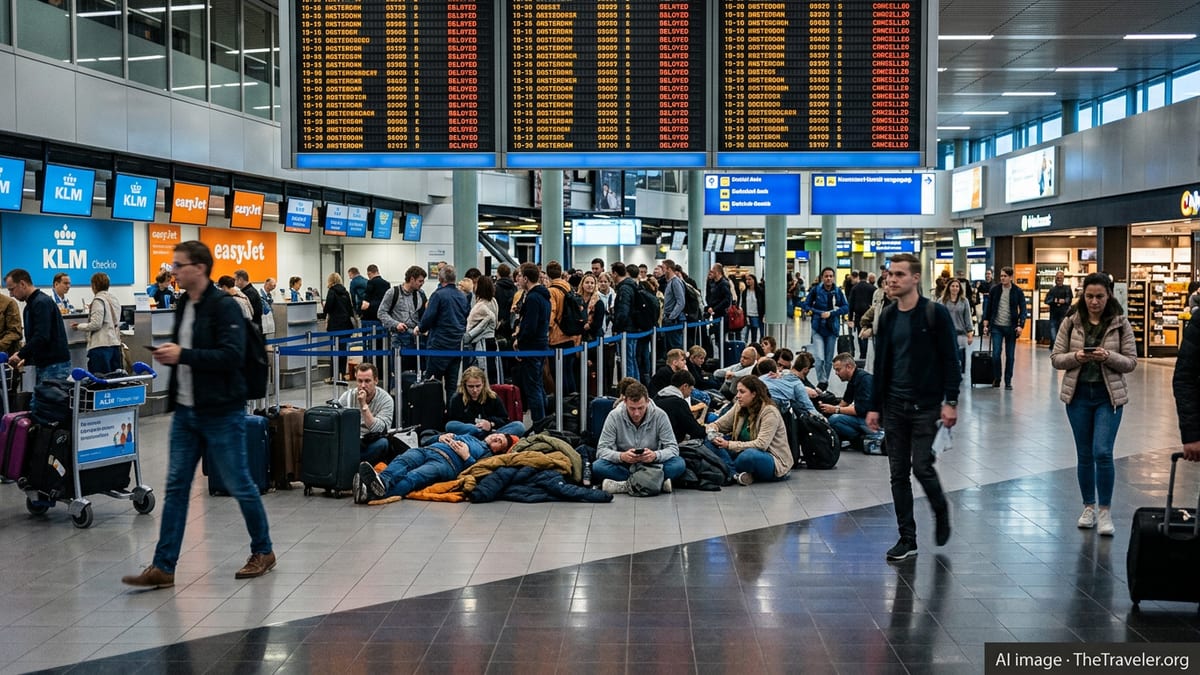
Amsterdam, Zurich and Other Hubs Buckle Under Strain
Operational data from airport boards and flight-tracking services show that disruption has been concentrated at large transfer hubs, including Amsterdam Schiphol and Zurich, with knock-on effects at airports in France and Germany. The pattern mirrors earlier episodes in April when severe weather around London Heathrow triggered more than 1,400 delays and about 150 cancellations across the continent, rippling into Amsterdam, Frankfurt, Munich and Paris Charles de Gaulle.
Amsterdam Schiphol continues to be one of the most exposed airports, as airlines use it as a gateway for both transatlantic and intra European connections. When arrival flows are restricted by weather, air traffic control constraints or aircraft availability, even short delays can cascade quickly, stranding passengers who miss tightly timed connections. Recent experiences shared by travellers indicate that some have waited days for rebooking when entire waves of departures are thinned out.
Zurich has also seen heightened disruption as part of wider schedule reductions by Lufthansa Group carriers and their partners. The Swiss hub is handling increased rerouting traffic at the same time as Lufthansa is trimming regional capacity, which reduces the number of alternative options available to passengers whose original flights are delayed or cancelled.
With spring storms and low cloud still affecting Western Europe, aviation analysts caution that weather related flow restrictions can quickly combine with infrastructure and staffing constraints to push delays into the four to six hour range, particularly at slot constrained hubs like Amsterdam and Paris.
Jet Fuel Crisis Drives Structural Cancellations
Beyond day to day operational issues, a structural squeeze on jet fuel supplies is reshaping airline schedules across Europe. Industry reports describe a regional jet fuel crisis triggered by the conflict in Iran, with the International Energy Agency warning in April that stocks could become critical within weeks if Middle East shipments remain disrupted.
In response, Lufthansa has announced cuts of about 20,000 short haul flights through October 2026 across its European hubs, including Frankfurt, Munich, Zurich, Vienna and Brussels. Publicly available information on these reductions indicates that low demand point to point routes are being removed from timetables so that remaining fuel can be focused on denser trunk routes. This strategy means fewer daily frequencies and less slack in the system when irregular operations occur.
Dutch carrier KLM has already cancelled at least 160 flights for the coming months as part of a broader effort to manage fuel exposure and operational resilience. These cancellations are heavily focused on intra European sectors to and from Amsterdam, affecting popular business and leisure routes and contributing to the tally of travellers stranded when alternate departures fill up quickly.
Travel industry briefings note that other European airlines, including budget operators, are also trimming capacity or selectively closing bases in response to higher costs, creating a tighter market in which last minute rebooking is often difficult or expensive. For passengers caught up in today’s disruptions, the underlying capacity squeeze means fewer spare seats are available, especially at peak times.
KLM, Lufthansa, Ryanair and Others Under Pressure
The brunt of the current disruption has been borne by Europe’s largest airline groups. Lufthansa and KLM, as network carriers, are particularly exposed because many of their customers rely on connections through a single hub; when a feeder leg is delayed, entire long haul journeys can be thrown into disarray.
Over recent weeks, Lufthansa’s operations have also been unsettled by a series of labour disputes involving pilots and cabin crews, which at times have brought large parts of the group’s network close to a standstill. Even though industrial action has paused for now, the residual effect on crew positioning, aircraft rotations and timetable stability continues to be felt when fresh weather or fuel related constraints appear.
KLM, for its part, has faced criticism from passengers over communication and rebooking speeds during mass disruptions at Amsterdam. Public posts and consumer forums describe situations in which travellers learned of cancellations only hours before departure and were offered alternative flights several days later, forcing them to arrange their own accommodation or seek rail and coach options.
Low cost carrier Ryanair is dealing with a different set of pressures. The airline has announced the closure of at least one European base and the cancellation of multiple routes in response to rising airport taxes and user charges in markets such as Germany and Spain. While these decisions are commercially driven and planned in advance, they intersect with the wider disruption by reducing point to point options that might otherwise absorb stranded passengers from full service airlines.
Weather, Strikes and Capacity Cuts Combine
The scale of the latest disruption, with 1,539 delays and 148 cancellations recorded across a short window, reflects the way multiple stress factors have converged on Europe’s air travel system this year. Severe weather episodes in April and early May triggered days of reduced runway capacity, forcing airports to slow arrivals and departures. These cuts were then amplified by lingering staffing limitations in air traffic control and ground handling.
At the same time, major airlines entered the spring season with less operational slack due to structural schedule cuts linked to fuel costs and previous industrial disputes. Once weather forced a wave of tactical cancellations, there were simply fewer spare aircraft and crews on standby to operate recovery flights. The result has been a pattern of rolling disruption that leaves some passengers stranded overnight when onward connections cannot be protected.
Labour unrest earlier in the year has also left a mark. Series of strikes among Lufthansa cockpit and cabin crews in February and April led to large numbers of cancellations over multiple days. This history has encouraged airlines to build extra buffers into rosters, but it has also constrained their willingness to add ad hoc flights when demand spikes, especially while fuel prices remain elevated.
Aviation observers note that even when no single factor is extreme, the combination of modest weather issues, high fuel prices, congested hubs and ongoing labour negotiations can produce a fragile network in which minor disturbances escalate quickly. The current situation across the Netherlands, France, Germany and neighbouring countries is viewed as a clear example of this dynamic.
What Today’s Chaos Means for Travellers
For those already on the move, the immediate impact is visible on terminal floors and in hotel lobbies across affected cities. Travellers left without seats on the day’s final departures from hubs such as Amsterdam and Zurich have reported being rebooked days later, with some resorting to long distance rail journeys to reach Germany, France or beyond.
Passenger rights advocates stress that European regulations require airlines to provide care, including meals and accommodation, during long delays and to offer rebooking or refunds when flights are cancelled. Recent guidance from European institutions has also reiterated that higher fuel prices alone do not count as an extraordinary circumstance, meaning that many fuel driven cancellations remain eligible for compensation where other criteria are met.
Travel management firms advise that passengers monitor their bookings closely, as schedule changes are now common in the days leading up to departure. Checking airline apps, signing up for text alerts and reconfirming key connections through hubs such as Amsterdam, Frankfurt, Paris and Zurich are widely recommended steps as the jet fuel situation evolves.
With summer approaching and demand for European travel expected to rise, analysts warn that similar episodes of widespread delay and cancellation may recur, particularly if fuel supplies tighten further or new rounds of industrial action emerge. For now, the disruption that has stranded hundreds of travellers serves as an early test of how resilient Europe’s air transport system will be in the months ahead.