


Few ancient sites are as easy to reach on a tight schedule as Ephesus from Kusadasi. Whether you are stepping off a cruise ship for a short port day or waking up in a hotel along the Aegean coast, the ruins lie only about 19 to 20 kilometers away, a drive of roughly 25 minutes on good roads. The challenge is not getting there, but choosing the right way to do it. This guide walks through every major option, with concrete examples of costs, routes, timing strategies and crowd avoidance so you can shape the perfect day trip for your style and budget.
Get the latest updates straight to your inbox!
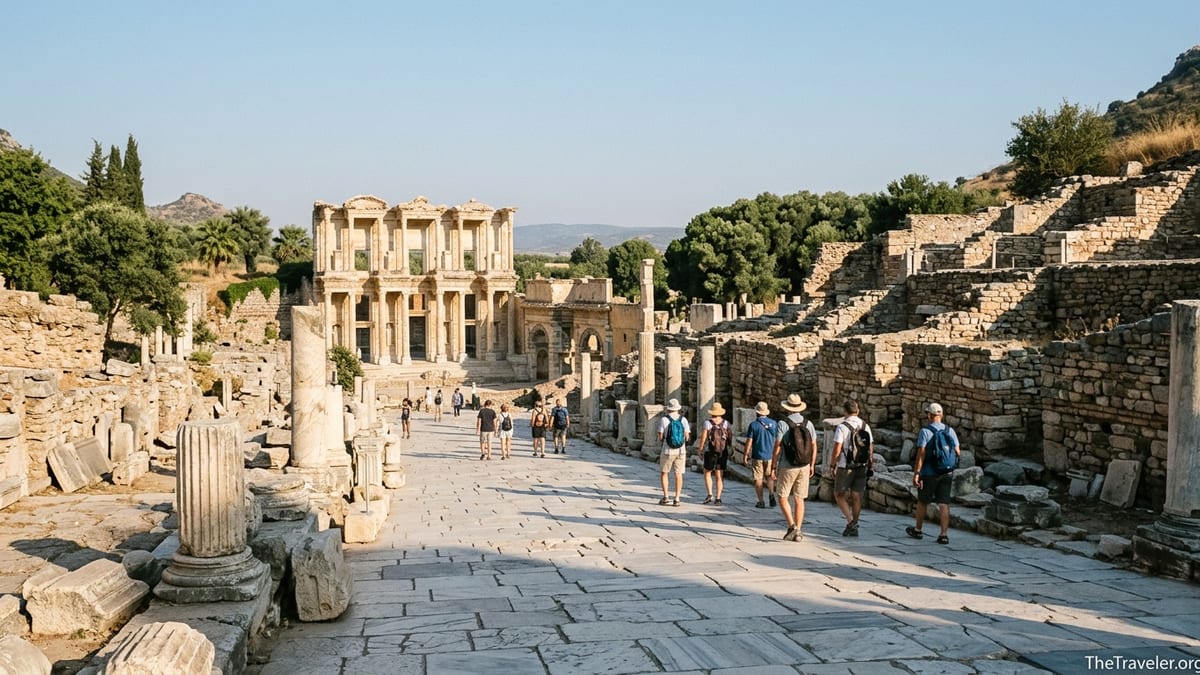
Understanding the Route from Kusadasi to Ephesus
Ephesus sits inland near the town of Selçuk, while Kusadasi spreads along the coast as a resort town and major cruise port. The distance from Kusadasi cruise port to the main Ephesus entrance is usually given as between 18 and 20 kilometers, and in normal traffic it is around a 20 to 30 minute drive each way. The road climbs gently out of Kusadasi, passes low hills and orchards, and then skirts the edge of Selçuk before turning toward the archaeological site.
Cruise visitors dock at Ege Ports, which sits right on the edge of Kusadasi’s compact center. From the terminal exit you can be in the main taxi rank in a couple of minutes on foot. Hotel guests are usually staying along the waterfront, in the Ladies Beach area, or at larger resorts a short taxi or dolmuş ride away. In all cases, you will first reach the ring road around town and then follow signs toward Selçuk and Ephesus.
There are two main gates at Ephesus: the upper gate near the Magnesian Gate and the lower gate near the old harbor street and the coach park. Many organized tours start at the upper gate and walk downhill through the site to the lower gate, where their bus meets them. Independent visitors arriving by taxi or dolmuş can start from either gate, but starting upstairs gives you an easier downhill walk and slightly better crowd flow at the beginning of the day.
Because the distance is short and the road is straightforward, almost every transport mode works in practice: cruise line excursions on big buses, prebooked private tours, yellow taxis, local dolmuş minibuses, or a combination of dolmuş and walking from Selçuk. The key differences are price, comfort, how much time you spend waiting, and how much stress you feel about getting back to your ship or hotel on time.
Cruise Excursions vs Independent Trips
If you are visiting Ephesus on a cruise itinerary, the first big decision is whether to book the ship’s own excursion or to organize something yourself. Cruise line tours from Kusadasi to Ephesus are usually the most expensive way to visit, with prices that commonly fall in the approximate range of 85 to 135 euros per person for a standard half‑day Ephesus tour that includes bus transport, a guide and entrance tickets. Some premium options that add the Terrace Houses, House of the Virgin Mary, or a lunch can cost more.
What you are paying for is not only the seat on the bus and the guide, but also the cruise company’s guarantee that if their tour runs late, the ship will wait. For many travelers, that peace of mind is invaluable, especially when Kusadasi is a short stop on a long itinerary. A common pattern on large ships is to see long lines of coaches parked at the port early in the morning, loading passengers for a tightly timed program that visits Ephesus, a carpet or leather factory, and possibly the House of the Virgin Mary before returning everyone to the ship with an hour or two to spare.
Independent options are almost always cheaper and more flexible. For example, a couple stepping off the ship might choose a private driver for around 120 to 150 euros total for the day, which works out to less per person than a ship tour if they share with another couple. Some visitors simply walk through the port gates, find a yellow taxi, and negotiate a fixed round‑trip price with waiting time included. Others prefer the ultra‑budget dolmuş route, spending only a few euros each on public minibuses and then walking from the road down to the site.
The trade‑off is risk and responsibility. When you plan your own trip, you must keep an eye on the clock, allow generous buffers for traffic back into Kusadasi, and avoid over‑ambitious add‑ons if your ship leaves mid‑afternoon. On a day when three or four big ships are in port and the road is full of buses, even seasoned travelers should build in an extra 30 to 45 minutes on the return leg to avoid last‑minute panic.
Taxi and Private Tour Options: Comfort & Control
For many cruise and hotel guests, a taxi or private tour from Kusadasi to Ephesus hits the sweet spot between comfort, cost and flexibility. From the cruise port taxi rank, a straightforward round‑trip taxi to Ephesus with waiting time often falls in an approximate bracket of 60 to 120 euros total, depending on season, demand and negotiation. Prices closer to the lower end are more likely if you are visiting in shoulder season or are willing to share the car with another couple you meet on board. During peak summer days with several large ships in port, drivers may ask toward the higher end.
In practice, a common informal arrangement looks like this. You agree on a price at the taxi rank for a round trip with three to four hours of waiting time. The driver takes you directly from the port to the upper Ephesus gate, drops you near the ticket booths, and waits at the lower gate car park. You walk downhill through the site at your own pace, add the Terrace Houses if you wish, and then meet the same driver at the lower gate to return to Kusadasi. If you want to add quick stops at the Temple of Artemis or the viewpoint near Selçuk, you negotiate that at the beginning.
Prebooked private tours and transfers work similarly but usually include a licensed guide and entrance tickets. Many local agencies based in Kusadasi and Selçuk offer a “Private Ephesus from Kusadasi Port” package where a driver and guide meet you as you exit the terminal with a sign in hand. Prices can vary widely, but as an example, a small‑group private tour for four people that includes transport, guide, site entry and Terrace Houses might fall in the rough range of 80 to 130 euros per person, with lower per‑person cost if your group is larger.
Private arrangements have two significant advantages over taxis alone. First, your guide walks with you through the site instead of dropping you at the gate, helping you time your route to stay ahead of the biggest tour groups. Second, you can customize the day: some guests prioritize a long, quiet wander through the streets of Ephesus and a short coffee in Selçuk’s old town; others ask to add the Basilica of St John and the hilltop House of the Virgin Mary, accepting that this leaves less time inside the main ruins.
Dolmuş and Selçuk Connections for Budget Travelers
If you are staying in a hotel in Kusadasi or you are a confident, budget‑minded cruise passenger, the dolmuş system offers a very cheap and authentic way to reach Ephesus. Dolmuş are shared minibuses that run fixed routes but leave as they fill. From central Kusadasi, minibuses toward Selçuk run throughout the day, especially in the main season from spring through autumn. Typical travel time from Kusadasi town center to the Ephesus turn‑off is about 30 minutes, give or take, depending on how many stops the minibus makes on the way.
You will usually first take a local dolmuş from your hotel area to the main minibus hub on Candan Tarhan Boulevard. From there, you board another dolmuş marked for Selçuk. Ask the driver to drop you at the Ephesus turn‑off rather than in the town center. The stop is on the main road above the site, and from there it is a short downhill walk of roughly 10 to 15 minutes to the lower gate ticket booths. It is useful to carry a map screenshot or an offline map on your phone for this short walk, although there are usually signs and other visitors heading the same way.
Fares are modest. Recent reports suggest that the Kusadasi to Ephesus or Selçuk dolmuş trip costs the local equivalent of just a few euros per person each way, with prices updated regularly to reflect fuel costs and inflation. You usually pay the driver in cash in Turkish lira when boarding or as you disembark. Because routes and fare structures can change, it is wise to ask your hotel reception or a local tourism office for the latest information the evening before you travel.
For hotel guests planning a low‑cost full day, one practical pattern is to take a morning dolmuş to Ephesus, explore the site for three to four hours, then hop a second dolmuş from the main road down to Selçuk after your visit. You can spend a couple of hours at the Ephesus Archaeological Museum and the Basilica of St John, have a late lunch in one of the small restaurants around Selçuk’s square, and then return to Kusadasi on an afternoon dolmuş. This DIY combination gives you a deeper sense of place at minimal cost, though it is more suitable for those not under cruise‑ship time pressure.
Opening Hours, Tickets, Terrace Houses & Crowds
Ephesus is open daily, with longer hours in the main season. Exact times can shift slightly year to year, but a common pattern sees the gates opening around 8:00 in the morning and closing in the early evening, with last entry time set at least an hour before closing. The attached Terrace Houses complex inside the site, famous for its mosaics and frescoes, typically follows similar hours but sometimes has an earlier last entry. Before your trip, it is worth checking the current schedule for the specific month you are visiting, especially if you are traveling early in spring or late in autumn.
Ticketing for Ephesus and the Terrace Houses is usually handled separately. A standard entrance ticket admits you to the main archaeological site, including the theatre, Curetes Street, the Library of Celsus facade and the old harbor street. The Terrace Houses require an additional ticket purchased at a booth just outside their entrance near the middle of the site. For many visitors, especially those who have come all the way from Kusadasi by cruise or road, this extra cost is worth it: inside you walk on raised glass platforms through a series of excavated Roman homes with remarkably preserved floor mosaics and painted walls.
Crowd patterns are predictable. The main surge arrives mid‑morning, when fleets of cruise buses and large group tours tend to reach the site around 9:30 to 10:30. On days with several ships in port, these waves can be intense, especially around the Library of Celsus and the Marble Road leading down to the theatre. If you value quieter conditions, the two best windows are right at opening time and again in the late afternoon, typically after 3:30 or 4:00, when the largest groups have begun to leave for Kusadasi.
A practical strategy for both cruise and hotel visitors is to start at the upper gate at opening time, walk down through the site, and aim to reach the Terrace Houses before the densest mid‑morning crowd assembles. If you cannot arrive early, consider reversing the usual loop: many big groups head directly to the Library of Celsus first, so spending your first hour among the upper‑level streets and the Varius Baths can buy you a bit of breathing space. No matter when you go, bring water, wear a hat and sunscreen, and be prepared for uneven stone underfoot; even in spring and autumn, the sun on the exposed marble can feel intense by late morning.
Is a Guide Worth It at Ephesus?
Even for independent travelers, a good guide can transform Ephesus from an impressive pile of ruins into a vivid city with stories, voices and context. At first glance, the site is self‑explanatory: you can wander down the main streets, read the interpretive panels and admire the big monuments without help. Many cruise passengers who prefer flexibility simply hire a taxi, buy their own ticket, and explore on their own with a printed map or a downloaded audio guide.
The missing layer in a self‑guided visit is narrative. Without someone to connect the dots, it can be hard to imagine where the Roman elites lived, how the public baths functioned, or why the Library of Celsus was designed as it is. A licensed local guide can point out small details you might overlook, such as carved game boards scratched into marble paving stones, faint graffiti that marks early Christian presence, or the remains of street fountains that once cooled the crowds.
For many visitors, the most compelling arguments for a guide are time efficiency and crowd navigation. On busy cruise days, a guide who knows the typical bus schedules can adjust your route to keep you slightly offset from the largest groups. For example, if they see ten buses unloading at the upper gate, they might start your visit at the lower end of the site and work uphill to avoid bottlenecks. They will also make sure you see the highlights and the Terrace Houses in a logical order that fits your time frame, which is especially valuable if you have only three or four hours before you must be back in Kusadasi.
If your budget allows, a middle‑ground approach is to hire a guide only for the first two hours of your visit. Some agencies and freelance guides based in Selçuk offer short private guiding sessions that begin at the gate. After the guided portion, you can continue wandering on your own, revisiting your favorite corners or spending longer among the Terrace Houses. This hybrid model keeps costs below a full‑day private tour while still giving you the benefits of expert interpretation and a well‑planned route.
Hotel‑Based Visitors: Full‑Day Itineraries from Kusadasi
Travelers staying in Kusadasi hotels rather than visiting on a cruise have more flexibility with timing and can craft a richer full‑day itinerary that goes beyond a quick out‑and‑back to the ruins. A straightforward plan for a first‑time visitor is to leave Kusadasi soon after breakfast, arrive at Ephesus close to opening time, and spend three to four hours exploring the main site and Terrace Houses. You can then continue on to nearby sights or spend the afternoon in Selçuk before returning to the coast for an evening stroll and dinner.
One popular combination for hotel guests is Ephesus plus the Ephesus Archaeological Museum and the Basilica of St John in Selçuk. After finishing at the ruins, you can ask your taxi or driver to take you into Selçuk town, or you can catch a short dolmuş ride from the main road. The museum is compact but dense, housing many of the original statues, reliefs and household objects removed from the site, while the hillside basilica offers fine views over the plain. A simple lunch in a café near Selçuk’s main square, followed by a wander through its backstreets, gives a different, slower rhythm to the day than the cruise‑ship tempo.
Those with a full day and a private car or driver sometimes add the House of the Virgin Mary, a small Catholic and Orthodox pilgrimage site located in the hills above Ephesus. Reaching it requires a winding drive up from the main road and an additional entry fee, so it is best suited to visitors particularly interested in religious history. Others opt instead for a swim and sunset back in Kusadasi, perhaps at Ladies Beach or one of the quieter coves south of town, making use of the cooler evening hours after a hot visit among the ruins.
Whichever combination you choose, build in rest. Ephesus involves a lot of walking on stone, and in summer temperatures the midday heat can be draining. Hotel guests have the advantage of being able to retreat to air‑conditioned comfort and return to town restaurants at their leisure, so it is worth planning a slower morning inside the site and a more relaxed cultural or seaside program later in the day.
The Takeaway
Reaching Ephesus from Kusadasi is simple; the real decision is how you want your day to feel. Cruise excursions offer maximum security and minimal planning at a higher per‑person price. Taxis and private tours provide comfort and flexibility, often at good value for couples or small groups. Dolmuş minibuses and Selçuk connections make sense for budget‑conscious travelers and hotel guests with more time than money or for those who enjoy navigating local systems.
For most first‑time cruise passengers with only a few hours in port and a strong desire not to miss their ship, a guided excursion or a reputable private tour from the cruise port is the safest and least stressful choice. For independent travelers staying in Kusadasi, the balance tips toward either a taxi plus self‑guided visit or a combination of dolmuş, Ephesus and an unhurried afternoon in Selçuk. In all cases, arriving as early as possible, including the Terrace Houses if your budget allows, and considering at least a short guided component will deepen your experience of one of the finest ancient cities in the Mediterranean.
FAQ
Q1. How long do I need for a day trip from Kusadasi to Ephesus?
Most visitors should plan on at least four to five hours total from Kusadasi, including travel time and three hours inside the site. If you want to add the Terrace Houses and a quick visit to Selçuk or the Ephesus Archaeological Museum, a full day of six to eight hours is more comfortable.
Q2. What does a taxi from Kusadasi to Ephesus typically cost?
Prices vary with season and demand, but a common ballpark for a round trip taxi with a few hours of waiting time is between 60 and 120 euros total per car. Always confirm whether the agreed price includes both directions and waiting before you get in.
Q3. Is the dolmuş safe and practical for cruise passengers?
The dolmuş system is widely used by locals and is generally safe and reliable, but it is less predictable than a taxi or tour. Because departure times can be flexible and buses make many stops, dolmuş is better suited to hotel guests or cruise passengers with very long port calls who are comfortable managing their own timing and walking from the main road down to the site.
Q4. Can I walk from Selçuk to Ephesus?
Yes, it is possible to walk from Selçuk to Ephesus, and some travelers enjoy the roughly three kilometer route. However, the walk is partly along roads without continuous shade, which can be tiring in hot weather. Most visitors choose a short taxi or dolmuş ride from Selçuk to the Ephesus entrance instead.
Q5. Do I need to buy Terrace Houses tickets in advance?
In most cases you can buy Terrace Houses tickets on the spot at the separate booth inside Ephesus. Advance purchase is not usually essential, although very busy days can see short queues at the booth. If you are on a guided tour, your guide will normally handle the purchase for the group as you arrive.
Q6. Are guided tours inside Ephesus available at the gate?
Yes, licensed guides often wait near the entrances and may approach you offering their services. You can negotiate a private guiding session on the spot, with prices that vary by length and group size. For a more predictable experience, many travelers prefer to book a guide through an agency or their hotel in advance.
Q7. What is the best time of day to visit Ephesus to avoid crowds?
The quietest and most pleasant times are usually right at opening in the morning and again in the late afternoon. Mid‑morning, from about 9:30 to 11:30, tends to be busiest when cruise buses and large tours arrive. Planning to be at the gate at opening time is the single most effective way to beat the crowds and the heat.
Q8. Is Ephesus suitable for travelers with limited mobility?
Ephesus presents challenges for visitors with limited mobility because many paths are uneven, sloping and paved with ancient stone. There are some flatter stretches and resting points, and it is possible to focus on the lower areas near the theatre and Library of Celsus, but wheelchairs and walking aids can be difficult to maneuver. If mobility is a concern, consider a private tour that can adapt the route and pacing to your needs.
Q9. What should I wear and bring for a summer visit to Ephesus?
In summer, light breathable clothing, a wide‑brimmed hat, comfortable walking shoes with good grip, and high‑SPF sunscreen are essential. Carry a refillable water bottle and consider a small umbrella or sunshade, as shade inside the site is limited. Even outside the peak months, the stone surfaces can reflect heat, so sun protection is important.
Q10. Can I combine Ephesus with a beach visit in one day from Kusadasi?
Yes, many travelers combine a half‑day at Ephesus with a few hours at the beach back in Kusadasi. A practical plan is to visit the ruins in the morning, return to town by early afternoon, have a late lunch near the waterfront and then spend the rest of the day swimming or relaxing at Ladies Beach or another nearby stretch of coast.