

More news on this day
Hundreds of passengers were left stranded at Kuwait International Airport this week after scores of flights were abruptly canceled amid ongoing regional airspace closures, disrupting key routes linking Kuwait City with Dubai, Cairo, Riyadh, Mumbai and other major hubs.
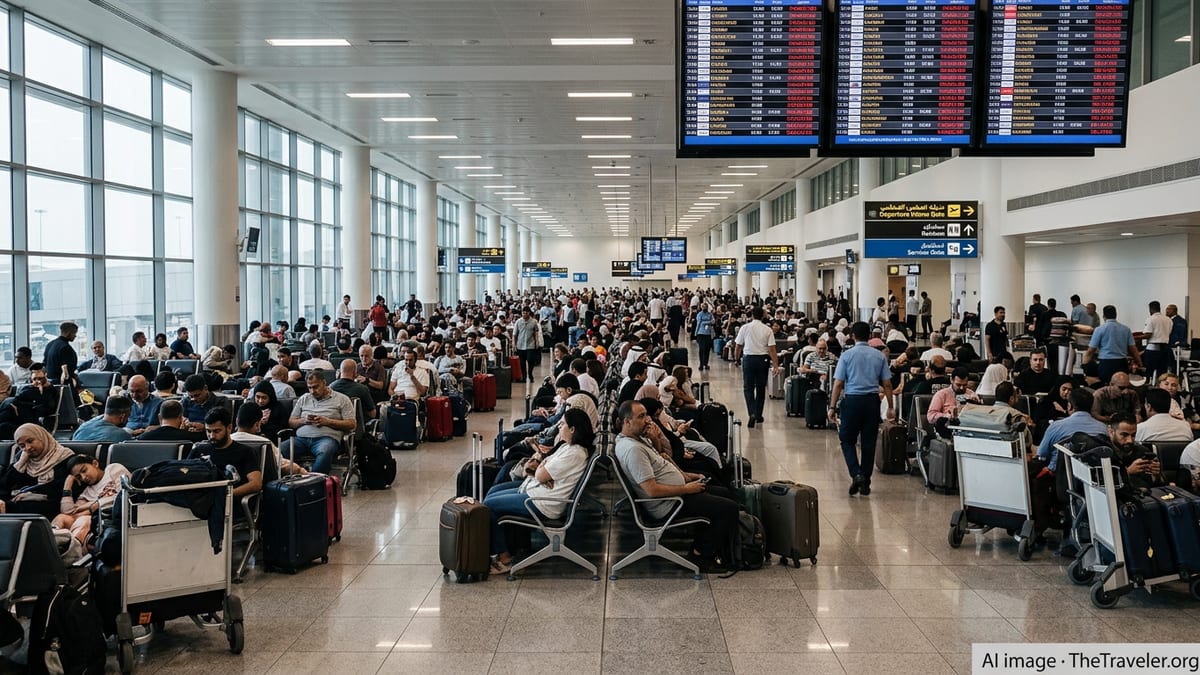
Sharp Wave of Cancellations Hits Kuwait City Hub
Operational data from Kuwait International Airport indicate that more than 60 departures and arrivals were scrubbed in a single day, creating a sudden bottleneck for travelers attempting to transit through the Gulf. Airlines affected include leading regional and international carriers such as Saudia, Qatar Airways, FlyDubai and Emirates, alongside other operators serving Kuwait’s primary gateway.
Flight tracking snapshots show Kuwait International, normally a busy connector between the Gulf, the wider Middle East, South Asia and Europe, operating at a fraction of its usual schedule as cancellations replaced routine departures. While some airlines initially posted delays, a large number of those services were later updated to canceled, leaving aircraft on stands and passengers stuck in terminals with limited onward options.
Airport officials have offered only limited forward guidance, citing the fluid security picture in the region and the knock-on effects of earlier airspace shutdowns across several Gulf states. Passengers scheduled to travel in the coming days are being urged to monitor airline notices closely and avoid heading to the airport until they have confirmed flight status and rebooking arrangements.
Regional Airspace Closures Ripple Across Global Networks
The disruption in Kuwait is part of a broader aviation shockwave triggered by the temporary closure or restriction of airspace over parts of the Gulf and surrounding states following a sharp escalation in regional tensions at the end of February. With Kuwait, the United Arab Emirates, Qatar, Bahrain and portions of neighboring countries tightening or suspending civilian overflights, long-haul routes that typically rely on these hubs have been forced into large-scale cancellations or diversions.
Global aviation data providers report thousands of cancellations across major Gulf airports in recent days, with Kuwait listed among the hubs experiencing some of the most complete shutdowns of outbound traffic. While selective services have begun to resume from airports such as Dubai and Riyadh under reduced schedules, Kuwait continues to face a high cancellation ratio, leaving relatively few options for travelers attempting to reroute.
Because Kuwait City sits on important corridors linking Europe and North America to destinations in India, Pakistan and Southeast Asia, the impact extends well beyond the immediate region. It has disrupted complex multi-leg itineraries, leaving passengers stranded not only in Kuwait but also in cities as far afield as Mumbai and Cairo, where onward Kuwait-bound services have been withdrawn or suspended pending clearer guidance from aviation authorities.
Stranded Travellers Face Uncertainty and Limited Support
Inside Kuwait International Airport, stranded passengers have described long waits at service desks, repeatedly changing departure times on information screens and uncertainty about accommodation and visa arrangements. With airlines citing force majeure due to the security-driven nature of the disruption, many customers are discovering that usual compensation rules do not apply, even as they shoulder extra costs for hotels and meals.
Travellers en route from Asia to Europe who were due to connect through Kuwait have been particularly hard hit. Some report being held airside in transit zones for extended periods while airlines attempt to secure scarce seats on alternative routings through open hubs such as Istanbul or Cairo. Others have been told that rebooking may take several days, given limited aircraft and crew availability and the need to prioritize passengers already stuck in the region.
Local travel agents say they have been inundated with calls from residents of Kuwait who are abroad and suddenly unable to return, as well as from families trying to bring relatives home from affected cities including Dubai, Riyadh and Mumbai. Many are being advised to wait for formal airline communications rather than cancel itineraries themselves, as voluntary cancellations can complicate refund and reissue rights.
Major Gulf and International Carriers Scramble to Adjust
For the airlines, the sudden closure of key airspace corridors has forced a complex operational recalibration. Gulf giants such as Emirates and Qatar Airways have introduced limited repatriation services from select airports and are rebuilding truncated schedules as conditions permit, but a full restoration of normal operations across the region remains distant. Kuwait’s own network is further constrained by the tight restrictions on departures from its main airport.
Carriers like Saudia, FlyDubai and regional codeshare partners are rerouting some flights around restricted zones, but such detours are only practical on a small subset of routes due to fuel, crew duty time and aircraft availability constraints. On many Kuwait-linked sectors, especially shorter regional flights to cities such as Riyadh, Dammam, Jeddah and Dubai, airlines have opted to cancel outright until safer, more predictable routings can be guaranteed.
Industry analysts note that Kuwait International, while smaller than Dubai or Doha, is an important spoke in the Gulf’s interconnected hub system. When cancellations stack up at one airport, it reduces network flexibility elsewhere, undermining the ability of major carriers to reposition aircraft or free up capacity from other markets to clear backlogs. That interdependency helps explain why passengers in faraway destinations like Cairo or Mumbai are feeling the effects of decisions taken over Kuwait’s skies.
Advice for Passengers With Upcoming Kuwait Travel
With no clear timeline yet for the full normalization of traffic at Kuwait International Airport, travel experts are urging passengers with flights touching Kuwait in the coming days to adopt a cautious, information-led approach. The strongest guidance is to avoid making unilateral changes or cancellations before airlines have updated schedules and waiver policies, as this can jeopardize eligibility for free rebooking or refunds.
Passengers already ticketed on Saudia, Qatar Airways, FlyDubai, Emirates and other affected carriers are being advised to rely on official airline apps, email notifications and customer service channels for real-time status updates, rather than solely on third-party travel platforms. Many airlines are rolling out flexible change policies, including the option to reroute through alternative hubs or postpone trips at no extra fare, but availability is limited and typically prioritized for those already stranded.
Those currently in Kuwait City and needing to travel urgently are encouraged to stay in close contact with both their airline and, where relevant, their embassy or consulate. Diplomatic missions in multiple countries have begun coordinating with carriers to organize ad hoc evacuation or repatriation flights out of functioning hubs, a process that is expected to continue as long as airspace restrictions remain in place and Kuwait’s regular commercial schedule is heavily curtailed.