

More news on this day
Operations at New York’s LaGuardia Airport faced fresh disruption after a surface “depression” detected during an airfield inspection prompted the temporary shutdown of Runway 4/22, one of the hub’s two primary landing and departure strips.
Get the latest news straight to your inbox!
Inspection finding triggers swift runway closure
Publicly available aviation notices and local media coverage indicate that the irregularity in the pavement was identified during a scheduled inspection of LaGuardia’s airfield. The depression was reported in the vicinity of Runway 4/22, a key artery for both arrivals and departures at the compact Queens airport. As a precaution, authorities removed the runway from service while engineers examined the affected area.
Initial characterizations described the defect as a depression adjacent to the runway surface rather than a wide, gaping sinkhole cutting through the entire strip. Even so, the finding was considered significant enough to halt operations on 4/22, reflecting how major airports increasingly favor conservative decisions when any irregularity appears on or near active pavement used for takeoffs and landings.
The closure added to an already challenging operating environment at LaGuardia, where routine maintenance, long-running construction projects and previous pavement issues have periodically forced traffic restrictions. With only two intersecting runways, LaGuardia has far less flexibility than larger multi-runway hubs when one strip goes offline.
Aviation tracking data and delay reports showed that traffic was quickly funneled to the remaining runway, limiting capacity and contributing to delays across the domestic network. Airlines adjusted by consolidating flights, retiming departures and, in some cases, temporarily rerouting aircraft to other New York-area airports.
From sinkhole scare to depression repair
The latest disruption comes only weeks after a separate incident in which a sinkhole near Runway 4/22 triggered a more extensive closure and inspection regime. In that earlier case, coverage from regional television outlets reported that a void discovered near the runway led to hours of delays and a ground delay program, before repairs were completed and the runway returned to service following broader inspections.
By comparison, current reports describe the new problem as a localized depression rather than a deep cavity in the underlying soil. Infrastructure specialists note that while the terms “sinkhole” and “depression” are often used interchangeably in early reports, they can represent very different engineering challenges. A shallow settlement or localized subsidence can sometimes be corrected by milling and repaving sections of asphalt, whereas a true sinkhole may require deeper excavation and structural work.
LaGuardia’s location on reclaimed waterfront and former marshland has long been cited as a factor that makes its pavement and subsurface structures more vulnerable to water intrusion and gradual settlement. Commenters in the aviation community and regional observers frequently point to the airport’s geology when new pavement anomalies emerge, particularly around the heavily used intersection of Runways 4/22 and 13/31.
Recent federal construction impact reports also show that LaGuardia has been undergoing phased runway rehabilitation work, including interim pavement projects and alternating closures of its two runways. Those projects, aimed at improving the keel sections and drainage, underline how much of the airport’s core infrastructure is being rebuilt while it continues to handle tens of millions of passengers each year.
Safety protocols and ripple effects for travelers
According to publicly available aviation documentation, modern runway inspections are designed to catch even small changes in pavement condition before they pose a hazard to aircraft. Depressions, cracks and soft spots may seem minor, but they can affect how water drains from the runway, alter braking performance and, in extreme cases, contribute to structural damage on airframes and landing gear.
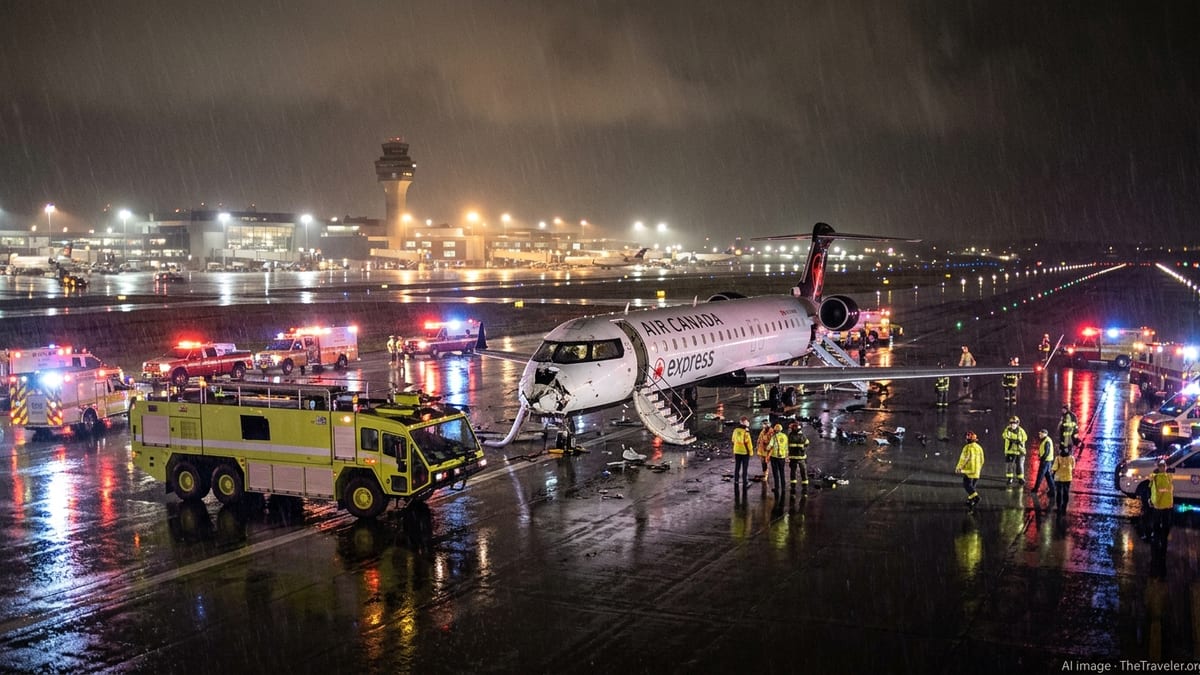
In recent months LaGuardia has already been under heightened scrutiny after a fatal collision in March involving an arriving regional jet and a fire truck on one of its runways. Preliminary findings from federal investigators, summarized in several published accounts, pointed to a combination of technology issues and communication lapses that allowed an emergency vehicle to cross an active runway just seconds before the aircraft landed. Against that backdrop, any new irregularity on the runway surface is likely to be treated with particular caution.
For travelers, the most immediate impact of the 4/22 closure has been schedule disruption. Capacity constraints at LaGuardia mean that taking one runway out of service, even for a short period, quickly triggers arrival metering and departure delays. Passengers have been advised through airline alerts and airport updates to monitor their flight status closely and to expect longer ground times while the runway remains under evaluation or repair.
Some carriers have used larger aircraft on remaining slots to preserve seat capacity, while others have shifted a small number of flights to nearby Newark Liberty International and John F. Kennedy International airports. Travel advisors note that because LaGuardia operates under strict slot controls, the airport has limited ability to absorb irregular operations once a runway closure compresses the schedule.
Infrastructure challenges at a constrained urban airport
LaGuardia’s latest runway issue highlights the broader challenges of maintaining and upgrading a major airport built on constrained land in a dense urban setting. The airport has undergone a multibillion-dollar terminal transformation in recent years, earning industry awards for the passenger experience, even as its airfield layout remains largely defined by decisions made decades ago.
Runway 4/22 itself has been the focus of long-term rehabilitation plans. Environmental and planning documents from the regional airport operator and federal transportation agencies describe projects to strengthen pavement, improve drainage and modernize connecting taxiways. These works often require carefully choreographed closures, lane-like restrictions and night-time construction windows to preserve daytime operations.
Engineering specialists note that even with ongoing upgrades, legacy infrastructure and subsurface conditions can continue to produce localized problems such as depressions or soft spots, especially where utilities, fuel lines or historical fill materials lie beneath the pavement. Regular inspections, combined with rapid-response repair teams, are viewed as essential tools to keep those issues from escalating.
In the case of Runway 4/22, the ability of inspectors to spot a developing depression and trigger a closure is being interpreted by some in the aviation safety community as evidence that monitoring systems are working as intended. However, the recurring nature of pavement anomalies at or near the same runway is prompting renewed calls in industry commentary for more extensive, long-term ground stabilization efforts.
What travelers can expect in the days ahead
Based on previous incidents and current public information, runway closures linked to pavement depressions at LaGuardia have typically lasted from several hours to a few days, depending on the severity of the damage and the complexity of repairs. Engineers must first determine whether the problem is limited to the surface or indicates deeper subsurface instability.
If the depression is shallow and localized, crews may be able to mill away the affected asphalt, compact the base material and repave the segment relatively quickly. More serious subsidence, or evidence of water-related erosion beneath the runway, could necessitate more intrusive work and extend the closure window. Aviation advisories are expected to provide updated estimates as assessments progress.
For now, travelers using LaGuardia are likely to see longer taxi times, occasional gate holds and congestion at security and boarding areas as flights are rescheduled around the temporarily reduced runway capacity. Industry analysts say that while New York’s broader three-airport system offers some flexibility, LaGuardia’s role as a key short-haul and business-travel hub means even modest disruptions can ripple across multiple airlines’ networks.
As New York’s peak summer travel season approaches, the episode reinforces how fragile airport operations can be when critical infrastructure reaches capacity and must undergo constant repair. The situation at Runway 4/22 is emerging as another test of how well LaGuardia’s upgraded terminals and long-planned airfield projects can coexist with the day-to-day demands of one of the country’s busiest urban airports.