

More news on this day
New York’s LaGuardia Airport is contending with significant delays and cancellations after a sinkhole forced the closure of a key runway days before the Memorial Day travel rush.
Get the latest news straight to your inbox!
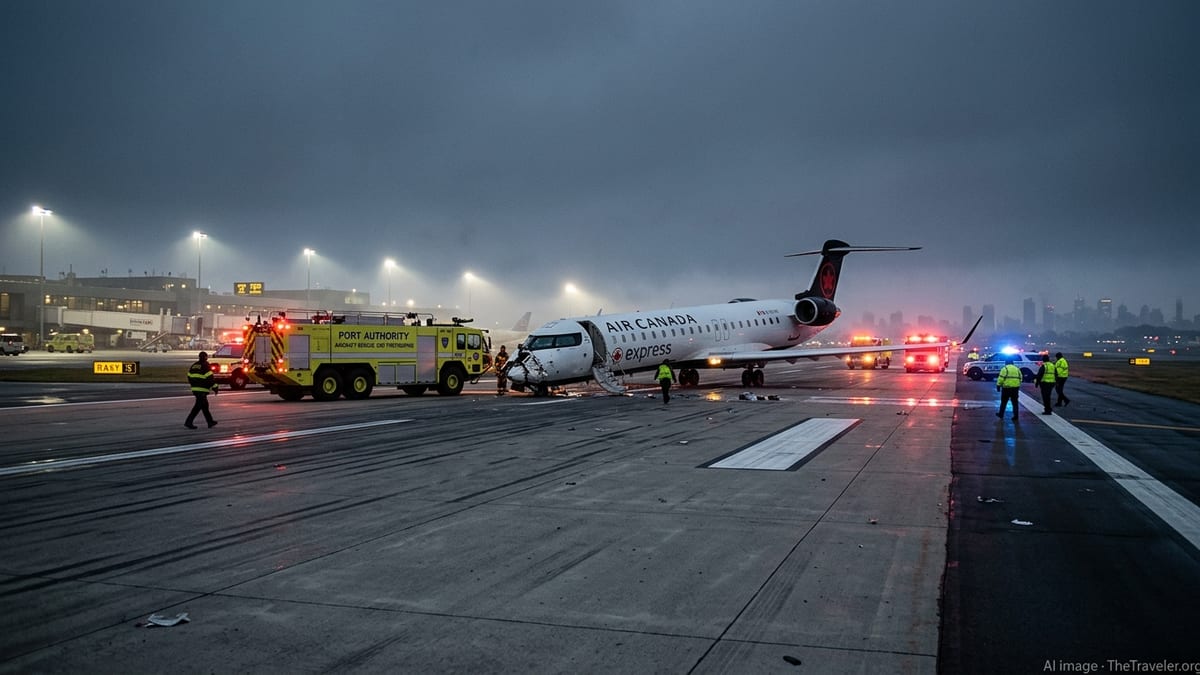
Runway 4/22 Shut After Sinkhole Discovery
The disruption began on Wednesday, May 20, when airfield inspection crews identified a sinkhole near Runway 4/22, one of LaGuardia’s two primary runways. Publicly available statements from the Port Authority of New York and New Jersey describe the closure as an immediate safety step while emergency construction and engineering teams assess the damage and stabilize the affected area.
Reports from outlets including Reuters, ABC News and local New York broadcasters indicate that Runway 4/22 has remained out of service as crews continue intensive repair work. Images shared in published coverage show excavators, trucks and floodlights clustered around the damaged section, along with temporary barriers that limit aircraft movements in the vicinity.
With Runway 4/22 offline, LaGuardia has been operating on a single runway configuration that sharply constrains the number of aircraft it can handle per hour. For an airport that typically relies on both runways to accommodate dense banks of short-haul flights, the loss of one strip has an immediate impact on schedules even in normal conditions.
As of Friday morning, May 22, publicly available updates still described the runway as closed while work continues. Some local coverage has pointed to a tentative target to restore operations by later in the day, but no fixed reopening time has been widely published, leaving airlines to plan around a potentially shifting repair timeline.
Delays, Cancellations and a Strain on Holiday Schedules
The timing of the closure is particularly difficult for travelers. Memorial Day weekend is traditionally one of the busiest travel periods of the year in the United States, and advance forecasts had already projected crowded terminals and tight departure banks across the New York region.
Data compiled from flight tracking services and summarized in travel-industry coverage show that hundreds of LaGuardia flights have been delayed or canceled since the sinkhole was discovered. Many disrupted flights involve major domestic hubs such as Chicago, Atlanta and Dallas, magnifying the effect as missed connections ripple across airline networks.
Ground delay programs and revised departure slots have been implemented to manage the reduced capacity, according to operational summaries shared by aviation tracking services. With fewer takeoff and landing slots available, carriers have tended to prioritize high-demand routes while trimming frequencies on others, leaving some travelers with limited same-day alternatives.
Passengers flying into or out of LaGuardia in the coming days are widely being advised, in airline and airport public messaging, to check their flight status repeatedly and allow additional time at the airport. Even flights that ultimately depart may face extended taxi times or airborne holding as controllers balance demand on the remaining runway with congestion in the wider New York airspace.
Repair Effort Intensifies as Crews Race the Clock
Published accounts describe a round-the-clock effort to repair the affected portion of pavement and investigate what caused the sinkhole to open beneath such a critical piece of infrastructure. The damaged area has been excavated so engineers can assess the subsurface, with heavy machinery visible around Runway 4/22 as crews work to remove unstable material and rebuild the support layers.
Airport operations summaries note that returning the runway to service involves more than filling a visible cavity. Teams must reconstruct the underlying base, repave the surface to meet strict aviation standards, and complete inspections and test operations before aircraft can safely use the strip again. Weather is an additional factor, as recent forecasts have called for thunderstorms that could complicate repair work and further strain the already tight holiday schedules.
LaGuardia has been undergoing stretches of construction and maintenance in recent years, including planned overnight closures and weekend runway work highlighted in Federal Aviation Administration construction outlook reports. Those projects were designed to be scheduled and predictable. The sinkhole, by contrast, is a sudden and unplanned event that has forced a rapid reshuffling of priorities as crews focus on stabilizing the ground under Runway 4/22.
While no significant injuries have been reported in connection with the sinkhole itself, the operational impact has been substantial. Travel reporting suggests that some airlines have issued flexible rebooking options or travel waivers to accommodate passengers who wish to avoid transiting LaGuardia during the disruption.
Regional Ripple Effects Across the Northeast
Reduced capacity at LaGuardia reverberates quickly across the Northeast corridor and beyond. The airport is a major domestic hub for flights into and out of New York City, and many short-haul routes are tightly scheduled with minimal buffer. When one of its two runways is unavailable, neighboring airports often see knock-on effects.
Tracking data and airline network updates indicate that some carriers are shifting select flights to John F. Kennedy International Airport or Newark Liberty International Airport when aircraft and gate space are available. However, those airports are also facing heavy Memorial Day weekend demand, limiting their ability to absorb large numbers of additional operations.
Downstream delays have been noted at connecting hubs, especially where LaGuardia flights feed larger national and international networks. Missed inbound connections can lead to empty seats or off-schedule departures on onward flights, while outbound delays from LaGuardia can push aircraft and crews out of position for later segments.
Travel analysts point out that even after Runway 4/22 reopens, there may be a period of lingering disruption as airlines reposition aircraft and work through backlogs from earlier cancellations. Memorial Day weekend travelers whose trips span several days may still encounter irregular operations, even if the runway returns to use during the holiday period.
What Travelers Should Expect Heading Into Memorial Day
With LaGuardia still operating at reduced capacity on the Friday before Memorial Day, travelers passing through the airport face a higher-than-usual risk of schedule changes. Publicly available airline advisories encourage passengers to monitor flights closely through official apps and alerts, arrive early at the terminal, and be prepared for potential rebooking if a flight is canceled.
Industry observers say that early-morning and late-evening departures, which typically rely on tightly choreographed use of both LaGuardia runways, may be especially vulnerable to delays while the single-runway configuration remains in place. Midday flights can also be affected as disruptions cascade through daily rotations.
For those with flexibility, some travel publications suggest considering alternative airports in the region or adjusting departure dates by a day where feasible. However, high demand around the holiday weekend means that remaining seats on many routes are limited, and last-minute changes can be costly.
As crews continue work near Runway 4/22 and airlines adapt schedules, the situation at LaGuardia remains fluid. Travelers planning to use the airport over Memorial Day weekend are likely to experience a busier, more unpredictable operation than usual, shaped by a runway closure that arrived at one of the most challenging times on the U.S. travel calendar.