


More news on this day
Czech open access operator Leo Express has begun selling seats on a new 1,300 kilometre corridor linking Frankfurt, Prague and Przemyśl, with the international train running as scheduled in Germany and the Czech Republic while passengers in Poland are carried by bus during the first phase of operations.
Get the latest news straight to your inbox!
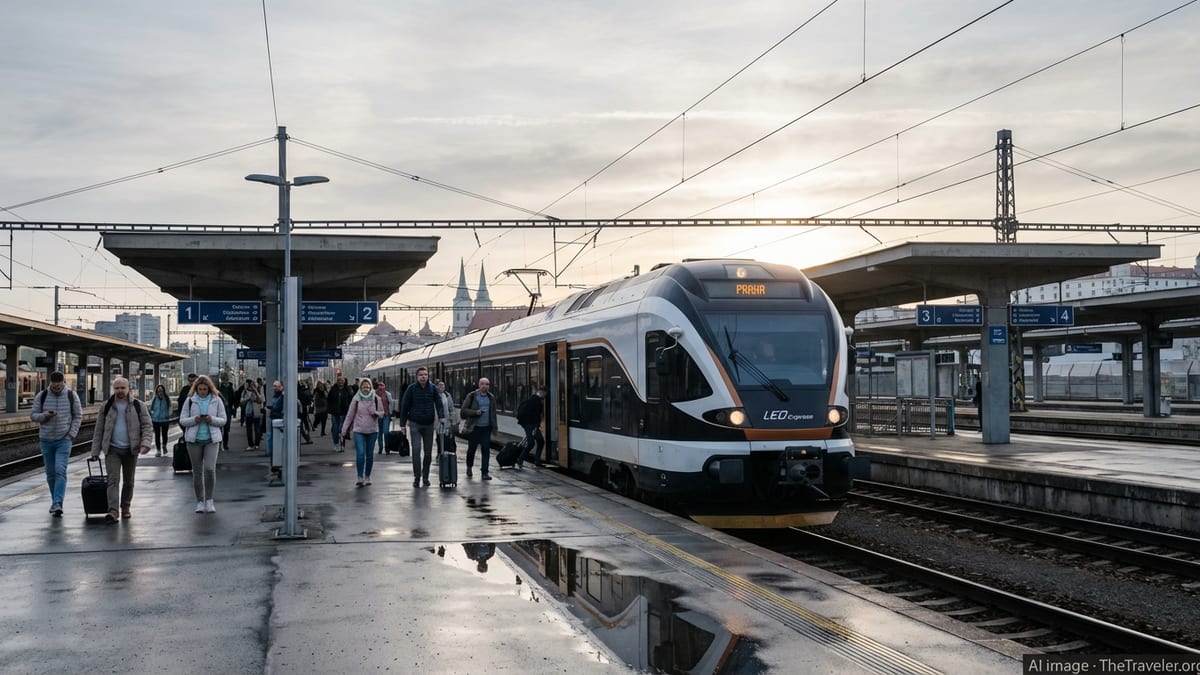
Hybrid launch for one of Europe’s longest rail journeys
The new Frankfurt–Prague–Przemyśl service is being introduced as a hybrid operation, combining rail and road to keep the schedule intact while infrastructure and regulatory issues in Poland are resolved. Publicly available timetables show the train running between Frankfurt and the Czech–Polish border area, where passengers transfer to buses that complete the journey on Polish territory.
Reports from timetable compilers and rail specialist outlets describe the route as one of the longest open access passenger services in Europe, crossing Germany, Czechia and Poland and reaching the gateway city of Przemyśl near the Ukrainian border. The full timetable has been published in international schedules, but annotations clarify that the Polish segment is offered by bus rather than by train for the time being.
Information published by Leo Express in recent months has promoted the link as a direct long distance connection between major economic and cultural centres, including Frankfurt, Leipzig, Dresden, Prague, Ostrava, Katowice, Kraków, Rzeszów and Przemyśl. The current mixed rail and bus launch allows most of that itinerary to be offered in a single through ticket even though only part of the journey presently operates on rails.
Journey times on the new corridor are designed to suit overnight and long distance travel patterns, with departures from Przemyśl in the early afternoon reaching Frankfurt and its airport the following morning, and an opposite flow from western Germany into southeastern Poland overnight. The interim use of buses in Poland keeps these timings largely intact, according to independent schedule summaries.
Why trains give way to buses inside Poland
The decision to run buses within Poland rather than trains from the outset appears linked to a combination of access rights, path allocation and the economic equilibrium test that new commercial services must undergo. Earlier coverage in Polish and European media highlighted that the state operator PKP Intercity requested a regulatory review of the proposed Przemyśl–Frankfurt route, raising questions over its impact on subsidised long distance services.
While the review process unfolded, Leo Express proceeded with planning and marketing the corridor, drawing on its existing experience of linking trains and buses across multiple countries. The company already sells combined rail and coach connections in central Europe, and observers note that it has used bus segments before to bridge gaps where rail access or capacity is limited.
Operational constraints in southern and eastern Poland, including maintenance windows on key arteries used by long distance trains, have also been cited in public reporting as reasons why running a full rail service immediately could prove difficult. A temporary bus solution allows the operator to honour advertised travel times without waiting for ideal train paths on every section of the route.
Industry commentators point out that using buses in Poland may also reduce the financial risk of entering a new market while ticket demand is still uncertain. Coaches require lower upfront costs than deploying additional rolling stock, and they can be adjusted more flexibly if ridership patterns change after launch.
What passengers can expect along the new corridor
For travellers, the new service creates a continuous chain of connections between western Germany and the far southeast of Poland, even if the experience currently involves at least one road segment. Journey planners and rail travel guides describe the route as daily, with departures timed to provide overnight rest for much of the distance and daylight views across central Europe at either end.
From Frankfurt, the train runs across central Germany through hubs such as Erfurt, Leipzig and Dresden before entering Czechia and continuing to Prague and Ostrava. From there, passengers heading toward Poland transfer to buses that continue via Katowice, Kraków, Rzeszów and finally Przemyśl. In the opposite direction, the bus links those Polish cities to the train heading back toward Prague and Frankfurt.
Through ticketing is a key part of the offer. Public descriptions of the product indicate that passengers can buy a single ticket covering the entire international journey, regardless of whether a segment is by rail or bus. This model, already used on other Leo Express routes, is intended to simplify planning for travellers crossing several borders.
Onboard standards on the rail portion of the trip follow the operator’s usual pattern, with multiple classes and at-seat services, while the bus segment is presented as an integrated continuation of the same journey. For many long distance passengers, especially those travelling between Germany, Prague and Kraków, the transfer may be relatively minor compared with the benefit of avoiding several separate bookings.
Strategic importance for cross border travel and Ukraine access
Beyond the practicalities of the interim bus operation in Poland, the Frankfurt–Prague–Przemyśl corridor is being framed as strategically significant for regional mobility. Commentaries in European transport media underline that Przemyśl has become a key gateway for travel toward Ukraine, with heavy flows of humanitarian, migrant and regular passenger traffic since Russia’s full scale invasion.
By extending the route to Przemyśl, Leo Express adds another option for passengers moving between western Europe and the Ukrainian border. Even though the Polish stretch is not yet fully rail based, the through service can feed onward trains and buses from Przemyśl toward Lviv and other Ukrainian cities, potentially reducing reliance on air travel and fragmented itineraries.
The route also supports tourism and business travel within central Europe. With direct access to Prague and Kraków alongside German cities like Leipzig and Dresden, the corridor offers a single booking option for multi city trips that previously required complex chains of national services. Travel publications have described it as an alternative backbone for overland journeys across the region.
From a policy perspective, the launch has been interpreted as a further test of how open access rail operators can coexist with state supported incumbents. The compromise of using buses in Poland underscores the challenges of entering markets where public service contracts and infrastructure capacity are closely managed, while still demonstrating demand for long distance cross border connections.
Next steps: from interim buses to full rail operations
Attention now turns to how long the hybrid train and bus model will remain in place. International timetable notes describe the service as subject to change, and rail observers anticipate that the operator will seek full rail operation in Poland once regulatory and path allocation issues are settled.
The long published plans for the Przemyśl–Frankfurt route envisage a continuous rail journey across the three countries, using standard gauge tracks along established intercity corridors. Achieving that goal would place the service among the longest uninterrupted cross border trains in Europe, a symbolic milestone for liberalised passenger rail.
For the moment, travellers are advised by independent travel guides to check schedules carefully close to departure, as the balance between rail and bus segments can shift with ongoing infrastructure works and timetable updates. The presence of a functioning corridor, even in hybrid form, is nonetheless seen as an important step in proving the viability of such long routes.
How quickly the Polish segment transitions from buses to trains will depend on regulatory outcomes, infrastructure readiness and commercial performance. The launch illustrates both the possibilities and the complications of knitting together a continent sized rail journey, with buses acting as a temporary bridge while the final pieces of the network fall into place.