


Most visitors walk into the Marc Chagall National Museum in Nice dazzled by color. The Biblical Message paintings flare in reds and blues, the stained glass glows above the auditorium, and phones come out for quick photos before everyone moves on to the next Riviera sight. Yet this small museum is full of hidden details that reward the traveler who slows down. From architectural choices Chagall made himself to tiny inscriptions almost buried in paint, the building and its works form a subtle, coherent world that most visitors never notice.
Get the latest updates straight to your inbox!
A Museum Designed Like a Home, Not a Monument
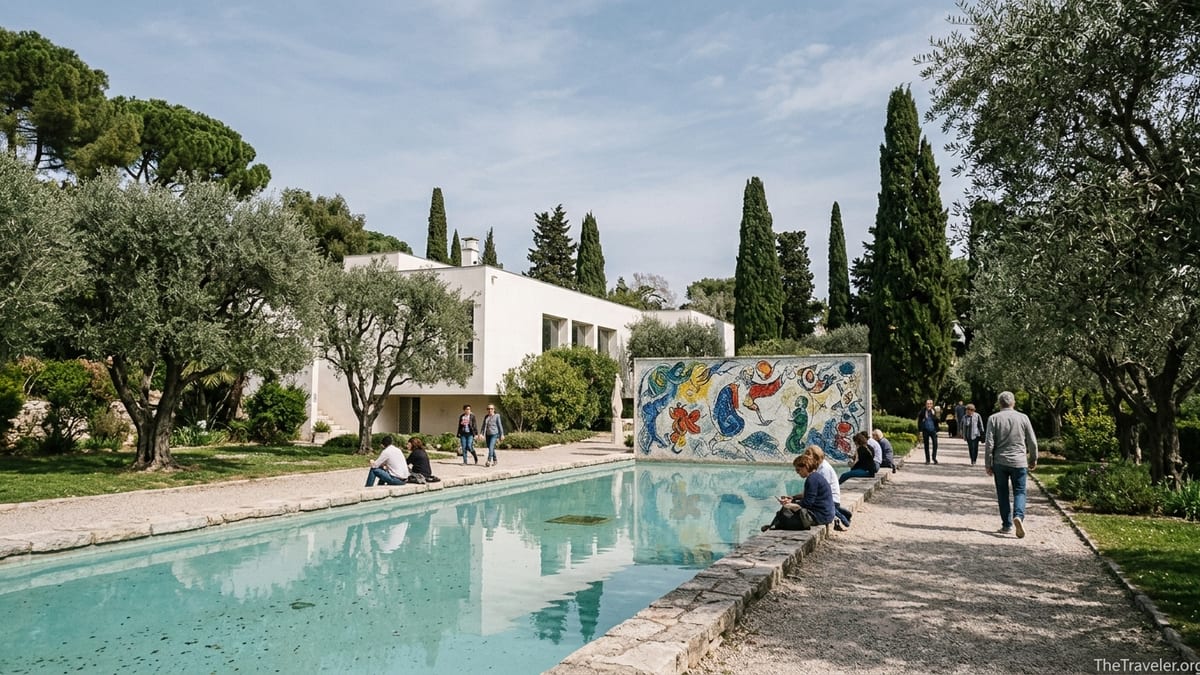
Unlike many French national museums, the Marc Chagall National Museum was conceived with the artist’s direct involvement and opened in 1973 while he was still alive. Rather than a grand palace, it was designed more like a modern Mediterranean house: low white volumes set in a garden of olive and cypress trees. This domestic scale is intentional. Chagall wanted visitors to feel they were entering a lived-in space, not a distant temple of culture. When you walk in from the quiet Cimiez neighborhood, notice how the museum never overwhelms you; rooms unfold like a series of bright, simple salons where large canvases can breathe.
One detail most travelers miss is how the central gallery is shaped. The main Biblical Message room, which houses the large canvases on Genesis and Exodus, is laid out like a Greek cross, its arms extending in four directions under a high ceiling pierced with natural light. Guides sometimes mention the cross shape, but many visitors never realize how they are moving through it. If you stand in the middle and look toward each “arm,” the paintings seem to radiate around you, hinting that you are standing at the symbolic crossroads of the biblical story.
The architecture also quietly controls your pace. Plain, slightly rough white walls, terrazzo-style floors, and simple benches keep your attention on the canvases. There are no gilded frames or elaborate moldings to compete with Chagall’s imagery. Travelers used to blockbuster museums in Paris often remark that this place feels oddly calm, almost residential. That was Chagall’s intention: a space where you can sit, listen to silence, and let his colors work gradually instead of in a single spectacular hit.
The Biblical Message Cycle: Tiny Clues in Vast Canvases
The seventeen paintings known as the Biblical Message cycle are the heart of the museum. Many visitors see only a blaze of floating figures, animals, and blue skies. Look closer and hidden details start to emerge, revealing Chagall’s layering of personal memory with religious narrative. In “Abraham and the Three Angels,” for instance, Abraham’s house doubles as a modest Eastern European dwelling, a quiet nod to Chagall’s childhood in Vitebsk. If you stand a few steps back and trace the rooflines, you may notice quaint wooden architecture that has more to do with a Russian shtetl than the Middle East.
Throughout the Genesis and Exodus canvases, the cityscapes often blend Jerusalem with hill towns of the South of France. In some works, observant visitors recognize the silhouette of Saint-Paul-de-Vence, where Chagall spent his later years, perched above older, more distant horizons. This fusion of places is easy to miss when you are focused on the main figures. Yet spotting a Provençal bell tower or a sloping tiled roof tucked behind a biblical wall can change how you read the scene. Suddenly, the story is not just ancient; it is folded into the landscapes Chagall saw from his own window.
Another overlooked layer lies in the inscriptions. Near several canvases, discrete plaques reproduce short biblical quotations in French and Hebrew, chosen by Chagall to guide interpretation. It is tempting to skim the French and ignore the Hebrew lines if you do not read the language, but their very presence matters. Chagall wanted to restore the Hebrew sound and script to stories many visitors know only in Christian churches. If you look carefully along some painting surfaces, you may even find faint, incised lines where he experimented with lettering directly in the paint before simplifying it.
The Song of Songs Room: A Hexagon of Private Symbols
Just off the main gallery, a smaller hexagonal room displays the five paintings inspired by the Song of Songs. Many guests walk through quickly, remarking on how “romantic” or “red” the room feels. Yet this intimate space holds some of the most personal symbols in the museum. The very shape of the room, a hexagon, subtly evokes a chapel or a jewel box, setting it apart from the cross-shaped main hall. If you stand in the center and slowly turn, each canvas feels like a facet in a circular story of love and devotion.
In one of the Song of Songs paintings, a bride and groom float over a blue townscape. Most visitors see a generic couple, but Chagall quietly folded scenes from his own life into these lovers. Look for a small violinist or a goat tucked near the bottom edge, motifs that haunted Chagall’s earlier works about his first wife, Bella. In later life, after he remarried in the South of France, he reimagined those motifs in a Mediterranean palette, bathing them in violet and carmine reds. The Song of Songs cycle is not only an expression of biblical love but also a reconciliation of old grief and new happiness.
Color itself is a coded language in this room. Reds dominate, but they are punctuated by small pockets of emerald green and deep blue that guide your eye. If you move slowly from left to right, you may notice that the green often appears around trees and gardens, suggesting earthly love and fertility, while blue pools around the lovers’ heads like a halo. It is a quiet reminder that the passionate love poem of the Bible has long been read as both human and divine. Many visitors pass through in less than three minutes; if you sit on the bench and give it ten, those color patterns start to reveal an entire emotional architecture.
The Garden, Pool, and Mosaic: A Sky of Zodiac Signs
Stepping outside into the museum garden, most travelers head straight for a quick photo of the turquoise pool and its reflection of the surrounding pines. Yet behind the water rises one of the museum’s most intriguing and least-understood works: the monumental mosaic often called “The Prophet Elijah” or “Elijah’s Chariot.” At first glance you may see only a fiery chariot and swirling forms, but a closer look reveals a ring of zodiac signs dispersed around the prophet. This unexpected pairing of Hebrew scripture with Greco-Roman astrology is one of the museum’s most quietly radical gestures.
Chagall chose to mingle the biblical vision of Elijah ascending to the heavens with familiar zodiac symbols to suggest a shared, Mediterranean sky of myths and beliefs. Many visitors who spot Aries or Libra assume the mosaic is a simple horoscope reference, but here the zodiac becomes a visual shorthand for the wider world watching Elijah’s ascent. Next time you visit, walk along the pool’s edge and identify as many signs as you can. You will notice how some are partially hidden by shifting reflections, so that the movement of water animates their appearance and disappearance.
The pool itself is not just decorative. On bright days, the water creates a moving mirror that breaks up and recombines fragments of the mosaic. If you time your visit for late morning, when the sun is high above the garden, you will see the white stone around the pool blaze while darker tesserae in the mosaic sink into shadow. On cloudy afternoons, the colors flatten and the zodiac ring becomes easier to read. Travelers with patience often linger on the low wall around the basin, watching how the mosaic’s story changes as ripples and light shift, a quiet performance most tour groups overlook entirely.
Inside the Auditorium: Stained Glass That Many Never See
One of the museum’s most surprising spaces is the small auditorium, tucked off the main lobby. Many day-trippers never even open its door, assuming it is reserved for concerts. Yet Chagall designed this room specifically to house his luminous stained-glass windows on the theme of Creation. Enter when the hall is empty and let your eyes adjust. Three tall windows bathe the space in layered blues and greens, their colors spilling across the pale floor and simple wooden seats.
Most visitors who do find the room snap a photo and leave, missing subtle iconography within the glass. Look carefully at the bottom sections, where fish, birds, and plants emerge from thick areas of color. As your gaze rises, figures and symbols become more abstract, hinting at the transition from earthly to cosmic creation. Because the windows face a particular direction, light changes dramatically over the course of the day. Around midday on a sunny day, the blues are nearly electric; in late afternoon, the room softens to a more introspective twilight, ideal if you want a quieter experience away from bus tours.
Another often-missed detail is how the auditorium’s architecture frames the windows. The walls are bare, the stage shallow, and the ceiling unobtrusive, so that the glass itself functions as a kind of backdrop for music and lectures. If you attend a chamber concert by the Nice Philharmonic’s musicians, which the museum regularly hosts, the performers stand almost in silhouette against the blue light. Travelers who plan ahead and buy a ticket for one of these evenings get a very different relationship to the art, hearing live Schubert or Debussy while Chagall’s Creation glows softly behind.
Hidden Craftsmanship: Surfaces, Signatures, and Light
Because the museum is compact, it is easy to rush from canvas to canvas, treating them like enlarged book illustrations. Slow down and step close to the paint surface. Chagall often worked in thick, reworked layers, scraping and repainting to adjust a line of a wing or the curve of a city dome. In raking light, especially near the side windows, you can see ghost images beneath the final figures: a hand that once reached higher, a house that shifted slightly to balance the composition. These pentimenti are not visible in reproductions and are hard to see in photographs. They reward in-person looking in a way few visitors expect.
Signatures are another discrete pleasure. Chagall sometimes tucked his name into quiet corners, almost like a whispered presence rather than a proud declaration. Look for small, cursive “M. Chagall” markings in lower corners, often partially veiled by later paint or varnish. In one canvas, his name sits close to a cluster of flowers, so that it nearly merges with their stems. For travelers used to brash modern branding, this modesty is striking. It reinforces the idea that Chagall saw himself as a participant in a long storytelling tradition rather than a celebrity imposing his image.
Finally, pay attention to how natural light interacts with the works. The museum’s architects aligned windows and skylights so that daylight passes across certain paintings at particular hours. For example, in the main hall, morning light often grazes the lower left sides of the Genesis paintings, emphasizing animals and minor characters that get lost under even artificial light. Late in the day, the upper zones glow more strongly, throwing emphasis back on angels and celestial motifs. If you have flexibility, consider visiting either shortly after opening time or in mid-afternoon, then walk the room twice to feel how emphasis shifts with the sun.
Planning a Visit With an Eye for Detail
Most visitors include the Marc Chagall National Museum in a half-day outing that also covers the nearby Matisse Museum in Cimiez. This is doable, but if you want to notice the hidden details described above, it is worth devoting at least two unhurried hours to Chagall alone. Plan to arrive close to opening time, when tour buses are fewer and galleries are quiet enough that you can hear your own footsteps. Admission prices are comparable to other French national museums, and the ticket includes access to the garden and auditorium, so there is no extra charge to linger in those spaces.
Audio guides and printed leaflets focus on major themes and dates but rarely mention the more elusive clues such as pentimenti or cross-cultural symbols in the mosaic. To compensate, consider choosing just three or four works you will study closely rather than trying to “cover” everything. For example, many travelers pick one Genesis painting, one Exodus painting, a Song of Songs canvas, and the garden mosaic, then build their own mini itinerary around them. Sitting on the built-in benches and simply looking for ten minutes at a single work can be far more rewarding than snapping thirty quick photos.
The museum shop, small but thoughtfully curated, also offers subtle help for detail hunters. Instead of generic souvenirs, you will find reproductions of individual details from the paintings and stained glass: a dove from the Creation window, a fragment of cityscape, or a pair of lovers from the Song of Songs. Browsing these near the end of your visit can prompt you to go back into the galleries to search for the original motif you have just seen on a postcard or print. It turns the final half hour into a gentle treasure hunt, sending you home with a sharpened memory of specific colors and shapes.
The Takeaway
The Marc Chagall National Museum is often sold as a stop for people who like “colorful, dreamy” paintings. That description is not wrong, but it barely touches what you actually find when you slow down in its quiet rooms and garden. The building’s cross-shaped plan, the intimate hexagon of the Song of Songs, the zodiac encircling a prophet, and the near-hidden traces of Chagall’s revisions all point to an artist who thought deeply about how visitors would move, look, and feel inside his museum.
For the traveler willing to linger, these hidden details transform a pleasant museum visit into something more like a conversation with Chagall himself. You begin to notice how he stitches together Jerusalem and Saint-Paul-de-Vence, Hebrew scripture and Mediterranean skies, private love and public faith. The next time you are in Nice, give this small museum more than a quick stop between the sea and the old town. Walk its rooms twice, sit by the pool, and step into the blue glow of the auditorium. What most visitors never notice will become the very heart of your memory.
FAQ
Q1. How much time should I plan for the Marc Chagall National Museum in Nice?
Most travelers are satisfied with 60 to 90 minutes, but if you want to notice the more hidden details in the paintings, garden, and auditorium, two hours is ideal. This gives you time to sit in front of key works, revisit the main hall, and linger by the mosaic and pool without feeling rushed.
Q2. Is the museum suitable for visitors who are not familiar with the Bible?
Yes. While the works are based on biblical stories, the themes of love, exile, and hope are accessible even if you do not know the narratives. The audio guide and wall texts offer brief story summaries, and many visitors simply respond to the color, emotion, and dreamlike imagery rather than focusing on theology.
Q3. What is the best time of day to visit for the light and atmosphere?
Morning visits shortly after opening are usually quieter, and angled sunlight can pick out textured details in the canvases. Midday brings stronger light in the garden and more intense color in the stained-glass windows of the auditorium. Late afternoon can feel more contemplative as the galleries empty and the light softens.
Q4. Can I see the stained-glass windows in the auditorium if there is no concert?
Yes. When the auditorium is not in use for rehearsals or events, visitors are generally free to enter, sit for a moment, and look at the Creation-themed windows. Staff may temporarily close the space before performances, but during normal opening hours you can usually step inside for a quiet break.
Q5. Are photos allowed inside the Marc Chagall National Museum?
Non-flash photography for personal use is typically permitted in the galleries and garden, though tripods and professional lighting are not allowed. Rules can change, so it is wise to check posted signs near the entrance or confirm with staff on the day of your visit before taking pictures.
Q6. Is the museum accessible for visitors with limited mobility?
The museum is relatively compact and on a gentle slope, with flat paths around the garden and seating in most rooms. There are ramps or elevators for level changes, and staff are accustomed to assisting visitors with mobility needs. If you rely on a wheelchair or scooter, planning a slightly longer visit allows comfortable movement between spaces.
Q7. Can children enjoy a visit, or is it mainly for adults?
Children can enjoy the bright colors, animal figures, and dreamlike compositions, especially in the Genesis and Exodus canvases. The garden offers a chance to move and explore safely around the pool and mosaic. Families often stay about an hour, using the more vivid scenes as storytelling prompts rather than trying to analyze every work.
Q8. How does the Chagall Museum compare to the Matisse Museum in Nice?
The Chagall Museum is more focused, built around a single monumental cycle of works and a purpose-built architecture, while the Matisse Museum spans many periods of that artist’s career in a historic villa. Chagall’s museum feels more intimate and contemplative, with a strong spiritual thread, whereas the Matisse collection offers a broader survey of styles and materials.
Q9. Do I need to book tickets in advance?
In the quieter months, many visitors simply buy tickets at the door without waiting long. During busy holiday periods and peak summer days, advance booking can reduce queuing times and give you more control over your schedule, especially if you want to combine the museum with other Cimiez sights.
Q10. Is there a recommended way to approach the collection on a first visit?
A simple route is to start in the main Biblical Message hall, choose one Genesis and one Exodus painting to study closely, then move into the Song of Songs room. After that, step into the garden to see the mosaic and pool, and finish in the auditorium under the stained glass. This sequence mirrors the museum’s own rhythm while leaving room for personal discoveries.