

More news on this day
Rail passengers in North and West Wales are being promised more trains, quicker journeys and new cross-border links from May 2026, as Transport for Wales and the UK and Welsh governments prepare a sweeping timetable upgrade designed to make rail a more attractive option for residents, commuters and visitors alike.
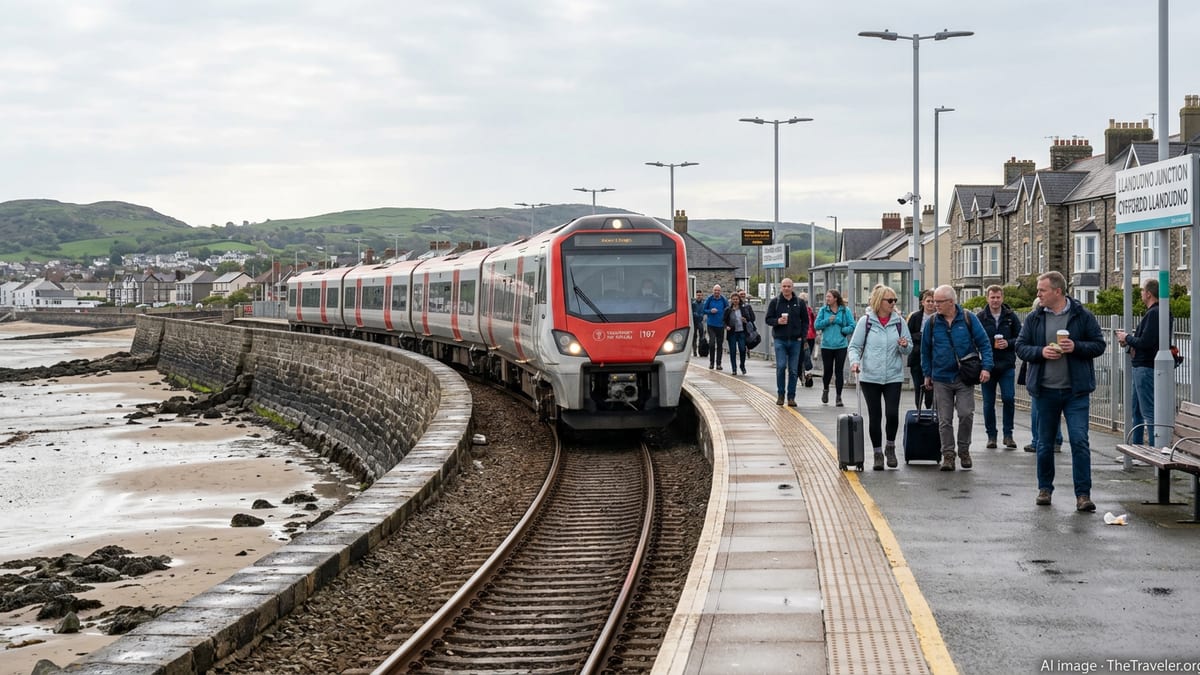
Fifty Percent More Trains on the North Wales Main Line
The most eye-catching change is planned for the North Wales Coast Main Line, where Transport for Wales expects to introduce 50 percent more services from May 2026. This uplift, supported by recent funding commitments, will unlock extra trains between Holyhead, Llandudno Junction, Chester and beyond, tightening headways on a corridor that has long struggled with capacity constraints at peak periods and during the busy summer season.
Government announcements in early 2026 confirmed that new infrastructure on the route, including upgraded level crossings and station access improvements at key coastal locations such as Prestatyn and Abergele, is being delivered specifically to support this service expansion. By removing high-risk crossings and improving line speeds at pinch points, engineers aim to create enough timetable headroom to run more frequent trains without sacrificing reliability.
For passengers, the practical impact will be shorter waiting times and a more “turn up and go” style of service, particularly between larger hubs like Llandudno Junction, Rhyl and Chester. Operators expect this to be especially significant for tourism-dependent communities along the coast, where better rail connectivity is viewed as vital to reducing road congestion and supporting local businesses.
The increased frequency also lays the foundations for future electrification and further capacity enhancements along the corridor, which feature in longer-term planning documents for the Network North Wales programme and Transport for Wales’ vision for rail across Wales and the Borders.
New Direct Links to Liverpool and Faster Routes to Manchester
Alongside more trains on the coast, May 2026 is being positioned as the start of a new era for North Wales’ cross-border connectivity. Plans published by regional and national transport bodies highlight the introduction of a new direct service from Llandudno to Liverpool, routing via the North Wales Main Line and onward connections through Chester. This is intended to integrate North Wales more closely with Liverpool’s growing commuter and visitor economy.
At the same time, the existing Manchester Airport services are expected to be restructured and extended to Holyhead, rather than terminating at Llandudno. Rail planners suggest that this recast will give Anglesey and west-coast communities a faster, one-seat ride to one of the UK’s busiest international airports, cutting connection times and simplifying journeys for both outbound holidaymakers and inbound visitors heading for North Wales.
These cross-border improvements dovetail with wider Northern Powerhouse and North West England rail investments, which are focused on faster, more frequent services between Liverpool, Manchester and hubs such as Warrington and Chester. For Welsh passengers, this should mean better onward connections to the wider northern English rail network, including links to Leeds, Sheffield and Newcastle.
Business groups in North Wales have long argued that stronger daily rail links to Liverpool and Manchester are essential for attracting investment and supporting high-value employment. With May 2026 pencilled in as the first big step-change in service patterns, attention is now turning to final timetable modelling and the integration of new rolling stock diagrams.
Hourly Aberystwyth Services and a Stronger Cambrian Corridor
West and mid Wales are also in line for a meaningful boost from May 2026, with an hourly Aberystwyth to Shrewsbury service set to become a summer-season standard. Transport for Wales’ future timetable review confirms that from May to September, trains on the Cambrian Main Line will run every hour instead of every two hours, giving both residents and tourists far more flexibility when travelling between the coast, Machynlleth and the English border at Shrewsbury.
This enhancement builds directly on a major programme of infrastructure works that concluded on the Cambrian Coast Line in early 2026, including extensive track renewals, drainage improvements, bridge inspections and level crossing upgrades between Pwllheli and Dovey Junction. Network Rail has described the package as a long-term resilience investment intended to reduce delays, smooth journeys and protect the route against increasingly frequent extreme weather events.
The combination of fresh infrastructure and a more intensive timetable is expected to cut journey times by a few minutes on some services and, more significantly, to offer more options for connections at Shrewsbury towards Birmingham, the Midlands and London. For holidaymakers heading to Aberystwyth or the Cambrian coast, the extra trains should also make it easier to plan short breaks and day trips without being constrained by the current sparse timetable.
Local representatives along the Cambrian corridor, who have previously raised concerns about timetable cuts and reliability, are likely to scrutinise performance carefully once the new pattern is in place. However, operators insist that the upgraded infrastructure, newer rolling stock and more robust diagrams should result in a more dependable service overall.
Knock-on Benefits for Conwy Valley and Rural Tourism
Although the main Conwy Valley timetable overhaul is scheduled for December 2026, planners have indicated that several issues raised during early engagement will begin to be addressed in the May 2026 update. Draft documents highlight ambitions to improve connections between Conwy Valley services and key tourist routes, including integration with heritage railways and local bus networks at hubs such as Betws-y-Coed and Blaenau Ffestiniog.
For the tourism sector, the alignment of more frequent North Wales Coast services with better-timed Conwy Valley and Cambrian connections could be transformative. Coastal visitors will have a smoother onward journey into Snowdonia and Eryri National Park, while those staying inland will find it easier to reach seaside towns without relying on cars or complex multi-change itineraries.
Hotels, guesthouses and adventure operators across Gwynedd and Conwy have long argued that inconsistent rail timings deter car-free travellers from booking stays outside peak weekends. With a more regular coastal service and a clearer framework for future valley and branch-line improvements, local tourism boards are preparing marketing campaigns built around low-carbon access to the mountains and coast.
There is also an expectation that more predictable rail links will help spread visitor demand more evenly through the shoulder seasons, easing pressure on the busiest summer weeks while supporting businesses in spring and early autumn.
What Passengers Should Expect as May 2026 Approaches
While final timetables for May 2026 have yet to be formally published, both National Rail and Transport for Wales stress that major changes are confirmed in principle and will follow the regular May timetable change process. Detailed journey information is typically released around four weeks before the change date, a pattern that operators are promising to maintain so that passengers, tourism providers and event organisers have time to adjust travel plans.
In preparation, Transport for Wales has been ramping up communications through its “Today, Tomorrow, Together” rail vision, setting expectations that some routes will see major improvements, others minor adjustments and a small number potential reductions where demand is lower. The emphasis, officials say, is on using finite public subsidy to provide capacity where it is most needed while still delivering a clear uplift on key inter-urban and leisure corridors.
Passenger groups are urging travellers to engage early with consultation material and draft timetables as they emerge over the next year, particularly where local commuting patterns or school and college travel could be affected by retimed services. Accessibility advocates are also watching closely to ensure that station upgrades and new service patterns translate into genuinely easier journeys for disabled passengers and those requiring assistance.
For now, the message to rail users in North and West Wales is to prepare for a busier, more connected network from May 2026. With more frequent trains on the North Wales Main Line, a stronger Cambrian timetable and new direct links to Liverpool and Manchester, the coming changes look set to elevate the region’s rail offer from a patchy lifeline to a credible everyday choice for work, study and leisure travel.