


More news on this day
Passengers travelling through Manchester Airport today, 23 June 2026, are encountering a mix of minor delays and isolated cancellations across several airlines, with disruption levels varying throughout the day and across the airport’s three terminals.
Get the latest news straight to your inbox!
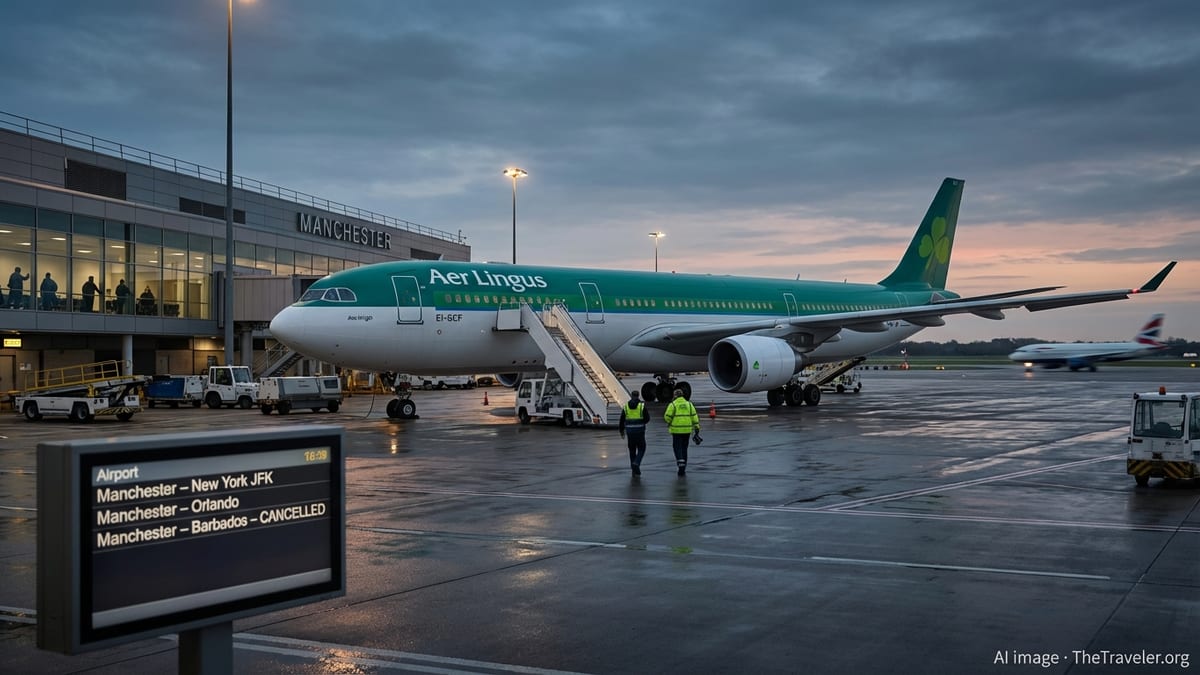
Overall disruption remains limited but uneven
Live departure and arrival boards for Manchester Airport on Tuesday indicate that the majority of services are running broadly to schedule, with many flights continuing to depart and arrive on time. Real-time feeds from flight-tracking and travel platforms show long stretches of the timetable where services are listed as scheduled, rather than delayed or cancelled.
Despite that generally stable picture, today’s operation is not entirely smooth. A number of services have been marked as delayed, particularly during busier peaks in the morning and evening, and there are a small handful of cancellations affecting specific routes. The pattern suggests localised operational or airline-related issues rather than a single airport-wide failure such as a power outage or air-traffic control shutdown.
Available information for Tuesday’s schedule also suggests that long-haul and short-haul services are both operating. Transatlantic flights, European city links and leisure routes to Mediterranean destinations are all visible on today’s boards, highlighting that the airport’s summer 2026 programme is largely intact despite the scattered disruption.
Compared with the severe power-related disruption seen at Manchester Airport on 23 June 2024, when a major outage led to widespread cancellations and advice for some passengers to stay away, conditions today appear significantly calmer, with no comparable terminal-wide stoppages being reported.
Terminals 1, 2 and 3: where delays are most visible
Manchester Airport’s three-terminal layout means that the impact of delays and cancellations can differ by airline and by part of the site. Today’s live data shows terminals 2 and 3 handling a heavy share of the schedule, including many European short-haul services and popular holiday routes, while the remaining operation at terminal 1 continues alongside ongoing refurbishment and reconfiguration works elsewhere in the complex.
In terminal 2, a number of departures to European and Mediterranean destinations are showing minor delays, typically expressed as revised departure times shifted back by tens of minutes rather than hours. Services operated by leisure carriers and flag airlines alike are affected in places, though most flights continue to show as scheduled. Arrivals into terminal 2 are displaying a similar pattern, with occasional late inbound services feeding through to knock-on delays for outbound rotations.
Terminal 3, which handles a high volume of low-cost European traffic, also shows some pressure in today’s schedule. Budget carriers serving routes to hubs such as Dublin, Brussels and Italian and Spanish destinations display a mix of on-time and delayed statuses, again with most delays remaining in the short range. The data available this afternoon does not indicate a systemic shutdown of any single airline’s operation from terminal 3.
Across all three terminals, there is no clear indication of a single cause for today’s irregularities. Instead, the pattern resembles a typical busy summer day at a major UK hub, with weather along routes, aircraft rotation constraints and wider European airspace congestion all likely contributing to sporadic delays.
Specific services affected by cancellations and longer delays
While most of Tuesday’s schedule is operating, a small number of flights have been cancelled outright or subjected to more pronounced delays. Publicly available status pages for individual flights show isolated examples where services between Manchester and certain European cities have been scrubbed from the timetable, with affected passengers being offered rerouting or later departures by their airlines.
On the short-haul side, regional and European routes are the most commonly impacted when cancellations appear, simply because these flights operate at higher frequency and are more easily consolidated. Passengers booked on services to secondary cities on the continent may therefore be more likely to see their flight combined with another departure or moved to a different time of day.
For long-haul travellers, information from airline feeds and tracking services indicates that core intercontinental links, including routes to major hubs in the Middle East and North America, are largely running to schedule. Where delays do occur on these longer services, they tend to be closely tied to late-arriving inbound aircraft or broader congestion at overseas hubs rather than issues attributable solely to Manchester Airport.
Importantly, there are no signs today of the widespread, rolling cancellations that can result from large-scale problems such as prolonged ground handling shortages or significant air-traffic control restrictions over northern Europe. The disruption remains scattered, and the majority of passengers are still expected to depart on the same day as booked.
Advice for travellers flying from Manchester today
Given the current pattern of disruption, travellers using Manchester Airport today are being encouraged, through airline and travel-industry guidance, to pay close attention to live flight status tools and official airline notifications. Many carriers continue to push updates via mobile apps and text alerts, which tend to reflect schedule changes more quickly than static booking confirmations or printed itineraries.
Passengers departing in the early morning and late afternoon peaks are the most likely to encounter queues at check-in and security, particularly in terminal 2, which is bearing much of the summer 2026 traffic. Allowing extra time to move through the airport remains a prudent step, especially for those checking baggage or travelling with families.
For those whose flights are cancelled or heavily delayed, consumer guidance and aviation regulations set out potential entitlements to rebooking, meals and accommodation, depending on the cause of the disruption and the notice provided. Travellers are generally advised to retain boarding passes and receipts and to use airlines’ official claim processes rather than informal channels.
Rail and road access to Manchester Airport has been operating broadly as normal today, with no major surface-transport incidents reported in connection with the flight delays. That stability on the ground has helped to limit secondary disruption for passengers attempting to reach or leave the airport.
How today compares with recent operations at Manchester
Today’s mix of largely smooth operations alongside sporadic delays and a few cancellations comes at a time when Manchester Airport is carrying record or near-record passenger numbers through its terminals during the 2026 summer season. Capacity declarations and industry reports for this year highlight a busy schedule of short- and long-haul flying, supported by continued investment in terminal infrastructure and airfield management.
In contrast to earlier years when sudden power failures or severe weather created large backlogs and prompted emergency travel advisories, current operations are more resilient. While individual passengers today will still experience the frustration of missed connections or rescheduled departures, the wider system at Manchester appears to be absorbing pressure without tipping into full-scale disruption.
Industry observers note that, as with many European hubs, Manchester’s performance on any given day is influenced not only by processes within its own perimeter, but by conditions across the continental network. Airspace restrictions, staffing levels at overseas airports and thunderstorms along busy corridors all feed into the pattern of delays and cancellations that appears on local departure boards.
For Tuesday’s travellers, the practical consequence is that most flights at Manchester Airport are operating close to schedule, but with enough exceptions to make real-time status checks essential. Those due to fly later today are being advised, through published guidance from airlines and travel providers, to monitor their bookings closely and to be prepared for gate changes or modest shifts in departure times.