


More news on this day
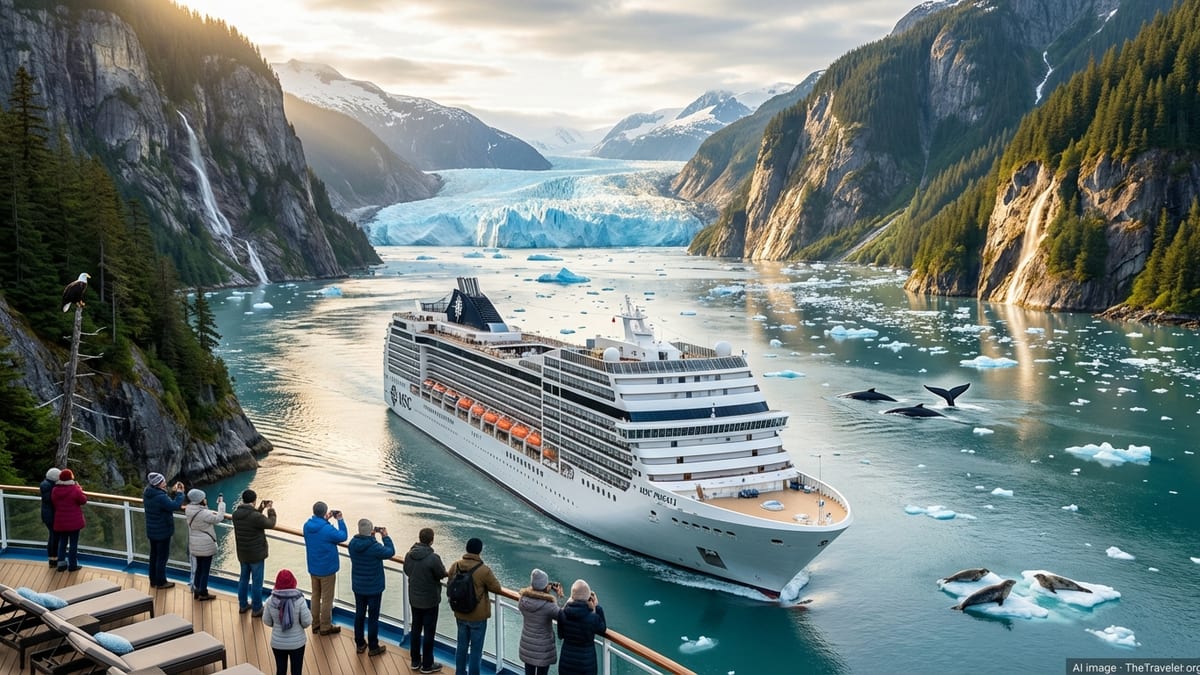
Marine Mammal Observer Maria Snell has officially joined MSC Poesia in Alaska, marking a high-profile step in cruise industry efforts to better protect whales and other marine wildlife along one of the world’s busiest cold-water cruise corridors.
Get the latest news straight to your inbox!
Industry-First Role Aboard MSC Poesia
According to recent company press information and cruise industry coverage, Maria Snell boarded MSC Poesia in late July as a dedicated Marine Mammal Observer during the line’s inaugural Alaska season. Her deployment follows a wider collaboration between MSC Cruises and marine conservation charity ORCA, which earlier this year outlined plans to place a trained observer on board the ship for part of the 2026 summer schedule.
Reports indicate that Snell’s assignment focuses on voyages between Seattle and Southeast Alaska, including transits of the Inside Passage and key whale habitat near Juneau. These itineraries coincide with peak summer feeding season for humpback whales, when large numbers of animals congregate in rich foraging grounds that overlap major cruise lanes.
MSC Poesia is MSC Cruises’ first vessel dedicated to Alaska, and the appointment of a named observer is being framed as a testbed for science-led mitigation measures. Publicly available information from the company describes the initiative as a way to combine real-time wildlife monitoring with crew training and guest education, using a single ship as a floating research platform.
Travel trade publications note that the collaboration builds on ORCA’s long-standing use of trained observers on ferries and other commercial vessels. Placing a Marine Mammal Observer on a large international cruise ship in Alaska is being viewed as a notable expansion of that approach into one of North America’s most closely watched cruise destinations.
Monitoring Whales to Reduce Risk of Ship Strikes
Coverage of the program explains that Snell’s day-to-day work will center on spotting and tracking whales from MSC Poesia’s bridge, using binoculars and camera systems to monitor the sea surface ahead of the ship. When whales are detected near the vessel’s path, she is expected to advise the bridge team on their position and behavior so that officers can consider course or speed adjustments.
Marine mammal observers are commonly used in industrial settings such as offshore energy projects to help reduce disturbance or injury to protected species. In this case, cruise-focused reporting indicates that Snell’s presence is aimed at gathering systematic data on whale distribution around large ships in Alaska and exploring how real-time observations can translate into practical avoidance measures in complex coastal waterways.
Environmental briefings shared with the travel trade describe the Alaska initiative as part of a broader push to address the risk of ship strikes, which remain a concern for large whales worldwide. By pairing visual monitoring with detailed recording of whale behavior, distances, and vessel responses, Snell is expected to help build a dataset that can inform longer-term guidance for cruise operations in sensitive habitats.
The MSC–ORCA collaboration is also being linked to regional conversations about how cruise lines can support research into whale movement patterns, particularly in busy ports such as Juneau where traffic from multiple operators converges. Observers like Snell provide an on-the-water vantage point that complements acoustic monitoring and shore-based research programs already active in Alaska.
Science Partnership Between MSC Cruises and ORCA
MSC Cruises announced its partnership with ORCA earlier in the year, highlighting plans for a dedicated Marine Mammal Observer to sail aboard MSC Poesia during the line’s debut Alaska season. Press material emphasized that the observer would play a dual role in scientific research and onboard training, signaling a more formal integration of conservation expertise into day-to-day cruise operations.
ORCA, a United Kingdom-based marine conservation organization, has previously embedded trained observers on commercial ships in Europe to monitor whales, dolphins, and porpoises. The Alaska project with MSC Poesia extends that model into North American waters and into a high-profile international cruise brand, drawing attention from both environmental and tourism outlets.
Reports indicate that the partnership was introduced to the wider industry during a Pacific Northwest cruise symposium earlier in the year, where cruise and port stakeholders discussed approaches to environmental stewardship. The MSC–ORCA initiative has since been cited by commentators as an example of voluntary, science-centered measures that can complement regulatory frameworks already in place for protected species.
Within that context, Snell’s arrival on board MSC Poesia is being presented as a practical milestone in transforming a paper partnership into daily operational practice. Her presence provides a visible point of contact between the research community, the ship’s crew, and the thousands of passengers sailing Alaska’s scenic routes this season.
Elevating Crew Training and Passenger Awareness
In addition to real-time monitoring duties, publicly available descriptions of the role state that Snell is expected to lead training sessions for bridge and deck crew on whale identification and avoidance procedures. By improving crew familiarity with local species and typical behaviors, the program aims to enhance officers’ ability to interpret sightings and respond appropriately when whales are observed ahead of the ship.
Travel reports add that Snell will also participate in passenger-facing activities, including talks on marine wildlife, informal discussions on deck, and interpretation of sightings during scenic cruising segments. These interactions are intended to increase guest awareness of both the abundance of marine life along the route and the practical steps being taken to minimize disturbance.
Cruise commentators note that this kind of educational outreach can influence traveler expectations and demand for more environmentally conscious itineraries. By giving passengers a clearer view of the science and operational decisions behind wildlife protection, the presence of a Marine Mammal Observer like Snell may contribute to growing public support for slower speeds, routing adjustments, or other mitigation measures in sensitive areas.
For MSC Cruises, hosting a specialist on board MSC Poesia also adds a distinctive feature to its Alaska product at a time when many lines are seeking to differentiate their environmental credentials. The line has highlighted investments in cleaner technologies and fuel efficiency elsewhere in its fleet; the ORCA partnership and Snell’s assignment provide a human-centered complement to those technical measures.
Implications for Future Cruise Operations in Sensitive Waters
Observers across the travel and environmental sectors are watching the MSC Poesia project for indications of how embedded marine mammal specialists could shape future cruise practices. If the data collected by Snell and ORCA demonstrate measurable benefits for whale avoidance or improved understanding of animal movements around large vessels, similar roles could be adopted more widely, particularly in regions with high concentrations of endangered or vulnerable species.
Alaska’s Inside Passage, where Poesia is sailing this summer, is regarded as an important testing ground due to the overlap of busy cruise routes with critical feeding and breeding areas for humpback whales and other marine mammals. A successful season of observer-led monitoring could provide a template for deployments in other sensitive destinations, from the North Atlantic to parts of the Southern Ocean.
Published analysis from conservation groups suggests that solutions will likely involve a combination of tools, including voluntary speed reductions, dynamic routing based on real-time sightings, and enhanced data sharing between researchers and operators. A shipboard Marine Mammal Observer such as Snell offers one practical way to translate scientific insight into day-to-day navigation decisions while also informing those broader discussions.
As MSC Poesia continues her Alaska program, the work of Maria Snell is expected to feed into post-season evaluations by the cruise line and ORCA. Those assessments may determine whether the observer model becomes a regular feature of MSC’s operations in wildlife-rich waters and whether other operators follow with similar appointments on their own fleets.