


More news on this day
Passengers at Paris Charles de Gaulle Airport faced hours of disruption today as operational data showed 254 flights delayed and five cancelled, snarling domestic and international connections across Europe, the Middle East and North America.
Get the latest news straight to your inbox!
Major Hub Hit by Wave of Delays
Paris Charles de Gaulle, one of Europe’s busiest hubs and the main base for Air France, experienced a sharp spike in delays that rippled across airline networks and alliances. Publicly available tracking dashboards and aviation data feeds for 14 May indicated that a total of 254 movements at the airport were running late, while five flights were listed as cancelled, affecting departures and arrivals throughout the day.
The disruption affected both short haul and long haul traffic, with knock on effects across connecting banks of flights. Delays were recorded on services linking Paris to major cities including London, Amsterdam, Rome, Dubai and New York, complicating onward connections for connecting passengers and leaving many travelers facing long queues at transfer desks.
Operational data show that the pattern of disruption was not limited to a single carrier. While Air France and its partners bore a significant share of the impact due to their scale at Paris Charles de Gaulle, services operated or marketed by other European and long haul airlines were also affected as aircraft and crew rotations slipped behind schedule.
By late afternoon, airport departure and arrival boards continued to show a high volume of flights running behind schedule, although some mid day services had begun to depart closer to their planned times as airlines worked through the earlier backlog.
Air France, KLM and Alliance Partners Face Network Strain
The Air France KLM group, which relies heavily on Paris Charles de Gaulle as a key transfer point, saw disruptions across multiple domestic and European routes. Feeder services bringing passengers into Paris from regional French cities and other European airports reported delays, putting pressure on onward long haul departures to destinations such as New York and Dubai.
Codeshare and joint venture partners were also caught in the disruption. Flights marketed by Delta Air Lines and other SkyTeam members using Paris as a transatlantic gateway showed delays or schedule changes in tracking tools, reflecting the way a single congested hub can quickly affect a wider network of airlines and routes.
Data for recent days already showed several long haul Paris bound services operating off schedule, and today’s combination of late arrivals and delayed turnarounds added further strain. Passengers connecting through Paris to reach North America, the Middle East or other parts of Europe were among those most exposed, particularly where minimum connection times were tight.
In response to the disruption pattern, publicly available information from airlines advised customers to monitor their flight status closely, make use of mobile apps and digital tools, and allow extra time at the airport in case of schedule changes, rebooking needs or longer lines at customer service points.
Impact Spreads to British Airways, Lufthansa and Other Carriers
The knock on effect from delays at Paris Charles de Gaulle extended beyond the Air France KLM network. British Airways, Lufthansa and other major European airlines with scheduled links to Paris saw their own timetables tested as late inbound aircraft and air traffic restrictions filtered through to their operations.
On the Paris to London corridor, travelers reported disrupted plans as flights departed later than scheduled, compressing turnaround times at both ends and affecting subsequent rotations. Similar patterns were visible on services linking Paris with Amsterdam and Rome, two of Europe’s other key hubs, where any delay can quickly cascade into missed connections and aircraft reassignments.
Lufthansa group traffic was also affected, particularly on routes feeding into its German hubs from Paris. In recent months, European aviation reports have highlighted the sensitivity of hub and spoke systems to disturbances at major nodes, with even short operational events capable of triggering wider schedule instability.
While only a small number of flights at Paris Charles de Gaulle were formally cancelled, each cancellation can displace hundreds of passengers and require significant rebooking efforts, especially on busy travel days when alternative seats are limited.
Routes to London, New York, Dubai, Rome and Amsterdam Disrupted
The scale of the disruption was particularly evident on high traffic routes connecting Paris Charles de Gaulle with other global cities. Services to London and Amsterdam, which function as vital shuttle links for business and leisure travelers, recorded a succession of delayed departures and arrivals as the day progressed.
Long haul routes were not spared. Flights to New York and other North American destinations experienced schedule changes and extended ground times, partly due to late arriving aircraft from previous sectors. Services to Dubai and other Middle Eastern hubs also showed longer than usual departure delays, increasing the risk of missed onward connections for passengers continuing to Asia or Africa.
In Southern Europe, routes between Paris and Rome recorded delays on multiple rotations, highlighting how quickly operational stress at one major airport can spread to others. With Rome and Amsterdam acting as important connection points in their own right, knock on effects extended far beyond point to point travelers between France and Italy or the Netherlands.
Travel guidance from industry and consumer platforms continued to emphasize the importance of checking real time flight information on the day of travel, arriving at the airport well ahead of departure, and being prepared for potential gate or schedule changes when flying on these busier corridors.
Passengers Face Queues, Rebooking and Compensation Questions
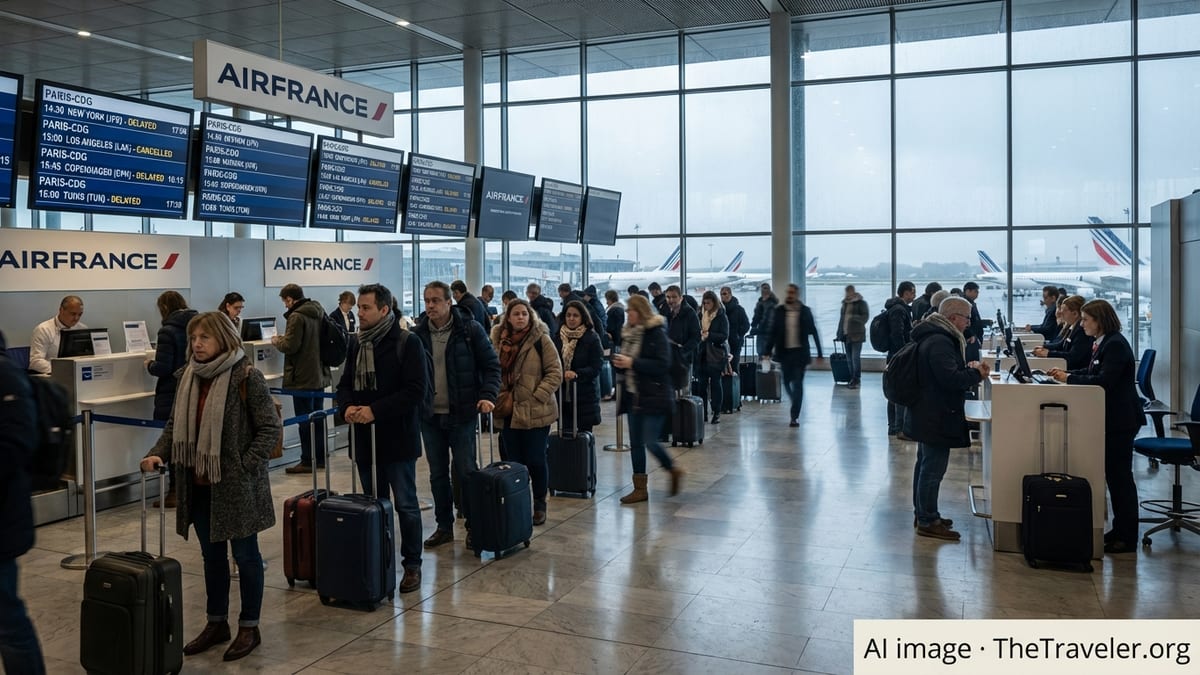
For travelers caught in today’s disruption at Paris Charles de Gaulle, the operational statistics translated into long waits and uncertainty. Images and reports shared via social and travel forums described crowded departure halls, long customer service lines and passengers resting on the floor near gates as they waited for new departure times.
Those with tight connections were among the most affected, particularly families and long haul travelers arriving from overnight flights who then faced missed onward services to London, New York, Dubai, Rome or Amsterdam. Some passengers reported being rebooked onto later flights or rerouted through alternate hubs, extending overall journey times by several hours.
The extent of the delays also renewed questions among travelers about their rights to care and compensation. Consumer information portals highlighted European Union regulations that may offer fixed compensation or reimbursement where significant delays or cancellations are not caused by extraordinary circumstances such as severe weather or air traffic control closures.
Travel advisors and passenger advocacy groups generally recommend that affected travelers keep boarding passes, booking confirmations and records of expenses, and submit claims directly to the operating airline where appropriate once their journey is complete.
Outlook for Operations at Paris Charles de Gaulle
By early evening, some indicators suggested that operations at Paris Charles de Gaulle were gradually stabilizing, although residual delays were expected to affect late night departures and early morning rotations for the following day. Aircraft and crew displaced by the day’s irregular operations often require several scheduling cycles to return to normal patterns.
Industry reports in recent months have noted that European air travel has largely recovered to pre pandemic levels, but infrastructure and staffing at some hubs remain under pressure during peak travel periods. Paris Charles de Gaulle, as a central node in this network, is particularly sensitive to any combination of technical, staffing or airspace constraints.
Passengers with upcoming flights through Paris are being advised by publicly available information sources to keep a close eye on live flight status tools, consider longer planned connection times where itineraries allow, and ensure that contact details with airlines and booking platforms are up to date in case of further schedule changes.
While the immediate disruption at Paris Charles de Gaulle is expected to ease as airlines clear the backlog of delayed services, today’s events underline the continued vulnerability of tightly timed hub operations and the importance for travelers of building flexibility into their plans wherever possible.