

More news on this day
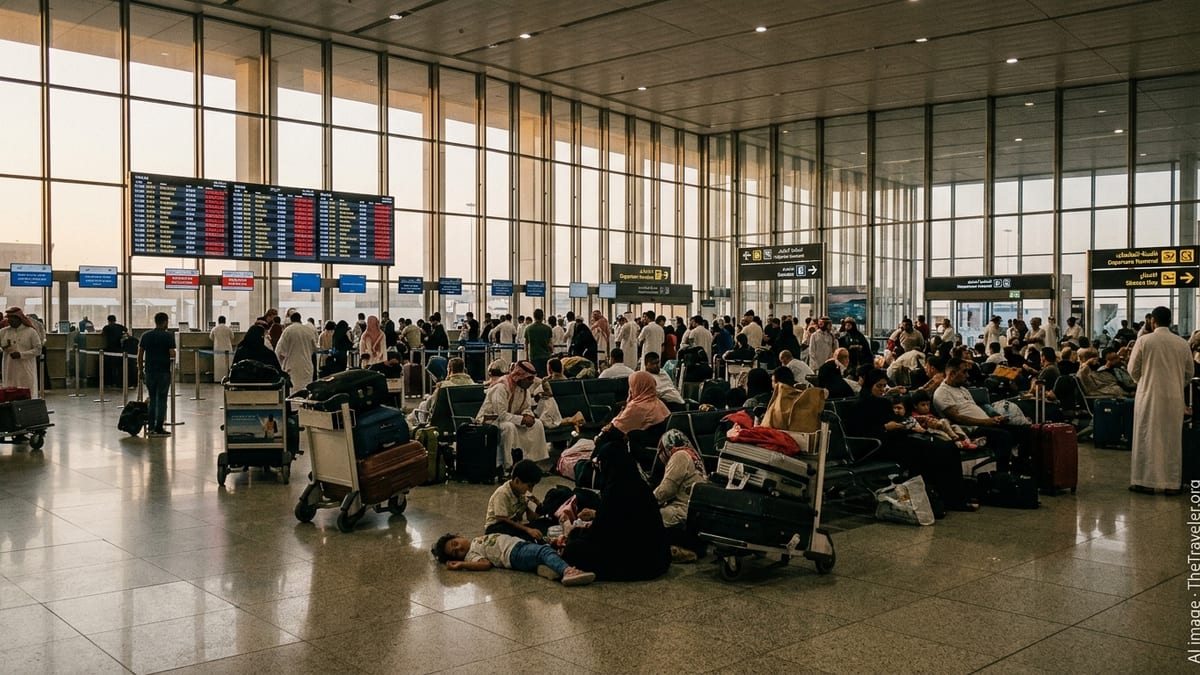
Hundreds of travelers were stranded at King Fahd International Airport in Dammam on Tuesday after a wave of 35 flight cancellations and 19 delays disrupted services by Saudia, Qatar Airways, Emirates, Gulf Air, Air Arabia and other carriers across key routes to Dubai, Cairo, Riyadh and several regional hubs.
Get the latest news straight to your inbox!
Operational Turmoil Hits Key Eastern Saudi Hub
King Fahd International Airport, a major gateway for Saudi Arabia’s Eastern Province and a growing transfer point for Gulf connections, has become an unexpected pressure valve for wider Middle East airspace disruption. Publicly available airport data and airline advisories indicate that a cluster of cancellations and rolling delays on services to and from Dammam has intensified in recent days, culminating in 35 flights cancelled and 19 delayed over a single 24 hour period.
The latest disruptions affect a mix of domestic and international operations. Flights to regional heavyweights such as Dubai and Cairo, as well as high-demand domestic links to Riyadh and Jeddah, have seen schedules repeatedly revised or pulled altogether. The knock-on effect has left departure halls crowded with passengers waiting for rebooking options or alternative routings via other Saudi and Gulf airports.
Travel industry monitoring of airline schedules shows that the turbulence is part of a broader pattern linked to constrained airspace, capacity bottlenecks at neighboring hubs, and shifting operational priorities as carriers focus on repatriation services and limited core routes. While Dammam itself remains open and functional, the airport is now feeling the ripple effects of decisions taken across the wider Gulf network.
Airlines Adjust Networks Amid Gulf-Wide Constraints
Saudia, Qatar Airways, Emirates, Gulf Air and Air Arabia are among the carriers most visibly affected at King Fahd International Airport, according to published schedules and passenger reports. Some services have been cancelled outright, while others have been consolidated, downgraded to smaller aircraft or retimed with extended layovers as airlines work to keep at least a skeleton network in operation.
Publicly available travel alerts show that several Gulf-based airlines have already suspended or sharply reduced services to select destinations in recent weeks, in response to airspace closures and security concerns around key hubs such as Doha and Dubai. As capacity at those primary hubs remains constrained, Dammam has increasingly appeared in airline communications as a temporary alternative or relief station for certain routes, particularly for Gulf Air and partner carriers.
The shift has created an unusual dynamic in which King Fahd International is both gaining strategic importance and suffering from intensified pressure. Airlines are attempting to balance their role in wider evacuation and repatriation efforts with the need to maintain commercial flights for business and migrant traffic, often resulting in last-minute schedule changes that are difficult for passengers to predict.
Passengers Face Long Waits, Complex Rebooking Options
The immediate impact for travelers transiting Dammam has been a familiar mix of uncertainty, long waits and scrambling for scarce seats. Accounts shared on social media and aviation forums describe passengers sleeping in terminal seating areas, queuing at service desks for hours and weighing whether to route themselves through alternative Saudi airports such as Jeddah or Riyadh to continue their journeys.
According to publicly shared airline guidance, rebooking policies have varied by carrier and by original travel date. Some airlines have broadened their waiver periods to allow free date changes or rerouting via different hubs, while others have remained more restrictive, prompting criticism from stranded travelers who feel their options are limited as the disruption drags on. The uneven policy landscape has added another layer of complexity for passengers already contending with cancellations and missed connections.
Travel agents and online booking platforms have reported spikes in searches for overland or multi-leg alternatives that circumnavigate the most affected parts of Gulf airspace. However, with neighboring countries also experiencing intermittent disruption, many of those workarounds remain vulnerable to last-minute schedule shifts. For now, flying through Dammam can involve a patchwork of separate tickets, extended stopovers and the risk of being caught by fresh cancellations.
Regional Conflict and Airspace Restrictions Drive Disruption
The strain at King Fahd International Airport is unfolding against the backdrop of an escalating regional conflict that has reshaped commercial aviation across the Gulf. Publicly accessible briefings and media coverage of the 2026 Iran war describe widespread airspace closures, missile and drone incidents around major hubs and a surge in emergency repatriation operations coordinated by national carriers and foreign governments.
According to open-source aviation and security assessments, closures or severe restrictions in the airspace of Qatar, the United Arab Emirates, Kuwait, Bahrain and other Gulf states have triggered thousands of daily flight cancellations since late February. Major hubs including Dubai and Doha have experienced repeated shutdowns or capacity curbs following security incidents, redirecting traffic and putting added pressure on secondary airports such as Dammam.
The pattern of cancellations and delays recorded at King Fahd International in recent days reflects this larger context. While Saudi airports remain officially open, reduced inbound traffic from neighboring states, rerouted overflights and rapidly changing operational risk assessments have forced airlines to reshuffle their networks on short notice. In this environment, even airports not directly targeted by attacks can see severe schedule volatility.
Travel Advisories Urge Flexibility as Situation Evolves
Travel advisories issued by governments and airlines in recent days have urged passengers bound for the Gulf to remain flexible, monitor their flight status closely and be prepared for last-minute changes. Public advisories point to the potential for further cancellations at short notice, particularly for flights crossing or approaching higher-risk airspace corridors.
For travelers using Dammam as either an origin, destination or transit point, practical guidance has increasingly focused on contingency planning. That includes allowing extra time between connections, keeping alternative routings in mind within Saudi Arabia’s domestic network and ensuring that accommodation, visa and insurance arrangements can accommodate unexpected delays.
With no clear timeline for a return to normal operations across the region, the cluster of 35 cancellations and 19 delays at King Fahd International Airport serves as a snapshot of a wider and still-unfolding crisis in Gulf aviation. For the hundreds of passengers left waiting in Dammam’s terminals, the hope is that additional capacity and clearer timetables will emerge before the disruption deepens further.