


Choosing between Maya Mobile and aloSIM can feel like splitting hairs: both are reputable eSIM providers, both work in well over 150 countries, and both can be dramatically cheaper than roaming with your home carrier. Yet once you dig into the pricing models and the way each service handles multi-country travel, it becomes clear that the “cheapest” option depends very much on how, where, and how often you travel.
Get the latest updates straight to your inbox!
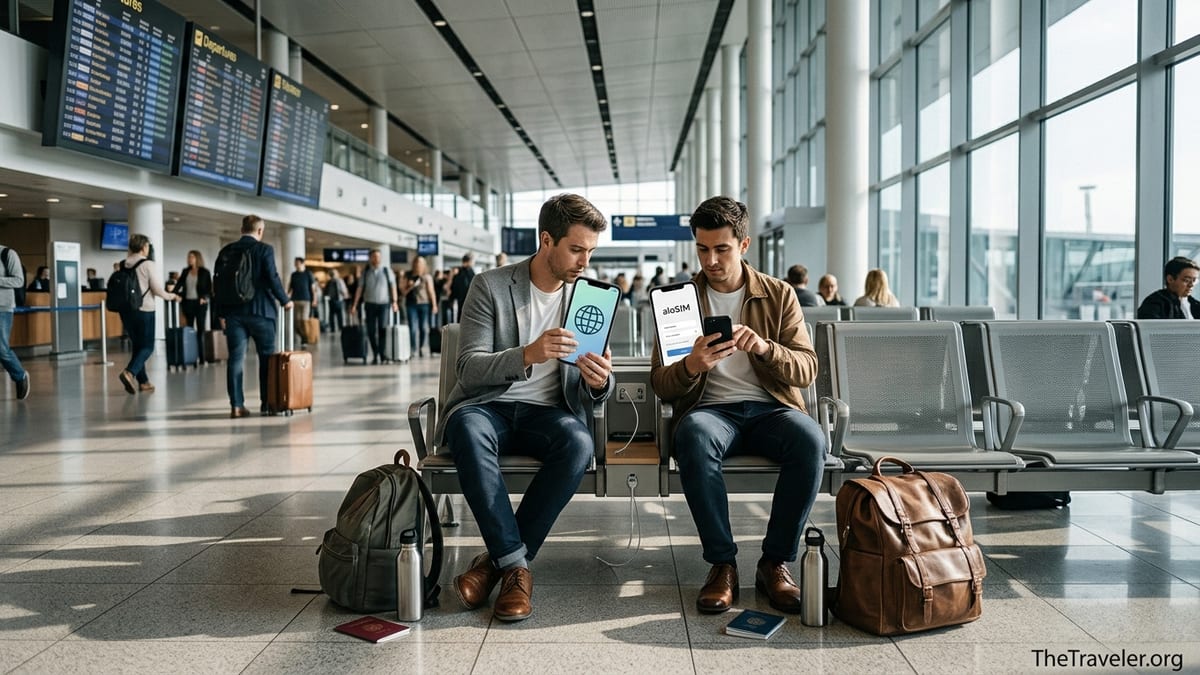
How Maya Mobile and aloSIM Work in Practice
Maya Mobile and aloSIM are both app-based eSIM providers aimed at travelers who want data without the hassle of physical SIM cards. You buy a plan online, scan a QR code or use an in-app install, and your phone connects to local partner networks when you land. In real-world use, that means you can step off a flight in Rome, New York, or Bangkok and start using maps and messaging within minutes, with no visit to a kiosk and no contract.
The biggest difference is how they structure those plans. Maya Mobile leans heavily into multi-country, unlimited-style offerings, especially with its newer “TravelMode” and Global plans that cover around 165+ countries under a single eSIM. Your one eSIM stays on your phone and can be toggled on only when you leave home, which is particularly useful for frequent travelers or digital nomads bouncing between regions.
aloSIM, on the other hand, focuses on highly granular prepaid data bundles, often country by country, with specific data caps such as 1 GB, 3 GB, or 20 GB over a fixed period. That suits travelers who know roughly how much data they need and prefer tight control over spending. In practice, a long-weekend traveler to Mexico or a seven-day city break in Paris often finds aloSIM’s small bundles very cost-efficient, while someone circling Europe for six weeks may gravitate toward Maya’s broader coverage and longer-duration plans.
From a usability perspective, both platforms are designed so that first-time eSIM users can get online quickly. aloSIM’s interface emphasizes picking a destination and data amount, whereas Maya Mobile pushes global or regional passes. For most travelers the learning curve is modest, but the kind of trip you are taking will heavily influence which app saves you more money.
Headline Prices: Global and Regional Plans Compared
To understand the money question, it helps to look at real prices available at the time of writing. Maya Mobile’s flagship global product offers unlimited data across roughly 165 countries, sold in day-based packages. Current published pricing for global coverage starts at about 9.99 US dollars for a 3-day package, 19.99 dollars for 7 days, 27.99 dollars for 14 days, and 49.99 dollars for 30 days, working out to about 1.67 dollars per day on the longest plan. The same price typically applies whether you are in France or Japan, which simplifies budgeting for multi-country trips.
aloSIM does not sell a single global unlimited product. Instead it lists different packages per country or region. For example, a current United States eSIM page shows 1 GB for 7 days priced around 4 dollars, 3 GB for 30 days at roughly 9 dollars, 10 GB for 30 days at about 23 dollars, and 20 GB for 30 days near 37 dollars. In Europe, aloSIM often sells regional plans that work across multiple EU countries, with similar tiered data options aimed at light, moderate, and heavy users, each with clear caps.
Those headline numbers immediately highlight the trade-off. Maya Mobile is easiest to understand if you value “set it and forget it” unlimited data: a month of global data under 50 dollars, whether you cross one border or ten. aloSIM’s tiered bundles can undercut that sharply for single-destination trips or light use. A solo traveler spending ten days in Italy who only needs 5 to 10 GB for maps, messaging, and occasional browsing might find aloSIM’s mid-range bundle closer to 15 to 25 dollars for the entire trip, compared with 27.99 dollars for a 14-day unlimited-style global plan from Maya Mobile.
However, once you start stringing together multiple destinations, the gap often narrows. Buying three separate aloSIM country plans for a multi-stop itinerary through Spain, France, and Germany can quickly approach or exceed the cost of one Maya Mobile global plan that simply follows you across the borders. That is why it is essential to map your route and rough data usage before deciding who is truly “cheaper.”
Short Trips and City Breaks: Where aloSIM Often Wins
For quick, focused trips to a single country, aloSIM usually has the money-saving edge. Consider a long weekend in New York City. A seven-day aloSIM United States plan with 1 GB of data is listed around 4 dollars, enough for maps, rideshare apps, messaging, and quick restaurant lookups if you lean on hotel and cafe Wi-Fi for heavier use. Even if you opt for a 3 GB, 30-day US bundle at about 9 dollars to play it safe, you are still paying well under Maya Mobile’s 9.99 dollars for a 3-day global plan.
Another good example is a five-day business trip to London. If you spend most of the day in an office with Wi-Fi and mainly need mobile data for navigation and taxi apps, a small aloSIM UK or Europe bundle of 2 to 3 GB might cost in the neighborhood of 8 to 12 dollars. Maya Mobile’s minimum seven-day tier is closer to 19.99 dollars, which makes less sense if you are leaving on day five and have modest data needs.
City-break travelers also tend to appreciate aloSIM’s pay-for-what-you-use style. If you know you are a light user, you can choose a 1 or 3 GB package and consciously keep heavier activities like streaming for the hotel’s Wi-Fi. This level of granular control makes aloSIM attractive for budget-conscious solo travelers, families trying to keep teens’ social media usage in check, and business travelers whose company only reimburses capped amounts.
In short, if your travel pattern is one country at a time with clear start and end dates and you are willing to think about your data consumption, aloSIM is often the more cost-efficient choice. The main caveat is that if your plans change mid-trip, you may need to top up or buy another package, which can nibble away at the savings if not managed carefully.
Multi-Country Itineraries and Long-Term Travel: Maya’s Strongest Arena
Where Maya Mobile starts to look cheaper over the full journey is on extended or multi-country travel. Take a 30-day backpacking trip through Western Europe, hitting Portugal, Spain, France, Italy, and Germany. With Maya Mobile’s 30-day global-style package at about 49.99 dollars, you buy once, install once, and use unlimited data across all those countries for roughly 1.67 dollars per day. There is no need to stop in each city to compare local packages or worry about which country your eSIM is “locked” to.
Replicating that with aloSIM would usually mean either buying a regional Europe eSIM with a sizable data cap or stacking multiple country-specific bundles. While aloSIM’s Europe regional data plans can be competitively priced, heavy users who stream music and video, upload batches of photos, and rely on hotspot tethering may find that they burn through the allotted data and need top-ups. By the time you purchase one or two extra bundles, the total outlay can creep close to or above Maya Mobile’s flat-rate unlimited price.
Similarly, consider a digital nomad spending three months in Southeast Asia, hopping between Thailand, Vietnam, and Indonesia. With Maya Mobile’s model of one installed eSIM that you toggle on each time you leave your home country, you can use a sequence of 14- or 30-day global passes without juggling multiple providers. The per-day rate is predictable, which simplifies monthly budgeting. For someone working remotely, the peace of mind of not running out of data mid-call or mid-upload often justifies the cost difference versus meticulously managing multiple capped regional bundles.
That does not mean aloSIM cannot work for long-term travel, especially if you are disciplined about usage and mostly based in one country at a time. A remote worker who spends entire months in Spain or Mexico might find that aloSIM’s 20 GB or 30 GB plans at a competitive price meet their needs if they lean on apartment Wi-Fi during work hours. The financial tipping point usually comes when you add frequent country changes, high data usage, or both; that is where Maya Mobile’s style of coverage becomes comparatively more economical.
Real-World Case Studies: Who Saves What?
To put all this into perspective, imagine three real-world scenarios. First, a couple from Chicago takes a 10-day honeymoon split between Paris and Rome. They each expect to use maps, social media, and some video calls home. If they choose aloSIM, one approach would be to buy a Europe regional eSIM with 10 to 20 GB for each person, costing roughly 20 to 35 dollars per person for the trip depending on the specific package and current promotions. With Maya Mobile, a 14-day global package at 27.99 dollars per person easily covers the entire trip with unlimited-style data. In this setup, aloSIM may be slightly cheaper if the couple keeps usage moderate, but Maya Mobile is competitive and may be preferable for those who do not want to think about gigabytes.
Second, consider a solo traveler from Toronto heading to Tokyo for seven days. aloSIM’s Japan country plan might offer a 5 GB, 10 GB, and 20 GB range, with mid-tier packages commonly priced between about 10 and 25 dollars. If that traveler expects to be out and about all day streaming music, translating signs with camera apps, and navigating complex train systems, a 10 GB or 20 GB bundle could easily be consumed. A Maya Mobile 7-day global package at around 19.99 dollars gives what is effectively unlimited usage for about 2.85 dollars per day, which can be cheaper than buying and topping up large aloSIM bundles in a high-data scenario.
Third, a family of four from Australia spends three weeks driving across the United States, visiting several national parks and major cities. If each family member buys a separate aloSIM US plan, even modest 10 GB 30-day bundles at about 23 dollars each add up quickly, especially if the kids stream video in the car. The family might end up spending close to 90 dollars or more on aloSIM just to keep everyone comfortably online. By contrast, parents could opt for two Maya Mobile 30-day global plans at 49.99 dollars each and use those phones as hotspots for the kids. That totals roughly 100 dollars but delivers truly unlimited data and hotspot sharing, removing the constant anxiety over who has “used up the data.”
These scenarios show that “cheapest” is not a single answer. aloSIM tends to win when users are light to moderate data consumers staying mostly in one place. Maya Mobile often pulls ahead when usage is heavy, countries are many, or when one device is used to supply data to several others via hotspot.
Beyond Sticker Price: Reliability, Support, and Hidden Costs
Price is only one part of value. Reliability, ease of setup, and support can quietly influence how expensive a service feels. aloSIM earns solid ratings on major review platforms, with many customers praising the straightforward purchase flow and responsive support when activation issues arise. Some reviewers mention that initial setup can be confusing if attempted on mobile data alone, but once configured, coverage in popular destinations like Scandinavia, the United States, and Australia is generally described as “good” to “very good,” with only occasional gaps in rural areas.
Maya Mobile also enjoys strong overall feedback, particularly from frequent travelers who like being able to install one eSIM and use it across multiple trips. The recent launch of its TravelMode app underscores the company’s push to make country-by-country planning obsolete by offering unlimited data in 165-plus countries with a single, permanently installed eSIM that activates only when you travel. Some user reports highlight intermittent technical hiccups in specific regions, but these are not unusual in the eSIM market and are often related to local network partners rather than the app itself.
Hidden costs tend to appear when something goes wrong. If you misconfigure an eSIM or lose access due to an installation error, you may need customer support to reissue or reset it. Both providers generally offer chat or email-based help, but the time lag and any potential need to purchase a replacement plan can turn a seemingly cheap package into a more expensive ordeal. Travelers who are not especially tech-savvy might find Maya Mobile’s “one eSIM for everywhere” approach less error-prone over multiple trips than juggling several aloSIM installs.
Another subtle factor is how each service handles auto-renewal and top-ups. Maya Mobile’s plans are one-time purchases by default, with optional auto top-up if you want a plan to renew when it expires. aloSIM typically requires a conscious decision to buy another bundle once your data is consumed. For a forgetful traveler, Maya’s ability to auto-renew a global pass can prevent last-minute scrambles, while aloSIM’s more manual style can prevent accidentally paying for days you do not use. Neither approach is inherently cheaper, but understanding how they work can help you avoid surprise expenses.
The Takeaway
When you strip away marketing language and look at how plans work on real itineraries, a simple pattern emerges. aloSIM is usually the more economical choice for short, single-country trips and for travelers with predictable, moderate data needs. Maya Mobile is often the better value for longer, multi-country journeys or for anyone who needs generous or unlimited data without micromanaging usage.
If you are taking a four-day work trip to Berlin or a five-day city break in New York, a small to mid-sized aloSIM data bundle will likely cost less than a week of global-style coverage from Maya Mobile, provided you are comfortable keeping heavy tasks on Wi-Fi. If, however, you are backpacking across multiple regions for a month, road-tripping across several US states, or working remotely from different countries in the same season, Maya Mobile’s per-day pricing can quickly become competitive or even cheaper once you factor in the cost of stacked or topped-up aloSIM bundles.
The real money saver is planning. Before you buy, sketch out your route, count how many borders you will cross, and estimate whether you are a 5 GB or a 50 GB traveler. Then compare a single Maya Mobile pass that covers the entire time against one or more aloSIM bundles tailored to specific countries. Whichever app you choose, using Wi-Fi generously, disabling background data-hungry apps, and sharing one high-capacity plan via hotspot can help stretch your budget further.
Ultimately, there is no one-size-fits-all winner. Instead, think of Maya Mobile as a global flat-rate tool and aloSIM as a precise, pay-as-you-go scalpel. Choose the one whose strengths best match your itinerary and data habits, and you will almost certainly spend far less than you would on traditional roaming from your home carrier.
FAQ
Q1. Which is cheaper for a one-week trip to a single country, Maya Mobile or aloSIM?
For most one-week, single-country trips, aloSIM is usually cheaper, because you can buy a small 1 to 3 GB bundle tailored to your needs, which often costs less than Maya Mobile’s seven-day global-style package.
Q2. When does Maya Mobile usually save more money than aloSIM?
Maya Mobile typically becomes better value on longer or multi-country trips, or when you expect heavy data use such as streaming, frequent hotspot tethering, or constant navigation and uploads.
Q3. Are both services really cheaper than roaming with my home carrier?
In most cases, yes. Traditional roaming often charges per megabyte or offers expensive day passes, whereas both Maya Mobile and aloSIM provide clear, upfront pricing that usually works out far cheaper over an entire trip.
Q4. How much data do I need for a typical city break?
A light user who relies on Wi-Fi for streaming can often manage a four- or five-day city break with 3 to 5 GB. Heavier users who stream music on the go or upload lots of photos may want 10 GB or more.
Q5. Can I share my Maya Mobile or aloSIM data with other devices?
On most modern phones, both services allow personal hotspot use, so you can share data with a laptop or tablet. Always check your specific plan details and phone settings before relying on tethering.
Q6. What happens if I run out of data on aloSIM mid-trip?
If you exhaust your aloSIM data allowance, you can usually top up by purchasing another bundle in the app. Just be aware that multiple top-ups can erode the initial cost advantage versus an unlimited-style plan.
Q7. Do I need a separate eSIM for every country I visit with aloSIM?
Not always. aloSIM offers regional plans, for example covering multiple European countries, but if you choose strictly country-specific bundles you may need separate plans as you cross borders.
Q8. Is setup complicated for first-time eSIM users?
Both providers are designed for non-experts. You follow on-screen instructions, scan a QR code or tap an install button, and then enable the eSIM. Some travelers prefer to do this over Wi-Fi before departure to avoid confusion upon arrival.
Q9. What if my phone is locked to my home carrier?
To use Maya Mobile or aloSIM, your phone generally needs to be carrier-unlocked and eSIM compatible. If your device is locked, contact your carrier to request an unlock or consider using a portable Wi-Fi hotspot instead.
Q10. Can I use promotions or discount codes to reduce costs further?
Yes. aloSIM, in particular, often circulates discount codes through partners and promotions, while Maya Mobile may run periodic sales or offer referral credits. Checking for current offers before purchasing can yield additional savings.