


For most visitors, the journey from Melbourne Airport to the city begins on a bright red SkyBus bound for Southern Cross Station. This busy transport spine on the western edge of the CBD is where airport coaches, suburban trains, regional rail and trams all converge. Understanding exactly how SkyBus works, how to connect onward to your hotel and when Southern Cross is (and is not) the smartest arrival point will save you both money and stress after a long flight.
Get the latest updates straight to your inbox!
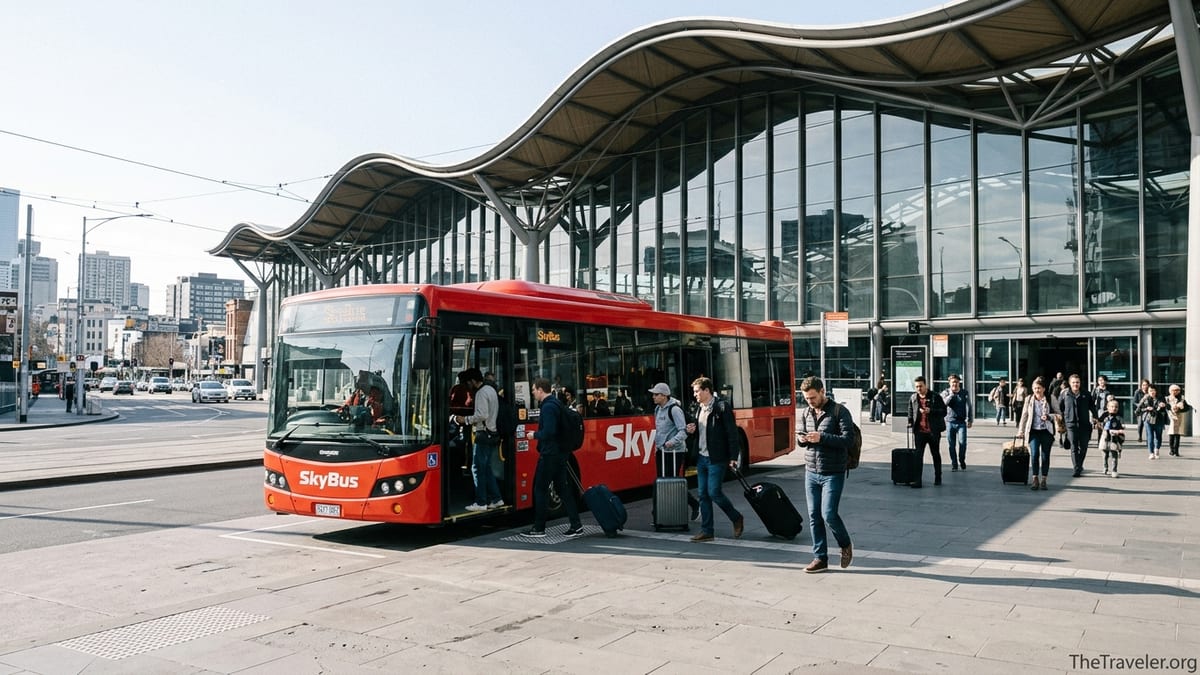
SkyBus: The Main Link Between Melbourne Airport and the CBD
SkyBus is the primary public transport-style connection between Melbourne Airport and central Melbourne, running an express Melbourne City Express service to Southern Cross Station. Buses depart from outside Terminals 1, 3 and 4 and operate around the clock, with services advertised as at least every 10 minutes in peak times and typically every 10 to 20 minutes off-peak. In practice, on a weekday mid-morning you can usually expect to wait less than 10 minutes, while late-night or very early morning services may be slightly less frequent but still regular.
The journey from the airport to Southern Cross is marketed as taking about 20 to 25 minutes in light traffic, although at peak times on the Tullamarine Freeway it is sensible to allow 35 to 45 minutes. For example, a mid-afternoon weekday arrival might see your coach glide into Southern Cross in roughly 25 minutes, while a Friday evening arrival could stretch closer to 40 minutes as traffic builds around the city exits.
SkyBus is not part of Melbourne’s Myki ticketing system and must be paid for separately. One-way adult fares on the Melbourne City Express commonly sit in the mid-20 Australian dollar range, with discounts for return tickets, children and families. Prices do fluctuate over time, so it is best to treat any figure you see as indicative, but it is reasonable to budget roughly the cost of a short taxi ride into the CBD, often less than half the price of a door-to-door ride share in heavy traffic.
On board, SkyBus is set up for air travellers, with underfloor luggage storage and overhead racks, plus free Wi-Fi and air conditioning. Seats are similar to long-distance coach seating rather than city buses, which makes the 20 to 40 minute ride after a long-haul flight comparatively comfortable. There are no stops between the airport and Southern Cross, so once you leave the terminal you can settle in without worrying about where to get off.
Buying SkyBus Tickets and Navigating the Terminals
Tickets for SkyBus can be purchased in several ways, and the choice can affect how quickly you clear the airport. Many travellers now buy online before they fly, using a card payment and either saving the QR code to their phone or printing it. This can be useful if you are landing at busy times when queues at the airport kiosks can be long, or if you are travelling with a family and want the cost locked in before arrival.
If you prefer to buy after landing, there are SkyBus ticket counters and self-service kiosks located landside in the arrivals halls near the exits to the coach bays. At Terminal 2 (international), you typically walk out after customs, turn toward ground transport and follow the red SkyBus signs to the ticket machines and bus stands. At Terminal 1 (Qantas domestic) and Terminal 3 (Virgin and others), SkyBus stops are directly outside the terminal doors, with signage pointing to ticket machines nearby. At Terminal 4, which handles several low-cost carriers, the SkyBus pick-up point is in the transport forecourt just a short walk from the arrivals area.
Tickets are checked either by the driver or a staff member at the bus bay before you board. If you have a digital ticket, make sure your phone screen brightness is high enough for scanners to read the QR code quickly. Physical tickets can usually be folded and kept in a passport, but avoid creasing the barcode area. Unlike public buses around Melbourne, you do not tap on and off with a Myki card; SkyBus uses its own ticketing system, so keep any Myki card you already have in your pocket until you reach Southern Cross.
Families and groups should note that children under a certain age often travel free with a paying adult on the Melbourne City Express. The exact age threshold and conditions can change, so check the latest terms, but it remains a cost-effective option compared with putting a family of four in a single taxi in heavy traffic. Some airlines and tour operators also bundle SkyBus tickets into packages, especially for study groups or conference delegations, so it is worth asking if your organiser has pre-arranged transfers before you purchase separately.
Arriving at Southern Cross: Layout, Luggage and First Steps
Southern Cross Station sits at the corner of Spencer and Collins Streets, beneath a distinctive undulating roof that makes it easy to recognise from the coach platforms. SkyBus services arrive at the coach terminal section on the western side of the station precinct, separate from the main suburban rail platforms. On arrival, luggage is unloaded from the underfloor compartments by passengers, so be prepared to lift your bags quickly to avoid delays for the next departure.
Once you step off the bus, you will find yourself in a covered coach terminal with clear signs to trains, trams and the main concourses. If you have large suitcases, it is worth taking a moment to adjust your bags before heading into the crowd; there are ramps and lifts linking the coach bays to the main station, but some routes involve moderate slopes and can be awkward with multiple bags. Trolleys are not as common around the coach terminal as they are inside the airport, so assume you will be rolling your own luggage.
Inside Southern Cross, the concourse is wide but can be busy during commuter peaks and event days, especially when major sports are on at nearby Marvel Stadium. Information screens list both metropolitan Metro Trains services and regional V/Line departures, while a Public Transport Victoria information hub and ticket windows are typically located near the Spencer Street side. If you plan to connect straight to a train or tram, follow the colour-coded signs to the relevant platforms or street exits, taking care to keep your bags close as the station is a bustling public space.
Southern Cross offers amenities such as cafes, convenience stores, ATMs and public toilets, which can be very welcome after a flight. A practical routine for many visitors is to head to a cafe near the Collins Street entrance for a quick drink while checking accommodation details and planning the next leg. Wi-Fi is often available in parts of the station and in nearby cafes, though quality can vary, so do not rely on it for major downloads right after arrival.
Connecting to CBD Hotels: SkyBus Hotel Transfer vs Trains and Trams
For many travellers, the most important question is how to get from Southern Cross to a CBD hotel. SkyBus has historically offered a complimentary or low-cost hotel transfer shuttle from Southern Cross to a selection of central hotels and serviced apartments, operating on a loop. These services tend to focus on popular areas such as around Queen Street, Swanston Street, and the eastern end of the CBD. Availability and coverage can change, and seats are generally first-come, first-served, so always check current details before planning on a hotel shuttle as your main connection.
In practical terms, if your hotel is near Spencer Street, Collins Street west or Docklands, you may simply walk from Southern Cross with your luggage. For example, guests staying at properties close to Batman’s Hill, around King Street, or near Marvel Stadium can often reach their hotel in under 10 to 15 minutes on foot using wide, well-lit footpaths. In this case, a taxi or shuttle would offer only marginal time savings compared with walking.
If you are staying around Flinders Street, Federation Square, or the eastern CBD near Parliament, trams are usually the most efficient option. Free trams run along much of the CBD grid, including routes on Collins Street, Bourke Street and Flinders Street, and Southern Cross has tram stops immediately outside on Spencer Street and Collins Street. For instance, arriving at Southern Cross and taking a Collins Street tram east can bring you to the heart of the business district or the top-end hotels near Spring Street within 10 to 15 minutes, and much of this ride falls within the Free Tram Zone so no ticket is required if you are travelling solely within that area.
For hotels outside the CBD, such as in South Yarra, Richmond, or North Melbourne, connecting to a suburban train from Southern Cross can be effective. You might, for example, arrive on SkyBus, buy or top up a Myki card at the station, then board a train towards Frankston or Sandringham and alight at South Yarra for hotels lining Toorak Road and Chapel Street. In these cases, Southern Cross works well as a central interchange, but it may not always be the absolute best station depending on your hotel location and preferred route, which we explore later.
Understanding Myki, Train Connections and When to Skip SkyBus
Once you move beyond Southern Cross, Melbourne’s wider public transport runs on the Myki smartcard system. This covers suburban trains, trams and most buses within the metropolitan area. You cannot use Myki on SkyBus, but you will need it if you plan to continue by train, tram or regular bus. Conveniently, there are Myki machines and staffed windows within Southern Cross where you can buy a card and add credit. Visitors staying primarily inside the central area often find that many short tram trips are inside the Free Tram Zone, but you will still want a Myki for any travel beyond the inner grid.
Connecting from SkyBus to suburban trains is straightforward in principle. From the coach terminal, follow the signs to the suburban platforms, check the overhead screens for your line and platform, then tap on with Myki at the fare gates. For example, to reach Fitzroy or Collingwood you might board a Mernda or Hurstbridge line train from Southern Cross to Parliament or Collingwood, then take a short tram or walk. To reach St Kilda, you might instead take a tram from Southern Cross along Collins or Bourke Streets to a connecting route, or use a separate SkyBus service that runs directly to bayside suburbs if it better fits your plans.
There are also fully public transport alternatives to SkyBus that combine suburban trains with regular bus routes to the airport, typically at a lower overall fare but with longer travel times and more changes. A commonly used route is the train to Broadmeadows on the Craigieburn line, then the 901 bus from Broadmeadows to Melbourne Airport. In practice, if you arrived at Southern Cross by regional train from country Victoria and were heading to the airport, you might choose to continue by train to Broadmeadows and then take the 901, especially if cost is a higher priority than speed. However, this route can take over an hour from the CBD and involves transferring at an outer suburban station, so it is less attractive for heavily loaded visitors than the dedicated SkyBus coaches.
Some travellers staying in specific suburbs may find that SkyBus to Southern Cross is not the optimal method at all. For example, if your hotel is in the northwest suburbs near Essendon or in the inner north around Coburg, you might reach your accommodation more directly using the 901 or 902 orbital buses from the airport, connecting to the local tram and train network without ever visiting Southern Cross. Similarly, if you have a very early regional rail departure from another suburban hub, it is sometimes worth comparing door-to-door ride share fares with the combined cost of SkyBus plus a train, especially when travelling as a group of three or four.
Travel Time, Peak Periods and How Early to Leave for the Airport
Estimating how long it will take to travel between Melbourne Airport and Southern Cross is crucial, particularly for your return journey. While SkyBus can complete the run in around 20 minutes in free-flowing traffic, peak hour and incidents on the Tullamarine Freeway can add substantial delays. For morning flights departing between about 7 am and 9 am on weekdays, it is wise to allow at least 45 minutes on SkyBus plus a buffer for reaching the bus stop at Southern Cross. Similarly, for afternoon and early evening flights, particularly on Fridays, build in extra time from the city to the airport.
A practical rule used by many locals is to aim to be on a SkyBus leaving Southern Cross at least 2.5 to 3 hours before a domestic departure and 3 to 3.5 hours before an international departure, depending on their airline’s check-in cut-off. For example, if you are on a 6 pm international flight, plan to board a SkyBus around 2.15 pm to 2.30 pm. Even if you reach the airport in just 25 minutes, you will appreciate the extra time if security queues are long or if baggage drop lines move slowly.
Conversely, when arriving in Melbourne, it is usually less critical to time your SkyBus precisely, because you can simply board the next available service. However, if you are connecting to a specific regional train departure from Southern Cross, such as a V/Line service to Geelong or Ballarat, check the timetable in advance and allow a generous margin. Missing a regional train can leave you waiting 30 minutes to an hour for the next one, which is far more inconvenient than waiting 5 or 10 extra minutes for a SkyBus at the airport.
Weather in Melbourne can also affect travel times indirectly. Heavy rain can slow freeway traffic and increase the likelihood of minor accidents, particularly in the cooler months. On days when major events are scheduled in the CBD or at Marvel Stadium, road traffic around the city exits can thicken earlier in the evening. If you know a big football match or concert is happening, consider catching an earlier SkyBus from the airport or adjusting your connection through the CBD to avoid the heaviest crowds.
Is Southern Cross Really the Best Arrival Point for Everyone?
Southern Cross Station has become the default arrival point between Melbourne Airport and the city, but it is not necessarily the best option for every traveller or itinerary. Its strengths are clear: it offers a direct, frequent, relatively fast coach connection; it is a major hub for suburban and regional trains; and it sits within walking distance of many CBD offices and western-end hotels. For someone staying at a Spencer Street hotel, working near Docklands, or catching a V/Line service to the regions, arriving at Southern Cross is almost always the most convenient arrangement.
However, the station’s location on the western edge of the CBD means that if your main destination is in the eastern or northern parts of the city, or in inner suburbs beyond, you will often need to backtrack via tram or train. For instance, guests staying near Parliament Station or in the lively restaurant district of Fitzroy Street in St Kilda may find that SkyBus to Southern Cross plus tram or train still works well, but alternative services, such as the SkyBus route to St Kilda or a combination of train and the 901 airport bus, could offer a more direct path depending on schedules and traffic.
Another consideration is accessibility and crowding. Southern Cross can be extremely busy during commuter peaks and major events, which can be overwhelming if you are jet-lagged or travelling with children, bulky sports equipment or mobility aids. While the station has lifts, ramps and accessible paths, navigating them with heavy luggage at 8.30 am on a weekday may not feel especially relaxing. In contrast, some travellers choose to avoid the hub entirely by arranging a door-to-door taxi, rideshare or private shuttle from the airport to their accommodation, trading higher cost for simplicity and comfort.
For regional and interstate train passengers, Southern Cross is unquestionably the right place to be. It is the terminus for most long-distance and regional V/Line and interstate services, so if you are headed straight from the airport to Geelong, Bendigo or even Adelaide by train, SkyBus to Southern Cross remains the most coherent strategy. In that context, Southern Cross is less an optional arrival point and more the essential interchange linking air and rail travel for Victoria.
The Takeaway
For most visitors, SkyBus from Melbourne Airport to Southern Cross Station is the most practical and predictable way into the city. The coaches are frequent, purpose-built for travellers with luggage and integrated into a transport hub that offers fast onward links by tram, suburban train and regional rail. Buying tickets in advance, understanding that SkyBus is separate from the Myki system and giving yourself a generous buffer for peak-hour traffic will all make your trip smoother.
Southern Cross works especially well if you are staying in the western CBD, Docklands or connecting to a regional train. If your hotel lies deeper inside the CBD or in nearby suburbs, plan your second leg carefully: the free city trams, occasional SkyBus hotel shuttles and suburban train lines can all play a role in completing your journey. For some travellers, particularly those with mobility needs, young children or very late-night arrivals, the simplicity of a taxi or rideshare directly from the airport to the door may outweigh the savings of SkyBus.
Ultimately, there is no single perfect route for every visitor. What matters most is matching your transport choice to your specific destination, schedule, budget and tolerance for crowds. By understanding how SkyBus, Southern Cross Station and Melbourne’s wider network fit together, you can step off the plane with a clear plan and start enjoying the city sooner.
FAQ
Q1. How long does SkyBus take from Melbourne Airport to Southern Cross Station?
In light traffic, SkyBus usually takes around 20 to 25 minutes, but at busy times on the Tullamarine Freeway you should allow 35 to 45 minutes to be safe.
Q2. Do I need a Myki card to ride SkyBus?
No. SkyBus uses its own ticketing system and does not accept Myki. You buy SkyBus tickets separately, then purchase or top up a Myki card at Southern Cross for trains, trams and regular buses.
Q3. How much does a SkyBus ticket from the airport to the city cost?
Adult one-way fares on the Melbourne City Express typically sit in the mid-20 Australian dollar range, with discounted return, child and family options. Treat any example price as approximate, as fares may change.
Q4. Where exactly does SkyBus drop me at Southern Cross?
SkyBus services arrive at the coach terminal area of Southern Cross Station, on the western side of the precinct. From there, signed walkways and ramps lead into the main concourse and on to train and tram connections.
Q5. Is there a free hotel shuttle from Southern Cross Station?
SkyBus has offered hotel transfer shuttles from Southern Cross to selected CBD hotels on some services. Coverage, times and pricing can change, so always check the latest information before relying on a shuttle for your connection.
Q6. Can I walk from Southern Cross to my CBD hotel?
Yes, if your hotel is in the western or central CBD, walking is often the simplest option. Many hotels near Spencer Street, King Street and Docklands are within about 10 to 15 minutes on foot from Southern Cross.
Q7. What is the best way to reach the eastern end of the CBD or Parliament area?
From Southern Cross, trams along Collins Street or Bourke Street are usually fastest. Much of this trip falls within the Free Tram Zone, so you can ride without tapping a ticket if you stay inside the central grid.
Q8. Are there cheaper alternatives to SkyBus using regular public transport?
Yes. A common low-cost option is to take a suburban train to Broadmeadows on the Craigieburn line, then connect to the 901 bus to Melbourne Airport. This is usually slower and involves more changes, but can be cheaper than SkyBus.
Q9. How early should I leave the city for a flight using SkyBus?
Many travellers aim to board a SkyBus 2.5 to 3 hours before a domestic flight and 3 to 3.5 hours before an international flight. This covers coach travel, ticketing, security and possible traffic delays.
Q10. Is Southern Cross always the best arrival point from the airport?
Southern Cross is ideal if you are staying in the western CBD, Docklands or catching regional and interstate trains. If your destination is in other suburbs or on specific tram lines, alternative routes or SkyBus services may sometimes be more direct.