


Melbourne Airport can feel confusing on arrival, especially if you see four different terminal numbers on the same forecourt. Qantas, international, Virgin Australia and Jetstar all use different parts of the airport, and choosing the wrong one can easily cost you a missed flight. This guide breaks down Terminals 1, 2, 3 and 4 in practical, real-world terms so you know exactly where to go, how to move between them, and what to do if you end up in the wrong place.
Get the latest updates straight to your inbox!
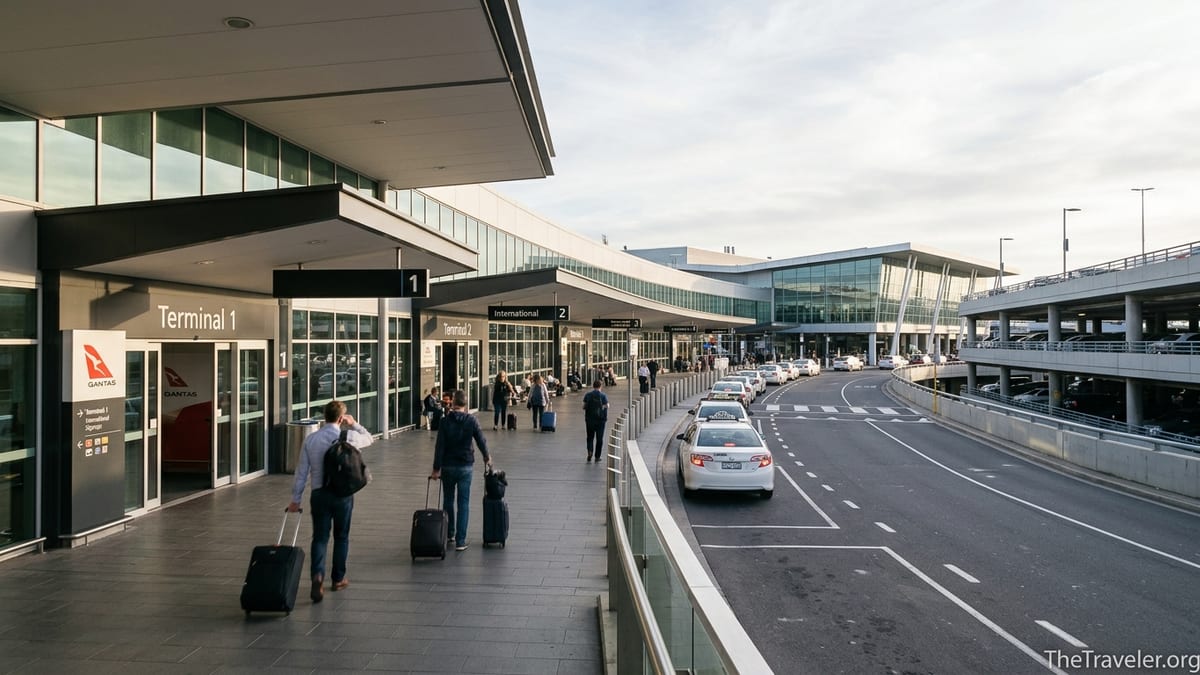
Melbourne Airport at a Glance: The Four-Terminal Layout
Melbourne Airport at Tullamarine has four passenger terminals, all arranged in a rough line along a single elevated forecourt. Terminals 1, 2 and 3 sit together in one large connected building, often referred to as the “T123” complex by the airport. Terminal 4 is a newer, separate building a short walk further along the same frontage. You can walk between any two terminals airside only when specifically permitted, but in most cases you move between them on the public side of security, following clear overhead signage.
In broad terms, Terminal 1 is Qantas domestic, Terminal 2 is international for all airlines, Terminal 3 is Virgin Australia domestic, and Terminal 4 is the budget-style domestic terminal used mainly by Jetstar, Rex and Link Airways. Qantas international flights depart and arrive from Terminal 2, not Terminal 1, even though their domestic services are next door. This split catches a lot of first-time travelers out, especially those who simply follow the first Qantas sign they see.
From the road and car parks, the T123 Terminal Car Park sits directly opposite Terminals 1, 2 and 3, while a separate multi-level car park serves Terminal 4. Typical walking time from the T123 car park to check-in desks is only a few minutes under cover, while walking between T1 and T4 along the forecourt usually takes around 7 to 10 minutes at an average pace. This matters when you are tight on time and considering whether you can correct a wrong-terminal mistake by walking.
All four terminals share the same general transport spine. SkyBus coaches to Melbourne’s Southern Cross Station, public buses, taxis and rideshare pick ups are clustered near the central forecourt and road system. The exact pick up point differs slightly for Terminal 4 versus Terminals 1, 2 and 3, which becomes important if you tell a driver “pick me up at the terminal” without saying which one.
Terminal 1: Qantas Domestic Hub
Terminal 1 is Qantas’s domestic stronghold at Melbourne Airport. If you are flying Qantas within Australia on a QF flight number, chances are your flight will depart from T1. This includes major trunk routes such as Melbourne to Sydney, Brisbane, Perth and Adelaide, as well as many regional services. Inside, you will find Qantas check-in zones, self-serve bag drops, security screening and access to the Qantas Club and Domestic Business lounges for eligible passengers.
All Qantas domestic check-in and baggage drop facilities are landside on the departures level. After you pass through security, the pier opens into a long concourse of gates serving both mainline and QantasLink flights. If you land here on a domestic sector and are terminating in Melbourne, you simply follow the “Baggage Claim / Ground Transport” signs to the carousel area, then out to the forecourt where you can access taxis, rideshare, SkyBus and the main terminal car park.
Confusion commonly arises when passengers have one domestic and one international Qantas flight. Qantas domestic flights operate from T1, but Qantas international services use T2, even when they are on the same ticket. For example, if you are flying Launceston to Melbourne on Qantas and then Melbourne to Singapore on Qantas, you will arrive at T1 and then walk across to T2 for your onward flight. On an international-to-domestic connection in the reverse direction, you will arrive into T2, clear immigration and customs, collect your bags, exit into the public area and then walk to T1 to re-check for your domestic sector.
A wrong-terminal mistake here often involves travelers going to T1 for an international Qantas flight because they associate Qantas with that building. If you see long-haul destinations like Singapore, Los Angeles or London on your itinerary, start your journey in Terminal 2, even if your airline is Qantas. Using the departure boards or the airport’s terminal finder before you leave home can prevent an unnecessary dash along the forecourt with luggage.
Terminal 2: International Flights and Passport Control
Terminal 2 is Melbourne’s dedicated international terminal. All scheduled international passenger flights, across all airlines, operate from T2. This includes Qantas, Jetstar international services, Virgin Australia international routes when they operate from Melbourne, as well as carriers such as Singapore Airlines, Emirates, Cathay Pacific, Air New Zealand, Malaysia Airlines and many others. If your flight crosses a border and requires a passport, you will almost certainly depart from or arrive into Terminal 2.
Departing passengers enter T2 on the departures level, where you find airline check-in rows for all international carriers. After check-in and bag drop, you proceed to outbound security screening and then to Australian outbound immigration. On the airside concourse, there is a central duty-free store, food outlets and a spread of airline-operated lounges on upper or side levels. Because all international flights share this space, it can be busy during the evening long-haul departure wave, so arriving at the airport the recommended two to three hours before departure is sensible, especially during school holidays or public holidays.
On arrival into Terminal 2, the process reverses. International passengers disembark and are funneled through immigration, baggage claim and biosecurity screening before reaching the public arrivals hall. Even if your bags are tagged through to a domestic destination, Australian regulations usually require you to collect your checked luggage in T2 on arrival, clear customs, then re-check the bags with your domestic airline. For example, a passenger flying Tokyo to Melbourne to Hobart on a single Qantas ticket will still retrieve luggage in T2, clear formalities, then walk over to Terminal 1 to drop bags for the domestic connection.
For travelers connecting between two international flights at Melbourne, you remain within T2 but still clear Australian immigration in most cases, as Melbourne does not operate an entirely separate sterile international-to-international transit zone that bypasses border controls for every route and airline. Minimum connection times vary by airline, but booking a legal through-ticket rather than separate tickets gives you better protection if delays occur. With separate tickets, you are responsible for collecting bags, exiting customs and re-checking, often requiring at least three hours between flights to be comfortable.
Terminal 3: Virgin Australia Domestic
Terminal 3 is the home of Virgin Australia’s domestic operations at Melbourne Airport. If your boarding pass shows “VA” and a domestic route such as Melbourne to Sydney, Brisbane, Hobart or Perth, you will almost always check in and depart from T3. Inside, you find Virgin’s check-in desks, kiosks and bag drop, followed by domestic security screening and access to the Virgin Australia lounge on the departure side for eligible passengers.
For domestic arrivals, bags are delivered to carousels on the ground level of T3. From here, exits lead directly to the main public forecourt. The arrangement is similar to T1, which means a Virgin passenger landing in Melbourne and heading into the city can walk out to the same line of taxi ranks and buses used by Qantas domestic travelers. This consistency helps when different people in the same group are flying in on different airlines but meeting up at the airport.
Virgin has historically offered connection support between its domestic services and certain international partners. In practice, this means some passengers arriving into T3 on Virgin and connecting to a partner international flight in T2 may have their baggage interlined and receive both boarding passes at their origin. Even then, you generally still need to walk landside from T3 to T2 to go through outbound immigration for your international sector. The two terminals are directly adjacent, and the walk at a moderate pace typically takes less than five minutes under cover.
A common error is confusing T3 with T4 for Virgin flights, because Virgin branding appears at both ends of the terminal frontage. Virgin primarily uses Terminal 3 for check-in and departures, but certain operational arrangements or overflow circumstances can see passengers directed through Terminal 4 for ground access or boarding gates on occasion. Always check the airport screens or your booking for “T3” before you head to the terminal, and if in doubt ask airport staff rather than assuming that a Virgin logo near T4 means you are in the right place.
Terminal 4: Jetstar, Rex, Link Airways and the “Budget” Setup
Terminal 4 is Melbourne Airport’s newer, low-cost-oriented domestic terminal. It is used predominantly by Jetstar for domestic routes, along with Rex and Link Airways. Many Australian travelers associate “Jetstar” with “Terminal 4” in Melbourne. If you are flying Melbourne to destinations like Sydney, Gold Coast, Cairns or Hobart on Jetstar, or on smaller regional carriers such as Rex or Link Airways, Terminal 4 is usually where you need to be.
T4 has a different feel from the older terminals. Departing passengers typically enter through a large hall with an emphasis on self-service kiosks and automated bag drops, reflecting the low-cost carrier model. After a single main security checkpoint, you emerge into a central food court and retail hub, from which a long straight pier leads down to the higher-numbered Jetstar and Rex gates. There are no travelators along much of this pier, so those heading to the furthest gates, commonly in the 40s, should allow extra time for the walk, especially if traveling with children or heavy carry-on.
Arrivals into Terminal 4 funnel passengers to baggage claim on the lower level, then out to clearly signed pick up points. T4 has its own multi-level car park located close to the terminal, which is especially convenient for people regularly dropping off or collecting Jetstar passengers. Many locals choose to meet arriving friends and family directly at the Terminal 4 pick up area because it is often perceived as less congested and more logically laid out than the older T123 front. If you arrive at T4 but your ride is waiting at the T123 forecourt, you can walk along the signed pathway between the two in around 7 to 10 minutes.
A frequent real-world mistake is passengers arriving at the main T123 forecourt for a Jetstar flight because they assume all domestic departures are together. Jetstar’s domestic check-in is in T4, not T1 or T3. If you spot that you are at the wrong place early, you can usually still walk to T4 and make your flight, but arriving at the airport only 45 minutes before departure and then discovering you are in the wrong terminal can easily lead to a missed service and same-day change fees. The safest approach is to double-check your booking confirmation, which almost always spells out “Terminal 4” for Jetstar, Rex and Link Airways at Melbourne.
Baggage Claim, Ground Transport and Walking Routes Between Terminals
Although each terminal has its own baggage claim area, the general ground transport options at Melbourne Airport converge on the same road system. After collecting your luggage in any terminal, you follow the “Exit / Ground Transport” signs to reach the public forecourt. Here you find taxi ranks, rideshare meeting points, hotel shuttles and the SkyBus coach services to central Melbourne and other suburbs.
From Terminals 1, 2 and 3, the exits lead out to a shared central forecourt. SkyBus coaches to the city depart from clearly marked bays adjacent to this area, and the main taxi and rideshare pickup zones are only a short walk away. The T123 Terminal Car Park is directly opposite these three terminals, meaning that someone who has parked there to collect you can walk across in just a few minutes. For instance, a family collecting relatives from a Qantas domestic flight can park in the T123 car park, meet them outside T1 arrivals, and be back to the car within 10 minutes if baggage appears promptly.
Terminal 4’s arrivals exit leads to its own ground transport forecourt and multi-level car park. While it is part of the same airport road network, it functions separately enough that you need to specify “Terminal 4” to your driver. It is common for Melbourne locals to say, “Meet me at T4 pick up, Level 1,” when collecting someone flying Jetstar or Rex, because the layout often results in smoother traffic flow. If a driver mistakenly heads to the T123 forecourt while you are waiting at T4, be prepared for around a 7 to 10 minute walk between the two, or arrange to meet in the middle next time.
Walking between terminals is straightforward thanks to continuous covered walkways. From T1 to T2 and T3, you simply follow indoor corridors and forecourt paths; the walk is only a few minutes. Extending that walk to T4 adds several more minutes but remains manageable for most passengers with wheeled luggage. This is particularly useful when self-connecting between airlines on separate tickets, such as arriving on a Jetstar flight into T4 and then walking to T2 for a long-haul flight on a different carrier. In that scenario, allow enough buffer for baggage claim, the walk, check-in and full security and immigration in T2.
Common Wrong-Terminal Mistakes and How to Fix Them
Because all four terminals share a single airport and are referenced under the same “Melbourne Airport” name in booking engines, wrong-terminal mistakes are common. The most frequent errors involve passengers going to Terminal 1 for international Qantas flights, turning up at Terminal 3 instead of Terminal 4 for a Jetstar departure, or getting dropped at T123 when their Jetstar or Rex flight actually leaves from T4.
If you arrive at the wrong terminal and your flight is from a neighboring one within the T123 complex, the fix is usually quick. For example, if you accidentally roll into T1 with a Virgin Australia boarding pass, you can walk inside the building or along the frontage to T3 in around five minutes. Security checks are separate for each terminal, so you will still need to rejoin the queue in the correct one, but as long as you have allowed standard domestic check-in time you are unlikely to miss your flight.
Mistakes involving Terminal 4 require more care because of the slightly longer walk and the different car park and drop off layout. Suppose you are flying Melbourne to Brisbane on Jetstar, but your friend drops you at T1 because “that’s where Qantas is and they figured all big airlines must use the same place.” On realizing the error, you would need to walk the length of the forecourt or follow the signed internal path to reach T4. With cabin baggage only and light foot traffic, this might still take only around 7 to 10 minutes, but in peak times with crowds and checked bags, it can feel longer. If you were already cutting it close to the cutoff for bag drop, the mistake might mean a rebooking fee.
The best way to prevent these issues is to triple-check both the airline and the terminal before leaving home. Domestic Jetstar, Rex and Link Airways usually mean Terminal 4. Qantas domestic means Terminal 1. Virgin Australia domestic means Terminal 3. Any international flight on any airline means Terminal 2. When arranging pick ups and drop offs, be specific, such as “Virgin, Terminal 3 arrivals” or “Jetstar, Terminal 4 pickup level,” so your ride is waiting in the same place you will emerge from baggage claim.
The Takeaway
Melbourne Airport’s layout is simple once you understand the basic pattern, yet the presence of four terminal numbers can still cause last-minute stress. Terminals 1, 2 and 3 form a single, closely linked complex for Qantas domestic, all international flights and Virgin Australia domestic respectively. Terminal 4, slightly separated along the same frontage, is the base for Jetstar, Rex and Link Airways domestic services with its own car park and ground transport zone.
Knowing which airlines use which terminal, how baggage claim and ground transport work in each, and how long it takes to walk between them can save you from expensive mistakes. Check your booking for the terminal number, allow enough time for transfers between T1 and T2 or between T4 and the main complex, and be precise when telling friends, family or rideshare drivers where to meet you. With a little preparation, navigating Melbourne Airport’s terminals becomes a straightforward part of your journey rather than a last-minute scramble.
FAQ
Q1. Which terminal does Qantas use at Melbourne Airport?
Qantas uses Terminal 1 for domestic flights and Terminal 2 for international flights. If your Qantas flight is within Australia, go to T1; if it is international, go to T2.
Q2. Where do Jetstar flights depart from in Melbourne?
Most Jetstar domestic flights depart from Terminal 4, the newer low-cost terminal. Jetstar international flights use Terminal 2 alongside other international airlines.
Q3. Which terminal is for Virgin Australia flights?
Virgin Australia domestic flights operate from Terminal 3. If you are flying Virgin within Australia, you should check in and depart from T3.
Q4. How do I walk between Terminal 1 and Terminal 2?
Terminals 1 and 2 are directly next to each other in the T123 complex. You can walk between them along indoor corridors and the forecourt in just a few minutes.
Q5. How long does it take to walk from Terminal 2 or 3 to Terminal 4?
Walking from the main T123 complex to Terminal 4 typically takes around 7 to 10 minutes at an average pace, using the covered walkway along the terminal frontage.
Q6. Where is baggage claim located for each terminal?
Each terminal has its own baggage claim area on the arrivals level. After landing, follow the “Baggage Claim / Exit” signs for your specific terminal before heading to ground transport.
Q7. Is there a shuttle bus between terminals at Melbourne Airport?
There is no regular public shuttle between terminals. Passengers normally walk between terminals using the signed walkways. The walking distances are manageable for most travelers.
Q8. Which car park should I use for each terminal?
The T123 Terminal Car Park is best for Qantas domestic in T1, all international flights in T2 and Virgin domestic in T3. The dedicated T4 Terminal Car Park is closest for Jetstar, Rex and Link Airways in Terminal 4.
Q9. What should I do if I go to the wrong terminal?
If you arrive at the wrong terminal, stay calm, follow signs to the correct one and walk along the forecourt or internal corridors. Check the departure time and head straight to your airline’s check-in or bag drop.
Q10. How early should I arrive at Melbourne Airport for my flight?
For domestic flights, arriving around 90 minutes before departure is usually sufficient. For international flights, plan to arrive at least 2 to 3 hours before departure, especially during busy travel periods.