


More news on this day
Mexico’s official safety profile in 2026 presents a paradox: government advisories flag serious security concerns even as millions of international visitors continue to arrive and tourism helps power the country’s economy.
Get the latest news straight to your inbox!
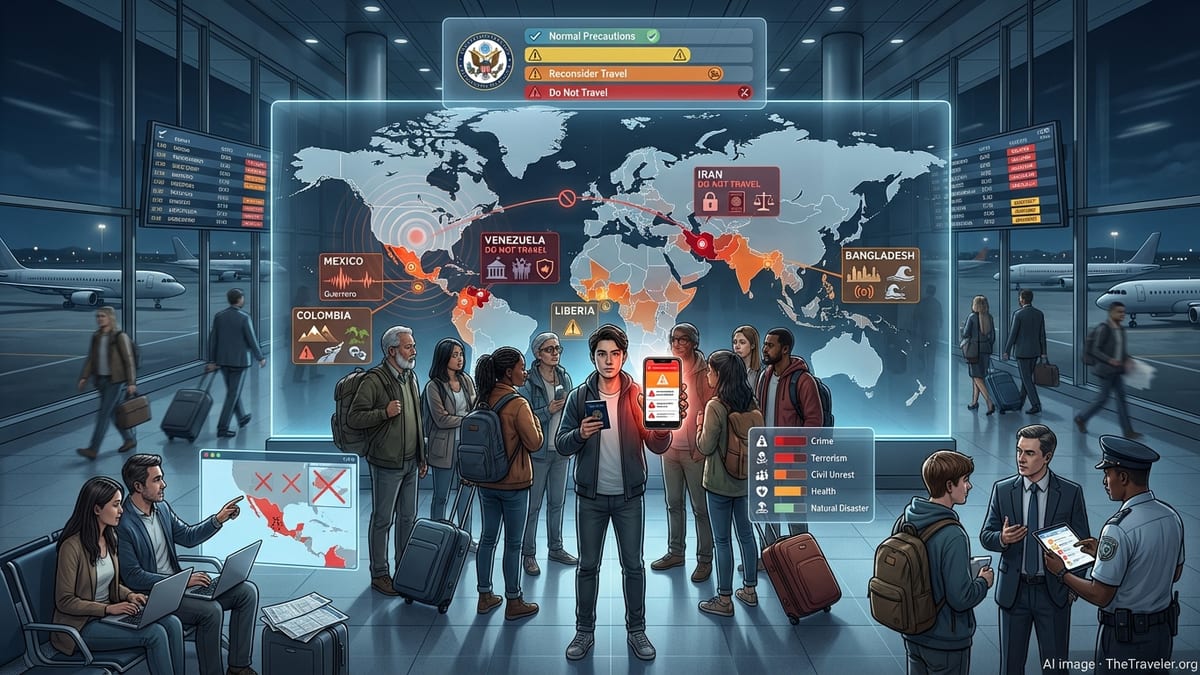
Mixed Signals: From Level 2 Warnings to Record Visitor Numbers
The United States currently assigns Mexico an overall Level 2 advisory, urging travelers to exercise increased caution due to crime, kidnapping and security risks, while also highlighting that risk varies significantly by state and city. The same advisory divides the country into detailed regional assessments, with some states listed as areas where visitors should reconsider travel and a handful marked as places where travel is not recommended at all.
Other governments echo this layered message. Canada’s latest Mexico advisory, updated in summer 2026, urges a high degree of caution nationwide and specifies regions where nonessential travel should be avoided due to crime, civil unrest or infrastructure disruptions. The United Kingdom’s travel advice similarly warns against all but essential travel in selected areas, while outlining routine precautions for major resort corridors.
Despite these cautions, tourism data shows that Mexico remains among the world’s most visited countries. Mexican government figures report more than 21 million international air arrivals in 2023, surpassing pre‑pandemic levels, while broader counts of total visitors place the country near the top of global tourism rankings. Industry analyses and UN tourism statistics indicate that international arrivals across the Americas rebounded strongly in 2023, with Mexico recovering faster than many competitors.
This coexistence of high alert language and robust travel demand illustrates why advisories can appear alarming when read in isolation. Without attention to regional differences, risk categories and local conditions, a national‑level warning can obscure the nuances that most travelers actually face on the ground.
How Risk Maps and Levels Really Work
Modern advisories are built on tiered systems. The U.S. State Department uses a four‑level scale, from Level 1 (exercise normal precautions) to Level 4 (do not travel), and then applies separate levels to each Mexican state. Recent guidance shows an overall Level 2 rating for the country while identifying specific states, such as parts of Tamaulipas and some border and interior regions, at Level 4 because of persistent violence and kidnapping risk.
Canada uses a similar multi‑tiered approach, pairing an overall national advisory with a color‑coded map that highlights areas where travelers are urged to avoid nonessential travel. The system is explained in detail on Canadian government pages that describe how factors such as crime, conflict, natural disasters and infrastructure limitations are weighed in determining each risk level. The United Kingdom’s advice follows a comparable model, advising against all but essential travel to specific regions while providing practical safety guidance for others.
These layered systems are designed to encourage risk‑based decisions. Yet headlines and social media posts often focus only on the highest warning language, such as references to kidnapping or cartel violence, without acknowledging that popular resort zones like parts of Quintana Roo, Baja California Sur or the Yucatán Peninsula may carry lower risk assessments than certain inland corridors.
Understanding that an advisory is a composite of multiple regional ratings helps explain why seemingly contradictory messages coexist. A single country label can mask the reality that conditions in a remote border state may be radically different from those in a tightly controlled tourism zone hundreds of miles away.
Security, Insurance and the Fine Print Travelers Miss
Government notices do more than flag crime statistics. They also influence how airlines, tour operators and insurers respond to emerging risks. Canadian industry statements in early 2026, for example, urged travelers in Mexico to review their policies after episodes of regional violence led to flight cancellations around cities such as Puerto Vallarta, Guadalajara and Manzanillo. Publicly available information from insurers and government portals emphasizes that traveling against official advice can affect coverage.
National travel sites increasingly spell out these implications. Canadian guidance on global disruptions encourages travelers to check for exclusions tied to regional conflicts, fuel shortages or civil unrest, while also directing readers back to the country‑specific advisory maps. The United Kingdom notes that some insurance policies may be invalidated if a traveler chooses to visit an area where the government formally advises against all but essential travel.
For Mexico‑bound travelers, the fine print matters. In practice, many visitors limit their itineraries to locations that carry lower advisory levels and remain within the bounds of what their insurance providers consider acceptable. That distinction may not come across clearly in a short alert or news headline, even though it can determine whether a medical evacuation or trip interruption claim is honored.
Seen in this light, travel advisories function as both safety tools and legal signals. Understanding how they are interpreted by airlines and insurers is as important as reading the security sections, especially in a country where risk is highly localized.
Context Matters: Reading Beyond the Headline
Travel experts and risk analysts frequently emphasize that advisories are starting points, not final verdicts. Government pages for Mexico routinely encourage travelers to read detailed state‑by‑state guidance, monitor local news and register for alert systems that provide updates when conditions change. The same sites point to seasonal risks such as hurricane activity in the Pacific and Atlantic basins, seismic hazards and occasional infrastructure disruptions that may be as relevant to a trip as crime trends.
Context also comes from data that shows how many trips proceed without incident. Public tourism statistics indicate that Mexico welcomed tens of millions of international visitors in 2023 and 2024, even as some regions carried Level 3 or Level 4 warnings. While any incident is significant for those affected, the overall rate of serious harm among tourists remains low compared with the volume of arrivals.
At the same time, advisories capture real, documented risks. Crime and kidnapping remain concerns in certain corridors, and local disputes can quickly alter conditions in places that previously felt stable. That is why recent trilateral statements by the United States, Mexico and Canada around major events such as the 2026 World Cup have stressed the need to balance open travel with coordinated public‑health and security measures in North America.
For individual travelers weighing a trip to Mexico, the challenge is not to dismiss warnings but to interpret them carefully. Reading the full advisory, focusing on regional breakdowns, checking insurance implications and monitoring developments in specific destinations can turn stark national‑level language into a more precise, actionable risk picture.
Why Nuanced Communication Is Essential for Mexico’s Tourism Future
Mexico’s economy depends heavily on tourism, with recent estimates suggesting that travel and hospitality account for a significant share of national output and employment. Government releases and international tourism reports note that the country has surpassed pre‑pandemic visitor numbers and remains a top global destination by arrivals, supported by steady demand from North America and Europe.
This success coexists with the need for honest communication about safety. Overly broad warnings can discourage visitors from low‑risk areas and strain local economies that rely on tourism revenue, while overly optimistic messaging can leave travelers unprepared for genuine hazards. The most effective advisories, analysts argue, are those that are specific, updated frequently and paired with practical advice on how to reduce exposure to risk.
Mexico offers a clear case study in why nuance matters. National‑level labels such as “exercise increased caution” do not capture the difference between a border crossing experiencing organized crime activity and a resort town investing heavily in surveillance and policing. As governments refine their advisory systems and travelers grow more accustomed to consulting them, the expectation is that guidance will continue to evolve toward more granular, map‑based and data‑driven formats.
For now, travelers considering Mexico in 2026 face a familiar but manageable equation: a destination with world‑class attractions, pockets of serious security concern and a complex advisory landscape. Approaching those warnings with curiosity, rather than alarm, can help visitors make informed choices while supporting communities that depend on responsible tourism.
U.S. Department of State: Mexico Travel Advisory
Government of Canada: Travel advice and advisories for Mexico
UK Foreign, Commonwealth & Development Office: Mexico travel advice
Secretaría de Turismo de México: Llegada de turistas internacionales 2023