


More news on this day
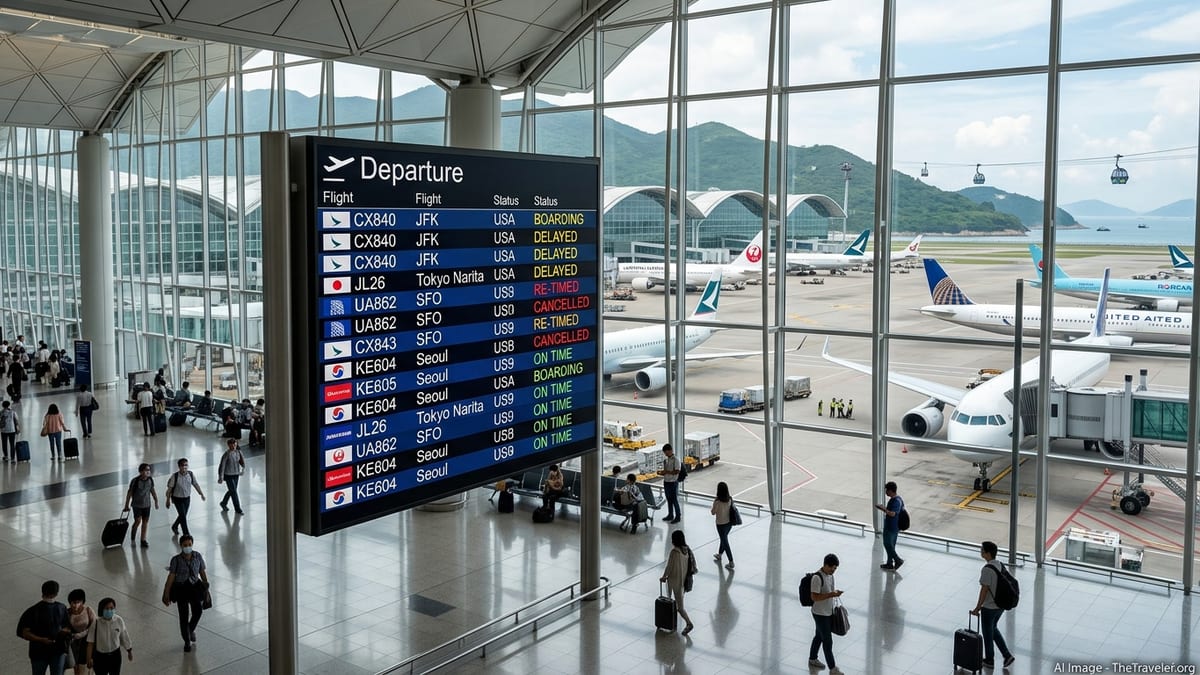
Major Asian airports including Hong Kong and Tokyo are reporting higher than usual delays and cancellations this week, as schedules absorb knock-on disruption from the United States’ nationwide ground stop on November 13–14 and a mix of local weather and operational constraints.
Get the latest news straight to your inbox!
Hong Kong’s Disruptions Remain Noticeable but Short of a Meltdown
Airport Authority Hong Kong has confirmed that the United States ground stop on November 13–14 disrupted more than a dozen Hong Kong–US services, with 17 flights affected over those two days through cancellations or delays on transpacific routes. Officials indicated that residual disruption for Hong Kong–US services was expected to continue into November 14 and 15 as airlines reshuffled aircraft and crews.
Live operational statistics show that Hong Kong International Airport has been busy but broadly functional in the days since. Publicly available flight data for November 21 indicates roughly 426 departures and 145 arrivals scheduled, broadly in line with Hong Kong’s typical pattern of about 400 to 430 daily departures and several hundred arrivals. While the number of flights experiencing some delay has risen, the majority of services are still operating within about 15 minutes of schedule.
These figures undercut the idea that Hong Kong alone accounts for thousands of delayed flights in a 24-hour period. Instead, the airport’s experience illustrates how a global disruption such as the US ground stop can ripple into a hub’s schedule without producing an outright operational collapse.
Asia-Wide Delay Totals Reflect Multiple Airports and Causes
Third-party tracking dashboards over the past several days have cited figures in the thousands for delayed flights across Asia, with hundreds of cancellations in some 24-hour snapshots. Those tallies aggregate activity across many countries and dozens of airports rather than any single hub, and they fluctuate hour by hour as airlines update schedules and operations.
No Asian regulator or major airport operator has issued a unified explanation for the total number of delays and cancellations across the region. Instead, the current disruption reflects overlapping local factors. The US ground stop temporarily halted departures to and within the United States on November 13, leading some Asian flights to be held, rerouted or re-timed. Separately, regional weather systems and routine operational constraints at individual airports have contributed to further schedule changes that are recorded in the same live data feeds.
Because of this patchwork, large regional totals such as “thousands of delays” should be treated as moving indicators of stress on the network rather than precise, official statistics. Travelers should assume that conditions will vary significantly by country, airport and time of day, even when the overall Asian numbers appear elevated.
Tokyo and Other Hubs Manage Local Knock-On Effects
Tokyo’s Narita and Haneda airports, key gateways for transpacific and intra-Asian traffic, have also seen a noticeable but manageable level of disruption. Live departure boards for November 21 show a modest share of flights departing late, with typical delays measured in tens of minutes rather than hours, and most departures still leaving broadly on schedule.
As in Hong Kong, the reasons for delays at Tokyo’s airports are mixed. Some long-haul services are still working through aircraft rotations affected by last week’s US ground stop. Others reflect local issues such as congested departure banks in peak hours or weather-related air traffic control measures. Similar patterns are visible at other busy Asian hubs, including major airports in Southeast Asia, where carriers are juggling high seasonal demand with tight aircraft utilization.
The picture that emerges is one of a stressed but functioning regional network. While many travelers are encountering later-than-planned departures, there is no evidence that any single Asian hub is experiencing an uncontrolled breakdown in service directly attributable to the US event.
What Travelers Should Do Next
For passengers traveling through Asian hubs over the coming days, the most practical response is to assume schedules may change at short notice, especially on US–Asia itineraries. Airlines are still repositioning aircraft and crews after the US ground stop of November 13–14, and that process can produce further short delays or equipment swaps even after the main disruption has passed.
Travelers should monitor airline apps, SMS alerts and airport flight-information pages closely from 24 hours before departure, and again on the day of travel. Building extra time into connections at major hubs such as Hong Kong, Tokyo, Seoul or Singapore can reduce the risk of missed onward flights if an incoming service is delayed by 30 minutes or more.
Because regional delay and cancellation tallies update continuously, passengers should avoid focusing on a single headline number for Asia-wide disruption. Instead, they will be better served by checking their specific flight status frequently, confirming minimum connection times, and reviewing airline policies on rebooking and refunds in case their service is significantly delayed or canceled.