


More news on this day
Air travelers moving between the United States and Mexico are beginning to see the early stages of a multibillion‑dollar airport overhaul, as authorities on both sides of the border lock in 2026 funding and construction for new gates, modernized terminals and expanded capacity at major hubs including Chicago O’Hare, Monterrey and Mexico City.
Get the latest news straight to your inbox!
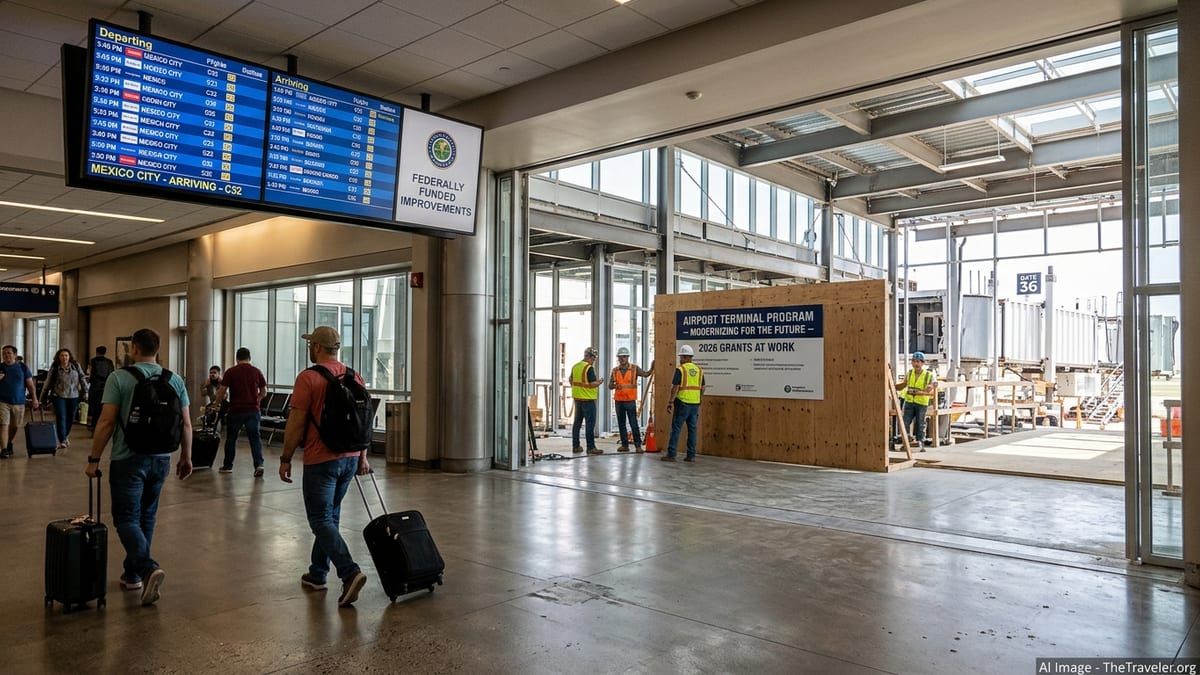
FAA Terminal Grants Cement U.S. Airport Spending Through 2026
In the United States, the Federal Aviation Administration’s Airport Terminal Program is providing a stable backbone for airport upgrades through the Infrastructure Investment and Jobs Act. The law sets aside 5 billion dollars in competitive terminal grants, or 1 billion dollars annually from fiscal year 2022 through 2026, to modernize aging terminals, expand capacity and improve safety and accessibility. FAA budget tables and program documents confirm that 970 million dollars per year is earmarked for terminal development projects, with the remainder covering related program costs.
For the 2026 funding round, the FAA lists 970 million dollars in Airport Terminal Program grants to specific airports nationwide, building on earlier awards in 2022, 2023 and 2024 that are already under construction or nearing completion. Recent FAA briefings and fact sheets show money flowing to a mix of major hubs and regional airports for additional gates, security upgrades, baggage facilities and passenger-accessible improvements such as expanded hold rooms and accessible restrooms.
For travelers, the immediate effect in late 2026 is uneven. Some U.S. terminals funded in earlier rounds have already opened new concourses or gate areas, while many of the projects supported by the 2026 grants will not be fully visible for several years. The confirmed multi‑year funding, however, means U.S. airports can move from planning into procurement and construction with more certainty, which is crucial as airlines anticipate higher cross‑border and domestic demand heading into events like the 2026 World Cup.
Chicago O’Hare’s New Concourse E Anchors U.S. Upgrades
Chicago O’Hare International Airport represents one of the most concrete U.S. examples in 2026. On November 17, 2026, the City of Chicago broke ground on the New Concourse E as part of the 8.8 billion dollar ORDNext modernization program, according to the Chicago Department of Aviation. The concourse carries a budget of approximately 917 million dollars and will sit at Terminal 2, forming a key element of O’Hare’s long‑term plan to boost gate capacity and redevelop the central terminal area.
City and project documents describe Concourse E as adding new contact gates, larger gate areas, natural light and updated concessions, along with upgraded security and baggage systems designed to handle a higher volume of connecting passengers. Chicago officials have said the broader ORDNext program is expected to increase the airport’s gate capacity by roughly the mid‑teens in percentage terms once all phases are complete. Concourse E itself is now in the construction phase, with opening targeted around the end of the decade, so current travelers will mostly encounter construction fencing and airfield work rather than finished facilities.
Other U.S. hubs are using a mix of federal and local funding to push forward more incremental terminal improvements. At Miami International Airport, county documents and airport briefings describe ongoing work to modernize passenger boarding bridges, restrooms and vertical circulation such as elevators and escalators, along with projects to improve regional commuter facilities. While these efforts are less visually dramatic than a brand‑new concourse, they can directly affect passengers in the near term through reduced equipment outages and more reliable boarding and transfer flows.
Monterrey and Mexico City Secure Hundreds of Millions for Terminal Works
On the Mexican side, 2026 has brought a series of confirmed investment decisions focused squarely on airport capacity and passenger experience. In May 2026, the government of Nuevo León announced that Vinci Airports will invest an additional 400 million U.S. dollars in Monterrey International Airport, on top of existing expansion plans. The state’s official bulletin describes the funds as targeted at terminal modernization and capacity, framed as essential to supporting both tourism and industrial logistics in the fast‑growing Monterrey region.
Project descriptions from Vinci and local authorities point to expanded check‑in halls, new boarding piers with added gates, enlarged baggage claim areas and upgraded security zones. Some of this work builds on an earlier multi‑billion‑peso terminal expansion already under way, while the 2026 commitment confirms fresh capital for subsequent phases. Most elements are still in design or early construction, which means current travelers will experience phased works and temporary detours inside the existing terminal rather than fully opened new facilities.
Mexico City International Airport, meanwhile, has embarked on an extensive multi‑year facelift. Official communications from the airport and federal government show that terminal remodels began in 2025, with contracts awarded for comprehensive works in Terminals 1 and 2 that include structural rehabilitation, renewed finishes, upgraded lighting, parking renovation and expanded waiting areas. Public investment documents and recent media reports place the total cost of the Mexico City program at close to 10 billion pesos, or roughly 500 million U.S. dollars, funded largely from airport revenues.
Guadalajara’s New Terminal and What Travelers Should Expect Next
Guadalajara International Airport is another major Mexican gateway where travelers can expect significant medium‑term change. Operator and regulatory filings describe a multi‑billion‑peso investment plan that includes constructing a new passenger terminal to relieve congestion in the existing facility, which has seen sustained passenger growth in recent years. Current information indicates that enabling works and early phases are progressing, but the new terminal itself remains several years from opening and has not yet entered full operations.
Across Monterrey, Mexico City and Guadalajara, the timing of visible benefits will vary. Some newly renovated departure lounges and check‑in areas in Mexico City are already open, while other sections remain construction zones that can mean longer walks, noise and temporary crowding. In Monterrey and Guadalajara, travelers in 2026 and 2027 should be prepared for active work sites, changed access routes and occasional gate reassignments as operators phase construction around peak traffic.
For cross‑border travelers, the practical payoff of these parallel U.S. and Mexican airport investments is expected to emerge mainly over the next three to eight years. Additional gates and larger terminal spaces at hubs such as Chicago O’Hare and Monterrey should support more flight options and smoother connections between the two countries, including during periods of heavy demand like the 2026 World Cup. Anyone planning travel through these airports should check airport and airline advisories close to departure for updated terminal maps, construction impacts and, over time, opening dates for new concourses and terminals.