


More news on this day
Travelers in California’s Inland Empire and central Virginia will gain more winter 2026–27 options to reach Chicago and connect onward, as American Airlines restores nonstop Chicago O’Hare service at Charlottesville–Albemarle Airport and resumes flights on the Ontario–Chicago route alongside existing United Airlines service.
Get the latest news straight to your inbox!
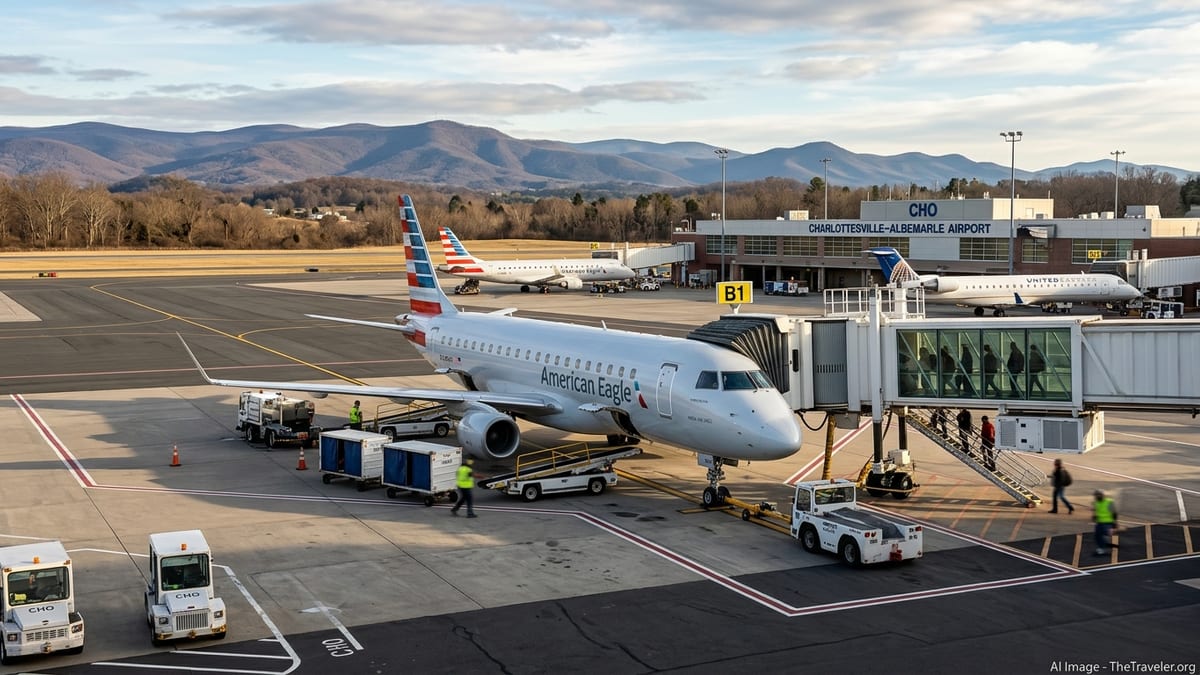
Charlottesville regains twice‑daily link to Chicago O’Hare
Charlottesville–Albemarle Airport has confirmed that American Airlines will restore twice‑daily nonstop service between Charlottesville (CHO) and Chicago O’Hare (ORD) from November 2, 2026, following earlier cuts on the route. In a public notice dated July 1, 2026, the airport specifies that the flights return as part of its strategy to strengthen access to four major connector hubs, with Chicago highlighted alongside existing links such as Charlotte and Washington Dulles.
Current airport information now lists Chicago among CHO’s nonstop destinations, served by American, Delta and United, confirming the route’s inclusion in the regular schedule rather than as a limited‑run experiment. Schedule data for late 2026 and early 2027 shows American operating two daily ORD–CHO round‑trips on regional jets, generally clustered in late‑afternoon and evening time bands that support onward connections at O’Hare.
For Charlottesville‑area travelers, the restored Chicago link provides additional one‑stop options to Midwestern cities and long‑haul destinations that may be harder to reach via the East Coast hubs alone. With both American and United offering ORD–CHO nonstops, passengers gain a broader mix of schedules and alliance options when planning winter trips, although frequencies vary slightly by week and some patterns may change after the initial ramp‑up period.
Ontario gains expanded ORD service as American returns
On the West Coast, Ontario International Airport in California’s Inland Empire is preparing for a busier Chicago schedule. The airport’s current nonstop destinations listing shows Chicago O’Hare served by both United and American, reflecting United’s ongoing ONT–ORD operation and American’s decision to resume service. Ontario’s July 1, 2026 announcement states that American will begin daily nonstop ONT–ORD flights on December 17, 2026, restoring a link that had previously been absent from the carrier’s local network.
Recent schedule summaries indicate that United is already operating multiple weekly ONT–ORD flights through mid‑November 2026, with service patterns that can fluctuate based on day of week and broader O’Hare capacity constraints. American’s addition of its own daily nonstop from mid‑December is therefore an expansion of existing Chicago connectivity rather than a brand‑new market, and the combined offering from two legacy carriers is expected to bring Ontario‑area flyers more departure‑time choice during the winter peak.
American’s own booking tools now show Ontario–Chicago itineraries on and after the mid‑December start date, typically using narrow‑body aircraft configured for domestic mainline service. Travelers should note that the precise schedule, including departure times and aircraft types, can still be adjusted as O’Hare slot management and airline fleet plans evolve closer to the winter season.
More winter one‑stop options without coastal hubs
Taken together, the Charlottesville and Ontario changes modestly widen the winter 2026–27 network of cities that can reach the broader American and United systems via Chicago in a single stop. In central Virginia, the twice‑daily American flights restore an additional pathway to destinations across the Midwest and Plains, while in Southern California the combination of United’s existing service and American’s December restart offers Inland Empire travelers an alternative to driving to Los Angeles or using coastal hubs for Chicago‑bound trips.
Sample schedules for a mid‑December week show multiple daily departures between Ontario and O’Hare when United and American services are combined, although exact flight counts differ by day. On the Charlottesville side, published timetables for late December and early January typically reflect at least two American round‑trips most days, complemented by United frequencies that together produce several ORD–CHO options over the course of the day. All of these patterns remain subject to change as airlines refine winter operations.
Fare data from major search engines suggests that round‑trip Ontario–Chicago tickets in the coming three months can often be found in the mid‑$200s, with one recent United example around the 270‑dollar mark excluding ancillary fees. Prices on the Charlottesville–Chicago route appear broadly in line with other short‑haul legacy‑carrier links of similar length, but may rise or fall based on demand around holidays and major events, as well as competitive pressures on nearby routes.
What travelers should check before booking
Although the key milestones are set, with Charlottesville’s American service scheduled to begin November 2, 2026 and Ontario’s American flights slated to start December 17, 2026, travelers should treat all winter schedules as subject to refinement. Frequencies around major holidays can be higher than in shoulder weeks, and some flights may operate seasonally or on specific days rather than as year‑round, daily departures.
Prospective passengers are advised to verify exact travel dates, departure and arrival times, operating carrier, and aircraft type directly with the airlines or through the airport’s latest schedule summaries before finalizing plans. Because both routes connect into O’Hare, travelers making onward domestic or international connections should allow extra time for potential weather‑related disruptions that are common in the upper Midwest during winter.
Given continuing adjustments tied to federal capacity management at Chicago O’Hare and evolving airline fleet strategies, those planning trips deep into the 2026–27 season should recheck fares and schedules close to departure. Booking systems already show the restored and expanded routes on sale, but last‑minute tweaks to timings or frequency remain possible as airlines balance demand, operational resilience and their broader hub networks.