


More news on this day
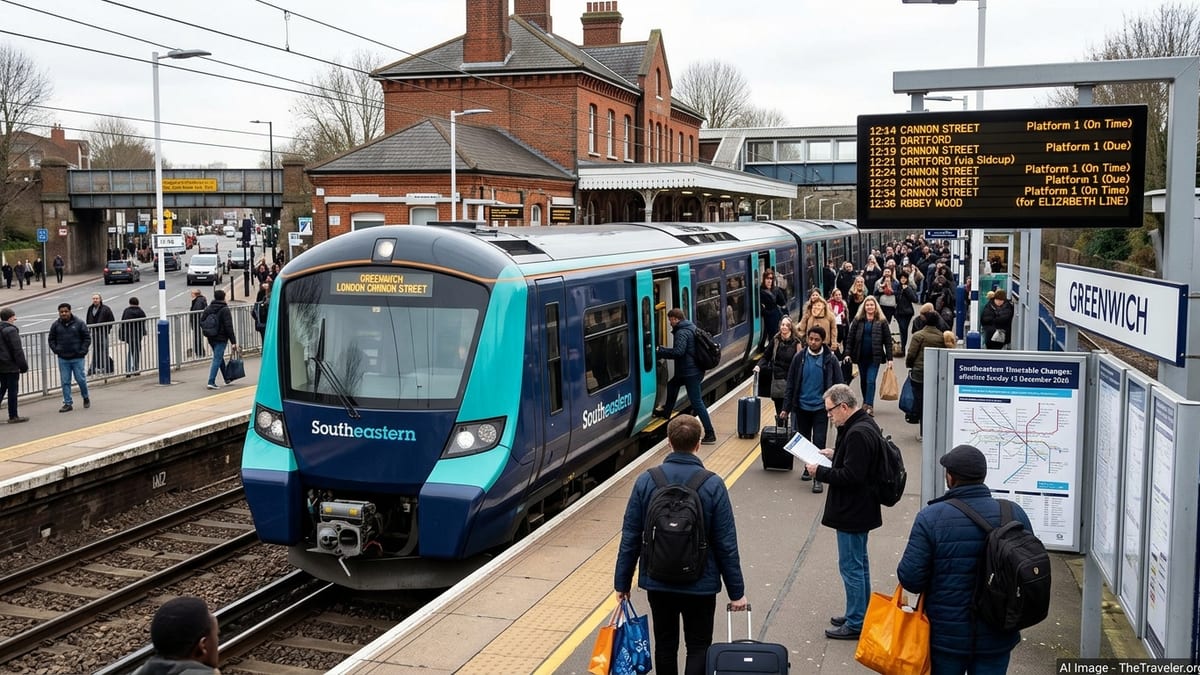
Southeastern will introduce a significantly expanded timetable from Sunday 13 December 2026, adding around 130 extra trains every weekday compared with May 2026 and delivering more frequent Metro and weekend services across south‑east London, Kent and East Sussex.
Get the latest news straight to your inbox!
What changes on 13 December 2026
The new timetable takes effect across the Southeastern network on Sunday 13 December 2026, as part of the rail industry’s regular December change that runs until 15 May 2027. National Rail and Southeastern journey planners for dates after 13 December already show revised departure times and additional services, and the operator is advising passengers to check timings carefully because many trains move by a few minutes as paths are adjusted.
Southeastern describes the December change as a major expansion of its timetable, with approximately 130 extra trains on weekdays compared with the May 2026 schedule. This uplift comes on top of earlier May and December 2024 improvements that added dozens of weekday services, particularly on Metro routes into London, building towards a more frequent “turn up and go” pattern.
Alongside the weekday boost, Southeastern’s latest announcement highlights a substantial weekend increase, with hundreds of extra services each Saturday and Sunday. According to the operator, weekend timetables now more closely mirror weekday frequencies on several Metro corridors, which is expected to offer greater flexibility for leisure trips, shopping and airport or cruise connections.
Metro routes move towards turn-up-and-go frequencies
A key focus of the December 2026 change is the Metro network in south‑east London. From 13 December, almost all Metro routes are planned to run at least four trains per hour during the daytime from Monday to Saturday, with up to six trains per hour on busy lines such as Greenwich, Sidcup and Bexleyheath. This follows through on a commitment first outlined ahead of the May 2026 timetable to make Metro services more frequent and easier to use without detailed advance planning.
For everyday passengers, the practical difference is a step up from patterns that could previously drop to two or three trains per hour outside the peaks on some routes. On the Greenwich, Sidcup and Bexleyheath lines in particular, the higher base frequency is intended to reduce waits between trains and improve reliability if individual services are delayed or cancelled, since the next train should follow more quickly.
The Metro uplift is not completely uniform. The Bromley North branch remains an exception to the four‑trains‑per‑hour target, reflecting its short shuttle operation to Grove Park. However, it still sees a notable improvement in the new timetable, particularly at weekends, where service has historically been sparse or non‑existent.
New and restored journey options, including Sundays
One of the most visible changes for local travellers comes on the Bromley North branch, which will regain Sunday trains from 13 December 2026 after decades without a regular Sunday service. Local reporting and Southeastern’s own timetables indicate a half‑hourly pattern on Sundays, giving residents a straightforward rail link to Grove Park throughout the weekend as well as more frequent peak‑time shuttles on weekdays.
Elsewhere, the December changes extend and restore links that are likely to matter for longer‑distance trips. Some Maidstone East services are scheduled to continue through to Ashford International, improving connections towards High Speed 1 and onward Eurostar services from London, and adding more options for Kent and East Sussex passengers making regional journeys without changing in the capital. The operator also flags more peak‑time capacity into London, including additional Victoria to Orpington trains via Herne Hill at the busiest times.
On selected services, new direct links between the Sidcup line and Abbey Wood will offer easier access to the Elizabeth line. For travellers heading to or from Heathrow Airport, west London or central hubs such as Paddington, the ability to stay on a Southeastern train to Abbey Wood and then transfer to the Elizabeth line can simplify journeys that previously required extra interchanges closer to central London.
Weekend uplift and what passengers should check
Southeastern’s December 2026 package also includes a marked expansion of weekend services, with several hundred more trains across Saturdays and Sundays than under the May 2026 timetable. The operator highlights particularly strong growth on Saturday Metro services and more Sunday options on historically under‑served branches, which may benefit day‑trippers heading for coastal towns, countryside walks in Kent or visits to attractions in and around London.
Despite the overall increase, the exact pattern varies by route. Some lines gain new early‑morning or late‑evening departures, while others see existing services retimed by a few minutes to fit the wider network plan. In addition, temporary engineering works and separate autumn “leaf‑fall” timetables apply at other times of year, which can override the base December schedule on certain dates.
Travellers planning trips from mid‑December onward should therefore re‑check specific trains in National Rail or Southeastern’s journey planners close to departure. This is especially important if you normally rely on a particular train for airport connections, cruise departures or tight onward links, as the new timetable may alter departure times, calling patterns or platform allocations even where overall frequency has improved.