


Mexico and Colombia have emerged as two of the most discussed destinations in Latin America for digital nomads and longer-term expats. Both combine relatively affordable urban centers with growing remote work ecosystems, but they present distinct profiles in terms of personal safety, infrastructure reliability, and digital connectivity. This briefing compares Mexico and Colombia strictly on those operational conditions that matter most for location-independent professionals deciding where to base themselves.
Macro Risk Profile and Urban Safety Context
Both Mexico and Colombia carry elevated security risks compared with most European and East Asian destinations, but the specific patterns of risk differ. On a regional crime index for the Americas in 2025, Colombia records a higher perceived crime score than Mexico, indicating a somewhat worse overall security environment at the national level. Mexico, however, concentrates a large share of its violence in particular states and secondary cities, many of which are not main expat hubs, while Colombia’s risk is more evenly distributed across major urban centers, including cities favored by digital nomads.
Homicide and organized crime remain structural issues in both countries. Mexico consistently has multiple cities listed among the world’s most violent, largely associated with cartel conflict and contested trafficking routes. Colombia also has several cities on similar rankings, but its most prominent digital nomad hubs, particularly Medellín and parts of Bogotá, have seen long-term improvements compared with their 1990s and early 2000s baselines. This means that for nomads and expats, risk is less about national averages and more about very specific choices of city and neighborhood.
At a practical level, digital nomads in both Mexico and Colombia face similar patterns of incident risk: street robbery, phone theft, and opportunistic scams rather than targeted violent attacks. In both countries, expats who adopt basic urban risk management practices, avoid intoxicated late-night street movement, and use vetted transport options significantly reduce exposure. Nevertheless, the underlying security baseline is weaker than in most developed markets, so relocation decisions should be framed as risk-managed rather than risk-free in either country.
City-Level Safety: Key Hubs in Mexico vs Colombia
The safety environment for digital nomads and expats is driven primarily by conditions in a handful of urban hubs. In Mexico, Mexico City, Guadalajara, Monterrey, Querétaro and Mérida are repeatedly cited as primary bases for remote workers. In Colombia, Medellín, Bogotá, Cartagena and to a lesser extent smaller cities such as Pereira and Bucaramanga play a similar role. Within these hubs, crime and security conditions are highly localized by neighborhood.
In Mexico, central districts of Mexico City such as Polanco, Roma, Condesa and parts of Del Valle show significantly better security outcomes than peripheral boroughs where cartel-linked violence and high-volume street crime are more common. Perception-based safety indices place Mexico City in the medium risk band: residents acknowledge crime as a concern, but day-to-day life in central, higher-income districts continues at a relatively normal pace. Secondary cities like Mérida and Querétaro frequently rank as among the safer large cities in the country, which is reflected in growing expat communities there.
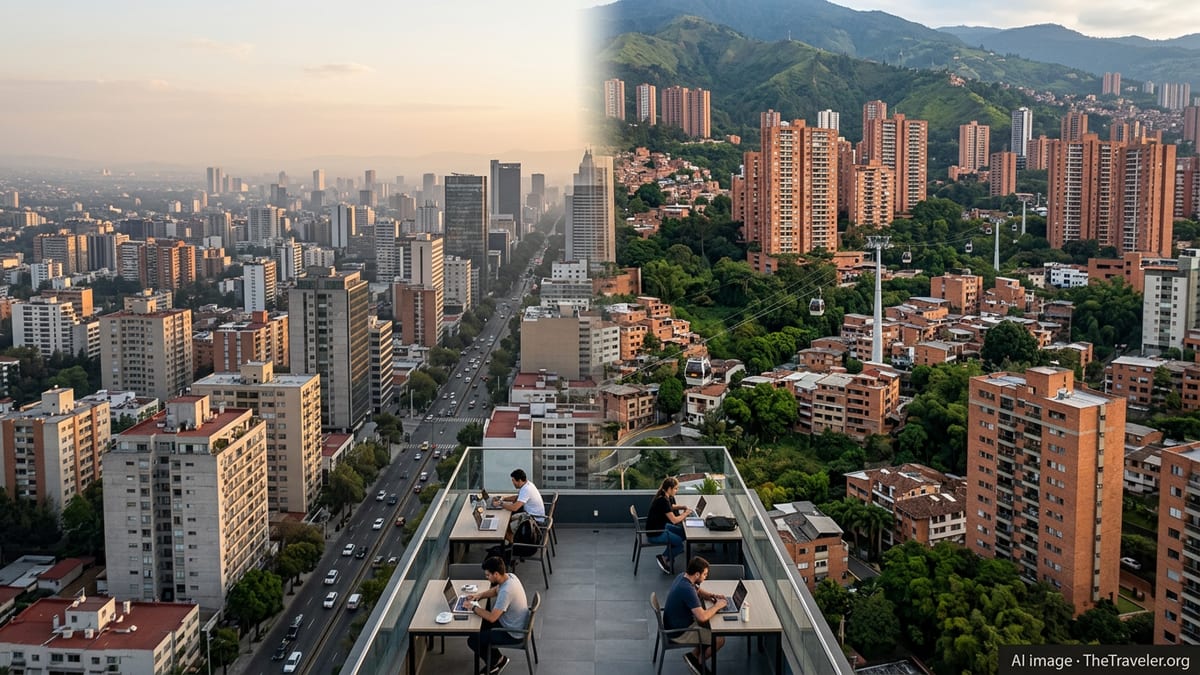
In Colombia, Medellín’s core neighborhoods such as El Poblado and Laureles typically rate safer than many outer districts and have become focal points for digital nomads. Medellín appears in the middle of global city crime rankings with a moderate crime index, suggesting risk comparable to some Southern European or US cities with elevated but manageable street crime. Bogotá’s safety perception is slightly worse than Mexico City’s and Medellín’s, but its more affluent districts still support sizeable professional and expatriate populations with predictable daily routines.
When comparing Mexico and Colombia strictly on city-level safety for nomads, a nuanced picture emerges. Some Mexican mid-sized cities offer clearly lower perceived crime than Colombia’s main hubs, but Mexico also has more extreme outliers of violence. Colombia’s mainstream nomad centers sit in the mid-risk band, with fewer ultra-high-risk outliers in the usual expat geographies but a higher national crime perception overall. As a result, neither country provides a decisive safety advantage, and city and neighborhood selection is more important than the national flag.
Everyday Security Experience for Digital Nomads and Expats
For digital nomads and expats, the operational question is less about abstract crime indices and more about daily routines: whether it is feasible to walk to coworking spaces, use public transport, and work in public-facing venues without undue concern. In both Mexico and Colombia, such routines are common in established expat districts, but they require more risk awareness than in lower-crime destinations.
In Mexico’s main hubs, working from coworking spaces and cafes is standard practice and generally considered safe during daylight and early evening hours in well-known districts. Mobile phone theft and bag snatching on the street and in public transport are recurring issues, so nomads often adapt by using lower-profile devices in public, minimizing visible valuables, and favoring app-based taxis for night travel. It is broadly feasible to combine walkability with digital work routines, provided sensible precautions are followed.
In Colombia, the risk profile is similar but perception of street crime is often more acute. Reports from Medellín and Bogotá point to a high incidence of phone theft, sometimes involving mild intimidation or distraction techniques. Locals and expats commonly advise against using phones in the street or on local buses, and recommend point-to-point rideshare services, particularly after dark. Despite these constraints, active expat and remote work communities continue to operate coworking spaces and social events, indicating that the environment, while imperfect, is workable for many professionals.
Overall, the everyday safety experience is best described as “operationally workable with disciplined precautions” in both countries. Mexico’s advantage lies in some relatively calm mid-sized cities, while Colombia’s advantage lies in the density of remote workers and services in specific Bogotá and Medellín districts which help normalize safety practices and provide peer information.
Digital Connectivity and Internet Reliability
For digital nomads and remote-working expats, the quality and reliability of internet connectivity is a core enabling factor. Mexico has the larger and more mature telecommunications market, with a high absolute number of internet users and rapid expansion of fiber networks in major cities. Fixed-line broadband speeds in Mexican metropolitan areas routinely reach tens to hundreds of Mbps where fiber or modern cable is available, and 4G mobile coverage is widespread along main urban corridors. Remote workers in Mexico City, Guadalajara and Monterrey typically report adequate bandwidth for video conferencing and cloud workloads.
Colombia has made significant progress in digital connectivity, particularly in urban zones. In Medellín, a commonly cited nomad hub, published measurements in recent guides indicate median fixed broadband download speeds around 100 to 130 Mbps and upload speeds around 30 Mbps, sufficient for high-bandwidth remote work and multi-party video calls. Other major cities like Bogotá and Cartagena show comparable performance in better-served neighborhoods, although national reports still highlight a gap between urban and rural connectivity.
Mobile connectivity presents a more mixed picture. Mexico’s mobile infrastructure is extensive, but digital nomads often highlight inconsistencies in speed and reliability away from major cities and highways. In Colombia, 4G service is strong in principal cities but can degrade quickly in outlying areas or during heavy rainfall, which is a relevant concern for those considering semi-rural living or frequent internal travel. For professionals whose work is highly latency-sensitive, such as live streaming or trading, urban fiber connections in both countries are the most reliable choice.
From a purely digital connectivity standpoint, neither Mexico nor Colombia has a structural advantage in the main urban nomad hubs; both can deliver high-speed fixed internet and workable mobile backup options. Mexico’s market scale supports a greater variety of providers and plans, while Colombia’s recent investments mean that connectivity in specific nomad quarters of Medellín and Bogotá is competitive and sometimes superior on a speed-to-price basis.
Urban Infrastructure, Transport and Power Reliability
Beyond internet access, the broader quality of infrastructure shapes how easily digital nomads and expats can maintain stable work routines. In Mexico, core infrastructure in major cities is relatively robust by regional standards but uneven. Mexico City, Monterrey and Guadalajara offer extensive paved road networks, modern airports, and established metro or bus rapid transit systems. However, congestion, air quality issues and deterioration of secondary streets are recurring concerns. Some expats report that intercity road travel can be affected by security incidents or roadblocks in specific states, which can complicate overland moves between hubs.
In Colombia, domestic infrastructure has improved substantially in the past two decades but remains constrained by challenging geography. Medellín and Bogotá have modernized public transport systems, including metro and cable-car lines in Medellín and a large bus rapid transit network in Bogotá. Airport connectivity to North America and Europe is adequate for most digital nomads. Nonetheless, frequent rain, landslides on mountain roads and occasional protests affecting highways can disrupt intercity travel. Within cities, steep gradients and limited road capacity can result in significant congestion, affecting commute predictability.
Power reliability is a more direct concern for remote work. Outages still occur in parts of both countries, especially during storms. In urban Mexico, short-term blackouts are typically infrequent, but they are not unknown in older neighborhoods or smaller coastal towns. Many coworking spaces and higher-end apartment buildings mitigate this risk with backup generators or battery systems. In Colombia, grid reliability has improved, and larger cities enjoy reasonably stable power, but heavy rainfall and infrastructure stress can still produce occasional interruptions. Again, professionally managed coworking spaces and modern residential complexes often advertise backup power provisions as a selling point.
Overall, Mexico’s larger and more diversified infrastructure base offers slightly better redundancy in aviation routes and telecommunications, while Colombia’s infrastructure in its main nomad cities is modern enough to sustain dependable remote work. Both environments require contingency planning such as having mobile hotspots, battery backups, and flexible scheduling for mission-critical workdays.
Community Density and Operational Support Ecosystems
A critical yet often overlooked dimension of feasibility for digital nomads and expats is the availability of support ecosystems: coworking spaces, device repair services, international courier options, and peer communities that can share local operational knowledge. On this dimension, both Mexico and Colombia host active and growing remote work communities but with different geographic distributions.
Mexico benefits from its proximity to the United States and Canada, producing large and diverse expat populations in multiple cities. Mexico City alone offers dozens of coworking spaces, while Guadalajara, Monterrey, Mérida, Playa del Carmen, Tulum and others maintain established remote-work infrastructures. This disperses the digital nomad crowd across a wider map, giving individuals more choice of urban scale and climate at the cost of a somewhat more fragmented community presence in each individual city.
Colombia’s digital nomad scene is more concentrated. Medellín in particular has developed a reputation as a Latin American remote-work hub, with numerous coworking venues, regular meetups, and a visible community of software engineers, content creators and online entrepreneurs. Bogotá also hosts a substantial professional and NGO-oriented expatriate population that supports a range of shared offices and business services. The benefit of this concentration is that new arrivals often find it easier to plug into established networks and obtain practical advice on safety, housing logistics and local service providers.
For relocation planning, the implication is that Mexico offers a broader portfolio of city types and lifestyle contexts that can support remote work at a technical level, whereas Colombia offers more concentrated hubs where digital nomads and expats are particularly visible and organized. Individuals prioritizing a strong peer network and coworking density may find Medellín or Bogotá attractive, while those preferring more choice of mid-sized, quieter cities with workable infrastructure may lean toward Mexico.
The Takeaway
From a strictly operational perspective focused on safety, infrastructure and digital connectivity, both Mexico and Colombia present workable but risk-aware environments for digital nomads and longer-term expats. Neither country offers the low-crime, highly predictable conditions found in many parts of Europe or East Asia, but both provide major urban centers where high-speed internet, coworking spaces and modern services can support sustained remote work.
Mexico’s main advantages are its larger, more diversified infrastructure base, broad choice of urban environments, and strong aviation and telecommunications links to North America. Some mid-sized Mexican cities offer relatively favorable local safety conditions compared with the regional average, which may appeal to risk-averse professionals who still want access to Latin American cost structures and time zones. However, the presence of highly violent regions and the uneven quality of roads and smaller-city infrastructure require careful geographic filtering and route planning.
Colombia’s strengths lie in the quality of connectivity and community support concentrated in key hubs such as Medellín and Bogotá. Urban digital infrastructure in these cities, particularly fixed broadband, is competitive, and the density of nomads and expats creates practical knowledge networks that help newcomers manage safety and day-to-day logistics. The trade-off is a somewhat higher national crime perception and a greater reliance on a small number of core cities, which may make diversification across locations more difficult for risk management.
For decision-makers, the choice between Mexico and Colombia should be made less on the basis of generalized country risk labels and more on precise alignment between professional needs and local conditions. Those prioritizing ease of access to North America, broader city choice and redundancy of infrastructure may find Mexico more practical. Those prioritizing tight-knit digital nomad ecosystems and strong fixed connectivity in a smaller set of urban hubs may judge Colombia to be the more efficient base, provided they accept a similar level of street-crime risk and adopt disciplined security practices.
FAQ
Q1. Which country is generally safer for digital nomads, Mexico or Colombia?
Both countries sit in a similar medium-risk band for urban crime, with Colombia typically scoring slightly higher on regional crime indices. For digital nomads, actual safety outcomes depend more on city and neighborhood selection than on the country itself.
Q2. Are Mexico’s major digital nomad cities safer than Colombia’s?
Some mid-sized Mexican cities are perceived as safer than Colombia’s main hubs, while Mexico also has more extreme high-violence areas. Medellín and the better districts of Bogotá sit in a mid-risk range where day-to-day life is manageable with standard precautions.
Q3. Where is internet connectivity more reliable for remote work?
High-quality fixed broadband is available in key cities in both countries. Mexico benefits from a larger telecom market, while Colombian hubs like Medellín and Bogotá offer competitive speeds and reliability in established expat neighborhoods.
Q4. Do power cuts frequently disrupt work in Mexico or Colombia?
Short power outages do occur in both countries, especially during storms or infrastructure stress. In large cities, they are usually infrequent and often mitigated by backup systems in modern apartment buildings and coworking spaces.
Q5. Is it safe to work from cafes and coworking spaces?
In recognized expat districts of major cities in both Mexico and Colombia, working from cafes and coworking spaces during the day is a normal and generally safe practice, though valuables should still be monitored carefully.
Q6. How different are the risks of violent crime versus petty theft?
Most incidents affecting digital nomads and expats in both countries involve non-violent theft of phones, laptops or bags. Violent crime is more associated with specific high-risk districts and criminal groups that most remote workers can avoid with informed location choices.
Q7. Are public transport systems safe to use for commuters?
Public transport in major Mexican and Colombian cities is widely used but can be a hotspot for pickpocketing and phone theft. Many expats prefer app-based taxis or ride-hailing services, especially at night.
Q8. Which country offers better infrastructure for frequent regional or international travel?
Mexico has a denser network of domestic routes and more direct international connections to North America, Europe and parts of Asia. This can be an operational advantage for nomads who travel frequently for work.
Q9. Is it realistic to base in smaller towns rather than big cities?
In both countries, smaller towns often have weaker infrastructure, less reliable connectivity and limited coworking options. For most digital nomads and expats, larger cities or well-established secondary hubs provide a more dependable working environment.
Q10. How important is community density when choosing between Mexico and Colombia?
Community density can significantly affect the ease of onboarding and local risk management. Mexico offers multiple dispersed hubs with active communities, while Colombia concentrates digital nomads particularly in Medellín and Bogotá, which can simplify networking and access to practical advice.