


Mexico and Costa Rica are two of the most frequently evaluated Latin American destinations for relocation. Both offer relatively affordable living by North American and Western European standards, but they differ significantly in lifestyle patterns, cost structure, and security dynamics. This briefing evaluates Mexico and Costa Rica specifically on lifestyle, cost, and safety, providing a structured comparison for individuals and families considering a medium to long term move.
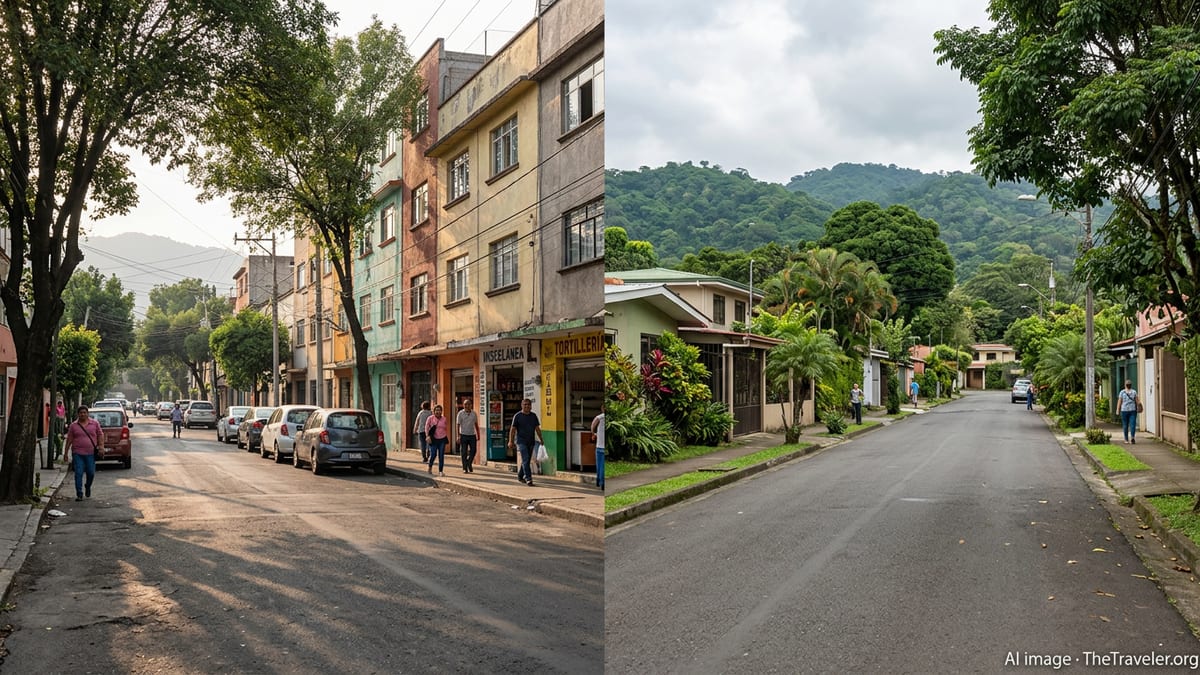
Overall Relocation Profile: Mexico vs Costa Rica
At a high level, Mexico offers a wider range of urban and regional lifestyles, from very large metropolitan hubs to smaller colonial cities and coastal towns, at generally lower cost than Costa Rica. Costa Rica, by contrast, is smaller and more centralized around the Greater San José metropolitan area and a limited number of coastal and highland communities, with a reputation for stronger institutional stability but higher day to day expenses.
Cost of living indices suggest that average consumer prices including rent in Costa Rica are modestly higher than in Mexico, while purchasing power within Mexico is typically lower due to lower average wages. Comparative datasets indicate that a single person’s basic monthly expenses (excluding discretionary travel and luxury consumption) are often around 10 to 20 percent higher in Costa Rica than in Mexico, though the gap varies by city and neighborhood profile.
On safety, both countries face crime challenges, but with different intensity and patterns. Mexico’s national homicide rate has been roughly double that of Costa Rica in recent years, driven largely by organized crime, even as official figures show a downward trend since 2020. Costa Rica has experienced an increase in violent crime since 2022 but still remains significantly below Mexico’s rates in most national level indicators.
For relocation decision making, Mexico tends to be more attractive for cost sensitive movers and those seeking diverse urban or cultural settings, while Costa Rica is often preferred by risk averse movers who are prepared to accept higher prices in exchange for comparatively lower levels of violent crime and a smaller, more manageable geographic environment.
Lifestyle Patterns and Everyday Living
Everyday lifestyle in Mexico is defined by large population centers and a broad hierarchy of cities. Mexico City’s metropolitan area exceeds 20 million people, and several secondary cities have populations above one million. This scale supports extensive dining, retail, coworking, and cultural ecosystems, particularly in middle and upper middle income districts. For relocators, this usually translates into strong access to services, international products, and diverse social networks, especially in major hubs and established expat neighborhoods.
Costa Rica’s population is about 5.3 million, with the majority concentrated in the Central Valley around San José. Urban density is significantly lower than in Mexico’s megacities, and the number of mid sized cities suitable for long term relocation is comparatively small. Daily life for many foreign residents centers on either the Central Valley (suburban and semi urban living with commuting into San José and nearby towns) or coastal communities, which have more limited retail and professional service options but a slower pace of life.
Work patterns and digital nomad lifestyles differ between the two countries. Mexico’s large cities tend to provide more coworking spaces, corporate offices, and networking environments, making them more suitable for professionals who depend on in person collaboration or wish to maintain strong ties to multinational employers. Costa Rica offers remote work friendly hubs as well, especially in the Central Valley and select coastal towns, but options are fewer and distances between nodes can be longer in terms of travel time relative to population size.
Infrastructure quality in daily life is also a differentiator. In Mexico, infrastructure quality varies sharply by region and municipality. Major urban centers and premium neighborhoods typically have reliable broadband, modern supermarkets, and developed transportation networks, while smaller towns may still present challenges with intermittent services. Costa Rica generally provides good access to utilities and internet in the Central Valley, though infrastructure can be less robust or more expensive in remote and coastal areas.
Cost of Living Structure and Budget Expectations
Both Mexico and Costa Rica remain less expensive than most large cities in the United States or Western Europe, but they are no longer “ultra cheap” destinations, particularly in high demand expatriate neighborhoods. For decision making, it is more useful to compare their internal cost structures than to rely on outdated notions of uniformly low prices.
Comparative cost of living aggregators suggest that overall living costs including rent in Costa Rica are somewhat higher than in Mexico. One dataset indicates that average one person rent in Costa Rica’s cities is roughly 25 to 30 percent higher than in comparable Mexican cities when standardized for similar central or desirable neighborhoods. Grocery prices, imported goods, and dining out in mid range establishments also tend to be higher in Costa Rica, reflecting the country’s smaller market size and higher reliance on imports.
Mexico, by contrast, offers a wider spread of budget tiers. Major cities and tourist heavy coastal areas have seen significant price inflation in recent years, especially for rentals and services oriented toward foreign demand. Nonetheless, in many mid sized cities and non luxury neighborhoods, a one bedroom apartment suitable for a single professional can still cost hundreds of dollars less per month than a comparable unit in key Costa Rican hubs. Local market groceries and public transportation in Mexico are usually cheaper than in Costa Rica.
Below is a simplified, illustrative comparison of typical monthly budgets for a single professional living in a mid range neighborhood in each country. These figures are generalized bands rather than exact quotes, and actual costs can diverge substantially by city and lifestyle choices.
Table: Illustrative Monthly Cost Bands for a Single Professional (USD)
Mexico (mid tier city, non luxury district): rent 450 to 750; utilities and internet 70 to 150; groceries 200 to 300; dining out and local transport 150 to 300; total core living costs often 870 to 1,500.
Costa Rica (Central Valley, mid tier neighborhood): rent 600 to 900; utilities and internet 100 to 170; groceries 250 to 350; dining out and local transport 180 to 320; total core living costs often 1,130 to 1,740.
For families, the gap in required budget usually widens. Three bedroom rentals with good access to quality schools and services tend to be noticeably more expensive in Costa Rica than in equivalent non luxury districts of medium to large Mexican cities, although top tier neighborhoods in Mexico’s most desirable urban areas can exceed Costa Rican prices.
Comparative Safety and Crime Patterns
Safety is the area where Mexico and Costa Rica diverge most clearly at the national level. Recent international crime and peace indices consistently place Mexico among the less peaceful countries globally, largely due to high homicide rates and organized crime activity. Estimates drawn from multiyear homicide datasets indicate that Mexico’s homicide rate in recent years has fluctuated in the mid twenties per 100,000 inhabitants, though with a downward trend since about 2020. By contrast, Costa Rica’s homicide rate, while rising, has most recently been reported in the low to mid teens per 100,000.
It is important to highlight that national averages mask substantial regional variation. In Mexico, a number of states experience homicide rates far above the national average, while others record levels closer to those of some North American or European regions. Several coastal and border states remain hotspots for cartel related violence, whereas many interior cities with strong service economies see substantially lower levels of violent crime affecting everyday residents.
Costa Rica’s recent increase in homicides has been linked in part to drug trafficking dynamics. However, many incidents are concentrated in specific areas and within criminal networks, and overall levels of everyday violent victimization for residents remain lower than in Mexico. Survey data and victimization studies indicate that while concerns about theft and property crime are common in Costa Rica, the proportion of the population reporting assaults or direct exposure to violence is still relatively modest by regional standards.
For relocators, both countries require heightened attention to personal security compared with lower crime European or East Asian destinations, but the baseline risk environment in Costa Rica is generally more favorable. Mexico may demand more rigorous risk management, careful city and neighborhood selection, and strict adherence to security routines, especially in regions with active organized crime.
Urban vs Regional Safety Differences
Within Mexico, safety profiles differ sharply not only by state but also at the neighborhood level. Large metropolitan areas such as Mexico City, Guadalajara, and Monterrey contain districts where day to day violent crime exposure for residents is relatively limited and where policing, surveillance, and community organization are stronger. At the same time, other districts in the same cities can face higher robbery, assault, or gang related incidents. Smaller colonial and highland cities often present lower crime rates but can lack some services.
Coastal and border regions in Mexico require particularly careful evaluation. Some resort areas have seen localized violence linked to criminal groups, while others maintain relatively stable security conditions. Prospective relocators should therefore treat “Mexico” as a patchwork of micro markets in security terms and avoid generalizing national level crime data to all localities.
In Costa Rica, the Central Valley shows the country’s highest concentration of both population and crime incidents. Certain districts of San José and surrounding cities have elevated risks of robbery and occasional violent crime, while many suburban and satellite communities maintain more favorable conditions. Coastal and rural communities can have lower violent crime but may present higher rates of property crime and occasional security incidents linked to drug trafficking routes.
Both countries exhibit a common pattern in which foreign residents who select relatively secure neighborhoods, avoid late night high risk behaviors, and invest in basic home and digital security tend to experience considerably lower personal victimization than suggested by national statistics alone. Nevertheless, in Mexico the consequences of misjudging local conditions can be more severe, given the higher prevalence of organized crime related violence.
Cost of Safety: Security Measures and Trade-offs
Security conditions in Mexico and Costa Rica have a direct impact on relocation budgets and lifestyle choices. In Mexico, living in higher security neighborhoods often involves premium rental costs, gated communities, or buildings with controlled access, private guards, and surveillance systems. Transport choices may be influenced as well, with some residents relying more on ride hailing services or vetted drivers and less on infrequent or unsafe public transportation in certain zones.
Costa Rica also sees a cost premium for safer neighborhoods, but the differential between standard and higher security housing is typically smaller than in Mexico’s largest cities. Basic measures such as solid perimeter fencing, alarm systems, and neighborhood watch practices are common, but the level of militarization or heavy private security presence is generally lower than in Mexico’s high risk areas.
Both markets demonstrate a link between perceived safety and location desirability. Coastal towns in Costa Rica with strong reputations for safety can command disproportionately high rental and property prices relative to local incomes. Similarly, in Mexico, districts that combine lower crime statistics with strong amenities have seen rapid price growth. For relocators, understanding that “safety” is a priced asset is important when comparing headline cost of living data that may not fully adjust for neighborhood level variation.
Personal security routines carry a time and lifestyle cost as well. In Mexico, some residents limit nighttime movement, avoid certain roads, and adjust commuting patterns to minimize exposure to potential crime or roadblocks. In Costa Rica, relocators may focus more on mitigating petty theft and vehicle break ins, which can alter choices about parking, carrying valuables, or leaving homes unattended for extended periods.
The Takeaway
Evaluated strictly on lifestyle, cost, and safety, Mexico and Costa Rica offer distinct value propositions for prospective relocators. Mexico delivers broader lifestyle choice, deeper urban infrastructure, and generally lower living costs, at the price of higher national level security risk and greater variability by region and neighborhood. It can be highly attractive to working professionals, digital nomads, and cost sensitive retirees who are prepared to actively manage security and select locations carefully.
Costa Rica provides a smaller but relatively stable environment where violent crime indicators remain significantly lower than in Mexico, albeit on a rising trend. Consumer prices and housing costs are higher, and choices in terms of cities and communities are more limited, but many relocators accept this trade off in exchange for a more moderate security environment and a more compact national setting.
For individuals and families prioritizing lowest possible budget and extensive lifestyle options, well chosen cities in Mexico may be the more practical choice. For those who place a premium on reduced violent crime exposure and are ready to absorb higher ongoing expenses, Costa Rica often emerges as the safer, though costlier, alternative. In both cases, granular city and neighborhood level analysis is essential, since national averages for cost and safety do not capture the full spectrum of relocation outcomes.
FAQ
Q1. Which country is generally cheaper for day to day living, Mexico or Costa Rica?
Mexico is usually cheaper for housing, groceries, and local services, although premium districts in top Mexican cities can match or exceed Costa Rican prices.
Q2. How do rental costs compare between Mexico and Costa Rica for a typical one bedroom apartment?
In mid range neighborhoods, monthly rent for a one bedroom is often several hundred dollars lower in Mexico than in comparable areas of Costa Rica’s Central Valley.
Q3. Is Costa Rica significantly safer than Mexico for long term residents?
At the national level Costa Rica has a noticeably lower homicide rate and fewer organized crime hotspots, though certain districts still require caution.
Q4. Are there parts of Mexico that are considered relatively safe for relocation?
Yes, several interior states and specific districts of large cities have comparatively lower violent crime, but conditions vary and require local level assessment.
Q5. Does choosing a safer neighborhood add much to the monthly budget in each country?
Both countries charge a premium for safer areas, with the cost uplift generally more pronounced in Mexico’s largest urban centers than in Costa Rica.
Q6. How do grocery and dining costs compare between Mexico and Costa Rica?
Local market groceries and casual dining are typically more affordable in Mexico, while Costa Rica often shows higher prices for imported goods and restaurant meals.
Q7. Is property crime a concern in both Mexico and Costa Rica?
Yes, property crime such as theft and break ins is a concern in both, though Costa Rica’s main issues are more often petty theft, whereas Mexico also struggles with more serious crime.
Q8. How do transportation and commuting affect lifestyle in each country?
Mexico’s large cities offer more transport options but also more congestion and some safety concerns, while Costa Rica’s smaller scale can reduce options but also limits commute distances.
Q9. For families, which country tends to require a higher budget to maintain a mid range lifestyle?
Costa Rica typically requires a higher budget for family sized housing and everyday expenses, especially in safe and well serviced neighborhoods.
Q10. If safety is the top priority, is Mexico automatically a poor choice?
Not necessarily; with careful city and neighborhood selection Mexico can be viable, but overall risk levels remain higher than in Costa Rica and demand more active management.