


More news on this day
Dubai International Airport, which ended 2025 with record passenger numbers and bullish forecasts for 2026, is confronting a sudden reversal as regional conflict and sweeping Middle East airspace closures disrupt its role as a global hub and drag down traffic volumes in the first months of the year.
Get the latest news straight to your inbox!
From Record Highs To A Sudden Shock
Dubai International Airport entered 2026 from a position of strength. Publicly available figures for 2025 show the hub handled about 95 million passengers, its highest annual total on record, with airport executives projecting close to 100 million travelers for 2026 as long-haul demand remained robust and tourism to the emirate continued to expand.
Early 2026 traffic data initially supported that optimism. A January 2026 operations report cited by aviation analytics platforms indicated that outbound flights from Dubai International grew year on year, reflecting ongoing network expansion by home carriers and the continued recovery of global air travel. For several weeks, the airport appeared on track to meet or even exceed its ambitious targets.
That trajectory shifted abruptly at the end of February, when a sharp escalation in the Iran conflict triggered coordinated U.S. and Israeli strikes and a wave of retaliatory action. Governments across the region responded with emergency airspace closures and capacity caps, transforming one of the world’s busiest aviation corridors into a patchwork of temporary no-fly zones almost overnight.
According to published coverage of the conflict’s economic fallout, multiple major Middle East airports, including Dubai International, were forced to halt or severely restrict operations as airspace over the United Arab Emirates and neighboring states was closed or tightly controlled. International passenger flows that typically pass through Dubai’s terminals in dense waves were suddenly disrupted or diverted.
Airspace Closures Cripple East–West Connectivity
The core of the crisis lies in the airspace above the Gulf and its surrounding states. Reports from flight-tracking services and aviation risk consultancies indicate that, following the first strikes on Iran on 28 February 2026, airspace over Iran, Iraq, Kuwait, Israel, Bahrain, Qatar and parts of the UAE was effectively shut to civilian overflights for days at a time.
Maps produced during the peak of the disruption showed large swathes of normally crowded skies virtually empty, with long-haul flights between Europe and Asia forced to detour either far north through the Caucasus and Central Asia or far south via Egypt and the Red Sea. Industry assessments describe these remaining corridors as narrow and congested, adding hours of flying time and significantly higher fuel costs for airlines.
For Dubai, whose hub model depends on efficient, high-frequency connections threading Europe, Africa and the Americas to Asia and Australasia, the effect has been immediate. Publicly available data referenced by Airports Council International Asia-Pacific & Middle East indicates that across nine key airports in the region, an estimated tens of millions of passengers did not travel as planned in March and April 2026, with overall volumes on some Middle East routes falling by more than half compared with a year earlier.
Airline network decisions are compounding the impact. Some European carriers have extended suspensions on most Middle East destinations into late 2026, citing ongoing airspace restrictions and security assessments. Safety regulators in Europe have also renewed advisories against overflying Iranian and Israeli airspace, pushing more carriers to route around the region and reducing the incentive to schedule connections through Dubai while conditions remain volatile.
Passenger Traffic Slides After Record Growth
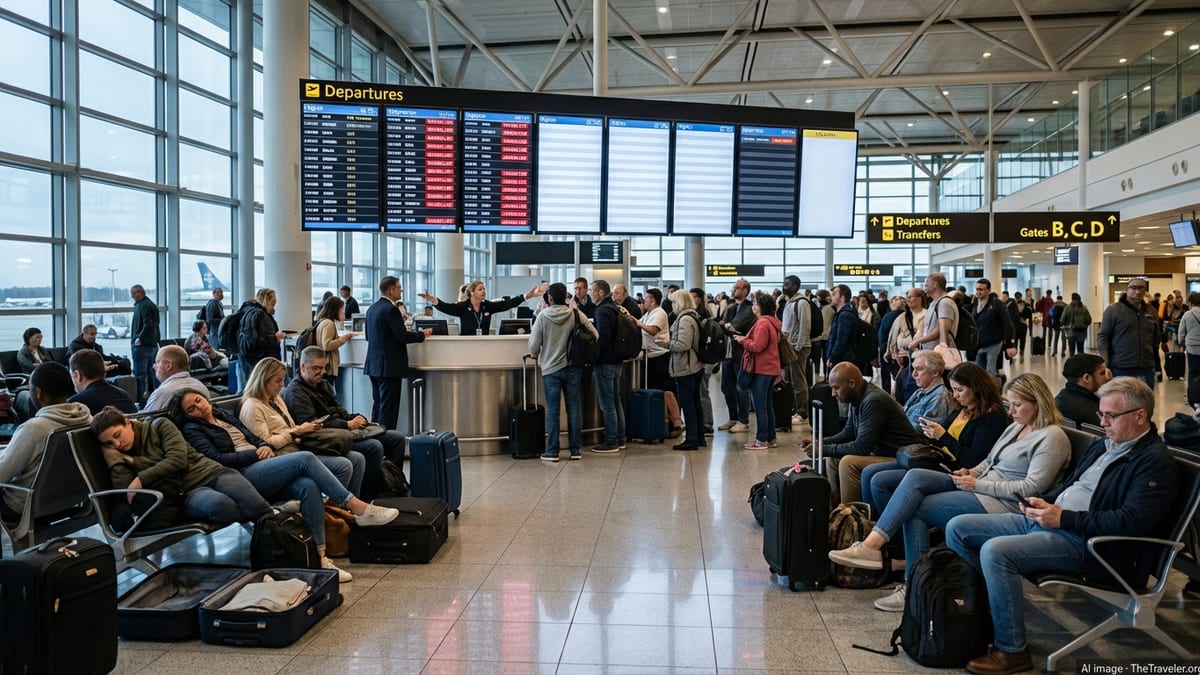
Although comprehensive, airport-issued passenger statistics for Dubai International in March and April 2026 have yet to be published, multiple indicators point to a sharp, conflict-linked downturn. Factbox-style summaries compiled by news organizations and passenger-rights services highlight temporary shutdowns or severe curbs at Dubai International and other Gulf hubs during the initial wave of strikes, with thousands of flights cancelled or significantly delayed over several days.
Analytics cited by travel compensation platforms suggest that more than a thousand flights into the wider Middle East were cancelled and many thousands more delayed globally in the immediate aftermath of the airspace closures. A significant share of these disruptions involved services to or via Dubai, where home carriers and international partners rely heavily on transiting passengers bound for onward long-haul connections.
Regional airport groups report that the closures and reroutings have translated into a steep year-on-year decline in March and April passenger volumes on Middle East corridors, even as traffic in other parts of Asia-Pacific remains relatively resilient. That divergence underscores how exposed Dubai is to geopolitical risk along its surrounding flight paths, despite strong underlying demand for travel to the city itself.
Preliminary distribution data from other hubs also points to reduced flows to and from Dubai as a destination. A February 2026 breakdown of international passenger traffic at Tel Aviv’s Ben Gurion Airport, for example, shows a year-on-year drop in passenger numbers on routes to Dubai, reflecting both Israeli airspace restrictions and weaker demand amid the broader security crisis.
Operational Strain And Network Realignment
The sudden contraction in available airspace has imposed significant operational strain on Dubai-based airlines and airport infrastructure. Publicly accessible overflight and schedule data shows aircraft that previously flew relatively direct tracks over Iran or Iraq now taking elongated routes south, often skirting along the Arabian Sea, or north via more circuitous paths across Central Asia.
These detours lengthen flight times by up to several hours on some Europe–Asia and Africa–Asia routes that would ordinarily connect through Dubai. Analysts note that the resulting increase in fuel burn, crew duty complexity and maintenance requirements erodes the economic advantages of using the Gulf as a transfer hub, particularly for price-sensitive connecting passengers.
Published commentary from industry consultancies describes airlines adopting a mix of strategies to cope. Some carriers are consolidating services, upgauging aircraft on a reduced number of frequencies while cutting marginal routes entirely. Others are shifting connecting flows to alternative hubs outside the immediate conflict zone, including points in Southern Europe and South Asia that are not subject to the same overflight constraints.
At Dubai International itself, flight-tracking snapshots during the most intense phases of the crisis show periods of unusually light traffic, followed by compressed peaks as restricted airspace partially reopened and carriers rushed to clear backlogs of stranded passengers. Airport operators across the region are now contending with irregular schedules, unpredictable slot utilization and mounting pressure on ground handling and customer service systems.
Outlook For Dubai’s Role As A Global Hub
Looking ahead to the rest of 2026, the central question for Dubai International is whether the current airspace crisis proves short lived or evolves into a prolonged constraint on the Gulf’s role as an east–west bridge. Industry bodies such as the International Air Transport Association continue to report solid global passenger growth, suggesting that demand for long-haul travel remains robust despite regional instability.
Analysts caution, however, that if extensive overflight restrictions and government advisories remain in place through the peak northern summer season, airlines may further entrench new routing patterns that bypass the most affected airspace. Such a shift could slow or reverse the rapid traffic growth Dubai has enjoyed since the pandemic, at least until a more stable security environment allows normal routing to resume.
Economic assessments of the 2026 Iran war already highlight aviation disruptions as a key transmission channel for broader regional losses, with several Gulf states highly exposed due to their reliance on hub-and-spoke air connectivity and tourism. For Dubai, the stakes are particularly high, given the airport’s integration with the emirate’s travel, trade and real estate sectors.
For now, publicly available information suggests that Dubai International is operating under constrained but improving conditions compared with the near-standstill seen around the beginning of March. Whether passenger traffic can recover enough in the second half of 2026 to offset the sharp declines recorded in the wake of the airspace closures will hinge on both the trajectory of the conflict and the willingness of airlines and travelers to return to Gulf skies at scale.