


More news on this day
Thousands of travelers have been left scrambling across Bahrain, India, Kuwait, the United Arab Emirates and beyond after a fresh wave of cancellations and delays involving FlyDubai, Saudia, Air Arabia, EgyptAir and Royal Jordanian disrupted at least 38 flights and delayed 34 more across the Gulf’s busiest corridors.
Get the latest news straight to your inbox!
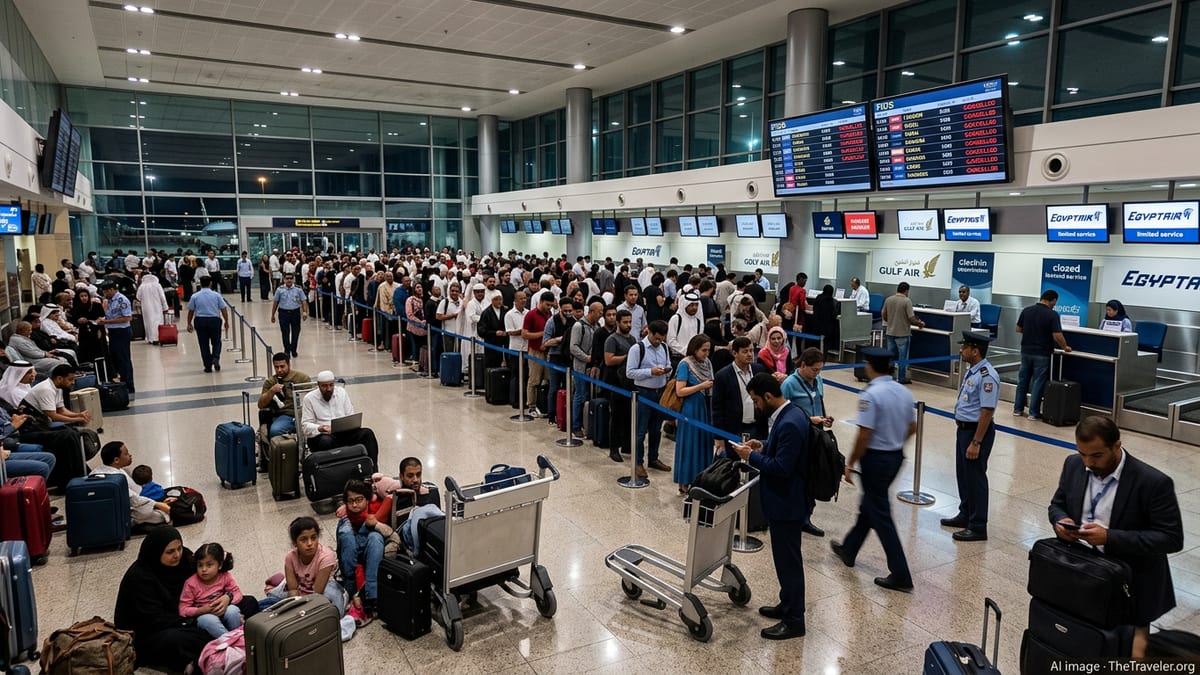
Regional Airspace Instability Fuels New Wave of Disruption
The latest disruption comes against the backdrop of months of volatility in Middle East airspace, where a combination of security tensions and shifting restrictions has repeatedly upended flight schedules. Publicly available aviation data and recent industry advisories show that airspace closures, tactical holds and rerouted corridors have become a defining feature of travel in and out of the Gulf since late February 2026.
While authorities in the United Arab Emirates announced a full resumption of normal air navigation operations earlier in May, reports indicate that renewed security concerns and intermittent restrictions are still rippling through regional networks. Carriers that rely heavily on hubs in Dubai, Riyadh and Cairo have been forced to trim frequencies, retime departures and, in some cases, cancel services at short notice as routing options shrink or become congested.
Industry trackers describe a patchwork of operating conditions. Airspace over parts of Bahrain, Kuwait and adjacent flight information regions has faced recurring limitations in recent weeks, with airlines required to navigate around conflict zones and potential risk areas. Even when airports remain formally open, these reroutings add time, cost and operational complexity that can quickly cascade into widespread delays and last minute cancellations.
In this context, the grounding of 38 flights and delays to at least 34 others involving FlyDubai, Saudia, Air Arabia, EgyptAir and Royal Jordanian represent the latest manifestation of a wider regional aviation crisis. The impact has been particularly visible on links connecting the Gulf with major South Asian markets, where high passenger volumes leave little slack in the system when disruption strikes.
Key Hubs Hit: Dubai, Riyadh, Cairo and Beyond
Dubai, Riyadh and Cairo have borne the brunt of the current wave of schedule upheaval, underscoring their central role in regional and global connectivity. Published operational updates from Dubai International highlight that the hub has already been managing constrained airspace capacity since late winter while still processing millions of passengers each month. The new round of cancellations and delays is compounding that pressure, especially for travelers using Dubai as a transfer point between Europe, Asia and Africa.
In Riyadh, both Saudia and newer operators linking the Saudi capital with regional destinations have faced a fluid operating environment. Travel bulletins circulated to corporate clients describe Saudi Arabia as open yet subject to ongoing delays, with airlines adjusting departures and arrivals as routing windows open and close. For passengers, this has translated into extended waits at King Khalid International Airport and tight or missed connections on onward flights.
Cairo, a major gateway between North Africa and the Gulf, is also deeply entangled in the disruption. EgyptAir only recently began rebuilding its schedule to Riyadh and other Gulf cities after earlier suspensions, and travel advisories note that flights to Bahrain and Kuwait remain constrained or suspended entirely on some routes. When additional cancellations hit, Cairo’s role as a backup option for rerouting Gulf-bound travelers becomes harder to sustain.
Secondary hubs across Bahrain and Kuwait are experiencing knock-on effects. Intelligence and risk consultancies tracking the situation describe Bahrain as facing intermittent operational changes, while Kuwait International Airport has endured repeated disruption tied to broader regional tensions. For travelers, the practical outcome is similar: fewer available seats, irregular schedules and a higher likelihood that a seemingly routine short-haul hop can suddenly turn into an overnight ordeal.
Passengers Stranded From Bahrain to India
The geographic reach of the disruption is wide. Flight data and traveler accounts point to passengers stranded or heavily delayed across Bahrain, Kuwait, the UAE, Saudi Arabia, Egypt and onward in India and Pakistan as Gulf carriers juggle limited capacity and shifting routings. Services linking Dubai and Sharjah with Indian metros, as well as routes from Riyadh and Cairo to South Asia, appear to be among the most affected.
FlyDubai and Air Arabia, which both carry large volumes of migrant workers and visiting families between Gulf cities and South Asian destinations, have been especially visible in public complaints about last minute cancellations and multi day delays. Social media posts and forum discussions from recent days describe flights being pulled just days before departure, with alternative options either sold out or priced far beyond original tickets.
Saudia and Royal Jordanian have also made targeted cuts and schedule changes on routes deemed higher risk or operationally challenging. According to travel management briefings, Jordanian services to Qatar, the UAE, Bahrain and Kuwait have faced prolonged closures or limitations, while Saudia has focused on maintaining core domestic and regional connections even as some international frequencies are trimmed.
For travelers originating in India, the picture is one of uncertainty at both ends of the journey. As UAE airspace gradually reopened earlier in May, Indian and Gulf carriers began reinstating some flights, but the latest disruptions show that reliability remains fragile. Passengers report rebookings spread over several days, circuitous itineraries via alternative hubs and, in some cases, the need to abandon plans altogether.
Operational Strain on FlyDubai, Saudia, Air Arabia, EgyptAir and Royal Jordanian
The operational impact on airlines is significant. FlyDubai, with its dense network radiating from Dubai to secondary cities across the Middle East, Central Asia and South Asia, must constantly reoptimize rotations as flight times lengthen and turnarounds tighten. Each new airspace restriction can ripple across its schedule, affecting aircraft availability and crew positioning for days.
Air Arabia, based in Sharjah but heavily exposed to similar regional patterns, faces comparable challenges. Reports from travelers suggest that the carrier has adjusted rebooking and refund practices in response to the sustained disruption, reflecting the financial strain of repeatedly canceling or delaying services in a volatile environment. Maintaining a balance between capacity, demand and safety-driven constraints has become a daily exercise.
Saudia and EgyptAir, both legacy flag carriers with extensive regional footprints, have been juggling their own sets of route suspensions and resumptions. EgyptAir’s phased restoration of links to Riyadh, Doha and Beirut, while key routes to Bahrain and Kuwait remain on hold, illustrates how incomplete the regional recovery remains. Saudia, for its part, has worked within a “situation fluid” environment in Saudi airspace, where flights operate but often under delay risk tied to broader Gulf routing issues.
Royal Jordanian sits at a crucial crossroads between the Levant and the Gulf, yet published advisories highlight that flights from Jordan to several Gulf states, including Qatar, the UAE, Bahrain and Kuwait, have been curtailed for extended periods. This constrains the airline’s ability to serve as an alternative bridge for passengers seeking to bypass more heavily affected hubs such as Dubai or Doha.
Advice for Travelers Navigating Uncertain Gulf Skies
Travel risk specialists and corporate mobility teams are advising passengers to treat timetables across the Gulf and neighboring regions as provisional rather than guaranteed. Publicly available guidance emphasizes the importance of monitoring airline apps and airport notices closely, as flights that appear confirmed can still be retimed or canceled within days or even hours of departure.
Travel planners increasingly recommend building additional buffer time into itineraries, particularly for journeys that require connections through Dubai, Riyadh, Cairo or other Gulf hubs. Booking earlier departures in the day, avoiding tight layovers and considering routings that spread risk across multiple carriers are recurring themes in recent guidance.
Passengers already in the region are being urged to secure written confirmation of any rebooking or compensation arrangements and to keep receipts for unexpected accommodation and meal costs in case they are eligible for reimbursement. Given that some airlines have adjusted refund timelines and conditions in light of the crisis, travelers may face longer waits for cash refunds and should be prepared for credit or voucher based solutions.
With no clear timeline for a full normalization of airspace and flight operations across Bahrain, Kuwait and all affected corridors, industry observers suggest that volatility in Gulf flight schedules is likely to persist in the near term. For travelers, that means vigilance, flexibility and a willingness to adapt plans remain essential when flying through one of the world’s most strategically important, yet currently unsettled, aviation regions.