


More news on this day
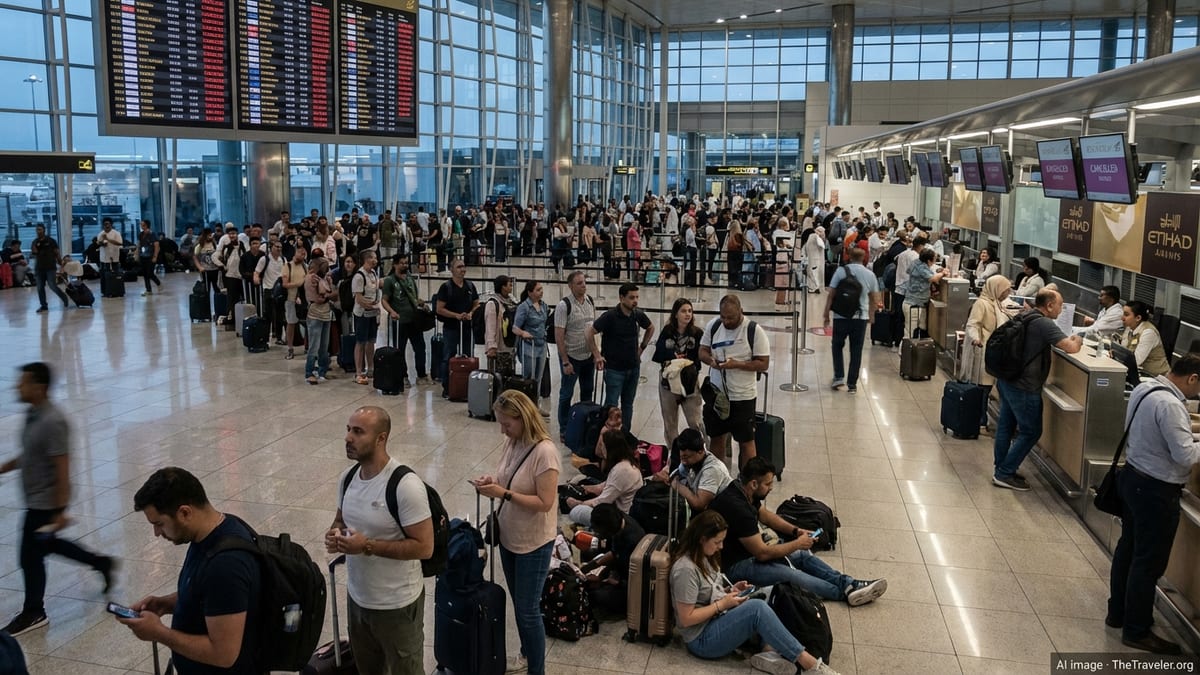
Air travel across the Middle East has been hit by a fresh wave of disruption, with regional data showing airports collectively logged 1,261 delayed flights and 59 cancellations in a single 24-hour period, highlighting the continued fragility of aviation networks amid conflict, constrained airspace and rapidly shifting security assessments.
Get the latest news straight to your inbox!
Ripple Effects Across Gulf and Levant Airports
Operational data and disruption-tracking platforms indicate that the latest spike in delays and cancellations was concentrated at major hubs in the Gulf and Levant, where already stretched schedules have been repeatedly redrawn in 2026. Bahrain International Airport and other regional gateways have been among the facilities most exposed to rolling changes in airspace access and routing requirements, resulting in banks of late departures and missed connections for passengers transiting between Europe, Asia and Africa.
Published coverage of recent disruption patterns shows that Kuwait, Sharjah, Tel Aviv and key United Arab Emirates airports have all experienced clusters of delayed and cancelled flights in recent weeks, linked to drone activity, temporary ground stops and shifting overflight permissions. On some days in July, Kuwait International Airport alone reported waves of delays as security measures were tightened following drone incidents, while carriers serving Sharjah and Tel Aviv contended with schedule knock-on effects that rippled into subsequent operating days.
Travel industry analyses describe a patchwork impact across the region, with global mega-hubs such as Dubai and Doha generally recovering faster from shock events than smaller regional airports. However, even when main hubs restore a large share of their schedules, the combination of extended routings around closed flight information regions and sudden tactical airspace restrictions continues to produce volatile day-to-day punctuality figures.
For travelers, the result is that a single day of elevated disruption, such as the 1,261 delays and 59 cancellations recorded across Middle East airports, can quickly translate into missed long haul connections, unplanned overnight stays and complex rebookings across several continents.
Conflict, Airspace Closures and Longer Routings
The surge in delays and cancellations cannot be separated from the broader aviation fallout of the 2026 conflict involving Iran and neighboring states. Industry intelligence providers and aviation data firms report that widespread airspace closures since late February triggered an unprecedented reshaping of flight paths between Europe, Asia and Africa, cutting overall flight volumes to, from and within the Middle East by well over half during the most acute phase of the crisis.
Reports indicate that multiple states, including Iran, Iraq, Kuwait, Qatar, Bahrain, the United Arab Emirates, Israel and Jordan, have at various times closed or severely restricted their airspace to commercial overflights. In response, airlines have been forced to adopt longer and less direct routes, adding flight time, fuel burn and crew duty complexity. Even as some airspace has partially reopened, carriers continue to avoid certain corridors, leaving schedules vulnerable to renewed disruptions when tensions flare.
Specialist disruption reports for the first quarter of 2026 highlight how coordinated closures of numerous flight information regions on a single day can cascade into thousands of cancellations and delays worldwide. When major Gulf hubs are constrained, long haul services linking cities such as London, Frankfurt, Mumbai, Singapore and Sydney often require significant retiming or last-minute rerouting, which then filters down into regional feeder flights across the Middle East.
Aviation briefings for corporate travel and tourism stakeholders emphasize that the current phase of disruption is characterized less by permanent route withdrawals and more by a constant churn of schedule adjustments. Airlines continue to serve most of their pre-crisis networks, but with lower frequencies, occasional aircraft storage and a heightened risk of operational changes close to departure.
Airlines Adjust Schedules as Passengers Face Uncertainty
According to publicly available airline statements and media coverage, Gulf carriers such as Emirates, Etihad, Air Arabia and flydubai are operating reduced yet still extensive networks while warning passengers that evolving security assessments may lead to short-notice delays or cancellations. Some international airlines, including Singapore Airlines and Air France, have extended suspensions or limited frequencies on selected Middle East routes, particularly services into Dubai, Riyadh and Beirut, as they reassess risk and resource allocation.
Consumer-focused claims platforms and flight compensation specialists report a marked increase in disruption cases involving Middle Eastern airlines in 2026, reflecting both outright cancellations and long delays that meet regional and international thresholds for assistance obligations. However, where disruptions stem from airspace closures or active conflict, passengers are often advised that compensation under European-style regulations may be restricted, even though airlines are generally expected to provide care, rebooking or refunds in line with their conditions of carriage.
Operational updates issued in recent days for flights originating in or transiting through the United Arab Emirates underscore that a schedule shown as operating can still be subject to late changes. Carriers continue to adjust departure times to accommodate revised routings and slot constraints at congested hubs, contributing to the high tally of delayed flights across the region captured in the latest 24-hour disruption snapshot.
For many travelers, the practical impact of a regional total of 1,261 delays and 59 cancellations is most visible in crowded departure lounges, extended waits at transfer desks and full flights on the limited alternative services that remain available when a connection is missed.
Hub Connectivity and Global Knock On Effects
Aviation analytics providers note that the Middle East functions as a critical bridge between Europe, Asia, Africa and Oceania, meaning that localized disruptions at Gulf hubs reverberate across global networks. During days of heavy disruption, aircraft and crew rotations are knocked out of position, leading to secondary delays on flights that do not directly touch the region but depend on aircraft arriving from Middle Eastern airports.
International traffic flow assessments prepared for airlines and corporate buyers in mid 2026 describe a sharp reduction in east west capacity via the Gulf, with some estimates indicating that flights between Europe and the Middle East were cut by more than half at the height of the crisis. Although capacity has gradually increased since then, each new wave of delays and cancellations, such as the latest 1,261-delay event, erodes schedule reliability and forces operators to run their remaining networks with less slack.
Industry digests tracking the economic impact of the conflict point to thousands of flights cancelled in the early weeks of the war and continuing volatility for sectors reliant on seamless connectivity, including tourism, cargo and high value business travel. The Gulf region previously positioned itself as a highly reliable transfer corridor, but the combination of airspace restrictions and infrastructure strain has at times left even resilient hubs struggling to clear backlogs quickly.
For travelers flying between regions as varied as South Asia and North America or Europe and Australasia, this means that seemingly distant developments in Middle East airspace can materially alter journey times, aircraft routings and the likelihood of missed onward flights.
What Travelers Can Do as Disruptions Persist
Travel organizations and aviation information services recommend that anyone flying to, from or through the Middle East in the coming weeks closely monitor airline communication channels, including mobile apps, email and SMS alerts. Real time flight tracking tools and global delay dashboards can help travelers understand whether disruption at a particular airport is isolated or part of a broader pattern, which may influence decisions about rebooking or rerouting.
Passenger advisory material prepared in response to recent Middle East disruption events suggests building additional buffer time into itineraries, particularly when self-connecting between separate tickets. Longer minimum connection times can reduce the risk of missed flights when departure slots are reshuffled or arrival times slip due to extended routings.
Travel risk briefings also underline the importance of flexible booking conditions and comprehensive travel insurance that clearly addresses delays and cancellations linked to conflict or airspace closures. While policies vary, products that allow fee free date changes, partial refunds or alternative routing can provide valuable options when large numbers of flights are disrupted on the same day.
With regional security dynamics still fluid and airspace restrictions subject to rapid change, industry observers expect elevated disruption risk to persist across Middle East aviation in the near term, even as airlines work to restore as much connectivity and schedule stability as conditions allow.
Middle East Air Travel Hit by 1,261 Delays and 59 Cancellations
UAE Flight Status and Cancellations Amid Iran War
Middle East Aviation Crisis: Latest Update
Middle East Flight Delays and Cancellations: Passenger Rights