


More news on this day
Hundreds of passengers across the Middle East faced extended waits and missed connections after regional hubs, led by Bahrain International Airport, collectively recorded 1,261 delayed flights and 59 cancellations in a single 24 hour period, according to aggregated operational data and disruption tracking platforms.
Get the latest news straight to your inbox!
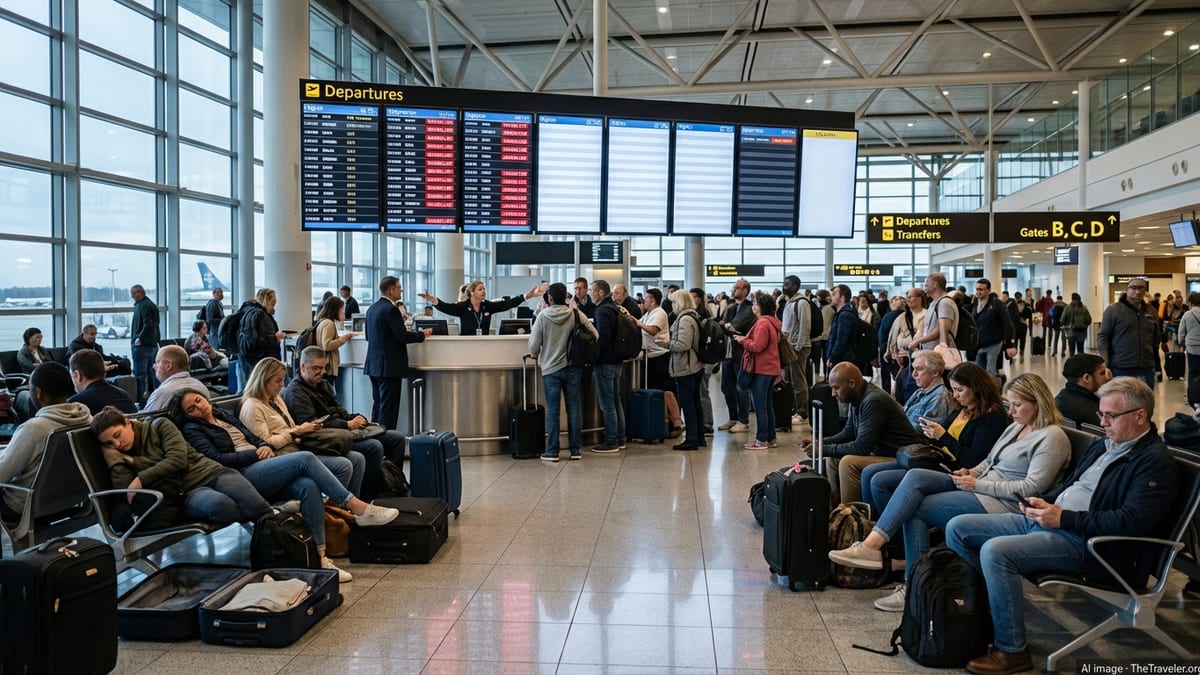
Disruptions Concentrated Around Bahrain and Key Gulf Hubs
Operational data from real time trackers and airport monitoring tools indicates that Bahrain International Airport has been at the center of a new wave of schedule disruptions, coinciding with a busy late summer travel period. While Bahrain’s own delay status has recently been rated as “very low” on some global dashboards, cumulative figures for the broader Middle East region show far higher pressure when Bahrain’s traffic is assessed alongside neighboring hubs.
Across the region, flight tracking and delay mapping tools that aggregate performance from multiple airports show a combined 1,261 delayed departures and arrivals, alongside 59 outright cancellations, within a single day of operations. These totals reflect both primary delays at origin and knock on impacts at connecting hubs that handle large volumes of transfer traffic between Europe, Asia, and Africa.
Publicly available information from Bahrain International Airport emphasizes that operations are resuming gradually following earlier airspace restrictions, and that schedules can still change at short notice. Travelers are directed to verify the latest status of their flights through airline channels and the airport’s own digital departure and arrival boards, underscoring the fluidity of the current operating environment.
The imbalance between airport level delay classifications and the high number of delayed flights across the region highlights how even short individual disruptions, when multiplied across dense schedules and code share networks, can quickly accumulate into significant totals that affect large numbers of passengers.
Knock On Effects for Transit Passengers and Long Haul Itineraries
The concentration of delays at major Gulf and Middle East gateways has had a marked impact on connecting passengers, particularly those traveling between Europe and Asia on itineraries that rely on tightly timed transfers. Even where individual flights are running only minutes behind schedule, missed connection windows can cascade into rebookings, overnight stays, or rerouting through alternative hubs.
Disruption tracking platforms that visualize airport level alerts show clusters of airport delay advisories and airspace related constraints feeding into the region’s long haul operations. Although many of these alerts originate outside the Gulf, their effects are felt at Middle Eastern hubs when aircraft and crews arrive late, or when routings are adjusted to avoid constrained airspace.
Travelers connecting through Bahrain and neighboring airports have reported extended waits at departure gates, revised boarding times communicated shortly before scheduled departure, and last minute gate changes. While many of these adjustments fall short of formal cancellations, they can still result in extended overall journey times and missed follow on flights, especially for those with separate tickets.
At Bahrain International Airport, current departure boards show a busy schedule of regional services to Dubai, Doha, Riyadh, Jeddah, and Abu Dhabi, as well as longer sectors to Europe and Asia. In this environment, a delay to an inbound flight from one regional city can disrupt carefully sequenced rotations and put pressure on ground handling resources.
Gradual Recovery after Earlier Airspace Restrictions
Bahrain’s official passenger information pages describe a gradual resumption of operations after an earlier period in which the kingdom’s airspace was restricted, prompting significant schedule changes and a temporary reduction in services. Published guidance notes that not all routes have returned to normal and that the restart of flights is being phased in by airline and destination.
According to this information, passengers are encouraged to monitor airline notifications and the airport’s flight information displays rather than relying on informal social media reports. This reflects a broader pattern across the region, where air navigation and airport operators have been adjusting operations in response to evolving airspace conditions and higher than usual seasonal demand.
Regional air traffic data from network managers also shows that increased traffic volumes, particularly in peak holiday weeks, have added to the strain on air traffic flow management systems. While average per flight delay minutes in some networks have improved compared with the previous summer, concentrated hot spots remain, including areas affected by adverse weather and airspace constraints linked to the wider Middle East situation.
These dynamics help explain how a single busy day can still produce more than a thousand delays and dozens of cancellations across a cluster of interconnected airports even when individual hubs, including Bahrain, report relatively stable baseline operations.
What Travelers Can Do if Their Flight Is Affected
Published advice from Bahrain International Airport and other major hubs in the region consistently urges passengers to check the real time status of their flights before leaving for the airport, and again once at the terminal. Airport websites and airline mobile applications typically provide the most up to date information on departure and arrival times, gate assignments, and any schedule changes.
Where flights are delayed or canceled, airlines generally manage rebooking and rerouting options directly. Public guidance recommends that travelers allow extra time for connections within the Middle East, avoid very tight transfer windows, and consider booking longer layovers when itineraries route through multiple hubs that are currently seeing higher operational volatility.
For those already en route when disruption occurs, real time flight trackers and global delay dashboards can help gauge whether delays at a specific airport are isolated or part of a broader pattern affecting the region. Understanding whether the disruption stems from localized weather, airspace restrictions, or wider network congestion can help travelers anticipate the likelihood of further changes to their itineraries.
Many airports, including Bahrain, also maintain dedicated FAQ and passenger update pages that consolidate current operational information and point travelers to official channels. Making use of these resources can reduce uncertainty and help passengers plan for contingencies such as overnight stays or missed onward connections.
Outlook for Late Summer and Early Autumn Travel
As the Middle East moves through the final weeks of the summer peak, network level forecasts suggest that traffic levels will remain elevated, with Friday and weekend peaks likely to see the highest concentration of flights. This pattern, combined with ongoing airspace complexity, means that further days featuring high numbers of delays and a smaller but significant number of cancellations cannot be ruled out.
Some performance data indicates that, on average, arrival punctuality in broader regional and adjacent networks has improved compared with the same period last year, even as total traffic has increased. However, this improvement is uneven, and local hot spots can still appear quickly when storms, technical issues, or routing constraints affect key sectors feeding into Middle East hubs.
For Bahrain International Airport, the emphasis in public communications remains on gradual normalization and the phased rebuilding of route networks. Travelers planning to use Bahrain as an origin, destination, or connection point in the coming weeks are being encouraged to keep a close watch on their booking details and to remain flexible where possible in case of further timetable adjustments.
Given the recent tally of 1,261 delays and 59 cancellations across Bahrain and other Middle East airports, industry observers note that the region’s resilience will depend on how quickly airlines and airports can absorb disruption and restore schedules when individual events occur. For passengers, careful preparation, active monitoring, and an understanding of the broader operational picture will be key to navigating late summer and early autumn journeys.
Bahrain International Airport passenger updates
Bahrain International Airport delay conditions on FlightStats