


More news on this day
A renewed wave of aviation disruption is sweeping across the Middle East, with at least 19 flight cancellations and 12 significant schedule changes reported across Saudi Arabia, the United Arab Emirates, Jordan, Qatar, Syria and Egypt, as regional airspace restrictions and tactical capacity cuts leave stranded passengers navigating gridlocked airports and uncertain itineraries.
Get the latest news straight to your inbox!
Fresh Disruptions on Top of a Prolonged Airspace Crisis
The latest cancellations and delays are unfolding against the backdrop of a wider aviation shock that began in late February 2026, when coordinated military action involving the United States, Israel and Iran triggered sweeping airspace closures across the region. Publicly available travel advisories and aviation analyses describe this as the most significant interruption to Gulf aviation in decades, with millions of passengers affected over recent weeks as key corridors between Europe, Asia and Africa were abruptly severed.
Data compiled by flight-tracking platforms, aviation analytics firms and regional travel advisories indicates that thousands of services have been cancelled or rerouted since the crisis began, including long-haul trunk routes that ordinarily rely on Gulf and Levant hubs as intermediate stops. Even as some airspace restrictions have eased slightly, many carriers are still avoiding portions of the skies over Iran, Iraq, Syria, Israel and parts of the Gulf, leading to longer routings, additional fuel stops and a rolling pattern of knock-on delays.
For travelers moving through Saudi Arabia, the United Arab Emirates, Jordan, Qatar, Syria and Egypt, this means that even a relatively small batch of 19 cancellations and 12 schedule changes within a short window can cascade into missed connections, overnight misconnects and aircraft out of position for subsequent rotations. Localized disruptions, such as tactical suspensions of flights to “high risk” destinations from Amman, Riyadh or Cairo, can rapidly amplify when combined with wider regional rerouting.
Industry briefings and risk updates released over the past month highlight that airspace is technically open over several of the affected countries, yet airlines and aviation regulators continue to impose their own restrictions on certain routes for operational and safety reasons. This discrepancy helps explain why some airports remain officially open while departure boards still show a mix of cancellations, rolling delays and last‑minute schedule adjustments.
Saudi Arabia, UAE and Qatar: Hubs Under Pressure
Saudi Arabia, the United Arab Emirates and Qatar have been at the center of the turbulence, given their role as connective hubs linking Europe, Asia and Africa. Travel risk bulletins and regional port advisories in March and April describe Saudi airports as fully operational but note that services to a cluster of nearby countries remain suspended, and that flights over selected conflict-adjacent airspace are being rerouted. That combination has translated into intermittent cancellations on regional and domestic legs, particularly where traffic feeds into long-haul departures.
Publicly accessible operational updates for Dubai International and Doha’s Hamad International show that both airports have reopened after earlier shutdowns, but with constrained schedules and an emphasis on repatriation and essential travel. Reports suggest that Gulf network carriers are gradually rebuilding their timetables while still operating under limitations imposed by conflict zone advisories and evolving airspace permissions, leaving little slack in the system when new disruptions occur.
For passengers, the result is a patchwork of outcomes. Some travelers transiting Riyadh or Jeddah report reaching their final destinations only slightly behind schedule thanks to rerouted flights that avoid restricted skies. Others, particularly those relying on separate tickets or low-cost regional connectors into Gulf hubs, have been stranded for 24 hours or longer after relatively small schedule shifts caused them to miss onward departures that were already operating near capacity.
Travel industry guidance increasingly advises those flying via these hubs to build in longer connection times, avoid last departures of the day where possible and treat any itinerary involving multiple nonaligned carriers with extra caution. With aircraft and crews still cycling through irregular rotations, on-time performance remains vulnerable to new security developments or changes in airspace access along key corridors.
Jordan, Syria and Egypt Face Tactical Cancellations
Jordan, Syria and Egypt are experiencing a different but related pattern of disruption. Publicly available advisories from regional logistics and port-monitoring firms note that Jordanian airspace is open, yet flights from Amman to certain Gulf countries, including the United Arab Emirates, Qatar and Syria, remain suspended or heavily reduced. These tactical cancellations reflect airline risk assessments rather than full airport closures, but they still leave passengers facing last-minute changes and constrained rebooking options.
In Syria, the broader airspace environment remains highly restricted, and commercial connectivity continues to rely on a limited number of routes that can operate under prevailing security and insurance conditions. Recent schedule changes affecting services into and out of Damascus have compounded earlier cuts, narrowing the options for travelers trying to connect between Syria and neighboring states such as Jordan and Egypt.
Egypt’s main airports, including Cairo, are described in recent maritime and aviation bulletins as fully operational, with no blanket closure of airspace. Even so, publicly available information on national carrier schedules shows selective suspensions and frequency reductions on routes that intersect with higher-risk zones or depend on overflight permissions now constrained by the wider conflict. These tactical moves can be difficult for travelers to predict, as flights may remain on sale but later be retimed, downgauged or consolidated.
Across all three countries, the interplay between national policy, airline risk tolerance and foreign overflight rules means that route maps can shift with little warning. Passengers booked on services linking Amman, Cairo or Damascus with Gulf and Levant destinations are particularly exposed to rolling timetable changes that may not be reflected in third-party booking platforms until shortly before departure.
Airport Gridlock and the Passenger Experience
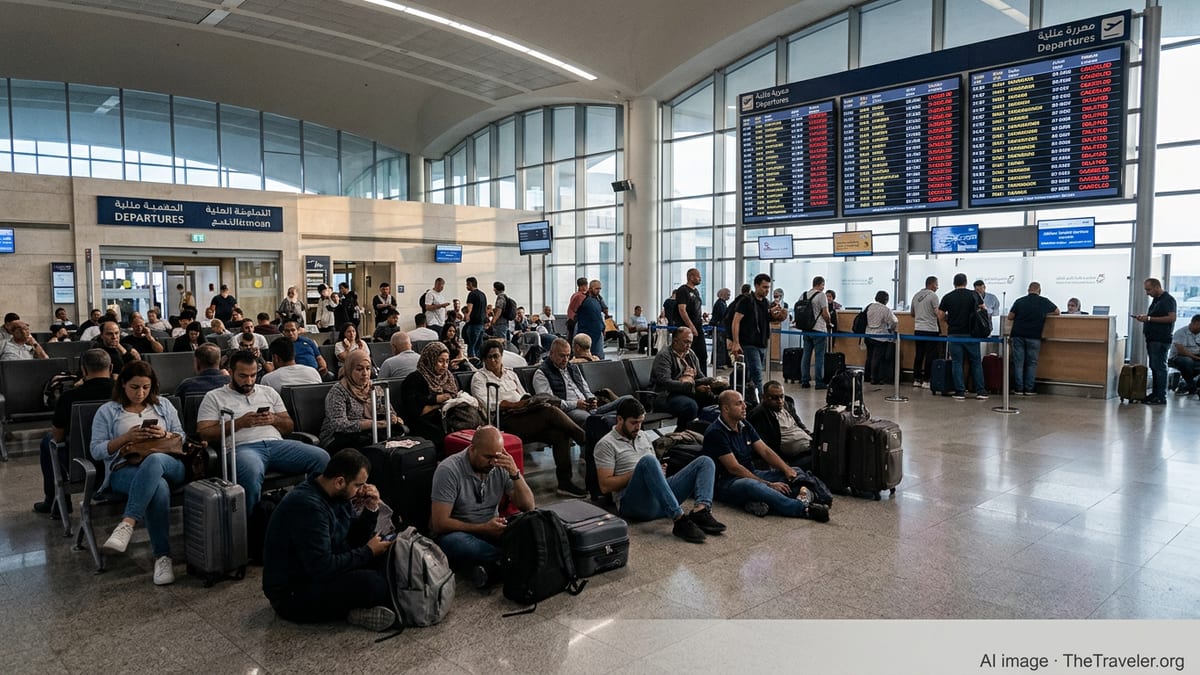
As cancellations and delays accumulate, airport terminals across the region have become increasingly crowded. Images and eyewitness accounts circulating in open media depict long queues at check-in and transfer desks, departure boards filled with red “cancelled” markers and families camping in seating areas as they wait for updates. In several cases, passengers have reported waiting hours for clarity on whether their flights would depart, only to be advised late in the day that services had been withdrawn.
Gridlock has been particularly acute at transfer-heavy hubs, where travelers arriving from relatively unaffected regions are suddenly funneled into congested rebooking lines after discovering that their onward legs have been canceled or significantly delayed. Because many of the affected flights connect multiple world regions, re-accommodating passengers often requires complex reshuffling across already busy networks, reducing the likelihood of same-day solutions.
Complicating matters, not all passengers hold tickets on a single carrier or alliance. Travel advisories and consumer-rights guidance note that individuals who have combined separate tickets, such as a low-cost regional hop into a Gulf hub followed by a long-haul flight on a different airline, may find themselves caught between carriers, each pointing to the other when a missed connection originates on a separate reservation. This can prolong time spent landside or airside with limited access to hotel accommodation or meal vouchers.
Amid this environment, stranded passengers are increasingly turning to airline apps, social media channels and online flight-status tools in an effort to obtain faster information than is sometimes available at physical desks. Publicly available commentary from passenger advocates stresses the importance of keeping digital contact details up to date, as some carriers are prioritizing rebooking notifications and boarding pass reissues through mobile platforms rather than via in-person queues alone.
What Travelers Need to Do Now
For anyone scheduled to travel through Saudi Arabia, the United Arab Emirates, Jordan, Qatar, Syria or Egypt in the coming days, the primary recommendation from travel advisers and risk consultants is to treat flight status as highly dynamic. It is widely suggested that passengers verify the operating status of every flight segment directly with the airline before leaving for the airport and again several hours before scheduled departure, even if tickets were purchased through an intermediary.
Travelers are being urged in publicly available guidance to allow additional buffer time between connections, particularly when itineraries involve transits through Dubai, Doha, Riyadh, Jeddah, Amman or Cairo. Longer layovers may reduce the risk of misconnecting if an inbound service is delayed by rerouting or extended flight times around restricted airspace. Where possible, opting for through-tickets on a single carrier or within one alliance can also simplify rebooking if timetable changes occur mid-journey.
Consumer advisories recommend that passengers retain all documentation related to cancellations and delays, including boarding passes, booking confirmations, written notices from airlines and receipts for emergency expenses such as hotels or meals. These records can be important when seeking refunds, vouchers or travel insurance reimbursement, particularly in situations where services were withdrawn at short notice due to evolving security conditions.
Finally, travelers are encouraged to remain flexible with routing and dates. With schedules still in flux and some destinations subject to ongoing suspensions, accepting alternative routings via less affected hubs, or shifting travel by a day or two where feasible, may significantly improve the chances of reaching the intended destination. While there are early signs that airlines are gradually stabilizing their networks, the combination of airspace restrictions and regional security uncertainty means that further pockets of cancellations and delays across the Middle East remain possible in the near term.