


More news on this day
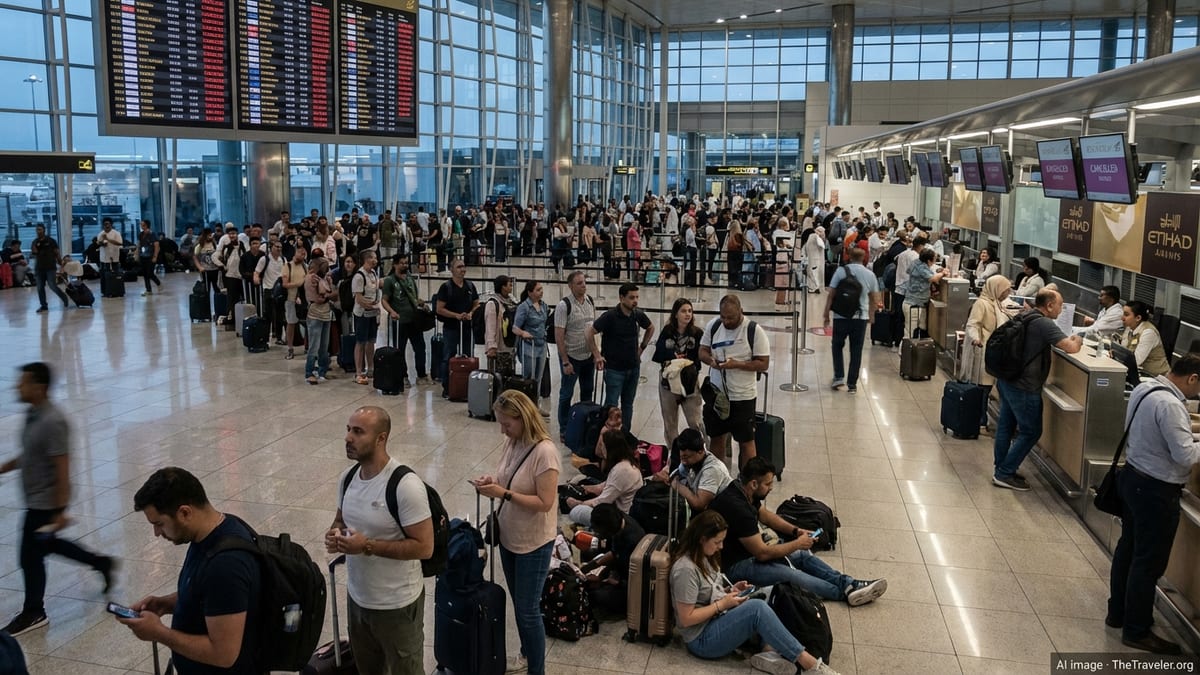
Fresh turbulence has swept across Middle East aviation as carriers in the United Arab Emirates, Saudi Arabia, Egypt, Qatar and neighboring states cancel 201 flights and delay more than 1,000 others, disrupting operations for major Gulf hubs and grounding wide swathes of the fleets of Emirates, Qatar Airways, Saudia, Etihad and regional competitors.
Get the latest news straight to your inbox!
Airspace Restrictions Ripple Across Key Middle East Hubs
According to publicly available operational data and industry briefings, a fresh round of airspace restrictions and route adjustments linked to the ongoing regional conflict has triggered widespread schedule disruption across the Gulf. Airspace constraints affecting corridors over and around Iran, Iraq and adjacent flight information regions have forced traffic to bunch into limited alternative routings or avoid affected skies entirely.
Aggregated flight-tracking snapshots for the latest 24-hour period indicate that at least 201 flights touching airports in the United Arab Emirates, Saudi Arabia, Egypt, Qatar and other nearby states have been cancelled, with a further 1,081 delayed. These figures include both departing and arriving services and capture knock-on effects as aircraft and crews have struggled to stay in position amid rolling restrictions.
The pattern reflects a familiar but intensifying cycle for the region: short-notice airspace closures, followed by diversion of long-haul services, ground stops at major hubs and a rolling backlog of delayed departures. Industry observers note that, while many Gulf airports technically remain open, frequent adjustments to overflight permissions and conflict-zone buffers are making reliable scheduling extremely difficult.
Operational updates from airports and travel-management advisories describe a constantly shifting mosaic of reroutes, extended flight times and day-of-travel cancellations. For passengers, even flights that eventually depart are often leaving many hours behind schedule, with extended waits at congested terminals from Dubai and Abu Dhabi to Riyadh, Jeddah, Cairo and Doha.
Flagship Gulf Carriers Forced to Ground and Reroute
The latest disruption has hit the region’s heavyweight airlines especially hard. Emirates, Qatar Airways, Saudia and Etihad, which normally rely on dense banked waves of connecting flights through their hubs, have all been forced to pare back operations, ground aircraft or maintain extended holds while new routings are secured.
Publicly available airline advisories describe widespread suspensions and reductions on routes that would ordinarily transit affected airspace, particularly overnight long-haul sectors between Europe or North America and South or Southeast Asia. In some cases, flights are being routed around the eastern Mediterranean and over North Africa, adding significant mileage, fuel burn and block time.
Network analyses produced by aviation consultancies in recent weeks already showed the big Gulf carriers operating at well below pre-crisis capacity due to earlier waves of conflict-related restrictions. The newest cancellations and delays add further strain, constraining aircraft utilization and forcing complex rebalancing of fleets between still-viable corridors and shutters routes.
Some carriers are reportedly concentrating what capacity they can operate on core trunk routes to major partner hubs while temporarily thinning frequencies to secondary cities. That strategy aims to preserve at least a skeleton network for essential traffic, but it also means passengers to and from smaller markets are more likely to see their flights among those cancelled or rescheduled at short notice.
Regional Airports Confront a Rolling Operational Challenge
For airport operators across the Middle East and North Africa, the current wave of disruption is another stress test of resilience following years of rapid growth and earlier geopolitical shocks. Publicly available airport status boards from hubs in the Gulf and the wider region show a patchwork of on-time departures interspersed with clusters of cancellations and multi-hour delays on affected corridors.
Industry bulletins focusing on the Middle East highlight that, while major airports in the UAE, Saudi Arabia, Qatar and Egypt remain technically operational, intermittent restrictions on key arrival and departure routes can prompt sudden ground stops or sequences of delayed take-offs. That situation has knock-on effects for connecting waves, as inbound aircraft arrive late and miss their original outbound slots.
Aviation risk and travel-security assessments published in recent days emphasize that the operational picture can change within hours, with countries reopening segments of airspace as perceived threats ease, only to tighten restrictions again following new incidents. This instability makes it difficult for airports to plan staff deployment, gate assignments and baggage operations, compounding the impact on travelers.
Several travel-management updates advise corporate clients to anticipate longer transit times through Gulf hubs and to avoid tight connections wherever possible. They also recommend that travelers departing from regional airports check flight status repeatedly on the day of travel, as early-morning schedules are particularly vulnerable to rolling delays when overnight long-haul services arrive off-slot.
Global Connectivity and Supply Chains Feel the Impact
The Middle East functions as a central crossroads in the global air network, particularly for east to west and north to south traffic connecting Europe, Africa, Asia and Oceania. Analysts tracking the economic impact of the 2026 conflict have already noted that previous waves of airspace closure in the Gulf significantly reduced available long-haul capacity and forced airlines worldwide to redesign their route maps.
Fresh cancellations involving Gulf hubs and carriers such as Emirates, Qatar Airways, Saudia and Etihad are once again reverberating well beyond the region. Long-haul passengers booked on itineraries between cities far outside the Middle East, but routed via Dubai, Abu Dhabi, Doha, Riyadh or Jeddah, face missed connections and unplanned stopovers as their journeys are broken up or rebooked.
Airfreight movements are similarly affected. Supply chain bulletins issued in late June and early July already flagged limited cargo capacity and longer transit times on lanes that rely on Middle Eastern hubs. With the latest service suspensions and delays, shippers moving time-sensitive goods, high-value components and pharmaceuticals through the region are being advised to anticipate further congestion and to explore alternative routings via Europe, Central Asia or direct ocean-air combinations.
Logistics analysts warn that as long as airspace unpredictability persists, airlines will be forced to operate suboptimal routings with higher fuel costs and lower aircraft utilization. These pressures could translate into higher fares and surcharges on some long-haul markets, particularly where alternatives to Gulf connections are limited or already operating near capacity.
Travelers Advised to Build Flexibility Into Middle East Itineraries
With Middle Eastern aviation once again subject to conflict-related turbulence, publicly available travel advice from airlines, airports and security consultancies converges on a similar message for passengers: build flexibility into any itinerary that touches the region in the near term. Same-day connections through Gulf hubs are currently at heightened risk of disruption, especially where flights rely on corridors near active conflict zones.
Travel guidance notes recommend leaving generous buffers between connecting flights, considering overnight stopovers where feasible, and closely monitoring booking channels or airline apps for schedule changes. Many carriers serving the region have retained flexible rebooking and refund policies introduced during earlier phases of the crisis, which can provide some relief for affected passengers willing to adjust their plans.
For travelers yet to book, routing via alternative hubs outside the immediate conflict-affected area, even at higher upfront cost or with slightly longer total travel times, may offer greater reliability until the regional airspace picture stabilizes. Where travel is essential and must pass through Gulf hubs, experts suggest prioritizing earlier departures in the day, when there is still some room to re-accommodate passengers on later flights if disruptions cascade.
Industry observers caution that the current count of 201 cancellations and 1,081 delays in the latest reporting window may fluctuate quickly, either easing if airspace constraints are lifted or worsening if new incidents trigger broader closures. Until a sustained period of stability emerges, travelers and companies with exposure to Gulf aviation are being urged to treat schedules as provisional and to plan accordingly.