

I thought I knew the Midwest. I grew up on its interstates and cheese curds, its ballparks and brick main streets. Yet no city in the region has blindsided me quite like Milwaukee. I arrived expecting another workaday Great Lakes town with good beer and predictable streets. I left with the sense that I had just walked through a place reinventing itself in real time, and doing it with a humility and creativity that bigger, louder cities often lack.
A Lakefront That Feels More Coastal Than Rust Belt
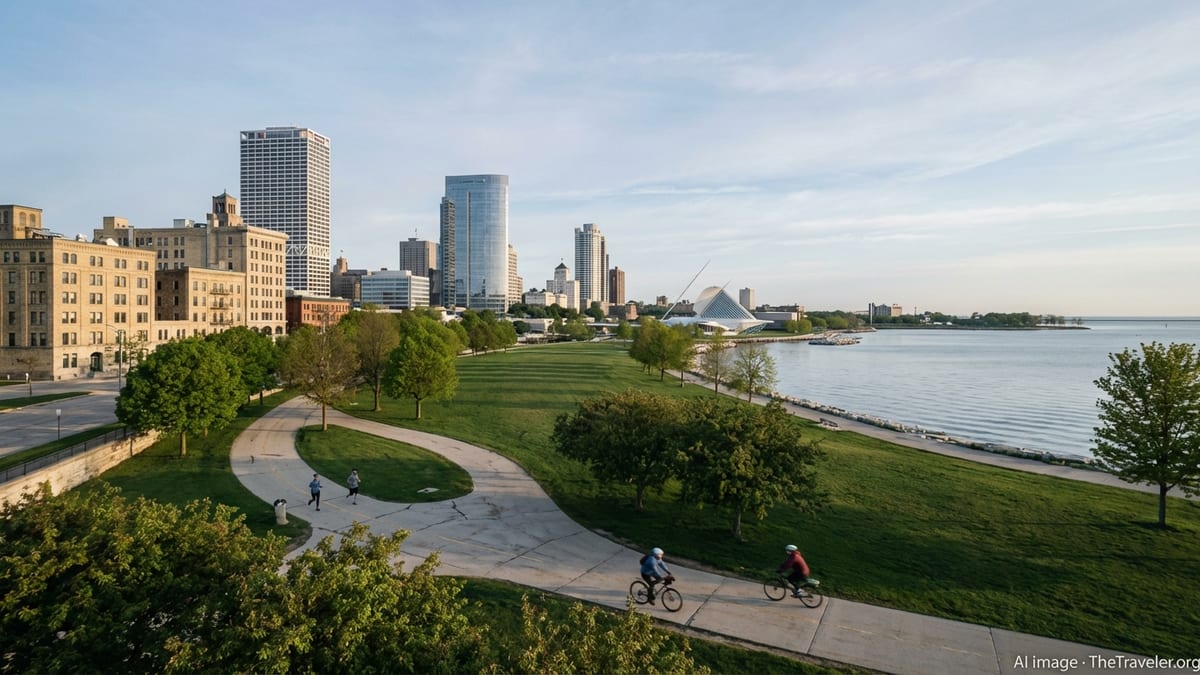
The first hint that Milwaukee would upend my expectations came at the edge of Lake Michigan. The city’s lakefront does not feel like an industrial afterthought. It feels like the front porch. Long stretches of parkland, bike paths, and promenades lead from downtown to the water, creating a nearly seamless transition from office tower to sailboat mast. Years of coordinated planning and infrastructure work have untangled highway ramps and opened up new pedestrian routes, improving the connections between downtown, the Historic Third Ward, and the shore. You sense immediately that the lake is not a backdrop. It is the main stage.
On a clear afternoon, the light has a softness that makes the skyline look almost coastal. Runners pass families pushing strollers. Cyclists ring their bells as they cruise toward the museum and festival grounds. There is industry here, but it feels pushed respectfully to the margins, as if the city reached a compromise with its working roots and chose to keep access to the water foremost for people. For a region better known for smokestacks than sailboats, that choice feels quietly radical.
What impressed me most was how accessible it all felt. There is no sense of an exclusive waterfront reserved for luxury towers or private clubs. Instead, lawns roll right up to the bike path. Public art dots the walkways. Even the reworked streets leading toward the lake feel designed with walkers and cyclists in mind, their former tangle of ramps simplified into calmer boulevards. In other Midwestern cities, you often have to fight your way to the water. In Milwaukee, you simply follow the flow of people headed east and eventually, the horizon opens.
At sunset, the city’s modest but confident skyline glows in shades of copper and brick. There are no overwhelming supertalls here, no need to shout. Milwaukee lets the lake provide the spectacle while it focuses on the details that make a shoreline livable day to day. That balance of restraint and ambition was my first clue that the city was going to surprise me again and again.
From Brew City To Brewery District: Reinvention In Brick And Steel
Milwaukee’s brewing legacy is as famous as its baseball team’s name suggests, but the familiar story of factory decline and rusted warehouses leaves out the most interesting chapter. Walk a few blocks northwest of the arena, and you step into the Brewery District, a walkable neighborhood built within the bones of the former Pabst Brewing Company campus. Once a 21 acre industrial complex, it has been painstakingly reborn as a mixed use district that folds student housing, offices, hotels, apartments, and new breweries into the historic brick architecture.
What could have become another cleared site and glass box development instead keeps the textures of the past. Smokestacks tower over courtyards filled with café tables. Original cream city brick facades frame modern windows. Old brewhouses now contain university facilities and event spaces. The effect is less like visiting a museum of industry and more like walking through a city that refused to decay quietly. You feel a sense of continuity, a trust that there was still life left in these buildings if someone was patient and imaginative enough to find it.
I have seen industrial conversions in other Midwestern cities, but few match the cohesion here. Because the Brewery District sits between the interstate, the arena, and the rest of downtown, it functions as a literal and figurative bridge between eras. On one side you have the new Deer District, buzzing with game night energy. On the other side, older neighborhoods where families have lived for generations. In between, these resurrected brewhouses offer something that feels distinctly Milwaukee: forward looking but never embarrassed by the past.
Perhaps most surprising is how lived in it all feels. This is not a trophy district built only for visitors. Residents walk dogs along narrow streets where cobblestones meet bike racks. Office workers grab coffee in former bottling plants. Students haul groceries past ornate gables that once announced a beer empire. The story of post industrial America often reads as one of loss. In Milwaukee, amid the red brick and steel trusses, the story feels more like a second act.
The Deer District And A Downtown That Finally Feels Like A Living Room
If you judged Milwaukee only by old jokes about brewing barons and blue collar taverns, you might miss how polished and people focused its downtown core has become. The epicenter of that transformation is the Deer District, the plaza surrounding the city’s basketball arena. On game nights it is electric, packed with fans in team colors, food vendors, and live music. But the real surprise comes on ordinary evenings when there is no major event scheduled and the streets are still lively.
Outdoor patios spill onto the sidewalks. Families let kids run in open plazas while adults linger under the glow of string lights. The space holds the energy of a town square rather than a single purpose sports complex. That distinction matters. Many cities have built flashy arenas that become dead zones on off nights. Milwaukee’s version, anchored by a design that invites people in from multiple sides and surrounded by bars, restaurants, and apartments, feels woven into the city’s daily rhythm.
From there, it is a short, pleasant walk to older downtown streets where historic facades house coffee shops, theaters, and independent retailers. The presence of the revived Brewery District just a few blocks away adds another layer of interest. Instead of a downtown that empties after work, you find a patchwork of overlapping districts, each with its own character but stitched together by walkable streets and human scale architecture. It is not perfect; there are still blank lots and quiet corners. Yet the trend is clear and surprisingly advanced for a city that rarely dominates national headlines.
What struck me most was the casual diversity of the crowd. Students, longtime residents, families from surrounding suburbs, and out of town visitors all seemed to share the same public spaces without ceremony. In a region where downtowns have often struggled with perception and purpose, Milwaukee’s center feels like a living room that the whole metro area actually uses.
Food That Earns Its Place On The National Map
Like most visitors, I arrived expecting excellent sausages, fish fries, and butter laden burgers. Milwaukee certainly delivers on that front, from venerable counters that have perfected the art of the butter burger to Friday fish fries that feel like weekly civic rituals. The surprise lies in how far beyond those clichés the city’s dining scene has evolved. Over the last several years, local chefs and bartenders have quietly built one of the Upper Midwest’s most compelling food cities.
Recent James Beard nominations tell part of the story. New ventures, including the city’s first dedicated omakase counter, have drawn national attention for chef led tasting menus that feel as meticulous as anything on the coasts. Neighborhood spots in areas like East Tosa and Bay View have produced chefs who show up regularly on regional best of lists, recognized for seasonal cooking that leans on Wisconsin’s agricultural strengths without being trapped by nostalgia. Even the city’s bar culture has matured, with small, personality filled cocktail rooms receiving recognition for serious drinks served in spaces that still feel like corner taverns at heart.
What I noticed table after table was a certain lack of pretense. Dishes were beautiful but not fussy, rooted in local ingredients and European and global traditions without having to explain themselves. It felt natural to eat handmade pasta one night, Lao or Mexican food the next, and then a classic supper club style meal on the weekend, all within a relatively compact urban footprint. Prices, while not inexpensive, remained more approachable than in many coastal cities with similar ambitions.
Perhaps the biggest endorsement came from how many locals spoke about their favorite restaurants with a mix of pride and protectiveness. They wanted outsiders to understand that Milwaukee is much more than comfort food, but they also wanted to keep a few neighborhood gems to themselves. For a city that still flies under the radar on national dining rankings, the level of confidence in its own culinary identity was striking.
The City Of Festivals Lives Up To Its Name
Many Midwestern cities schedule a handful of summer events and call it a season. Milwaukee builds an entire identity around its festivals. The most famous is Summerfest, a sprawling music festival that takes over a 75 acre park on the lakefront for multiple weekends each year. With hundreds of thousands of attendees and dozens of stages, it has been billed for years as one of the world’s largest music festivals. Yet even that superlative barely captures how central the event is to the city’s self image. For many locals, the rhythm of summer is defined by which weekends they will spend at the grounds.
What surprised me, however, was how much the smaller cultural gatherings impressed me. Milwaukee Irish Fest fills the same lakefront park each August, turning it into what organizers describe as the largest celebration of Irish culture in the world, with crowds well into six figures and hundreds of acts. German Fest, Polish Fest, and other long running events add layers of Central and Eastern European heritage to the calendar, while newer festivals spotlight Latino, African, and Asian communities. By the time the Holiday Folk Fair arrives in November, drawing performers and food from dozens of cultures to the state fair grounds, it becomes clear that this is a city that expresses identity through celebration as much as through monuments.
What sets Milwaukee apart from other festival heavy cities is how grounded these gatherings feel. They are not glossy, tourist only affairs staged for social media. They are intergenerational family traditions, complete with recipe competitions, community dance troupes, and volunteers who have staffed the same booths for decades. Visitors are warmly welcomed but never pandered to. The result is an authenticity that can be hard to find in the age of pop up experiences and branded events.
Even outside of these marquee weekends, the city seems to move from one neighborhood celebration to the next, particularly in the summer and early fall. Street festivals, church picnics, and neighborhood block parties spill into public space. Add in the city’s lively St. Patrick’s Day parade downtown and you begin to understand why Milwaukee has earned its “City of Festivals” nickname. For a visitor, it means that on almost any given weekend, you are likely to stumble into some kind of celebration you did not plan on, and that serendipity is part of the city’s charm.
Neighborhoods With Personality, Texture, And Real Lives
Many Midwestern downtowns fade quickly into car oriented suburbs. Milwaukee, by contrast, offers a necklace of distinct neighborhoods that feel lived in and layered. The Historic Third Ward, once a warehouse district, has transformed into a dense cluster of lofts, boutiques, cafés, and galleries. Its brick buildings and narrow streets channel a bit of New York’s SoHo energy, but the pace is gentler, the edges softened by the proximity of the river and lake. It is the kind of place where you might wander into a design shop, then a coffee roastery, then a riverside patio without ever crossing a major arterial road.
Head south and you encounter Bay View, a neighborhood on the lake that wears its independent streak proudly. Here, century old housing stock mixes with new apartments, and busy taverns share blocks with vinyl shops, craft cocktail bars, and inventive restaurants. It feels like the sort of creative enclave that in many cities has already tipped into unattainable. In Milwaukee, it still retains an approachable, neighborly feel. Conversations at the bar slide easily between music, local politics, and the best place to get frozen custard.
Further afield, areas like Bronzeville, Walker’s Point, Riverwest, and East Tosa add their own threads. You find Black owned cultural hubs, LGBTQ friendly bars, industrial spaces reborn as distilleries, and quiet residential streets where community gardens back up against corner taverns. Not every block is polished, and some neighborhoods continue to wrestle with underinvestment. Yet the variety and specificity of these places stand in contrast to the homogenized landscapes that surround many urban cores elsewhere in the region.
What makes Milwaukee’s neighborhood fabric feel especially surprising is its accessibility to visitors willing to step off the well worn tourist paths. Short transit rides, bike share stations, and a growing streetcar line make it relatively simple to explore beyond downtown. The more you wander, the more you sense that the city’s story cannot be told from the lakefront alone. It lives in these varied districts, where generations of residents have layered their tastes, tensions, and traditions onto the street grid.
Art, History, And A Culture Of Quiet Pride
Milwaukee’s cultural life does not clamor for attention, but it rewards anyone who pauses long enough to look. The city’s major art institutions, from modern lakefront museums to smaller contemporary galleries, anchor a scene that extends into repurposed warehouses and neighborhood storefronts. Public art appears in parks, on riverwalk walls, and along side streets, turning casual strolls into informal gallery tours. For a city of its size, the density of creative expression feels remarkable.
History, too, is everywhere if you know where to look. You see it in the cream city brick that gives many older buildings their warm hue, in the domes and spires of churches built by immigrant congregations, and in small historical markers that note everything from labor struggles to brewing milestones. Local historical societies and community groups offer walking tours that peel back layers of the city’s industrial and social past. The narrative is often more complicated than the tidy summaries in travel brochures, touching on topics like segregation, redlining, and labor unrest. Yet that willingness to engage with difficult stories alongside triumphant ones is part of what makes the city’s current evolution feel grounded.
What ties the arts and history together is a pervasive sense of quiet pride. Residents talk about their city matter of factly, with an almost amused awareness that outsiders often underestimate it. They are quick to acknowledge challenges, from economic inequality to the legacies of industrial pollution, but they are equally quick to point out the progress they see on their own blocks. That combination of realism and pride infuses everything from neighborhood murals to community theaters.
For a visitor, this manifests as a gratifying absence of salesmanship. Milwaukee does not strain to impress you with flashy slogans or gimmicks. Instead, it seems content to show you what it is, confident that if you spend enough time here, you will understand why locals stay and why more and more travelers are beginning to pay attention.
The Takeaway
In a region packed with cities competing for attention, Milwaukee surprised me more than any other Midwestern destination I have visited, not because it is the biggest or flashiest, but because of how fully it embraces its own strengths. It has reshaped its lakefront into a welcoming public front yard without turning its back on industry. It has reinvented its brewing heritage into vibrant new neighborhoods while preserving character rich architecture. It has nurtured a food and drink scene that garners national attention without losing its corner bar soul.
The festivals, the neighborhood variety, the growing cultural institutions, and the humble confidence of its residents all add up to a city that feels both familiar and refreshingly singular. Milwaukee is undeniably Midwestern in its friendliness and practicality, yet it also carries the inventive energy of a place in the midst of a long, thoughtful reinvention. That tension, between legacy and future, is what makes walking its streets so compelling.
If your mental map of the Midwest still paints Milwaukee as a secondary stop, it may be time to redraw your route. Give the city a long weekend, wander beyond the obvious spots, and talk to the people who call it home. You might find, as I did, that Milwaukee not only exceeds your expectations but quietly redefines what you thought a Midwestern city could be.
FAQ
Q1. How many days should I spend in Milwaukee for a first visit?
Plan on at least three full days. That gives you time for the lakefront, downtown, a festival if one is happening, and a couple of distinct neighborhoods.
Q2. Is Milwaukee a walkable city for visitors?
Yes, especially around downtown, the Historic Third Ward, the Deer District, and the lakefront. Many key sights are connected by sidewalks, bike paths, and transit.
Q3. When is the best time of year to visit Milwaukee?
Late spring through early fall is ideal, roughly May through October, when the lakefront is active and many of the city’s major festivals take place.
Q4. What is Milwaukee most famous for today?
Milwaukee is still closely associated with beer and brewing, but it is increasingly known for its festivals, revitalized neighborhoods, and a rising, award recognized food scene.
Q5. Is Milwaukee expensive compared with other Midwest cities?
Overall costs are generally moderate. Hotels and restaurants can be more affordable than in larger coastal cities, though prices rise during big events and festival weekends.
Q6. Do I need a car to get around Milwaukee?
A car helps for exploring farther flung neighborhoods and suburbs, but visitors can comfortably see downtown, the Third Ward, Bay View, and the lakefront using walking, rideshare, and transit.
Q7. Is Milwaukee safe for travelers?
Most popular visitor areas are busy and feel comfortable, especially during the day. As in any city, it is wise to stay aware of your surroundings and follow local guidance.
Q8. What should I eat on a first trip to Milwaukee?
Try a classic butter burger or fish fry, frozen custard, and cheese curds, then balance those with one or two of the city’s contemporary, chef driven restaurants.
Q9. How does Milwaukee compare to Chicago as a destination?
Milwaukee is smaller and more laid back, with shorter lines, easier navigation, and a closer connection to the lakefront, while still offering big city level culture and dining.
Q10. Are there family friendly things to do in Milwaukee?
Yes. The lakefront parks, museums, festival grounds, and many neighborhood events cater to all ages, making the city a strong option for family trips.