

More news on this day
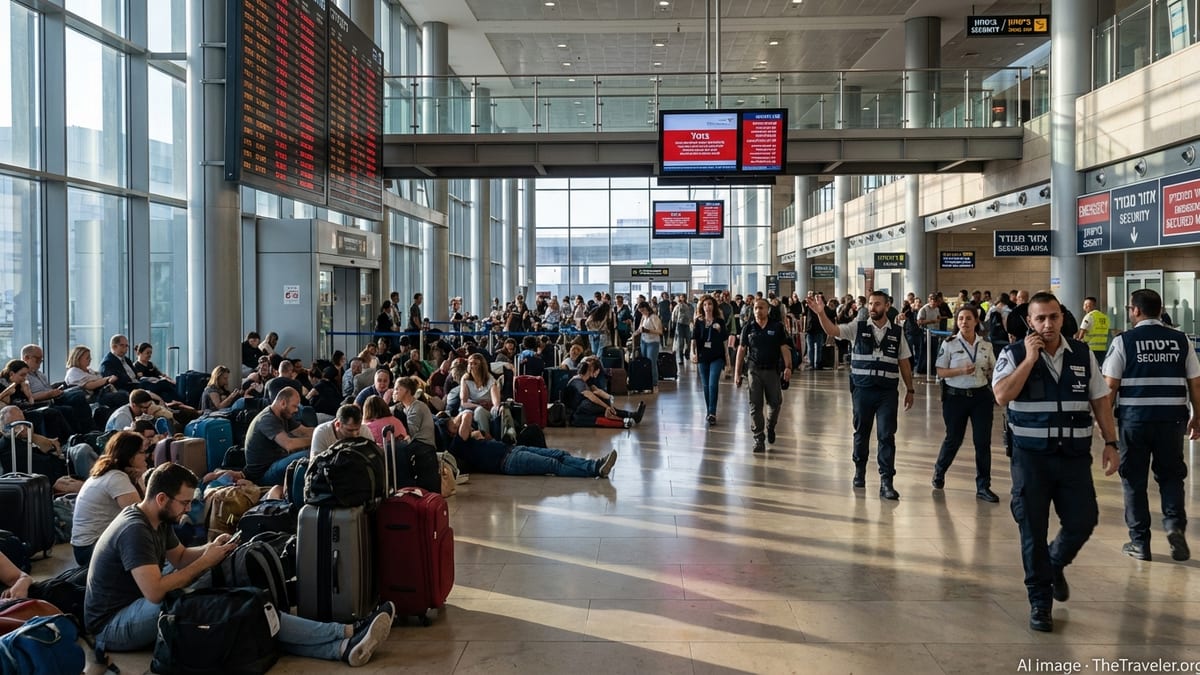
Ben Gurion Airport, Israel’s main international gateway, descended into chaos this weekend as a wave of Iranian missile strikes and retaliatory airspace closures forced around 180 flight cancellations, stranding thousands of travelers in Tel Aviv and across the wider Middle East network.
Airspace Closures Paralyze Israel’s Busiest Gateway
Israel’s Airports Authority moved swiftly to freeze all civil aviation activity after joint United States and Israeli strikes on Iran on February 28 were followed by Iranian missile launches, prompting security agencies to order the closure of national airspace. Takeoffs and landings at Ben Gurion came to an abrupt halt, turning the usually briskly flowing terminal into a landscape of queues, confusion and rolling delays.
Officials urged would-be passengers not to travel to the airport and to seek information directly from airlines or travel agents. Digital departure boards at Ben Gurion rapidly filled with red “cancelled” markers as local carriers Arkia, Israir and Air Haifa suspended operations and foreign airlines withdrew services, citing both the airspace shutdown and risk from missiles targeting infrastructure across the region.
According to industry data and local aviation authorities, roughly 180 flights linked to Ben Gurion were cancelled or diverted over the first 48 hours of the crisis. With Israel’s airspace closed and neighboring countries also restricting overflights, there was simply nowhere for many aircraft to go, leaving crews and passengers caught in a widening operational deadlock.
The shutdown in Israel formed part of a broader aviation freeze across the Middle East. Iran, Iraq, Qatar and segments of United Arab Emirates airspace were all closed or heavily restricted, creating a patchwork of no-fly zones that severed traditional east–west corridors and further isolated Tel Aviv’s primary hub.
Thousands Stranded as Airlines Cut Tel Aviv Links
The immediate human impact was visible in Ben Gurion’s departure halls, where families sat on luggage trolleys and business travelers crouched by power outlets, refreshing airline apps in the hope of a rebooked flight. With hotel capacity in the Tel Aviv area stretched and roads periodically disrupted by security alerts, many travelers chose to remain inside the terminal rather than risk missing a narrow window of possible departures.
International carriers reacted unevenly but decisively. Numerous European and North American airlines extended earlier suspensions of service to Tel Aviv, while some Gulf and low-cost operators quietly removed Israel from their schedules altogether in the first days following the missile onslaught. Analysts say the result was a de facto blockade of regular commercial links into and out of Israel, with Ben Gurion functioning more as an emergency logistics site than a passenger hub.
The impact was not confined to those physically present in Tel Aviv. Israelis overseas found themselves stuck in transit hubs such as Dubai, Athens and Istanbul when onward flights to Ben Gurion were scrubbed at short notice. Travel agents reported desperate calls from passengers stranded in cities as far apart as Prague, Rome, New York and Toronto, all searching for a route home that avoided the expanding ring of closed airspace.
Local airlines introduced emergency flexibility policies, offering refunds, travel credits and free date changes for departures over the coming weeks. Yet with no firm timeline for the full reopening of Israel’s skies or the restoration of normal regional traffic flows, many travelers remained in limbo, weighing the cost of extended stays abroad against the uncertainty of when they might safely fly.
Regional Shockwaves Across Middle East Aviation
The crisis at Ben Gurion unfolded against a backdrop of unprecedented disruption to Middle East aviation. Regional analytics indicated that close to one in four flights scheduled to land in Middle Eastern countries over the weekend was cancelled, with the tally rising above 1,800 when outbound services were included. Flight tracking services recorded tens of thousands of delays worldwide as carriers scrambled to redraw routes and crew plans around rapidly shifting risk zones.
Key hubs in Dubai, Abu Dhabi and Doha, which handle a significant share of global long-haul traffic, saw large portions of their operations suspended after Iranian missiles targeted airports and other infrastructure. Airlines including Emirates, Qatar Airways and Etihad grounded dozens of flights as authorities temporarily closed runways and restricted airspace, effectively cutting some of the world’s busiest transit corridors linking Europe, Asia and Africa.
Low-cost and leisure-focused carriers were equally affected. Wizz Air suspended all flights to and from Israel and several Gulf destinations, while regional operators in Greece and Turkey cancelled rotations to Tel Aviv, Beirut and other cities caught on the front lines of the airspace shutdown. For Ben Gurion, already at a standstill, the secondary effect was to strip away alternative routings that might otherwise have allowed stranded passengers to hopscotch home via neighboring hubs.
Industry experts warned that the knock-on effects could be felt for weeks. Aircraft and crew stranded out of position, complex insurance considerations for flying near conflict zones and the need for governments to reassess safety advisories were all cited as factors likely to slow any return to normality, even if missile exchanges subside.
Travelers Face Uncertainty, Limited Options and Rising Costs
For many travelers, the most immediate challenge has been information. With crisis hotlines overwhelmed and airline call centers inundated, passengers at Ben Gurion described relying on airport loudspeaker announcements, social media posts and word-of-mouth rumors to piece together what might happen next. The lack of clear timelines for airspace reopening has made planning nearly impossible for those with work, school and family commitments.
Accommodation has become another flashpoint. As flights evaporated, Tel Aviv hotel demand spiked, pushing up prices and forcing some stranded passengers to improvise with short-term rentals or stays in outlying towns. Others opted to pass nights in the terminal on benches and floors, unwilling to stray far from the departure gates in case of sudden changes.
Travel insurers and tour operators have had to navigate a wave of claims and rebooking requests. Policies that exclude acts of war or armed conflict have left some travelers facing unexpected out-of-pocket costs, particularly those who booked complex multi-leg itineraries through the region. Industry bodies are already predicting that the scale of payouts and lost revenue could rival or exceed previous Middle Eastern aviation shocks.
With global carriers rerouting around closed skies, ticket prices on remaining viable corridors have climbed, compounding the sense of a travel system under siege. For those attempting to reach or leave Israel, what was once a routine five-hour hop from Europe has, in many cases, become an open-ended ordeal involving multiple stops, long overland detours or indefinite delays.
Authorities Prepare for Gradual Reopening and Rescue Flights
Israeli officials have stressed that safety considerations will dictate any decisions on reopening Ben Gurion to regular traffic. Defense and civil aviation authorities are reviewing missile interception data, potential vulnerabilities in airport infrastructure and the broader regional threat picture before easing restrictions. Passengers have been told to expect several hours’ notice between an initial green light and the first scheduled departures.
In parallel, planners are working on a phased program of so-called rescue flights to repatriate Israelis and foreign visitors once corridors can be safely established. These operations are expected to prioritize travelers who have been stranded abroad the longest, as well as vulnerable passengers such as families with young children and those with urgent medical needs.
Foreign governments are also weighing their own evacuation and support options for citizens in Israel and neighboring countries. Several European states and North American allies have issued updated travel advisories urging people to defer non-essential trips to the wider region and to register their whereabouts with consular services in case of further deterioration.
For now, the departure boards at Ben Gurion tell the story: a sea of cancellations, a scattering of delayed flights awaiting airspace clearance and thousands of travelers caught in the middle of a geopolitical crisis that has pushed Middle Eastern aviation into an unprecedented nightmare.