


For decades, MoneyGram has been one of the default ways to move cash across borders. In 2026 it is still everywhere, from supermarket service counters in the United States to kiosks in Nairobi and convenience stores in Manila. But for travelers and expats, the big question is whether MoneyGram still makes sense for travel money and international transfers in a world full of app-based challengers and multi-currency cards. This review looks at how MoneyGram works today, what it really costs, and when it is a smart option on the road.
Get the latest updates straight to your inbox!
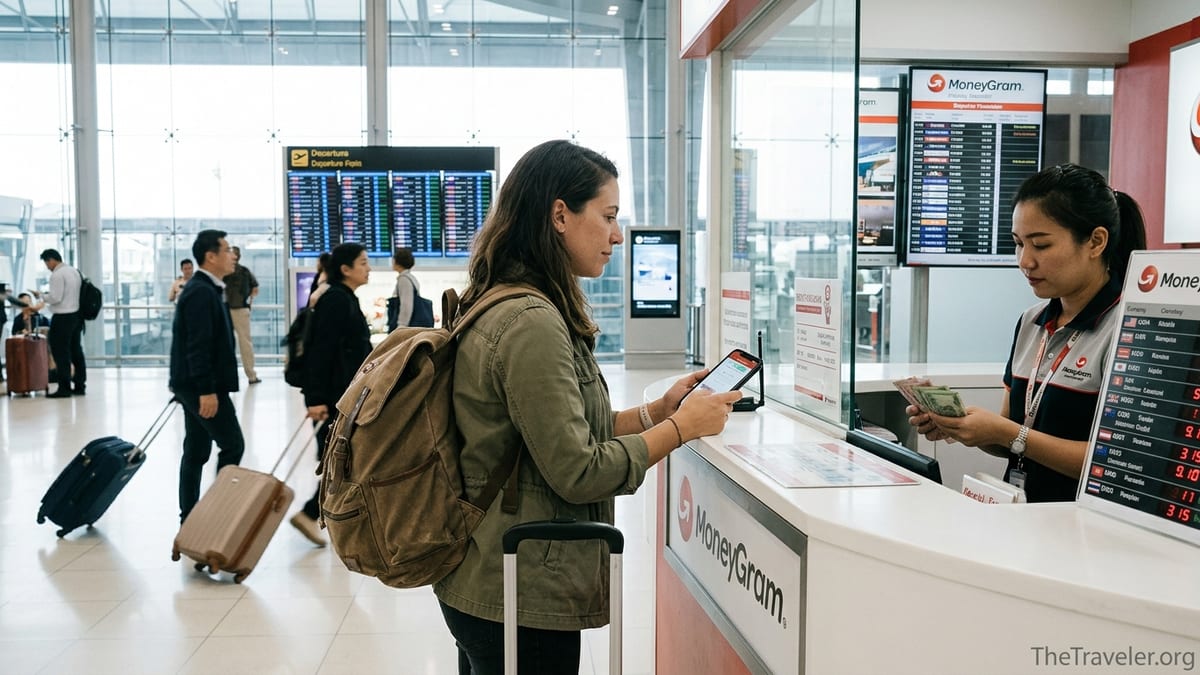
MoneyGram at a Glance in 2026
MoneyGram is a global money transfer company that lets you send funds to more than 200 countries and territories through a mix of online transfers, mobile app payments and a large cash pickup network. Industry sources put the agent network at roughly 400,000 to 500,000 locations worldwide, ranging from big-box retailers and post offices to small independent shops. For a traveler in an unfamiliar city, it often means you can find a pickup point within a short taxi ride or even walking distance.
In practical terms, MoneyGram offers three main ways to get money to someone abroad: cash pickup at an agent, bank account deposit and, in many corridors, mobile wallet deposit. In some markets there is also cash home delivery, useful in places where recipients cannot easily travel to town. Transfers are usually funded by a debit card, credit card, bank account, or with cash at an agent. Most transfers arrive in minutes when funded by card or cash, although bank-funded transfers can take longer depending on the corridor.
From a traveler’s perspective, MoneyGram is rarely the cheapest option, but it is often the most accessible when you or your recipient relies on cash, has limited access to banking, or is in a country where app-only challengers are not well supported. The trade-off you are making is between convenience and visibility of the cash network on one side and fees plus exchange rate markups on the other.
It is also worth noting that MoneyGram has moved deeper into digital services in recent years, including a proprietary mobile app, a digital wallet product in partnership with fintechs, and integrations with crypto and stablecoin platforms that use MoneyGram’s retail network as a cash-out rail. Those innovations matter mainly at the margins, but they show that MoneyGram is trying to keep pace with a fast-changing remittance landscape.
Fees, Exchange Rates and the Real Cost for Travelers
When you send money with MoneyGram, you usually pay in two places: an up-front transfer fee and a currency exchange markup baked into the exchange rate. Unlike some specialist providers that use the mid-market rate with a transparent service fee, MoneyGram typically quotes a weaker rate than what you would see on a neutral currency converter, and the difference can add several percentage points to your total cost.
For example, a recent comparison from an independent fintech provider looked at a 1,000 US dollar transfer from the United States to Mexico. MoneyGram charged a flat fee in the range of a few dollars when funded by bank transfer but used an exchange rate that was several percentage points worse than the mid-market rate. On the same corridor, a specialist low-cost provider might charge a similar or slightly higher up-front fee but offer an almost mid-market exchange rate, leading to more pesos delivered to the recipient. Travelers sending just one emergency transfer might not notice the difference, but frequent users can lose the equivalent of an extra restaurant meal or hotel night every few months.
Costs also vary sharply by funding method. Paying with a debit card or credit card is convenient and usually delivers money in minutes, but the fee tends to be higher, and credit card issuers may treat the transaction as a cash advance and add their own charges plus interest. Funding a MoneyGram transfer from a bank account or at an agent with cash is often cheaper on the fee side, even though the exchange rate markup will still apply. Before confirming any transfer, the online calculator or app shows the fee and the rate, and it is wise to compare that against a live mid-market rate from an independent source to understand the true margin you are paying.
Where MoneyGram can still be competitive is on small, urgent transfers to cash pickup locations in remote areas. If you are in a hostel in rural Guatemala and your bank card is suddenly blocked, having a friend in the United States send you 150 dollars through MoneyGram for pickup at the nearest town might be worth the extra few dollars in spread. In contrast, using MoneyGram to move several thousand dollars to a well-banked destination like Western Europe purely for travel funds is rarely cost effective next to multi-currency accounts and specialist international transfer apps.
Network Coverage, Payout Options and Real-World Scenarios
MoneyGram’s biggest selling point remains coverage. The company works with agents in more than 200 countries and territories and hundreds of thousands of physical locations. In practice, this means you will find MoneyGram counters inside large supermarket chains in the United States, franchised money shops in Dubai, mobile money agents in West Africa, and service desks in post offices across parts of Eastern Europe and Asia. For travelers moving between cities and rural regions, that breadth often beats even the best digital-only services.
Imagine a digital nomad from Texas working in Nairobi. Their landlord insists on cash in Kenyan shillings, and the nomad’s US-based bank card fails sporadically at local ATMs. A friend back home can send money for cash pickup through MoneyGram at a familiar supermarket chain or local Kenyan bank branch that acts as an agent. Within minutes, the nomad can walk out with shillings. The same pattern plays out for backpackers trying to get money to a guide in remote northern Vietnam, or for a family in Paris sending emergency funds to relatives stranded in Morocco when a card is swallowed by an ATM.
Beyond cash pickup, MoneyGram supports direct bank deposits in many popular travel corridors such as the United States to India, Pakistan, the Philippines, Mexico and much of Latin America. For travelers who are temporarily living abroad and have opened local bank accounts, this can be a viable way for family back home to top up that account. In markets like Kenya, Ghana, and parts of Southeast Asia, MoneyGram often integrates with local mobile wallets, letting recipients get funds straight to services like M-Pesa or other national wallet schemes. This can be ideal if you are traveling in places where phone-based payments are more practical than cash.
There are also new hybrid models emerging. Some crypto exchanges and digital wallet providers now allow users to convert crypto or digital dollars into local currency cash using MoneyGram’s agent network. A traveler who is paid in USDC or holds part of their savings in a crypto wallet could, in supported countries, walk into a MoneyGram location and cash out to local fiat. These services are still evolving, and coverage is uneven, but they highlight how embedded MoneyGram’s physical infrastructure is within the wider financial ecosystem.
Transfer Limits, KYC Rules and Practical Constraints
MoneyGram’s limits and verification rules matter for travelers planning larger transfers, such as paying a semester’s tuition abroad or moving a sizeable relocation fund. Official guidance from MoneyGram emphasizes that limits depend on the send country, receive country, payment method and receipt method, and that they can change over time. In practice, third-party analyses of MoneyGram’s US limits in 2026 suggest that typical online customers start with a relatively low cap, often around 1,000 dollars per transfer, and then move up to higher tiers, roughly around 10,000 dollars per transfer, after full identity verification and usage history.
There are also rolling-period limits. One widely cited guide indicates that MoneyGram’s standard maximum for many online international transfers from the United States is about 10,000 dollars per transfer and 10,000 dollars within any 30-day period, with some higher limits for domestic US transfers and for certain bank deposit payouts after enhanced verification. Exact numbers can differ by corridor and risk profile, so the safest approach is to start a quote in the app or on the website, enter your destination and amount, and see whether MoneyGram presents a cap or asks for more documentation.
For walk-in cash transfers at agents, different rules may apply. Large cash sends can trigger enhanced due diligence, additional identification checks and, in some jurisdictions, reporting to local regulators. As a traveler, you should expect to show a government-issued photo ID for most significant transactions, and the recipient at the other end will typically need to present an ID that closely matches the name in the transfer details. If names on passports and local IDs differ even slightly, pickup can be delayed, which is something to keep in mind when sending funds to partners or friends who use nicknames.
These constraints mean MoneyGram is best suited for modest travel-related transfers rather than moving your entire life savings. If you need to send more than the platform will allow, you may have to split transfers over time, provide additional documentation or use a specialist bank transfer service that is set up for higher-value remittances and relocation payments.
User Experience: Online, App and Agent Locations
MoneyGram’s app and website have improved significantly in recent years, and user ratings on major app stores are generally strong, often in the very high four-star range out of five. The app allows you to create a profile, verify your identity, store frequent recipients and repeat past transfers with a few taps. You can see fees, exchange rates and estimated arrival times in real time before confirming. For travelers who move in and out of the same countries throughout the year, the ability to quickly resend to a saved recipient can be a real convenience.
However, the digital experience is still layered on top of a more traditional remittance infrastructure. KYC checks can freeze accounts pending additional documents, and fraud controls sometimes block transfers that appear unusual, such as a high first-time send to a new country. Online reviews show a mix of satisfied customers who praise the speed and simple interface and frustrated users who complain about delayed refunds or transfers canceled by the compliance team. As with most remittance providers, the safest approach is to send smaller test amounts when using a new corridor, and avoid relying on a first-time transfer for something time critical like a visa payment deadline.
At the agent level, experience varies hugely. In a suburban US supermarket, the MoneyGram counter might be staffed all day, with clear signage and queue numbers. In a small shop in rural Africa or Central Asia, opening hours can be flexible, connectivity spotty and cash availability limited. Travelers picking up money in cash should factor in the possibility that a small agent may not have enough local currency on hand for a large payout and might ask you to come back later or take part of the amount. Whenever possible, try to schedule pickups during business hours in larger towns or branches of well-known banks that act as MoneyGram agents.
Language and documentation can also be friction points. In countries where you do not speak the local language, bring a printed or clearly written note with the reference number, sender name and amount. Keep your passport handy and be patient if the agent needs to call a help line or wait for system approvals. MoneyGram’s model assumes a human in the loop at cash pickup, and that human may be dealing with queues, technical issues and local regulations you cannot see.
Is MoneyGram Good Value Compared With Alternatives?
For pure cost, MoneyGram is often beaten by digital-first players that specialize in international transfers and multi-currency accounts. Services like Wise, Revolut, Remitly and others typically use lower exchange rate markups and simpler fee structures, particularly for bank-to-bank transfers between well-connected countries. For example, sending 1,000 dollars from the United States to a eurozone bank account is usually significantly cheaper through a specialist provider than through MoneyGram, and the money may still arrive within one or two business days.
Where MoneyGram retains an edge is where cash is king. If your recipient cannot easily open a bank account, lacks reliable access to a smartphone, or lives far from major banking centers, the presence of a MoneyGram agent in a nearby town may outweigh the higher price. This often applies to remote areas in Africa, parts of South and Southeast Asia, and some underserved regions in Latin America and Eastern Europe. In those situations, travelers may decide that paying a bit more is a fair trade for giving relatives, guides or landlords access to physical cash.
For your own travel money, it is rarely efficient to use MoneyGram to send yourself funds when you already hold a bank card from your home country. ATM withdrawals using a low-fee debit card and a multi-currency account usually deliver better exchange rates and lower overall fees. Where MoneyGram shines is as a backup channel: when your card is lost or compromised, when your bank suddenly blocks foreign ATM withdrawals, or when you need to get funds to a local contact quickly in a small town with no reliable ATM network.
There is also a growing overlap between MoneyGram and the crypto and stablecoin world. Some exchanges now allow customers to cash out in local fiat via MoneyGram locations, and MoneyGram itself has experimented with digital dollar wallets and on-off ramp services. These can be powerful tools for specific use cases, such as freelancers paid in stablecoins who want cash while traveling, but they remain niche compared with the traditional cash pickup and bank deposit flows that most travelers rely on.
Safety, Security and Recent Developments
MoneyGram is a long-established player subject to strict anti-money-laundering and know-your-customer regulations in the jurisdictions where it operates. Transfers are processed through regulated entities, and agent locations are expected to follow compliance procedures, including ID checks and transaction monitoring. From a basic safety standpoint, using MoneyGram is comparable to using a traditional bank wire or regulated online transfer service.
That said, no remittance platform is immune to fraud, and MoneyGram has historically been targeted by scammers who trick victims into sending funds that cannot easily be recovered. Common schemes include fake online sales, romance scams, and imposters posing as relatives in distress. As a traveler, you should only send money to people you know and trust, and treat any urgent demand for a MoneyGram pickup from a stranger as a red flag. Once cash is collected, reversing the transaction is effectively impossible.
On the technical side, independent security researchers and industry commentators have in recent years highlighted both improvements and concerns. MoneyGram has invested in more robust digital security and fraud analytics, but like many large financial institutions, it has also faced data and privacy incidents in the past. When creating an account or using the app on shared devices such as hostel computers or borrowed phones, avoid saving passwords and always log out after use.
Carrying large sums of cash after pickup is another neglected safety issue. If you are retrieving the local-currency equivalent of several hundred dollars from a MoneyGram agent in a busy market area, plan your route, consider using a money belt or under-clothing pouch, and avoid counting cash on the street. In higher-risk destinations, it may be wiser to do multiple smaller pickups over several days if circumstances allow.
The Takeaway
MoneyGram in 2026 occupies a clear but narrower niche than in the past. For mainstream travel money needs between well-banked countries, multi-currency cards and specialist online transfer services provide better value and a smoother experience. If your typical scenario is topping up your own foreign bank account or paying a hotel deposit in Europe or East Asia, you will almost always be better served by those alternatives.
Where MoneyGram still shines is where digital finance does not easily reach. Its vast cash pickup network, presence in small towns and emerging markets, and ability to move funds quickly in emergencies make it a valuable backup tool for travelers and expats. It is particularly useful when you are helping family, guides, or landlords who live in cash-driven economies and cannot easily plug into app-based solutions.
The key is to treat MoneyGram as part of a wider toolkit. Use low-fee cards and multi-currency accounts for everyday spending and self-funding your travels, and keep MoneyGram in mind for emergencies, cash-only situations, and transfers to recipients who depend on physical cash. Always compare fees and exchange rates before sending, start with small test transfers on new routes, and follow basic security hygiene. With those precautions, MoneyGram can still play a sensible supporting role in modern travel finances.
FAQ
Q1. Is MoneyGram a good option for everyday travel spending?
For most travelers, no. Everyday expenses are usually cheaper with a low-fee debit or credit card and a multi-currency account that uses close-to-mid-market exchange rates. MoneyGram is better reserved for cash pickups, emergencies and sending funds to people who cannot use banking apps.
Q2. How much does it typically cost to send money abroad with MoneyGram?
The cost depends on the corridor, funding method and payout type, but you normally pay a transfer fee plus an exchange rate markup. For common routes like the United States to Mexico or the Philippines, total costs can amount to several percentage points of the send amount once you factor in the weaker exchange rate.
Q3. How fast are MoneyGram transfers for travelers?
Card-funded and cash-funded transfers are often available for pickup within minutes, especially between major corridors. Bank-funded transfers can take longer, sometimes up to one or two business days, depending on the countries and banks involved. The app will show an estimated delivery time before you confirm.
Q4. What are the typical send limits with MoneyGram?
Limits vary by country and verification level, but many US customers start at around 1,000 dollars per transfer and can reach higher tiers after full identity checks. Common guidance suggests that around 10,000 dollars per transfer and per 30-day period is a typical upper cap for many online transfers, though some corridors and domestic transfers allow more.
Q5. Can I use MoneyGram to send money to myself while traveling?
Yes, you can send money to yourself and pick it up in cash, provided your name and ID match the details in the transfer. However, this is usually more expensive than withdrawing from an ATM with a low-fee travel card, so it is best treated as a backup option when cards or bank access are not working.
Q6. Is picking up cash from a MoneyGram agent safe?
The transaction itself is processed through a regulated network, but safety on the street is up to you. Choose well-lit, busy locations, avoid carrying very large amounts of cash if you can, and plan your route back to your accommodation. In higher-risk areas, consider taking a trusted taxi and using a money belt or under-clothing pouch.
Q7. How does MoneyGram compare to specialist transfer apps like Wise or Revolut?
Specialist apps usually win on price and transparency, especially for bank-to-bank transfers between well-banked countries. They often use mid-market rates with low service fees. MoneyGram’s advantage lies in its cash pickup network and presence in locations where those digital players have limited coverage or where recipients are unbanked.
Q8. What documents do I need to send or receive money with MoneyGram?
Typically you will need a valid government-issued photo ID, such as a passport when traveling. For higher amounts or certain countries, you may be asked for additional documentation, such as proof of address or source of funds. Recipients must also present ID that matches the name on the transfer.
Q9. Can I use MoneyGram for large transfers like paying overseas tuition or rent?
You can, but it is not always ideal. Limits and compliance checks may slow or block large payments, and fees plus exchange rate markups can be substantial on big amounts. For structured payments such as tuition or long-term rent, a specialist international bank transfer service or your bank’s dedicated remittance option is usually more efficient.
Q10. Is MoneyGram integrating with crypto and digital wallets?
Yes, MoneyGram has partnered with various fintech and crypto platforms to let users convert digital assets or stablecoins into cash via its agent network in selected countries. These services are still niche and corridor-dependent, but they offer an additional way for some travelers and remote workers to turn digital earnings into local-currency cash.