


Few places in Italy deliver a first glimpse quite as jaw dropping as the Bay of Naples. Two viewpoints in particular compete for the title of most unforgettable: Monte Solaro, the highest point on Capri, and Mount Vesuvius, the active volcano that looms over Naples and the ruins of Pompeii. Both promise sweeping horizons, both require a bit of effort and planning, and both leave travelers stunned for very different reasons. If you only have time for one, which summit leaves the bigger impression?
Get the latest updates straight to your inbox!
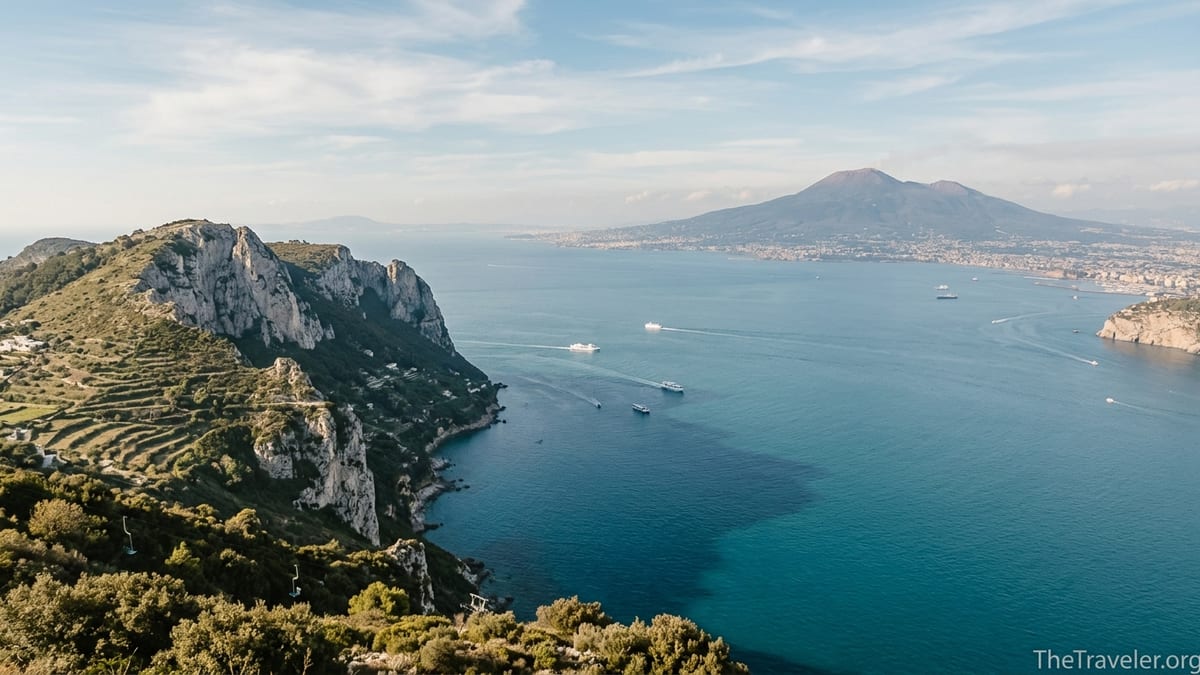
The Case for Monte Solaro: Capri From Its Highest Point
Monte Solaro rises about 589 meters above sea level, making it the highest point on Capri and one of the best natural balconies in southern Italy. From the summit, the island drops away almost vertically to a cobalt sea, with the Faraglioni rock stacks on one side, the Punta Carena lighthouse on the other, and the Sorrentine Peninsula and Amalfi Coast etched on the horizon. On clear days, you can pick out Ischia and Procida and even trace the curves of both the Gulf of Naples and the Gulf of Salerno in a single slow turn of your head.
The atmosphere on Monte Solaro is surprisingly relaxed. At the top you will usually find a simple bar terrace, a few scattered loungers, and visitors sitting quietly on stone walls taking photos or just staring at the water thousands of meters below. The setting is wild but not intimidating: birds circling, the breeze moving through low Mediterranean shrubs, the island’s white houses reduced to scattered dots far beneath you. Many visitors pair the summit with a walk to the old hermitage of Cetrella, tucked just below the peak, for a short taste of Capri’s rural side.
What makes Monte Solaro so memorable is the three dimensional sense of place it gives you. If you sailed over from Naples that morning, you can look back along your exact route across the bay. If you walked the lanes of Capri Town earlier in the day, you now see the full layout of the island and how steeply it rises from the sea. The view is not just pretty; it explains the geography of the region in one sweeping glance.
Travelers often describe their time on Monte Solaro in emotional terms rather than just visual ones. Couples come up in late afternoon to watch the light soften over the sea, solo travelers linger with a coffee while boats carve white trails below, and families point out landmarks from previous days. The summit invites lingering, reflection, and a surprising amount of quiet for such a famous island.
How You Get There: Chairlift Ease vs Volcanic Ascent
Access might be the single biggest practical difference between Monte Solaro and Mount Vesuvius. On Capri, you reach the viewpoint via a single seat chairlift that floats uphill from the main square of Anacapri. The ride itself takes around 12 minutes each way and feels like skimming over back gardens, vegetable plots, and terraced vineyards before the ground suddenly falls away into cliffs. As of recent seasons, return tickets for the chairlift are typically in the mid teens in euros per person, payable by card at the base station.
The alternative is to hike up from Anacapri along signposted paths. The walk can take an hour or more, with a steep climb through stone steps and forest, and is best for reasonably fit travelers wearing proper shoes. Some guided walking tours of Capri include this ascent as a highlight, especially in spring or autumn when temperatures are cooler, and then use the chairlift for the gentle ride back down.
Reaching the viewpoint on Mount Vesuvius feels very different. First you take a train, bus or tour shuttle to the quota 1000 car park on the flank of the volcano, then continue on foot. The classic Gran Cono trail climbs roughly 200 meters over about 30 to 45 minutes on a gravel and ash path to the crater rim. Several sources describing visits in early 2026 put the official park entry for the crater area at roughly 10 to 12 euros per adult, typically purchased online in advance and sometimes paired with a mandatory local guide at the top.
The ascent on Vesuvius is short but physically more demanding than the passive chairlift ride on Capri. The underfoot surface is dusty, loose volcanic grit, the gradient is steady, and there is very little shade. In summer, guides regularly turn back visitors in flimsy sandals and advise those with limited mobility to reconsider. The payoff is an encounter with an active volcano rather than just a pretty hilltop, but travelers should expect more sweat and less elegance than the smooth glide up Monte Solaro.
What You Actually See at the Top
On Monte Solaro, the view is almost entirely made of sea, sky, and coastline, with Capri itself laid out like a model below. From the summit terraces you can watch ferries departing Capri’s Marina Grande as tiny moving dots, see the zigzag of the Via Krupp if it is open, and follow the line of the Amalfi Coast as it dissolves into distant haze. In good visibility, Vesuvius itself is visible across the bay, a dark cone rising behind the sprawl of Naples.
The perspective from Monte Solaro is cinematic but serene. There is no single focal point; instead, the eye roams across multiple bays, islands, and headlands. Photographers often bring wider lenses to capture the full arc of the coastline; even a smartphone panorama can struggle to fit everything in. Colors are intense on clear days: dense blues in the sea, chalky white of Capri’s cliffs, and the ochre and pastel of the mainland towns.
On Mount Vesuvius, the view divides into two very different directions. Looking inward, you stare directly into a vast crater roughly 440 meters across, scarred with layers of rock and ash. Wisps of steam often curl from fumaroles on the inner walls, and you can see old lava flows frozen in mid roll. Wooden barriers keep visitors at a safe distance, but you are close enough to smell minerals on the air and feel the unstable, granular texture of volcanic soil underfoot.
Turn outward and you see perhaps the most commanding vantage point over Naples and its bay. On clear days you can trace the sweep of coastline from Pozzuoli to Sorrento, identify the archaeological site of Pompeii below, and watch planes lifting off from Naples airport. Modern Naples sprawls across the plain, giving an immediate sense of the millions of people living under the shadow of the volcano. It is beautiful, but tinged with unease in a way that Monte Solaro never is.
Emotion and Atmosphere: Romance vs Raw Power
The emotional impact of Monte Solaro is closely tied to Capri’s long history as a romantic escape. The combination of quiet summit paths, scented vegetation, distant church bells from Anacapri and the glint of private yachts below creates a mood of relaxed privilege. Many travelers describe arriving at the top after a busy morning in Capri Town, suddenly finding a bench with no crowds, and staying far longer than they had planned while the chaos of the marina feels a world away.
For couples, Monte Solaro is an obvious choice. Late afternoon visits mean warm, slanting light across the sea, perfect for photos and unhurried drinks on the terrace. Even when the chairlift is busy at midday, the summit area usually has space to spread out. The soundscape tends toward birds and wind rather than tour groups, especially if you walk a few minutes along the paths beyond the main bar.
Mount Vesuvius, on the other hand, hits a very different emotional register. Standing on the rim, looking into the crater while a guide explains the eruption that buried Pompeii in AD 79, it is hard not to feel a mix of awe and discomfort. This is not a gentle landscape. The ground is dark, almost lunar in places, and the vegetation thins as you climb. When clouds scud across the summit or the wind picks up dust, the volcano feels every bit as unstable as its history suggests.
Families with older children often report that Vesuvius is the moment when the story of Pompeii becomes real. After walking ancient streets and seeing plaster casts of victims, they find themselves standing on the very crater that caused it all. School geography lessons about tectonic plates and magma chambers suddenly have a physical reference point. The impact is less about beauty and more about confronting nature’s power hovering over a densely populated modern city.
Crowds, Seasonality, and Timing Your Visit
Both viewpoints are highly seasonal, but the rhythm of their crowds differs. Capri is overwhelmingly popular from late spring through early autumn, with July and August seeing packed ferries from Naples and Sorrento. Even so, Monte Solaro remains markedly calmer than Capri Town or the Marina Grande. The chairlift can form queues in mid morning and early afternoon, but many travelers find that arriving shortly after opening or mid to late afternoon keeps waits fairly short.
Weather matters. On hazy or overcast days, you may still get a pleasant view from Monte Solaro, but the long distance panoramas toward the Amalfi Coast and Ischia lose their drama. In very windy or stormy conditions, the chairlift may pause or slow. Spring and autumn often deliver the best combination of clear skies and milder temperatures for those planning the hike instead of the lift.
Mount Vesuvius has its own constraints. The crater area can close at short notice for strong winds, heavy rain, or volcanic risk management, and access generally runs from late morning to late afternoon with last entry times that shift by season. Many visitors in 2025 and 2026 have highlighted that tickets must be purchased online for specific entry windows, and that day-of availability sometimes sells out in high season. Arriving without a reservation can mean relying on last minute releases or paying a premium to third party tour operators that bundle tickets with transport.
Heat is a bigger issue on Vesuvius. In July and August, the exposed path can feel punishing by mid day, with very limited shade and reflective light from the pale ash underfoot. Morning slots not only offer cooler conditions but also better visibility before haze builds over the plain. In shoulder seasons, the summit can still be chilly and windy, so a light layer is essential even when Naples feels warm at sea level.
Practicalities: Cost, Time, and Trip Planning
If you are choosing between Monte Solaro and Vesuvius for a day in your itinerary, cost and time can be deciding factors. Visiting Monte Solaro typically fits into a broader Capri day trip that might include a boat tour to the Blue Grotto or the island’s sea caves, a stroll through Capri Town’s piazzetta, and perhaps a stop at Villa San Michele in Anacapri. Fast ferries from Naples to Capri and back, local buses up to Anacapri, and the chairlift can together add up to a substantial but predictable daily spend, often in the range of a full excursion budget for the Amalfi Coast.
Once on Capri, the chairlift fee itself is relatively modest compared to the ferry costs that get you there, and there is no separate park admission just to stand at the summit. You are free to stay as long as you wish, within operating hours, and can easily slot the visit around lunch or a coastal walk. Independent travelers can manage everything via the island’s regular buses and ticket booths without needing a guided tour.
A self arranged visit to Mount Vesuvius usually starts from Naples or Sorrento. Typical independent itineraries involve taking a Circumvesuviana train to Ercolano Scavi or Pompei stations, then connecting with a dedicated shuttle service or public bus that climbs to the quota 1000 car park. The combined cost of train, bus, and official park entrance often totals a few tens of euros per person, significantly less than a full Capri day, but tour companies also sell packages that include transport, a guide, and guaranteed crater entry for a higher price.
In terms of time commitment, Vesuvius can be a half day excursion paired with Pompeii or Herculaneum, while Monte Solaro naturally consumes a larger slice of a Capri focused day. Travelers on tight schedules might favor Vesuvius for efficiency, whereas those already planning a full day on the island will find Monte Solaro almost effortless to include.
Which View Leaves the Bigger Impression?
Deciding which viewpoint is more impactful largely depends on what you want to feel when you look out over the Bay of Naples. If your dream is a postcard perfect panorama, with the island of Capri beneath your feet and multiple coastlines running to the horizon, Monte Solaro is hard to beat. The combination of chairlift ride, open terraces, and the island’s glamorous reputation creates an experience that feels both relaxed and special.
If, instead, you are drawn to geology, history, and the tension between beauty and danger, Vesuvius delivers a very different sort of thrill. The view outward toward Naples is striking, but the image that tends to stay with people is the crater itself, with its walls of ash and rock and faint breath of steam. It is a reminder that the landscape they have been admiring all week is still shaped by forces beneath their feet.
Many travelers who have done both in one trip say Monte Solaro gave them their favorite photographs and sunset memories, while Vesuvius left the deeper intellectual and emotional mark, especially after visiting Pompeii. For some, the most powerful moment is standing on Capri’s highest point and then, days later, looking back at that exact peak from the rim of the volcano, realizing just how tightly woven the region’s geography really is.
If you can find space in your itinerary, the combination of both viewpoints is the ideal way to understand the Bay of Naples from two very different vantage points: one island and intimate, one continental and volcanic. If you must choose, think honestly about whether you are chasing romance and sea views or a visceral encounter with an active volcano.
The Takeaway
Monte Solaro and Mount Vesuvius are not interchangeable viewpoints competing for the same role in your trip. Monte Solaro offers the quintessential Capri panorama: blue water in every direction, limestone cliffs, distant islands and the elegant hum of an island devoted to pleasure. It is about beauty, perspective and lingering in the sun.
Vesuvius, by contrast, confronts you with the engine behind the region’s history. The views over Naples and the bay are impressive, but the emotional weight comes from standing on the rim of the volcano that buried ancient cities and still quietly shapes the lives of millions. It is as much a lesson in geology and human vulnerability as a scenic stop.
For honeymooners, photographers and anyone who wants a single image that encapsulates Capri, Monte Solaro likely leaves the bigger impression. For history enthusiasts, families combining Pompeii with a climb, or travelers who want to feel the scale of nature’s power, Vesuvius may prove the more unforgettable summit. In the end, the best vantage point is the one that matches your own idea of an unforgettable view: peaceful perfection above Capri, or raw, restless earth above Naples.
FAQ
Q1. Which has the more scenic view overall, Monte Solaro or Mount Vesuvius?
Monte Solaro usually wins for pure scenic beauty, with sweeping sea and coastline views, while Vesuvius is more striking for its crater and the sense of standing on an active volcano.
Q2. Which viewpoint is easier to reach for most travelers?
Monte Solaro is easier once you are on Capri, thanks to the chairlift from Anacapri. Vesuvius involves trains or buses plus a steep walk from the car park to the crater.
Q3. Is either viewpoint suitable for people with limited mobility?
The Monte Solaro chairlift helps, but there are steps at stations and uneven paths at the top. Vesuvius has a loose gravel trail with a notable incline, which can be challenging for anyone with mobility issues.
Q4. How much time should I budget for each visit?
Monte Solaro can be comfortably done in 1 to 2 hours within a full Capri day. A Vesuvius visit usually takes half a day from Naples or Sorrento, including transport and hiking.
Q5. Which is better with children?
Families with younger children often find Monte Solaro more relaxed and fun because of the chairlift and open terraces, while older children may find Vesuvius more exciting for its volcano and crater.
Q6. Do I need to book tickets in advance?
Vesuvius crater entry often requires advance online booking for a specific time slot, especially in high season. Monte Solaro chairlift tickets are typically bought on the spot, with no pre booking needed.
Q7. Can I visit both Monte Solaro and Vesuvius in one day?
In practice it is very difficult and not recommended, as Capri and Vesuvius are in different directions and each deserves several hours. Most travelers dedicate separate days.
Q8. Which viewpoint is better for sunset?
Monte Solaro is usually better for sunset, with wide western and southern horizons over the sea and the Amalfi Coast, while Vesuvius normally closes before or around sunset hours.
Q9. What should I wear and bring for each viewpoint?
For Monte Solaro, comfortable shoes, a light layer and sun protection are usually enough. For Vesuvius, add sturdy footwear, water, a windproof layer and be prepared for dust and strong sun.
Q10. If I have to choose just one, which would you recommend?
If your focus is romance, photography and classic coastal scenery, choose Monte Solaro. If you are more interested in history, geology and dramatic landscapes, prioritize Vesuvius.