


If you ride NJ Transit regularly, you already know the sinking feeling: a garbled announcement in a crowded car, a “system-wide delay” push alert, or the sudden red banner on departure boards at New York Penn. But while you cannot control signal problems or aging infrastructure, you can control how stranded you feel. The riders who suffer least are the ones who treat NJ Transit as one option in a much bigger regional network, and who walk into every commute with a plan B and even a plan C.
Get the latest updates straight to your inbox!
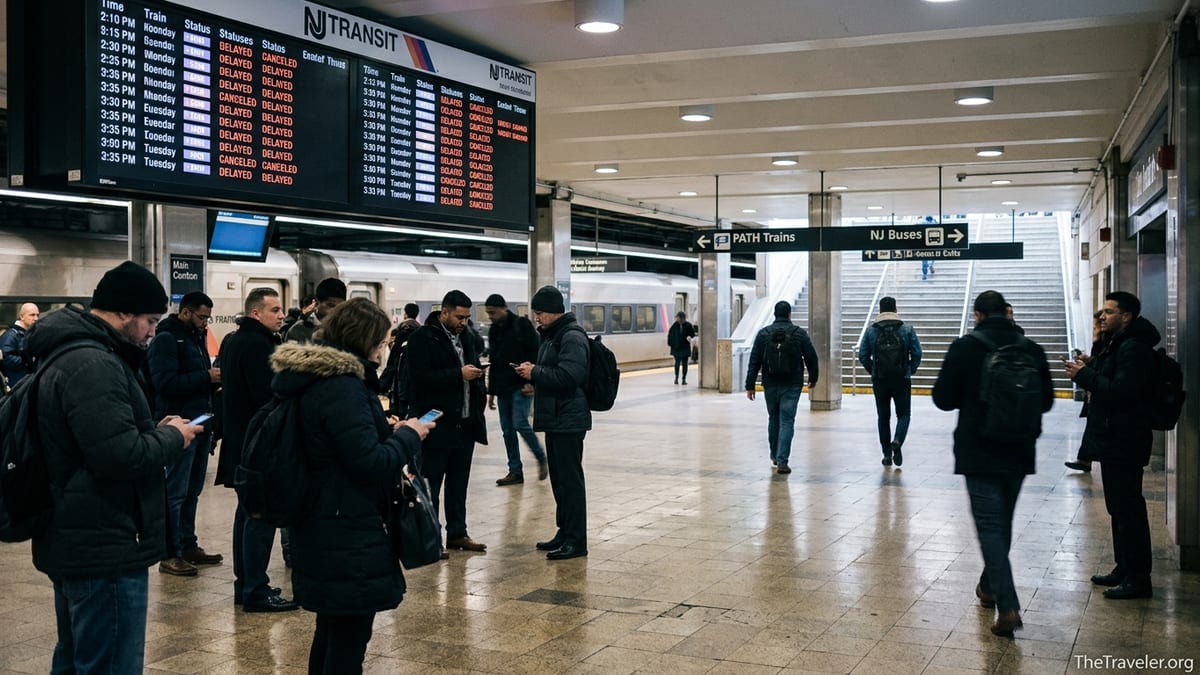
Why NJ Transit Delays Feel So Painful
NJ Transit’s rail network funnels much of northern and central New Jersey into a small set of chokepoints, especially the century-old rail tunnels into New York Penn Station and the busy stretch between Newark and Secaucus. When something goes wrong there, it ripples across the entire system. Any rider stuck on a Midtown Direct train that suddenly “diverts to Hoboken” or terminates at Newark in the middle of a storm knows how fast a predictable trip can turn into an open-ended wait.
Part of the frustration comes from expectations. A monthly rail pass from, say, Maplewood or Long Branch to New York Penn promises a one-seat ride to Midtown. When a switch issue or signal failure turns that into multiple transfers through unfamiliar stations, riders feel like they are paying more for less. Yet during the Portal Bridge cutover work in early 2026 and other major disruptions, the agencies involved have also quietly built a web of backup arrangements: cross-honoring on PATH, ferries from Hoboken, extra buses to the Port Authority Bus Terminal, and more. Knowing how these pieces fit together is what separates an endless, angry commute from a merely inconvenient one.
Think about the most recent system-wide suspension to and from New York Penn. Some riders sat for hours waiting for the first restored train. Others checked alerts, walked upstairs to PATH at Newark Penn, and reached Lower Manhattan in roughly the same time they would have reached Midtown. A few hopped a ferry from Hoboken and still made a morning meeting in Midtown. The difference was not luck. It was about having back-pocket options before the announcements started.
Understand Cross-Honoring Before You Need It
One of the most valuable tools in a bad delay is cross-honoring: when NJ Transit announces that your existing rail ticket or monthly pass will be accepted on other modes. The agency uses cross-honoring during major disruptions, allowing riders to use a rail pass on buses, light rail, or with partner systems such as PATH, NY Waterway ferries, or private carriers where agreements exist. Once activated, you usually just show your valid ticket or pass to the operator or station agent instead of buying a separate fare.
During the Portal Bridge cutover between February and March 2026, for example, riders on lines that normally enter New York Penn could instead use their rail passes from Hoboken with PATH to 33rd Street, or board NY Waterway ferries from Hoboken Terminal to Midtown, at no extra charge on weekdays. When similar diversions have occurred for repairs at New York Penn in past years, rail passes have also been accepted on targeted bus routes into Manhattan, helping riders bypass chokepoints altogether. Cross-honoring does not always cover every possible alternate, but when it is in effect, it can dramatically cut down your travel time.
The catch is that cross-honoring terms change with each event. Sometimes PATH is included, sometimes only NJ Transit bus routes that parallel the affected line are covered, sometimes certain ferries are part of the deal. The agency typically lists which modes are participating in each alert. A practical habit is to read those details when service advisories go out, not just the headline. If a morning alert quietly mentions that passes are being honored on a specific express bus into Manhattan, that line might become your fastest option if trains seize up an hour later.
Making the Most of PATH and Newark Penn
For many riders, especially those on the Northeast Corridor, North Jersey Coast Line, and Raritan Valley Line, the simplest backup when trains to New York Penn fall apart is PATH. Newark Penn Station is one of the region’s workhorse hubs, with NJ Transit rail upstairs and PATH trains running directly to the World Trade Center. If your train is suddenly terminated at Newark during a Midtown meltdown, you can often walk off, follow signs to PATH, and still reach Lower Manhattan in around 20 to 30 minutes once you are on a train, depending on crowding.
Consider a commuter from New Brunswick headed to a job near Wall Street. On a normal day, they ride the Northeast Corridor to New York Penn and transfer to a downtown subway, arriving in about 80 to 90 minutes door to door. On a day when problems halt traffic into New York but trains are still moving to Newark, their best move may be to get off at Newark Penn, take PATH to World Trade Center, and then walk or take a short subway ride to the office. Even with a 20-minute delay reaching Newark and a crowded PATH platform, they are likely to arrive far earlier than if they had stayed on a stuck train waiting for tunnel capacity to reopen.
Newark also anchors several layers of backup within New Jersey itself. The Newark Light Rail connects Newark Penn to Newark Broad Street, where Morris & Essex Line trains continue to Hoboken and other points. If Midtown-bound trains are diverted to Hoboken, a rider from South Orange or Montclair can sometimes shift to a Hoboken-bound train at Broad Street, then transfer to PATH or ferries for Manhattan. It is not as seamless as a one-seat ride, but it turns a dead-end delay into a detour that still moves you in the right direction.
Hoboken, Secaucus, and the Power of Indirect Routes
Secaucus Junction and Hoboken Terminal are the quiet heroes of many Plan B commutes. Secaucus connects most NJ Transit commuter rail lines, allowing riders to switch between, say, the Main Line and Northeast Corridor. Hoboken, in turn, has PATH service, Hudson-Bergen Light Rail, and multiple ferry routes to Manhattan. When New York Penn is struggling or a particular line is suspended, using these two hubs creatively can unlock options that are not obvious at first glance.
During extended work around the Portal Bridge, for example, many Midtown Direct trains that usually terminate at New York Penn have been diverted to Hoboken. Riders who only know Penn Station might be tempted to view this as a total loss of convenience. In reality, someone commuting from Summit to an office near Herald Square could ride to Hoboken, take PATH to 33rd Street, and walk a few blocks. The total travel time might be 10 to 15 minutes longer than a good day via Penn, but on a day with serious delays, it can be significantly faster than waiting for a limited set of through trains.
Secaucus Junction can play a similar role as a safety valve. Imagine a Bergen County rider on the Main/Bergen Line whose train is delayed approaching Secaucus due to congestion into Hoboken. If NJ Transit alerts show that Midtown-bound trains from the Northeast Corridor are moving more reliably, it may be worth getting off at Secaucus and hopping a New York-bound train there, especially in the evening when options thin out. Because nearly all NJ Transit rail lines touch Secaucus, it functions as a place where you can change your mind mid-commute instead of riding passively into a bigger bottleneck.
Express Buses, Jitneys, and Private Carriers
For riders in Hudson, Bergen, Essex, and Passaic counties, backup options often look like rubber tires rather than steel rails. A deep network of NJ Transit bus routes and private carriers runs into and around Manhattan, many funneling into the Port Authority Bus Terminal. In parallel, privately operated jitneys shuttle along key corridors such as Bergenline Avenue and John F. Kennedy Boulevard in Hudson County, often stopping at or near official NJ Transit bus stops and major transfer points.
Take a commuter from Union City who usually relies on a Main/Bergen Line train to Hoboken and then PATH to Midtown. On a morning when rail service is suspended west of Secaucus, they might instead walk to Bergenline Avenue and catch a jitney toward Journal Square, then take PATH into Manhattan. Another option is to rely on the NJ Transit 123 or 125 buses, which run from Union City and neighboring communities into Manhattan with frequent service at peak times. While buses are not immune to Lincoln Tunnel traffic, they can still be more predictable than waiting out a multi-hour rail disruption.
Similarly, Montclair and Bloomfield riders have historically looked to private carriers or NJ Transit express buses to cover gaps when rail options shrink, such as when a private bus company ceases operating a popular route. When a long-time private bus line exited several Essex County routes, NJ Transit and other operators stepped in to cover most of those stops, giving rail riders who lose patience with weekend track outages another way to reach Manhattan. Keeping an eye on which express buses run near your home station can reveal routes that, in a crisis, function as a de facto lifeline into the city.
When Ferries Become the Fastest Option
Ferries are often dismissed as an expensive luxury, but during major rail disruptions they can suddenly become competitive, especially when cross-honoring brings the marginal cost down to zero. Hoboken Terminal and various points along the Hudson waterfront host frequent ferries to Midtown and Lower Manhattan, with travel times that can be surprisingly short once you are onboard. During heavy work around the rail tunnels or Portal Bridge, agencies have sometimes added extra ferry sailings or honored rail passes at specific times to soak up stranded riders.
Consider the experience of a Jersey City commuter who normally rides PATH from Grove Street to Midtown. On a day when PATH to midtown is severely disrupted but NJ Transit is diverting trains to Hoboken and cross-honoring on ferries, that rider might instead walk or take light rail to Hoboken Terminal and board a ferry to West 39th Street. In good weather, the water crossing can be under 15 minutes. Even after you factor in a short shuttle or bus ride on the Manhattan side, the ferry can turn a would-be 90-minute ordeal into a 45-minute detour.
Even when ferries are not officially cross-honored, they can be an emergency fallback worth budgeting for a few times per year. If your monthly pass already pays off on typical days, it can be rational to accept the occasional out-of-pocket ferry fare in exchange for the certainty of reaching a critical appointment on time. Some riders keep a mental threshold: if a delay looks likely to exceed 45 minutes, they will walk to the nearest ferry terminal and absorb the extra cost.
Digital Tools and Real-Time Strategies
Knowing your options is only half the battle. The other half is knowing what is happening right now. Official alerts from NJ Transit, PATH, and ferry operators are the starting point, but riders increasingly combine those with crowd-sourced information and real-time maps to piece together the actual state of the system. Transit apps that show live train positions, bus arrivals, or PATH headways can help you decide whether to stay on your current train, bail out at Newark, or divert to Hoboken.
One emerging example is the growth of apps that integrate jitney routes and NJ Transit schedules on a single map, allowing riders in Hudson County to see in one view whether a jitney along Bergenline is a faster bet than waiting on an official bus. Similarly, independent websites and dashboards have sprung up around specific events like the Portal Bridge cutover, aggregating temporary schedules, maps, and alternative-route suggestions into plain language. Checking one of these tools while still on a moving train can be the difference between stepping off at a hub with multiple options or rolling past it into a cul-de-sac.
On a more personal level, the most effective riders sketch out “playbooks” for different scenarios. For example: “If my Midtown Direct train stops at Newark for more than 15 minutes and alerts mention tunnel problems, I will switch to PATH and head to World Trade Center.” Or: “If I arrive at Hoboken and PATH queues wrap around the concourse, I will check the next ferry departure and decide within five minutes whether it is worth the fare.” By pre-deciding your triggers and fallbacks, you avoid trying to do complex cost-benefit math in a crowded station when everyone else is also scrambling.
The Takeaway
No article can make NJ Transit run on time, but it can help you feel less helpless when it does not. The key is to stop thinking of your commute as a single fragile line and instead view it as a set of interconnected options anchored by hubs like Newark Penn, Secaucus Junction, Hoboken Terminal, and Port Authority. PATH trains, ferries, express buses, and even humble jitneys all form part of a regional safety net that becomes visible only when you look beyond your usual platform.
Before your next monthly pass renews, take an evening to study the alternatives that intersect your life: the PATH station you could reach on foot, the bus route one town over that goes to Port Authority, the ferry terminal that is a short light rail ride away, the light rail or jitney that connects two different rail lines. Save your agency apps, bookmark real-time status pages, and sketch out a few simple “if this, then that” rules for your own commute. The next time a garbled announcement turns into a system-wide suspension, you will not be the person glued to a darkened departure board. You will be the one already walking toward Plan B.
FAQ
Q1: What is the single most useful backup option when NJ Transit to New York Penn is suspended?
For most riders on the Northeast Corridor, North Jersey Coast Line, and Raritan Valley Line, the fastest backup is usually PATH from Newark Penn Station to the World Trade Center, especially when cross-honoring is in effect.
Q2: How do I know when my NJ Transit rail ticket is being cross-honored on PATH or ferries?
NJ Transit announces cross-honoring in its service alerts and advisories, specifying which modes are included. Check the alert text carefully in the app or station announcements to see if PATH, specific bus routes, or certain ferries are listed.
Q3: Are ferries ever free or discounted during major rail disruptions?
During planned major work, such as the Portal Bridge cutover, agencies have arranged periods when valid NJ Transit rail passes are accepted on certain ferries, effectively making them free for those pass holders. Outside those periods, you usually pay the normal ferry fare.
Q4: If my train is suddenly diverted to Hoboken instead of New York Penn, what should I do?
From Hoboken you can transfer to PATH for Midtown or Lower Manhattan, take Hudson-Bergen Light Rail to other waterfront points, or use ferries to reach Midtown and downtown terminals. Which is best depends on your final destination and current crowding.
Q5: Are NJ Transit express buses a realistic backup for rail riders?
Yes, particularly in Hudson, Bergen, Essex, and Passaic counties. Many express buses run to the Port Authority Bus Terminal and, during major rail issues, some of these routes may be used for cross-honoring, giving rail pass holders another way into Manhattan.
Q6: What role do jitneys play when NJ Transit service is disrupted?
Jitneys, especially along corridors like Bergenline Avenue and John F. Kennedy Boulevard, can bridge gaps between neighborhoods and major hubs such as Journal Square or Hoboken, where riders can then connect to PATH, ferries, or rail.
Q7: How can Secaucus Junction help me during a delay?
Because most NJ Transit rail lines pass through Secaucus Junction, it is often a strategic place to switch lines. If your original route is delayed into Hoboken, for example, you may be able to transfer at Secaucus to a train that is still running into New York Penn.
Q8: Is it worth learning the Newark Light Rail and Newark Broad Street connections?
For riders on the Morris & Essex and Montclair-Boonton lines, knowing how to move between Newark Penn and Newark Broad Street via light rail can unlock additional Hoboken-bound trains and alternate paths into Manhattan when direct Midtown service is disrupted.
Q9: Which apps or tools are most helpful in real time?
The official NJ Transit and PATH apps are essential for alerts and schedules, and many third-party transit apps provide live departure data for trains, buses, and sometimes jitneys, helping you compare options on the fly.
Q10: How can I prepare a personal backup plan in advance?
Start by identifying the nearest PATH station, major bus route, and ferry terminal that you can realistically reach from home or work. Then write down simple rules, such as when you would switch to PATH at Newark or abandon a stalled train for a bus or ferry, so you are ready before the next disruption hits.