


It only took one NJ Transit train ride for me to understand why New Jersey commuters develop almost superhuman instincts about schedules. I had imagined an easy weekend hop from New York Penn Station to the Jersey suburbs: buy a ticket, follow the signs, sit back and watch the marshes roll by. Instead, that short journey became a crash course in delayed trains, surprise track changes, and the subtle art of never trusting a single timetable. By the time I reached my stop, I was doing what the locals do without thinking: checking every schedule twice, and then checking real-time updates a third time for luck.
Get the latest updates straight to your inbox!
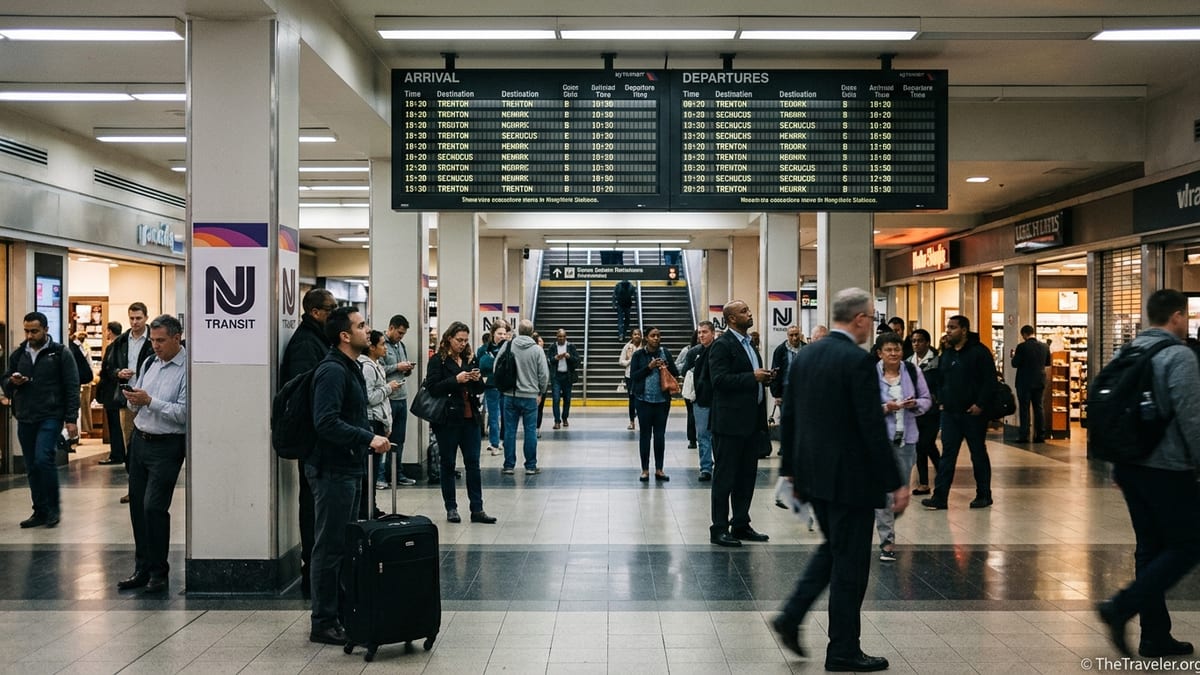
Learning the Hard Way at New York Penn Station
My introduction to NJ Transit began on a Saturday morning inside New York Penn Station, the underground maze that serves as the main gateway between Manhattan and New Jersey. I was headed to a friend’s place near Metropark on the Northeast Corridor line, one of NJ Transit’s busiest commuter rail routes linking New York and Trenton. I arrived about 25 minutes early, found the big departure board, and felt an almost touristy sense of relief when I spotted my train listed as “On Time.” It seemed simple enough: departure in 20 minutes, no track number yet, but that would surely appear soon.
Of course, that is not quite how NJ Transit works in real life. Regular riders know that at New York Penn, track numbers for New Jersey trains are usually posted only a few minutes before departure, and sometimes even later. What looks like a calm, empty concourse can turn into a sprinting crowd the moment a track flashes onto the board. I did not know that. I wandered off in search of coffee and nearly missed the initial surge as my train’s track finally appeared, prompting a stampede toward a staircase I could barely see over the crowd.
Just as I reached the platform, another twist appeared. The train that had been listed as “On Time” abruptly changed to “15 minutes late” on the platform screen. A few minutes later, the delay crept up again. Around me, a handful of regulars barely reacted. One woman glanced at her phone, muttered something about “should have checked DepartureVision,” and walked back up the stairs to see if another Northeast Corridor train might get her to Newark faster. I stayed put, surprised that the polished, official schedule had just been casually overruled by the reality of a Saturday morning at Penn Station.
By the time the train finally rolled in, we were roughly half an hour behind the initial timetable. For me, it felt like a frustrating anomaly. For the people around me, it was just another reason they always double check schedules before leaving home and then again once they are in the station.
Weekend Schedules: The Trap for First-Time Riders
The deeper lesson from that morning came when I looked more closely at the printed timetable I had screenshot from the NJ Transit website. The time I had aimed for was based on a weekday pattern, when trains on the Northeast Corridor, Morris & Essex, and North Jersey Coast lines can run relatively frequently during rush hours. On weekends, service is often less frequent, and ongoing work in and around the tunnels under the Hudson River can mean longer gaps between trains or adjusted departure times. That Saturday, the train I had expected to be “every 30 minutes” was, in fact, closer to every hour.
This mismatch between expectation and reality is exactly where many first-time visitors stumble. They assume that a big commuter rail system running between major hubs like New York, Newark, and Trenton must offer constant service. Instead, NJ Transit’s weekend schedules can be patchy, particularly for riders trying to connect from outlying lines onto core routes into New York. Miss a Saturday evening train from a branch line like the Gladstone Branch of the Morris & Essex system, and you may find yourself looking at a long wait for the next one.
Local riders handle this by building in extra time and refusing to rely on a single printed schedule. Someone heading from Hoboken to the Jersey Shore on the North Jersey Coast Line, for example, will often check the official timetable once, then plug the same trip into the NJ Transit mobile app, and finally glance at station-specific screens before they commit to a plan. If track work is scheduled near Rahway or Long Branch that weekend, the app may show special trains, bus substitutions, or odd stopping patterns that a casual glance at an older PDF schedule will not reveal.
By contrast, I had simply glanced at a weekday-style schedule, assumed the pattern continued on Saturdays, and left myself almost no margin for error. When the first delay hit, my carefully timed connection to a rideshare in the suburbs dissolved. I began to understand why regulars talk about “NJ Transit time” as its own unpredictable zone and why they advise new riders to treat weekend schedules as guidelines rather than guarantees.
Apps, Departure Boards, and the Double-Check Culture
After that first misadventure, I started paying attention to how experienced commuters actually use NJ Transit’s digital tools. The transit agency promotes its mobile app as the central hub where riders can buy tickets, plan trips, and see real-time status. Within the app are features like DepartureVision, which is designed to mirror the station departure boards on your phone, showing upcoming trains by station, along with current delays and track assignments when available.
In practice, riders often treat these tools with a mix of appreciation and skepticism. Many regulars will open the app to see DepartureVision for their origin station, then glance up at the physical board, and then cross-check again a few minutes later. If an evening Northeast Corridor train from New York to New Brunswick suddenly jumps from “On Time” to “20 minutes late,” the app may lag behind the station screens by a few minutes or vice versa. During recent app updates, some riders have reported that the new interface makes it harder to find the old, simple list of station departures, which has pushed some people to rely even more heavily on station boards or third-party tools that display NJ Transit data in a cleaner way.
This habit of constant cross-checking is especially visible at transfer points like Newark Penn Station and Secaucus Junction. Newark Penn, served by multiple NJ Transit rail lines along with PATH and Amtrak, can feel chaotic during the morning rush or after major events at Prudential Center. On a typical weekday, a commuter heading from Trenton to Hoboken might check DepartureVision at Trenton, again on the train as they approach Newark, and again on the platform to confirm which connecting train toward Hoboken is running closest to schedule. A single missed or delayed update on any one of those screens can mean a tight cross-platform transfer turning into a 30-minute wait.
That pattern explains why, when a conductor on my delayed train from New York announced that an upcoming Raritan Valley Line connection at Newark might not be held, half the car immediately lifted their phones. Within seconds, people were comparing the official schedule, the live status in the app, and what the departure board at Newark was showing through other riders’ photos and text messages. The technology is supposed to tell the story for you, but on NJ Transit, people still trust their own redundant checks more than any single data source.
Real People, Real Workarounds
Spending more time on NJ Transit trains after that first trip, I began to collect stories from regular riders about how they had learned to treat the schedule as a starting point rather than a promise. One accountant who commutes daily from Princeton Junction to Midtown told me she sets two alarms on her phone every morning: one for the train she intends to catch, and another for the earlier train, just in case the first one is suddenly cancelled or delayed long enough to threaten her day. She checks the schedule the night before, then looks at DepartureVision again when she wakes up, and finally refreshes it once more while she walks toward the station.
Another rider from the Jersey Shore described his Sunday routine on the North Jersey Coast Line. Because some weekend trains can originate farther down the line or terminate early at Long Branch, he never assumes the pattern is the same from one weekend to the next. Before heading to New York for a Sunday afternoon game, he checks the current NJ Transit PDF timetable for his line, confirms the same times in the app, and then looks at real-time status for his home station and for Rahway, where the line meets the Northeast Corridor. If he sees too many delays near Rahway or Newark, he will leave an hour earlier to protect his connection across the Hudson tunnels.
Even casual riders adopt small workarounds that reveal the depth of local knowledge. Parents traveling with kids to events in Newark or Jersey City plan meal stops that can stretch if a train is late. Students heading back to campus in New Brunswick keep an eye on both the official schedule and social media chatter to see whether earlier trains on the line have been stacking up delays. None of this shows up in the neat columns of a printed timetable, but it shapes how people actually move through the network every day.
For visitors, the most important takeaway from these stories is not that NJ Transit is uniquely unreliable. Many large commuter rail systems face similar challenges. It is that local riders have adapted by layering sources of information, watching patterns over time, and always leaving themselves an escape route, whether that means an earlier train, a different line, or a backup bus route.
Stations, Transfers, and the Geography of Uncertainty
Part of what makes NJ Transit tricky for newcomers is the geography of key stations and how small disruptions can ripple across multiple lines. Newark Penn Station, for example, is a major hub served by the Northeast Corridor, North Jersey Coast Line, and Raritan Valley Line, with the Morris & Essex and Montclair-Boonton lines stopping nearby at Newark Broad Street. A delay on one trunk route into New York can affect connections for riders headed as far away as Bay Head on the coast or Dover inland.
On my first ride, I had focused only on my origin and destination: New York Penn and Metropark. I did not think about what would happen if I needed to change trains mid-journey. When the conductor later announced that a signal issue ahead might cause further delays, I suddenly realized that my plan left no room for transferring to another line or even backtracking to an earlier stop if things went badly wrong. Around me, more experienced riders were calmly weighing options: stay on board and hope, hop off to try a different line at the next major station, or bail out at Newark and seek a bus instead.
Other stations bring their own quirks. Secaucus Junction, built to allow transfers between many of NJ Transit’s lines without going into Manhattan, can be a blessing or a curse depending on how closely services line up. If a Northeast Corridor train from Trenton is running a few minutes late, a rider trying to transfer to a Main Line or Bergen County Line train at Secaucus may miss a connection and face an unexpected wait. At smaller suburban stops on lines like the Morris & Essex, where service outside rush hours can be relatively infrequent, missing a single train may mean recalculating your entire evening.
These physical realities are why locals treat schedules as flexible and why they often check both the overall line timetable and station-specific departures. Knowing that your line runs roughly every 30 or 60 minutes is not enough; you also need to know how that pattern interacts with transfer points like Newark or Secaucus, and how delays upstream might eat into the few minutes of margin built into official connections.
For a first-timer, the best mindset is almost like driving in unfamiliar traffic: expect that things may slow down, give yourself more time than you think you need, and always know where your next possible exit is, whether that means a different train, a bus, or even a rideshare from a larger hub.
How to Ride NJ Transit Like a Local
My initial missteps on NJ Transit would have been less painful if I had borrowed some of the simple habits locals use every day. The first is to start planning from the official timetables for your specific line, which are posted in station displays and available as downloadable schedules that group routes like the Northeast Corridor and North Jersey Coast lines together. Those give you a baseline sense of how often trains are supposed to run and where they stop. Before you even leave home, check that timetable, then confirm the same trip using the trip planner in the NJ Transit app to capture any seasonal or construction-related changes.
Once you have a target train in mind, add redundancy. Use the app’s station departure view or DepartureVision-style tools to see what is actually running from your origin station within the next hour. If the 10:14 a.m. departure you had planned from New York to Metropark is already marked as delayed before you even leave your hotel, consider aiming for the earlier train if that is still available. At major hubs like Penn Station and Newark Penn, arrive early enough that you can react if your chosen train is cancelled or if a sudden gap in service appears.
On the day of travel, adopt a two-screen strategy. Watch both the main departure board and your phone, especially at New York Penn where track numbers are posted late and can change without much warning. Do not hesitate to re-check your return trip while you are still on your way to your destination; if a late evening train from the suburbs back into Manhattan looks fragile, you may decide to leave your gathering a bit earlier rather than gambling on the last train of the night.
Finally, build a buffer into any trip that connects to fixed events: airport flights, Broadway shows, or time-sensitive meetings. If your train into Newark Liberty International Airport should theoretically put you at the terminal 90 minutes before boarding, consider an earlier departure or be prepared to pivot to an alternative if delays start to stack up. Locals will often aim to arrive one train earlier than strictly necessary for anything that really matters, precisely because they have seen how quickly a quiet morning on NJ Transit can turn complicated.
The Takeaway
By the end of my first NJ Transit day, what had started as a simple ride had turned into a compact lesson in how large, busy commuter rail systems actually function. Schedules exist, but they live side by side with construction projects, tunnel constraints, equipment issues, and everyday crowding. The official timetable is the script; the stations, the riders, and the trains themselves often improvise around it.
What locals understand, and what I learned the hard way, is that the key to riding NJ Transit is not blind faith in a single source of information. It is the willingness to cross-check, to leave yourself options, and to respect the difference between a weekday rush-hour pattern and a sparse weekend schedule. Whether you are heading to a suburban barbecue, a concert in Newark, or a beach day at the Jersey Shore, the smartest move is to adopt a little of that New Jersey commuter mindset.
Check the schedule at home, check it again on your phone, and then check real-time station departures once more before you commit to a platform. The irony is that once you accept the need to verify everything twice, NJ Transit becomes far more manageable. The trains still have their quirks, but you are no longer surprised by them. You become part of that crowd at Penn Station moving with purpose when a track number appears, confident not because the schedule is perfect, but because you have learned how to read between its lines.
FAQ
Q1. Do I really need to check NJ Transit schedules more than once?
Yes. Check the printed or PDF timetable when planning, then use the NJ Transit app or station departure boards on the day of travel to confirm real-time status.
Q2. How early should I arrive at New York Penn Station for an NJ Transit train?
Aim to arrive 20 to 30 minutes before your planned departure, especially if you are unfamiliar with the station or traveling during busy hours.
Q3. Why do weekend NJ Transit schedules feel less predictable?
Weekend service is often less frequent and more affected by planned maintenance or construction, which can change stopping patterns and create longer gaps between trains.
Q4. Is the NJ Transit mobile app enough, or should I use other tools?
The app is useful, but many riders also watch station departure boards and sometimes third-party tools that display live departure data for extra reassurance.
Q5. What is DepartureVision and how does it help?
DepartureVision is NJ Transit’s real-time departure display by station, available in the app and online, showing upcoming trains, scheduled times, and delay information.
Q6. How much extra time should I allow when catching a flight via NJ Transit?
Plan to arrive at the airport at least one train earlier than the schedule strictly requires, giving yourself a buffer in case of delays or missed connections.
Q7. Are certain NJ Transit lines more prone to delays?
Lines using the busy corridor into New York Penn, such as the Northeast Corridor and North Jersey Coast Line, can be more sensitive to tunnel and signal issues, especially at peak times.
Q8. What should I do if my train is cancelled at the last minute?
Check the app and departure boards for the next available train, consider transferring at hubs like Newark or Secaucus, and be prepared to use buses or rideshare from major stations.
Q9. How do locals handle late-night NJ Transit trips?
They avoid relying on the very last train when possible, check live status before leaving their destination, and keep backup options in mind from larger stations.
Q10. Is NJ Transit safe and practical for visitors to use?
Yes, it is widely used by commuters and visitors. With a bit of planning, extra time, and regular schedule checks, it is a practical way to explore New Jersey from New York.