

Mount Pantokrator rises above Corfu’s northern skyline as both a geographical anchor and a cultural landmark. At 906 meters, it is the island’s highest peak, crowned by an old monastery, a windswept plateau and expansive views that stretch from the Greek mainland and Albania across the Ionian Sea. Whether you come to drive its hairpin mountain roads, hike from the stone village of Old Perithia or simply gaze across two countries from a café terrace at the summit, visiting Mount Pantokrator is one of the most rewarding days you can spend on Corfu.
Why Mount Pantokrator Belongs On Your Corfu Itinerary
Mount Pantokrator is not just another viewpoint. Standing on its summit, you gain a 360-degree sense of where you are in the Ionian world. On a clear day you can see the rugged Albanian coast just across the narrow channel, the Greek mainland beyond and, in exceptionally clear conditions, even the distant outline of Italy. The entire northern coastline of Corfu, from Kassiopi to Acharavi and beyond, unfolds below like a relief map. It is one of those rare viewpoints that genuinely reorients your understanding of a destination.
For many visitors, Pantokrator is also an accessible way to experience Corfu’s wilder interior. The island’s resorts and beaches can feel a long way from the shepherd tracks, dry-stone terraces and forests that once defined life here. A day on the mountain introduces you to those older rhythms. Goats graze below clusters of rock, raptors circle on thermals and abandoned hamlets slowly returning to life lie cradled on the slopes. A drive or hike to the summit offers a different perspective on Corfu, less about sun loungers and more about stone, sky and wind.
At the same time, you do not have to be an expert mountaineer to visit. A paved road leads almost to the very top, so anyone comfortable with mountain driving can reach the summit area. For walkers, several well-trodden trails climb steadily rather than technically. Options range from gentle loop walks in the foothills to challenging full-day ascents that form part of the long-distance Corfu Trail. This flexibility makes Pantokrator a realistic adventure even on a short trip.
The mountain also layers history and spirituality onto the experience. The monastery of the Pantokrator, dedicated to Christ the Almighty, has roots in the 14th century, even though the current complex is largely of later construction. Around the slopes you find tiny chapels, Venetian-era villages such as Old Perithia and paths that once carried pilgrims, merchants and shepherds rather than modern-day hikers. Many visitors combine a summit visit with time in one of these historic villages, turning a single excursion into a satisfying journey through landscape, culture and time.
Understanding the Mountain: Geography, Seasons and Weather
Mount Pantokrator dominates northeastern Corfu, rising behind coastal settlements like Nissaki, Barbati, Ipsos and Kassiopi. Its bulk forms a natural backbone of limestone ridges and folded slopes that descend toward olive groves and coastal plains. From the sea, especially if you approach by ferry or boat from the mainland, the mountain is the first significant landmark you notice. Its radio masts and the pale outline of the summit plateau are visible from great distances.
While 906 meters may not sound especially high to seasoned alpine hikers, in a maritime Mediterranean environment that elevation has a real effect. Temperatures on the summit can be several degrees cooler than at sea level, and even in midsummer the wind can be strong and surprisingly chilly. Cloud can build around the upper slopes quickly, particularly in spring and autumn, creating dramatic light but also reducing visibility. In rare winter cold snaps, the summit can see dustings of snow or frost, though most visitors will encounter clear, dry rock and scrub.
Season makes a big difference to the experience. From late April to early June, the mountain slopes green up with wildflowers and grasses, and daytime temperatures are usually comfortable for hiking. This spring period is widely regarded as one of the best times to visit, with long daylight hours and clear views. September and October offer similarly pleasant conditions, with the bonus of warmer sea temperatures if you plan to combine a hike with a coastal swim later in the day.
July and August bring high heat and bright, hard light. The exposed upper slopes can be punishing in the middle of the day, and heat haze may soften long-distance views. At this time of year, sunrise or early morning ascents are the best option, allowing you to reach the summit before temperatures peak. Late afternoon and early evening can also be beautiful, but you need to manage your timing carefully so you are not descending in darkness if hiking.
How To Get To Mount Pantokrator
The most straightforward way to reach the summit area is by car. From Corfu Town, the drive typically takes around 40 to 60 minutes, depending on traffic and your starting point on the island. You head north along the main coastal road, passing beach resorts such as Dassia and Ipsos, before turning inland and uphill through mountain villages like Spartilas and Strinilas. From there, a narrow paved road twists its way through a series of hairpins to near the top.
The summit road is fully paved for its main section and is generally passable in a standard car. However, it is narrow in places, with few guardrails and steep drop-offs. Drivers need to be comfortable with reversing into passing bays, handling blind corners and giving way on steep inclines. This is not a road to rush. The upside is that the views from lay-bys and roadside chapels are often as memorable as those from the summit, rewarding a slow, cautious approach.
Public transport options exist but are limited. Intercity buses serve coastal and some inland villages in the Pantokrator area, including routes to Nissaki, Barbati, Kassiopi and Perithia. However, these buses only take you to the lower slopes. From the nearest stops, you face a long and steep walk to the summit, potentially several hours on asphalt and dirt roads. For most visitors, combining a bus ride with a pre-booked taxi or a local transfer service to reach higher villages or Old Perithia works better. Organized excursions from major resorts and Corfu Town also operate in high season, often packaging a summit visit with stops at villages and viewpoints.
Cyclists occasionally tackle the Pantokrator road, but gradients and traffic make it suitable mainly for experienced riders comfortable with long climbs and technical descents. The elevation gain and tight bends demand good fitness and a well-maintained bike. For casual visitors, a guided jeep tour or minivan excursion is a far more relaxed way to experience the road while still enjoying scenery and photo stops.
Hiking Routes: From Gentle Walks To Challenging Ascents
Hiking on Mount Pantokrator ranges from easy village loops in the foothills to demanding, rocky climbs that take several hours. The most popular climbing route starts from Old Perithia, a historic stone village on the northern side of the mountain. From here, well-used trails and tracks lead up toward the summit through a patchwork of scrub, open pasture and limestone outcrops. Depending on the exact path you follow and your pace, the round trip from Old Perithia typically covers around 7 to 10 kilometers and takes between 3 and 6 hours.
The classic Old Perithia to summit route is considered moderate to challenging. The path is not technical, but it gains substantial elevation and includes rocky, uneven sections that can be slippery in wet weather. The ascent is steady rather than brutally steep, meaning fit walkers with good footwear and a basic sense of navigation can manage it. Along the way, you pass chapels, old terraces and grazing areas, with views expanding constantly as you climb. Many hikers describe the final approach to the summit, where trails meet the access road and monastery, as both physically and emotionally satisfying.
Other hiking options include circular routes from villages such as Strinilas or Spartilas, which form part of the longer Corfu Trail. These loops typically take around 3 to 5 hours and combine forested sections with open slopes. They may or may not reach the absolute summit but offer excellent vantage points and a sense of the mountain’s varied ecosystems. A popular long route links Old Perithia with other settlements via ridgelines and old communication paths, suitable for experienced walkers ready for a full day on the trail.
For those seeking something gentler, the foothills around Old Perithia feature shorter, easier circuits that explore abandoned hamlets, chapels and viewpoints without climbing all the way to the top. One such loop of about 5 kilometers keeps mostly to the lower slopes, threading through cobbled paths and dirt tracks with gradual inclines. These walks suit families and casual strollers who still want to experience the atmosphere of the Pantokrator massif without committing to a strenuous climb.
Old Perithia: Ghost Village Gateway To The Summit
Old Perithia, sometimes described as Corfu’s “ghost village,” is the most atmospheric starting point for exploring Mount Pantokrator. Tucked into a sheltered hollow on the mountain’s northern side, it dates back to at least the 14th century. The site was chosen as a refuge from coastal pirate raids, and over time it grew into a stone-built community with around 130 houses and eight churches. As coastal settlements became safer and tourism reshaped Corfu’s economy, villagers drifted down toward the sea, leaving Old Perithia largely abandoned.
In recent years, a slow renaissance has begun. Some houses have been sensitively restored as guesthouses and holiday homes, and a small number of tavernas operate seasonally, serving traditional Corfiot dishes under vines and plane trees. Yet the village retains a palpable sense of abandonment, with crumbling façades, roofless houses and silent chapels giving it an almost cinematic quality. Wander its lanes before or after your hike and you feel both the weight of history and the resilience of the landscape.
As a hiking base, Old Perithia has several advantages. It is already high on the mountain’s flank, so you begin your ascent with a head start on elevation. Trails are well established, with local businesses and accommodation providers able to offer advice on conditions. Paths lead directly from the village into the surrounding hills, passing chapels and viewpoints before joining more open slopes. Many walkers plan a full day: a mid-morning start for the summit, a picnic or monastery café stop at the top, a steady descent and then a late lunch or early dinner in one of the village tavernas.
Access to Old Perithia is typically by car, along a winding road that branches off the coastal route between Kassiopi and Acharavi. There is usually a small parking area just outside the village, from which you enter on foot. Because public buses do not serve Old Perithia directly, travelers without a vehicle often arrange a taxi or private transfer from nearby coastal resorts. Staying overnight in or near the village transforms the experience again, allowing sunrise or sunset walks and a deeper feeling of connection with the mountain setting.
The Summit Experience: Monastery, Café And Panoramic Views
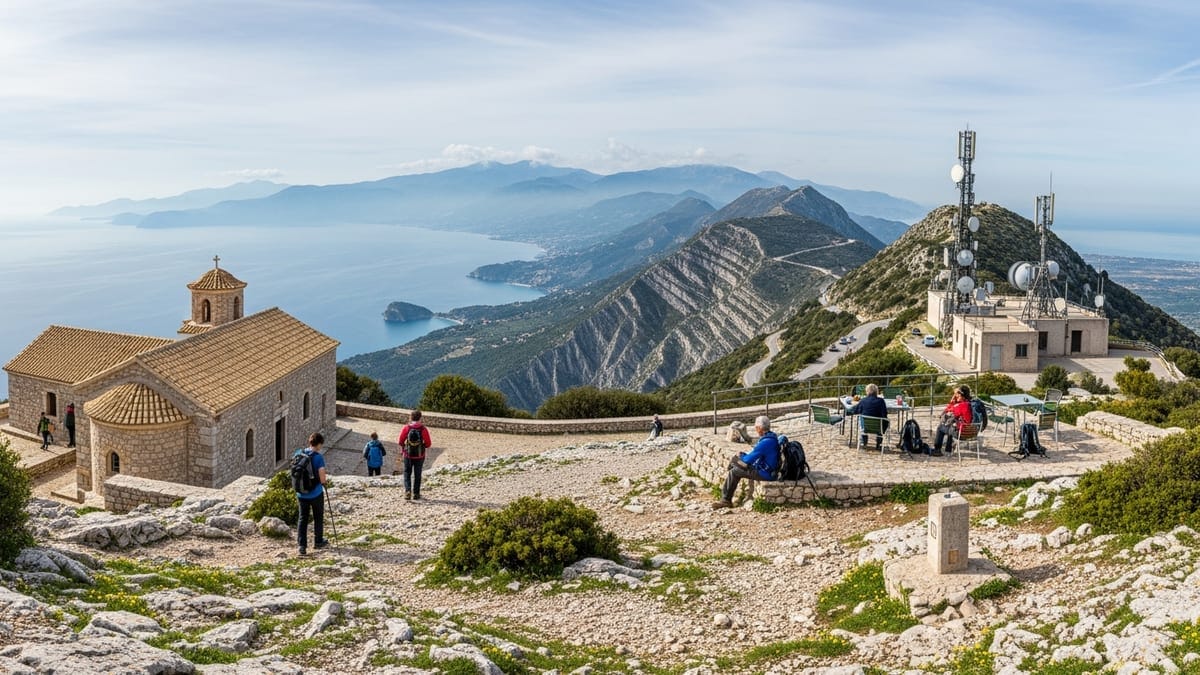
Arriving at the top of Mount Pantokrator, whether by car or on foot, you step into a compact but striking world. At the heart of the summit complex stands the monastery of the Pantokrator, a modest structure by the standards of grand island monasteries but one that carries centuries of devotion. The original monastic foundation dates back to the 14th century, though the present buildings have been rebuilt and modified over time. The church interior, when open, is small and intimate, adorned with icons and candles, and visitors are asked to dress respectfully.
Beside the monastery rises a tall telecommunications mast and associated structures. They are visually incongruous, but in practice most visitors find their eyes drawn instead to the surrounding landscape. A short stroll around the summit plateau reveals different vistas in every direction. To the east you see Albania’s mountains across the narrow channel, their peaks often snow-capped in winter and hazy blue in summer. To the south, Corfu Town and the central spine of the island stretch toward the horizon. The northern coastline bends away toward the Diapontia Islands.
A small café or kiosk usually operates near the summit in the main visitor season, serving drinks and simple snacks. Sitting with a coffee or a cold drink at nearly 900 meters while scanning the horizon is a memorable experience, especially if you have earned it with a long hike. Even drivers who have simply stepped out of their vehicles find themselves lingering longer than expected as changing light and passing clouds transform the scene. On days of exceptional clarity, some visitors report glimpsing the distant heel of Italy around 130 kilometers away across the sea.
Conditions at the summit can change quickly, and that variability is part of the appeal. On some days the air is crystal clear, with razor-sharp outlines and glittering water. On others, low cloud wraps the peak in mist and you get only tantalizing glimpses between swirls of vapour. Wind is common, and in cooler months it can be bracing. A lightweight windproof layer is advisable even in summer, particularly if you plan to spend extended time exploring the summit trails and viewpoints.
Practical Tips: Safety, Gear And Respectful Travel
A visit to Mount Pantokrator rewards a bit of advance planning. For drivers, that starts with understanding the mountain roads. They are narrow, steep and twisting, often with stone walls on one side and drop-offs on the other. Drive slowly, use low gears on both ascents and descents, and be prepared to reverse to a passing place if you meet oncoming traffic on a tight bend. Avoid looking at your phone or in-car navigation devices while moving; stop at widened sections if you need to check directions.
For hikers, footwear is crucial. Trails combine rocky limestone, loose gravel, old cobbles and dirt, so sturdy walking shoes or boots with good grip are strongly recommended. Trainers with smooth soles can feel insecure, especially on dusty rock. Bring more water than you think you will need, particularly from late spring to early autumn. For a half-day hike, most visitors are comfortable carrying at least 1.5 to 2 liters per person. Sun protection matters too: a hat, high-factor sunscreen and sunglasses make a big difference under strong Mediterranean light.
Navigation is easier today than in the past thanks to waymarking, local signs and widely available hiking apps, but it is still wise not to rely entirely on a smartphone. Batteries drain faster than expected when constantly using GPS, and reception can be patchy on certain slopes. If you are venturing beyond the main Old Perithia routes or planning to connect with the long-distance Corfu Trail, consider carrying a printed map or offline GPS track and paying close attention at junctions where shepherd paths and trails intersect.
Respect for local culture and environment enhances every visit. The monastery is an active religious site, not a museum, so shoulders and knees should be covered when entering the church. Speak quietly and avoid flash photography of icons if services are taking place. Around the mountain, close gates behind you, do not disturb livestock and carry all litter back down with you. Fire risk is a serious concern in dry months, so never discard cigarette ends or light open fires. By treating the mountain lightly, you help ensure that its fragile ecosystems and historic villages remain intact for future travelers and local communities alike.
The Takeaway
Mount Pantokrator is far more than Corfu’s highest point on a map. It is a place where geology, history and contemporary island life converge. From the abandoned lanes of Old Perithia to the quiet icons of the summit monastery and the modern antennas that link the island to the wider world, the mountain embodies Corfu’s layers of story. Standing at its summit, with Albania’s mountains on one side and the Ionian Sea spread beneath you, you sense how close and how connected this part of the Mediterranean has always been.
Whether you drive to the top for a quick panorama or spend a full day tracing old paths from village to peak, a visit here resets your relationship with the island. Busy beaches and harbourfronts feel suddenly small and contained, just one part of a larger landscape that has shaped human lives for centuries. With sensible preparation and a little respect for the roads, trails and traditions, Pantokrator delivers one of the most vivid and satisfying travel experiences Corfu has to offer.
FAQ
Q1. How difficult is the hike to the summit of Mount Pantokrator from Old Perithia?
The classic route from Old Perithia is usually rated moderate to challenging. It involves steady elevation gain on rocky and uneven paths but no technical climbing. Most reasonably fit walkers with proper footwear can complete the round trip in around 3 to 6 hours, depending on the exact route and number of stops.
Q2. Can I drive all the way to the top of Mount Pantokrator?
Yes. A narrow, winding paved road leads close to the summit, with parking near the monastery and communications towers. A standard car is usually sufficient in dry conditions, but the road requires confident, careful driving due to tight bends, steep sections and limited passing places.
Q3. Do I need a guide to hike on Mount Pantokrator?
A guide is not strictly necessary for the main Old Perithia to summit route, which is well trodden and broadly straightforward in good weather. However, less experienced hikers, those attempting longer or more remote trails, or anyone traveling outside the main season may benefit from hiring a local guide for added safety, navigation help and cultural insight.
Q4. Is there an entrance fee for the monastery or summit area?
There is generally no formal entrance fee to access the summit area or to visit the monastery, although modest donations are appreciated to support the upkeep of the church. Parking at the top is typically free as well, but you may wish to support the small café or kiosk by purchasing refreshments.
Q5. What should I wear and pack for a day on Mount Pantokrator?
Wear sturdy walking shoes or hiking boots, comfortable clothing in layers, a hat and sunglasses. Even in summer, bring a light windproof jacket for the summit. Pack plenty of water, some snacks, sunscreen, a basic first-aid kit and either a map or offline navigation app. A small backpack is sufficient for most day trips.
Q6. When is the best time of year to visit Mount Pantokrator?
Spring (roughly late April to early June) and autumn (September and October) are widely regarded as the best times. Temperatures are milder, visibility is often excellent and the slopes are either greening up with wildflowers or glowing with late-season light. In high summer, aim for early morning or late afternoon visits to avoid peak heat.
Q7. Are there public toilets, food and water at the summit?
Facilities at the summit are limited but usually include basic toilets and a small café or kiosk in the main visitor season. You should not rely on these as your sole water source, as opening hours can vary. Always carry enough water and some snacks with you, especially if hiking.
Q8. Can families with children visit Mount Pantokrator?
Yes. Families often drive to the summit to enjoy the views with children, and older or more active kids may also enjoy shorter walks around the plateau or gentle hikes in the foothills. The full Old Perithia summit hike may be too demanding for younger children, so consider age, fitness and heat when planning.
Q9. Is Mount Pantokrator suitable for people afraid of heights?
The summit plateau itself is relatively broad and does not demand walking directly along exposed cliff edges, so many visitors who dislike heights still feel comfortable there. The access road, however, has drop-offs and tight bends that can be unsettling for some passengers and drivers. If you are very sensitive to heights, consider joining an organized excursion rather than driving yourself.
Q10. Can I visit Mount Pantokrator without renting a car?
It is possible, but requires more planning. You can combine public buses to coastal or inland villages with taxis or pre-booked transfers to reach Old Perithia or higher trailheads. In peak season, several tour operators also offer organized trips that include transport, making it easier to experience the mountain without driving.