


The first time I arrived on Capri, I thought Marina Grande was the part you were supposed to rush through. It was the ferry port, the place of rolling suitcases and ticket queues, a blur between Naples and the Capri of glossy magazine spreads. Yet it took just one unhurried hour in Marina Grande to undo that assumption and change the way I saw the island entirely.
Get the latest updates straight to your inbox!
Stepping Off the Ferry Into Another World
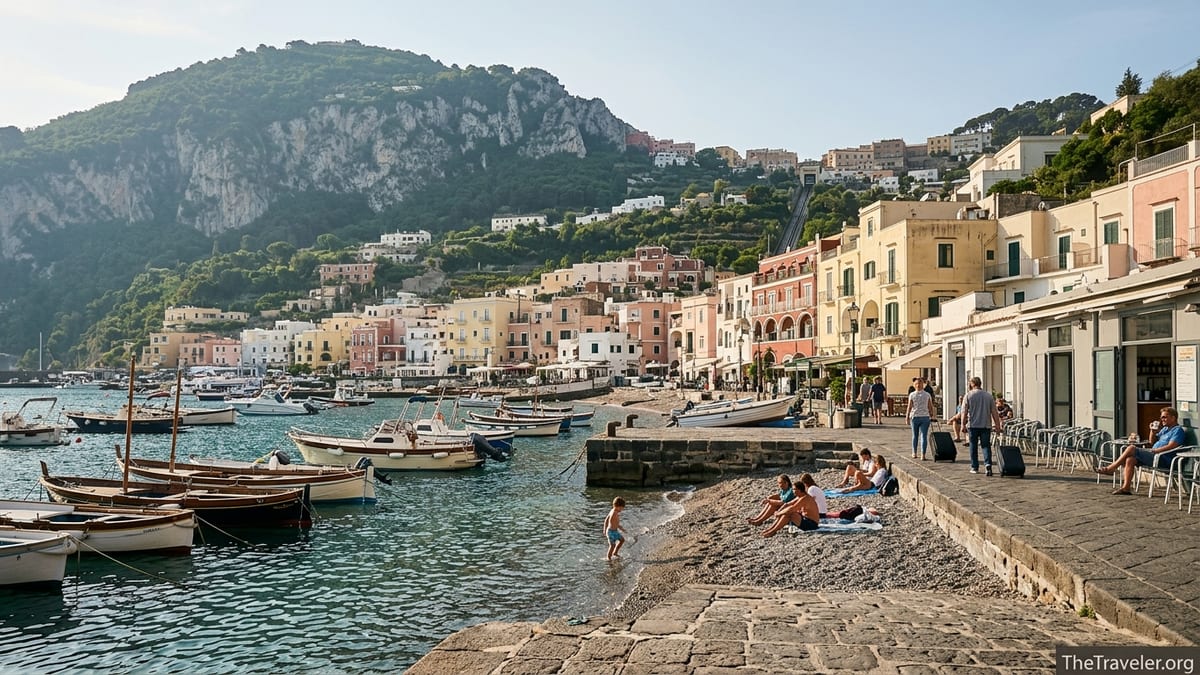
My first sight of Capri was not a glamorous hotel terrace or the famous Piazzetta. It was the low, practical curve of Marina Grande, framed by pastel houses and the steep green flank of Monte Solaro. The ferry from Naples eased into the harbor, past a mix of working fishing boats and glossy day cruisers, and the loudspeaker told us to prepare to disembark. On deck, people jostled for position, clutching wheeled suitcases, beach bags and selfie sticks.
On the pier, the air felt different from the city I had just left. The smell of diesel from the ferries mixed with espresso from the waterfront bars and the faint iodine scent of the sea. To my left was a line of ticket booths for hydrofoils and ferries heading back to Naples, Sorrento and the Amalfi Coast. Directly ahead, a strip of low buildings in faded yellows and terracottas housed bars, pizzerias and souvenir shops. Behind them, staircases and narrow lanes climbed toward Capri town.
I had arrived in mid-morning, which is when Marina Grande is at its most intense. Ferries from Sorrento, Positano and Naples tend to converge between about 9:30 and 11:30, and within minutes the pier filled with tour groups, wedding parties and day-trippers comparing printed itineraries. Yet beneath that surface bustle, there was another rhythm: fishermen cleaning nets on small boats, locals greeting each other with quick handshakes, porters in white polo shirts weaving through the crowd with luggage trolleys.
At first, my instinct was to get out as quickly as possible. I could see the entrance to the funicular that climbs from Marina Grande to Capri town in just four minutes. The crowd was already forming outside, clutching the same one-way tickets that now cost a little over two euros. The line snaked past the station and into the sun, and I found myself stepping toward it before stopping short. If I rushed straight into the postcard version of Capri, I realized, I would miss the island’s prologue.
Learning to Pause Where Everyone Else Rushes
Instead of joining the line for the funicular, I stepped back to watch. This was my first lesson from Marina Grande: Capri is not only about where you go, but how quickly you try to get there. Tour groups followed their guides straight from ferry to funicular, barely glancing at the harbor. Couples with rolling bags hurried to the taxi rank, where open-top Capri taxis waited with their distinctive striped canopies, offering rides to hotels in Capri and Anacapri for far more than a bus ticket but with far more style.
I dropped my backpack at a small luggage deposit just off the main pier, a simple shopfront with “Deposito bagagli” painted above the door. The price was just a few euros per bag for the day, a small cost to remove the weight from my shoulders and free up that first hour. For travelers arriving in the heat of summer, this is one of the smartest first decisions you can make in Marina Grande. Between traditional left-luggage shops and app-based services that partner with nearby businesses, there are now several options clustered around the port, meaning you do not need to drag a suitcase up into Capri town just to wander.
Freed from my luggage, I walked back toward the sea. To the right of the ferry pier, past the rows of ticket offices, began Marina Grande’s main beach. I had read that this was Capri’s most accessible shoreline, popular with families, and often dismissed by guidebooks in favor of more exclusive beach clubs. Yet in that first hour, it was the beach that convinced me Capri was not only a luxury playground but also an Italian island where people still came simply to swim before work or after school.
The free section of the beach sits closest to the ferry pier, a strip of pebbles and coarse sand where locals had already spread towels. Further along, neat rows of blue and white loungers marked off the private sections with daily rates that, while not cheap, were gentler than those at the island’s most famous clubs. Even here, you could expect to pay a substantial fee for a sunbed in high season, but the crowd felt mixed: families from mainland Campania, solo travelers with paperbacks, a group of teenagers passing a football back and forth near the waterline.
Coffee, Chaos and the Comfort of Routine
By now the morning sun had climbed high enough to make every patch of shade precious. I retreated to the arc of bars and cafes facing the harbor, looking for a place where I could watch the choreography of arrivals and departures. Bar Corallo, right on the waterfront, had outdoor tables that spilled almost onto the promenade. The menu was simple: espresso and cornetti for breakfast, panini, bruschette and slices of pizza al taglio for later in the day. Prices were higher than in Naples but not shocking when you considered the setting. A basic espresso cost a couple of euros, a spritz several more.
I took a seat with a view of the pier and ordered a cappuccino and a sfogliatella, the crisp, layered pastry that is a signature of this coast. Around me, other tables told a hundred Capri stories at once: a British couple comparing photos from the ferry; a group of Neapolitans loudly debating which boat tour to book; a hotel porter in immaculate white stacking suitcases onto a trolley for transfer up to a luxury property in Capri town.
As I lingered, I began to notice how much of Marina Grande runs on routine. The funicular departed every few minutes, but the ritual remained the same: travelers followed signs to the ticket office near the pier, sorted change and cards, then queued beneath the lemon groves that frame the track. Buses to Capri and Anacapri idled at the stop a short walk up the road, small minibuses rather than city coaches, their size a reminder of how narrow and winding the island roads are. Drivers leaned on their doors chatting in dialect between departures, moving only when enough people had gathered to fill the seats.
Even the chaos of taxi touts and tour sellers had a pattern if you watched long enough. Representatives of small boat companies waited near the harbor wall with laminated photos of Capri’s sea caves and the Faraglioni rocks. Some offered shared island tours that last a couple of hours and depart directly from Marina Grande’s small-boat dock, usually for a per-person rate that, while not insignificant, is still more attainable than a private charter. Others specialized in arranging private gozzo boats, those traditional wooden craft that feel like floating terraces for couples and small groups.
Seeing Capri From the Water Before the Hill
One of the biggest shifts in how I viewed Capri happened when I realized that the sea is not just scenery here; it is the island’s main road. Standing at the end of the Marina Grande pier, you can see a constant dance of vessels coming and going: ferries from mainland ports, workboats delivering supplies, small shuttles headed to beach clubs like Bagni Tiberio just around the headland.
On that first visit, instead of rushing upward to the Piazzetta, I booked a simple boat transfer from Marina Grande to a nearby beach club. The price was modest compared with a full island cruise. At the designated time, a small boat nosed up to the dock, and a handful of us climbed aboard: two friends from Milan, a German family with children already in swimsuits, and a local couple with beach bags and a folded newspaper. In a few minutes we were skimming along the coastline, close enough to see the bathers on Marina Grande’s pebbles and the fishermen’s nets hanging to dry.
That short trip showed me the island’s verticality in a way no bus ride could. Above us, pastel houses clung to the slopes; higher still, the terraces of hotels and the silhouette of the funicular line. It was also my first glimpse of the quieter rhythm that exists alongside Capri’s crowds. Away from the pier, the water turned a deep turquoise, and the noise of announcements and engines faded into the slap of waves against the hull.
Back in Marina Grande, you can taste this maritime life without committing to a full day at sea. Boat companies based here offer short group circuits around the island that depart regularly from late morning through the afternoon. It is worth checking schedules and prices in advance, especially in peak months, when popular slots sell out. Many packages sold at mainland ports include both a round-trip ferry ticket and a basic island boat tour from Marina Grande, which can be good value if you prefer not to arrange each step separately.
What struck me most was how normal all of this felt to locals. For them, Marina Grande is not a resort but a transport hub where everything from groceries to schoolchildren arrives. Watching schoolkids hop off a late-morning ferry from Sorrento, joking as they walked past artisans repairing nets, I began to see Capri less as a curated dream and more as a living community connected to the sea.
Finding Everyday Capri in the Back Streets
All it took to escape Marina Grande’s most touristy strip was a decision to cross the main road and start climbing. Behind the line of waterfront businesses, narrow lanes branched off toward residential areas and small guesthouses. The higher I walked, the quieter it became. Laundry fluttered from balconies, and the smell of frying garlic drifted from open kitchen windows. A tiny alimentari, half hidden behind crates of tomatoes and zucchinis, sold chilled water and packets of taralli for the same prices you might find in a small mainland town.
In one alley, I came across a simple church square with a bench in the shade. An elderly man sat reading a newspaper while a dog slept at his feet. From here, the harbor looked softer: the same colorful facades, but now miniaturized and framed by bougainvillea. It was a reminder that even in Capri’s busiest corner, you are rarely more than a few minutes from quiet if you are willing to climb a little.
This back-street detour changed how I approached the rest of the island. Later, when I reached Capri town and Anacapri, I instinctively looked for the layers behind the main piazzas: the local bar where workmen took their morning coffee, the side street where someone had propped open a door to let in the breeze. I realized that by pausing in Marina Grande instead of racing through, I had trained myself to look beyond the first impression everywhere.
For practical purposes, it also helped me understand Capri’s geography. From these higher vantage points, you can see how the funicular line slices through lemon groves, how the main road twists upward toward the town, and where the public buses crawl along the cliffs. That mental map paid off later in the day, when the queues lengthened and I could decide calmly whether to wait for the funicular, take a bus, hire a taxi, or simply walk part of the way.
How That First Hour Reshaped My Expectations
Before I set foot on Capri, I imagined an island divided starkly between luxury and crowding: five-star hotels and designer boutiques on one side, crushes of day-trippers on the other. Marina Grande, in my mind, belonged almost entirely to the second category. Yet in that first hour, as I moved from pier to beach, from café table to back street, I saw something more nuanced emerge.
Yes, there were inflated prices on waterfront menus and souvenir shops selling identical straw hats. Taxis queued with their meters ready, and boat tour sellers competed for attention with laminated flyers. But there were also families unpacking homemade lunches on the public beach, porters who knew their regular hotel guests by name, and baristas who handled a rush of ferry arrivals with a practiced rhythm that made every order feel both efficient and human.
It shifted the way I evaluated the rest of the island. When I later walked through the designer-lined streets near the Piazzetta, I no longer saw those boutiques as the whole story, just as the ferry chaos was not the whole story of Marina Grande. Capri, I realized, holds both exclusivity and normality in the same hand. How you experience it depends not only on your budget but on your willingness to slow down at the points most people treat as mere transit.
Most of all, that hour taught me to value my time on Capri in a different way. Instead of trying to “do” the island in a checklist of sights, I let moments accumulate: a swim while the ferries came and went, an unhurried coffee watching luggage trolleys roll by, a conversation with a local shopkeeper about which days the sea is too rough for the earliest boats. By the time I finally joined the funicular queue, I felt less like a visitor eager to reach “the real Capri” and more like someone already inside it.
Practical Tips Inspired by That First Hour
If your ferry schedule gives you even a small window in Marina Grande, it is worth planning to use it instead of racing through. Start by making a quick choice about your luggage. Long, hot walks uphill with heavy bags can sour a day quickly, so consider dropping larger items at one of the luggage deposits near the harbor for a few euros per bag. This is especially useful if you are visiting on a day trip and do not need your suitcase until the evening ferry back to the mainland.
Next, consider how you want to reach Capri town. The funicular is the fastest and most atmospheric option, climbing through lemon groves in around four minutes. Tickets are sold at the ticket office near the ferry docks, not at the funicular entrance itself, and cost a little over two euros for a single ride. Lines can be long in late morning, so if you dislike crowds, you might either go very early, wait until mid-afternoon when some day-trippers leave, or take one of the small buses that depart from a stop a short walk from the port.
If you are tempted by an island boat tour, Marina Grande is where almost all of them begin. Group tours lasting around two hours typically circle Capri’s dramatic coastline, passing under the Faraglioni rocks and into sea caves if sea conditions allow. Prices vary by season and operator but are usually advertised clearly along the harbor. For private gozzo rentals, expect significantly higher rates, but you gain the freedom to swim in quieter coves and linger where you like. Booking ahead in peak months is wise, although you can still sometimes find last-minute spots by asking at the kiosks when you arrive.
Finally, do not underestimate the value of a simple swim or coffee before you head uphill. The free segment of Marina Grande’s beach, close to the ferry ticket offices, offers an easy way to cool off without committing to a full day at a beach club. Alternatively, choose a café with a clear view of the pier and use that time to absorb the island’s rhythms. Watching the interplay of ferries, fishermen and porters for even half an hour will deepen your understanding of Capri more than a rushed lap around the shops ever could.
The Takeaway
My first hour in Marina Grande turned out to be the key that unlocked Capri. By resisting the urge to rush straight into the postcard scenes, I discovered an island that is far more layered than its glossy image suggests. Marina Grande is both a working port and a tourist gateway, a place of modest public beaches and aspirational yachts, efficient routines and slow rituals.
If you let that first hour belong to observation rather than urgency, Capri will meet you differently. You will see the island not just as a set of viewpoints to be conquered, but as a living place with its own pace and priorities. In the end, the ferries, funiculars and boat tours are just the mechanics. It is the decision to pause in the middle of them that changes how you see the island.
FAQ
Q1. How much time should I plan to spend in Marina Grande before heading up to Capri town?
Planning at least 45 to 60 minutes in Marina Grande allows you to store luggage, have a quick coffee or swim, and get your bearings before taking the funicular or bus uphill.
Q2. Is it worth swimming at Marina Grande’s beach, or should I save my time for other parts of Capri?
Marina Grande’s beach is an easy, low-effort way to get into the water, especially just after arriving. It may not be the most dramatic beach on Capri, but it is clean, convenient and ideal for a quick swim.
Q3. How do I get from Marina Grande to Capri town?
The funicular is the quickest option, taking about four minutes and costing a bit more than two euros per ride, with tickets sold near the ferry docks. Alternatively, small public buses and open-top taxis also connect the port with Capri town.
Q4. Can I store my luggage in Marina Grande if I am only visiting Capri for the day?
Yes. Several left-luggage options and app-based storage partners operate near the harbor, typically charging a few euros per bag, which is convenient for day-trippers who want to explore without suitcases.
Q5. Are boat tours around Capri easy to arrange on arrival at Marina Grande?
Yes. Kiosks along the harbor sell shared island tours and private boat trips. In high season it is wise to book ahead, but you can often still find last-minute spaces by asking at the stands when you arrive.
Q6. Is Marina Grande very expensive compared with the rest of Capri?
Waterfront prices are higher than on the mainland, but Marina Grande also has simple cafés, bakeries and small shops where costs are more moderate. Luxury experiences exist alongside more everyday options.
Q7. What is the best time of day to arrive in Marina Grande to avoid big crowds?
Early morning, before about 9:30, is usually calmer, with fewer ferries arriving at once. Late afternoon, when some day-trippers begin to leave, can also feel less hectic than the late-morning peak.
Q8. Do I need to book the Capri funicular or buses in advance?
No advance booking is required for the funicular or public buses. You simply buy a ticket at the port and join the queue, though waiting times can be longer during peak holiday weeks and midday hours.
Q9. Is Marina Grande suitable for travelers on a tighter budget?
Yes. While some restaurants and tours are pricey, you can keep costs down by using the public beach, choosing simple cafés away from the waterfront strip and focusing on short boat transfers rather than full private charters.
Q10. Can I experience a more local side of Capri without leaving Marina Grande?
You can. Wander a few streets back from the waterfront into residential lanes, small churches and neighborhood shops. Even brief detours uphill from the harbor reveal quieter corners where everyday island life continues behind the tourist scene.