


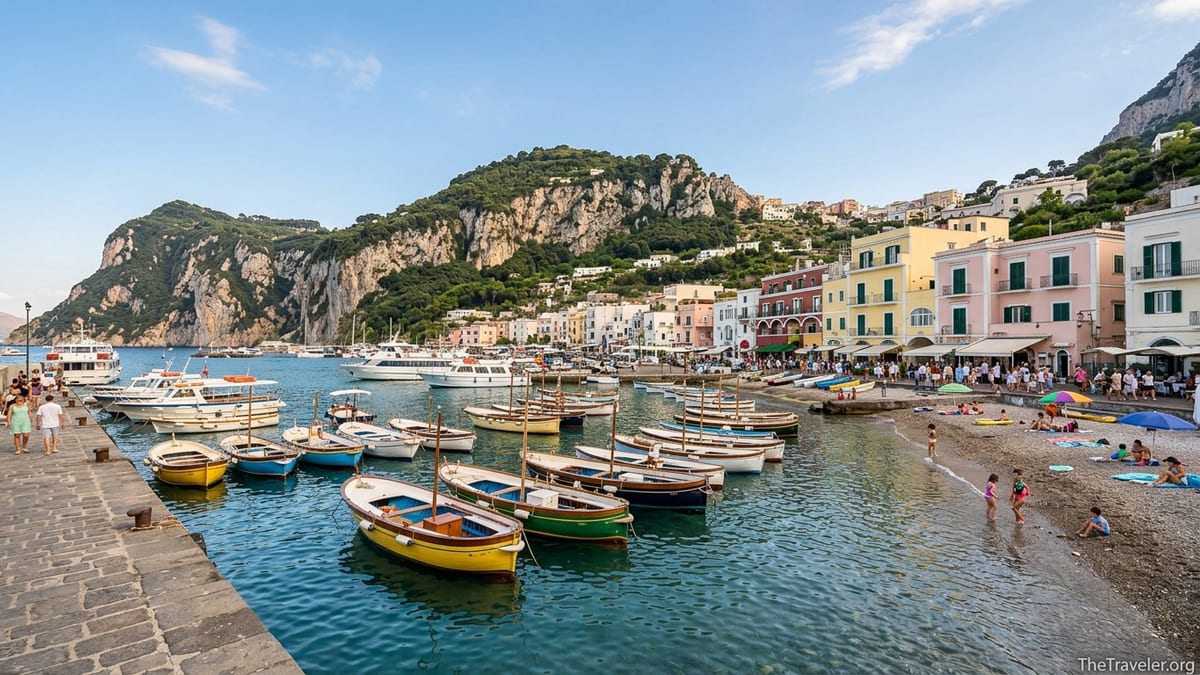
The first glimpse most travelers have of Capri is not the famed Piazzetta or the Faraglioni sea stacks, but the amphitheater of pastel houses wrapped around Marina Grande. Ferries from Naples and Sorrento pull into this sheltered cove all day long, spilling out day-trippers and honeymooners beneath cliffs that rise almost vertically toward Capri town. It is easy to treat Marina Grande as a mere transit hub, a place to rush through on the way to cable cars, buses and boat tours. Yet for travelers who pause, this waterfront neighborhood reveals itself as a living fishing village, a beach resort, and one of the most atmospheric corners of the island.
Get the latest updates straight to your inbox!
From Ancient Fishing Harbor to Capri’s Front Door
Marina Grande lies on the north side of Capri, directly below Capri town and at the foot of Monte Solaro. Today it functions as the island’s principal port, with hydrofoils and ferries arriving from Naples, Sorrento and the Amalfi Coast throughout the day. But long before ticket booths and luggage carts, this was a natural landing place used in Roman times, when nearby imperial villas such as Palazzo a Mare linked Capri to the sea. That layered history is still visible in the way fishing boats moor alongside sleek yachts, and in the cluster of low houses that press right up against the water.
For modern visitors, the port’s role as Capri’s front door is practical as well as scenic. With no airport on the island, everyone arrives by sea, typically in about 45 to 80 minutes from the mainland depending on whether you choose a faster hydrofoil or a slower, cheaper ferry. As your boat glides into Marina Grande, the scene is pure Mediterranean: blue and white gozzi (traditional fishing boats), the small church of San Costanzo with its simple facade, and a crescent of beach to the east of the pier. This is not a sterile terminal area but a genuine village that has adapted to tourism without entirely losing its working character.
Many travelers assume they must escape the port area immediately to “see the real Capri.” In reality, Marina Grande offers one of the most authentic snapshots of local life. In the early morning, you might watch fishermen unloading crates of squid or anchovies that will appear hours later on restaurant menus, while port workers greet each other over quick espressos at counters just meters from the water. Ferries come and go, but the daily rhythms of the people who live here continue largely unchanged.
The Beating Heart of Island Transport
Marina Grande is where Capri’s transport network converges. Steps from the landing quay stands the lower station of the funicular, a short cable railway that whisks passengers up the cliff to the central Piazzetta in about three minutes. Tickets cost in the region of 2.40 euros one way and are bought at the ticket office facing the harbor, not on board. In busy months, tap and go payment and timed boarding help manage crowds, turning what could be a frustrating bottleneck into a relatively smooth experience for most visitors.
For those heading elsewhere, orange island buses fan out from Marina Grande toward Capri town and Anacapri, with single rides generally priced a little above the funicular fare. During peak summer afternoons queues can form, so some travelers opt for the more expensive but time-saving option of a taxi. The open-top, convertible taxis that line up near the pier have become a Capri icon in their own right. A ride up to Capri town or across to Anacapri might cost several times more than public transport, but for small groups sharing the fare it can be a memorable way to start or end a visit.
The port is also the main departure point for sea excursions. Within a few steps of disembarking, you will see a row of kiosks selling boat tours around the island, trips to the Blue Grotto, and private charters. Prices vary depending on boat size and length of cruise, but as a rough guide, a shared one to two hour loop around Capri might start from a few dozen euros per person, while private gozzo rentals for a half day can run into the low hundreds. Because everything is concentrated along the same waterfront, it is easy to compare options on the spot, from large group boats to small six person outings that feel more personal.
This concentration of services means that Marina Grande is not just a gateway but a strategic planning base. Travelers doing a day trip from Naples often arrive in the morning, book an early afternoon boat circuit directly at the kiosks, then ride the funicular up to Capri town for a stroll before returning to the port for their cruise. Others heading to overnight stays in small hotels up the hill use the area to buy transport passes, ask at the tourist office about hiking paths, or arrange luggage transfers. For all the crowds, it is one of the few places on the island where you can handle nearly all your logistics in a single compact space.
Capri’s Largest Beach Right by the Pier
Capri is not a classic long sand beach destination, but Marina Grande hosts the island’s largest and most accessible stretch of shoreline. Just east of the ferry docks lies a pebbly beach backed by changing cabins and low buildings that offer showers and simple snacks. In high season, families from both Capri and the mainland stake out space along the water’s edge, while day-trippers who only have a few hours on the island appreciate that they can be swimming within minutes of stepping off the boat.
The main public section of the beach costs nothing to access, with visitors paying only for optional sun lounger and umbrella rental at private establishments that flank the free area. Prices vary by operator and season, but a pair of loungers and an umbrella can easily reach several tens of euros for a day in July or August, less in shoulder months. For budget travelers, spreading out a towel in the free zone and grabbing a takeaway panino from a nearby bar keeps costs contained while still enjoying the same clear, calm water.
Alongside the public beach sit traditional bathing establishments, some dating back more than a century, which have played a key role in Capri’s hospitality history. These beach clubs often offer wooden platforms built over the rocks, waiter service to your sunbed, and shaded restaurant terraces where you can linger over a plate of spaghetti alle vongole or a Caprese salad made with island tomatoes and local fiordilatte cheese. Because they are located so close to the port, they are particularly convenient for visitors with limited time who still want a taste of classic Italian seaside culture.
The proximity to transport makes Marina Grande’s beach uniquely practical. Parents traveling with young children appreciate that they can retreat to their accommodation or catch an earlier ferry if the little ones tire of sun and sea. Cruise passengers on a tight schedule often choose this beach rather than risk delays traveling to more remote coves. At the same time, staying until late afternoon or early evening rewards you with softer light on the pastel houses and a noticeable drop in crowds as the last big ferries depart.
A Working Village of Cafes, Trattorias and Daily Life
Step a few meters back from the piers and Marina Grande reveals a different face. Narrow lanes thread between fishermen’s houses painted in faded pinks, yellows and blues, laundry hangs from wrought-iron balconies, and the smell of frying anchovies drifts from open kitchen windows. For all its role in Capri tourism, this remains a community where people live year round, send children to school and shop at small grocers that stock everyday essentials rather than luxury labels.
Food is one of the most tangible ways travelers can connect with this local life. Seafood trattorias near the water specialize in just-caught fish, often grilled simply and served with little more than lemon and olive oil. Some spots, run by the same families since the mid twentieth century, have become institutions for traditional Capri cuisine, turning out dishes like ravioli capresi stuffed with caciotta cheese and marjoram, or torta caprese, the dense chocolate and almond cake that originated on the island. Ice cream parlors and bakeries a few steps from the waterfront sell cones piled with local lemon and fig gelato, while small bars offer quick espresso and sfogliatelle to commuters catching early boats.
Prices here tend to be slightly gentler than in the boutiques and piazzas higher up in Capri town. You might find a plate of pasta with seafood at a marina-side osteria for a moderate amount compared with the often steeper tabs on the fashionable shopping streets around Via Camerelle. Because many locals eat in these establishments, menus usually highlight straightforward, seasonal ingredients: grilled zucchini, cherry tomatoes, clams, and the island’s fragrant lemons. For travelers, this creates an opportunity to enjoy a more grounded Capri experience before or after exploring the glossier side of the island.
Beyond food, simple daily rhythms unfold around the port. Postal workers push trolleys loaded with parcels headed up to Anacapri, schoolchildren returning home in the afternoon pause for gelato by the church steps, and retirees gather on benches to watch boats glide in and out. Observing life in Marina Grande for even an hour can provide as much insight into the island as a list of must see monuments, and it costs nothing more than the price of a coffee.
Gateway to Boat Trips, Hidden Coves and Blue Grotto Adventures
Because of its sheltered location, Marina Grande is Capri’s main departure point for exploring the coastline by water. A classic choice is the full loop around the island, typically taking about two hours and including views of monuments like the Faraglioni rock stacks, the lighthouse at Punta Carena, and sea caves carved into the cliffs. Travelers can choose between larger group boats with commentary in several languages and smaller vessels that feel more intimate and flexible.
Many visitors also use Marina Grande as the staging point for visiting the Blue Grotto, Capri’s famous sea cave known for its electric blue light. Typical arrangements involve boarding a boat at the port, traveling along the coast to the grotto entrance, and then transferring to tiny rowboats that enter the cave itself when sea conditions allow. Because queues for the rowboats can grow long in high season, especially in late morning, experienced travelers often book an early boat from Marina Grande or combine the grotto visit with a slower circuit that includes time for swimming in nearby bays.
Smaller, less publicized experiences are also accessible from the harbor. Some local fishermen and skippers, often booked through hotels or by word of mouth, run small group or private outings that might include stops at quieter coves, snorkeling spots, or lesser known beaches like Bagni di Tiberio just west of the main port area. This family friendly beach, reachable by a short boat hop from Marina Grande, offers clear, shallow water and a more relaxed atmosphere than some of the island’s busier clubs.
The port further serves as a link to the wider Bay of Naples. Independent travelers sometimes use Marina Grande as the starting point for day trips by sea to other destinations, planning a morning ferry from Capri to Sorrento or Positano, then returning in the evening. Others arrive on chartered yachts that use the marina’s berths as a base for multi-day cruises along the Campanian coast. In each case, the compact scale of the harbor means that changing from one boat to another, or moving between land transport and sea, is strikingly straightforward.
When the Day-Trippers Leave: Evening Magic on the Waterfront
During peak hours, especially between late morning and mid afternoon in summer, Marina Grande can feel hectic. Groups surge from ferries toward the funicular, boat tour hawkers call out itineraries, and luggage trolleys rattle over the paving stones. Yet a very different atmosphere descends in the late afternoon and evening, once most day visitors have boarded their return boats to the mainland and the last large cruise tenders have departed.
As the light softens and the sun sinks toward the Bay of Naples, the facades around the harbor glow in warm pastels. Locals reclaim the promenade, strolling dogs or meeting friends for an aperitivo at simple waterfront bars. Tables that were hard to secure at lunch suddenly feel more relaxed, with staff chatting in a mixture of Italian and Neapolitan as they reset for dinner service. The relative quiet makes it easier to hear the slap of water against hulls and the clink of halyards on masts.
For travelers staying overnight on Capri, lingering in Marina Grande at this hour is one of the island’s underrated pleasures. You might order a spritz or a glass of local Falanghina and watch fishing boats return while children ride bicycles along the quay. Families come down for an after dinner walk or a gelato, and the funicular continues to shuttle people up to Capri town, but the frantic energy of midday has given way to something more village-like.
Even practical tasks become more pleasant in this quieter window. Purchasing tickets for the funicular or buses ahead of the next day’s excursions, confirming departure times for the following morning’s ferries, or chatting with boat operators about weather conditions for planned cruises can all be done without the crush of crowds. In this sense, Marina Grande in the evening is both emotionally and logistically rewarding, blending atmosphere with convenience.
Staying by the Port: Who Marina Grande Suits Best
Although many travelers instinctively look for accommodation in Capri town or Anacapri, basing yourself in Marina Grande has distinct advantages. For one, it eliminates the need to navigate with luggage on packed buses or the funicular. Guests walking out of the port can reach a number of small hotels, guesthouses and vacation rentals within minutes, some tucked into terraced gardens that climb the hillside above the waterfront. Waking up to the sight of boats arriving and leaving, or to early morning swimmers taking advantage of calm seas, can be as memorable as a view over the Faraglioni.
Staying here particularly suits travelers who plan to make heavy use of the sea. If your ideal Capri day involves alternating between beach time, boat trips and leisurely meals by the water, being headquartered in Marina Grande keeps everything at your doorstep. Families with young children often appreciate having the main beach so close, while older visitors or those with mobility concerns may value avoiding repeated uphill walks to reach their lodgings.
On the other hand, overnighting at the port area does mean you are a funicular or bus ride away from Capri town’s central square and the nightlife and shopping clustered around it. For many, this is a fair trade off, especially as the last funiculars run late enough to allow after dinner strolls in town before descending to the harbor. Some guests split their stay, spending a couple of nights up in Anacapri or Capri town and a night or two in Marina Grande to experience both mountain and sea perspectives.
Budget considerations also come into play. While Capri as a whole is not known as an inexpensive destination, some accommodations and eateries around Marina Grande can be slightly more forgiving on the wallet than in the major tourist arteries uphill. Simple rooms above restaurants or in small family run pensions may lack the glamour of five star properties, but they deliver immediate immersion in port life and convenient access to the first and last ferries of the day.
The Takeaway
Marina Grande is far more than a necessary stop between mainland ferries and Capri’s higher profile sights. It is a layered space where history, working life and leisurely seaside pleasures overlap. Within a compact area you can arrange boat excursions, ride a funicular to a chic hilltop piazza, swim at the island’s largest beach, sample traditional dishes in family run trattorias and watch locals go about their routines much as they did before Capri became a global destination.
Approached with intention rather than as a corridor to rush through, the harbor becomes a highlight in its own right. Spending even an extra hour or two here, especially early in the morning or after the day-trippers depart, reveals a side of Capri that is more human scale and grounded than its glamorous reputation suggests. For travelers eager to understand the island beyond postcard views, Marina Grande offers an accessible, authentic place to start.
FAQ
Q1. Is it worth spending time in Marina Grande, or should I go straight up to Capri town?
It is worth spending at least an hour or two in Marina Grande, especially if you want to swim at the main beach, arrange boat tours directly with operators, or get a sense of local daily life before heading up to Capri town.
Q2. How much does the funicular from Marina Grande to Capri town cost and how long does it take?
A one way funicular ticket typically costs around 2.40 euros per person and the ride itself takes about three minutes, making it the fastest and most convenient way to reach the central Piazzetta from the port.
Q3. Are there good places to eat near the port, or are they all tourist traps?
While some waterfront venues focus heavily on passing trade, Marina Grande also has long running family restaurants and simple bars where locals eat, serving straightforward Capri dishes like ravioli capresi, grilled fish and Caprese salad at prices that can be slightly lower than in the most fashionable streets uphill.
Q4. Can I go to the beach in Marina Grande if I only have a few hours on Capri?
Yes, Marina Grande’s beach is directly beside the ferry pier, so even travelers on a half day visit can realistically have a swim, with a free public section available alongside paid beach clubs offering loungers and umbrellas.
Q5. Is Marina Grande a good base for visiting the Blue Grotto and doing a boat tour around the island?
Marina Grande is the main departure point for both Blue Grotto excursions and full island boat tours, with multiple kiosks selling shared and private options, which makes it an ideal place to compare routes and departure times before choosing a cruise.
Q6. What is Marina Grande like in the evening after the day-trippers leave?
In the evening the area becomes noticeably quieter and more relaxed, with locals strolling the waterfront, families coming down for gelato and portside bars and restaurants offering a more village-like atmosphere than during midday.
Q7. Are accommodations around Marina Grande noisy because of the port activity?
Some rooms close to the quay can experience noise from early ferries and late arrivals, but many small hotels and guesthouses are set slightly back or higher on the hillside, where sound is more muted and you still enjoy views over the harbor.
Q8. How expensive are sunbeds and umbrellas on Marina Grande’s beach?
Prices vary by establishment and season, but in high summer a pair of loungers and an umbrella can easily cost several tens of euros for the day, while using the free public section with your own towel keeps beach time much cheaper.
Q9. Is Marina Grande suitable for families with young children?
Yes, the proximity of the beach to the ferry pier, the availability of shallow water areas and the concentration of cafes, restrooms and transport options make Marina Grande particularly practical for families with small children.
Q10. Should I stay overnight in Marina Grande or just visit during the day?
Staying overnight in Marina Grande is a good choice if you prioritize easy access to ferries, boat tours and the beach; if you prefer nightlife and designer shopping, you might instead base yourself in Capri town and visit the port area during the day and early evening.