


I had pictured Istanbul’s Grand Bazaar as a kind of historical theme park: a few postcard-ready stalls, polite bargaining over trinkets, a quick photo under the arches, and then out. Instead, my first time shopping there felt more like being dropped into a living organism that has spent centuries learning how to separate visitors from their money, while still managing to be genuinely magical. What surprised me most was not the chaos or the crowds, but how quickly the bazaar challenged every assumption I had about what things should cost, how sales conversations work, and what counts as a “good deal” when you are half-distracted by glowing lamps and the smell of roasted coffee.
Get the latest updates straight to your inbox!
Stepping Inside: A Maze That Feels Alive
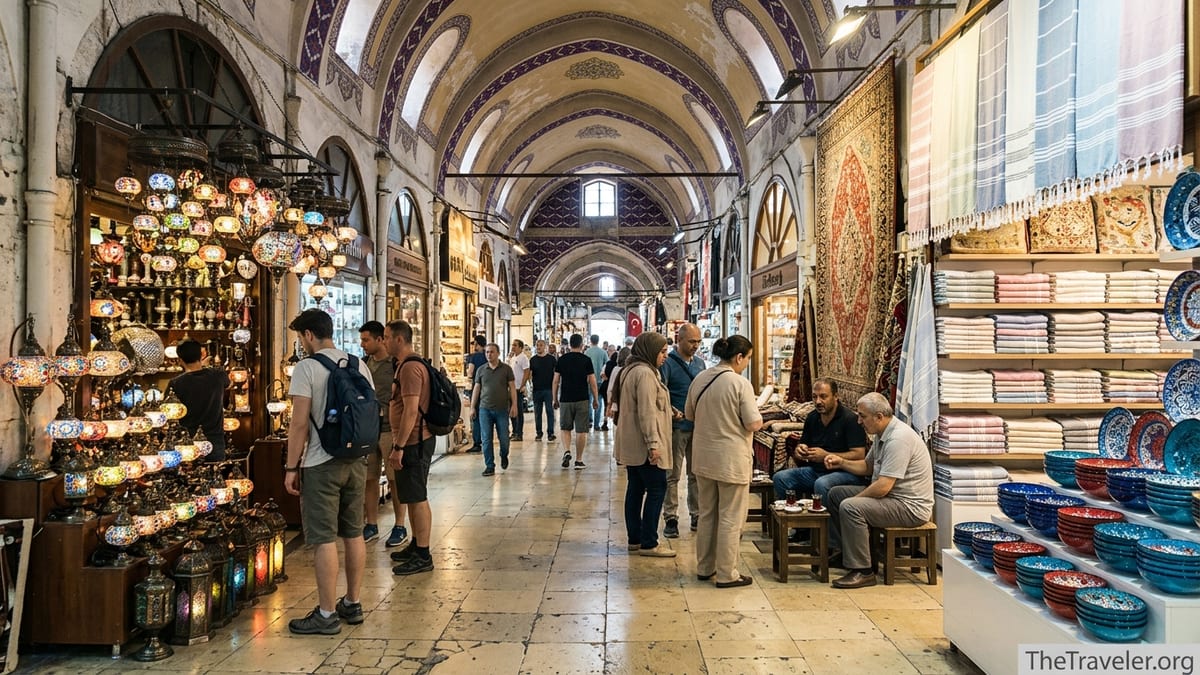
My first visit to the Grand Bazaar started at Beyazit tram stop on the T1 line, where the crowds seemed to be flowing in one direction: uphill toward a stone gate marked Kapalıçarşı. It was a weekday late morning in 2026, and by the time I passed under the arch the city outside had dissolved into a vaulted labyrinth of alleys, domes, and shop fronts. Guides describe the bazaar as more than 60 streets and around 4,000 shops, and it feels every bit that big the moment you step inside. The light is dim but warm, filtered through small windows high in the ceiling and neon from jewelry displays, giving everything a slightly golden cast.
Instead of a central square or obvious main corridor, I found a series of intersecting streets lined with tightly packed stalls. One direction was a shimmer of gold bracelets and engagement rings, another a river of leather jackets, another a cascade of colorful lamps. I had heard about the bazaar’s historical guild system where trades clustered together, and you still see that logic today. Walk a few minutes and you might pass ten nearly identical carpet shops in a row, all with rugs spilling out onto the stone floor, then turn a corner and find yourself surrounded by nothing but ceramics painted in cobalt blue.
The soundscape surprised me as much as the visuals. Instead of aggressive shouting, I heard a practiced murmur: "Hello my friend, where are you from" "You look for something special" "Just come for tea, no obligation." Vendors rarely physically block your way; they rely instead on rhythm and repetition. After a few minutes, you start to recognize the same lines delivered with subtle variations, tuned to your accent or the shopping bag you are already carrying. It feels like a game where everyone knows the rules except you.
One practical detail that became obvious quickly is that the bazaar is not air-conditioned like a mall. In early summer the temperature inside can feel noticeably warmer than the streets, especially in the interior lanes without much airflow. I understood immediately why so many local guides recommend arriving before noon, when the morning air still lingers and the energy of the place is curious rather than claustrophobic.
Sticker Shock and the Real Price of Souvenirs
My first attempt at shopping was for something simple: a hand-painted ceramic bowl. I had seen similar pieces in Istanbul’s modern neighborhoods for around 400 to 600 Turkish lira, so I walked into a small shop off one of the main arteries of the bazaar expecting a similar starting point. The piece I picked up was a deep blue bowl with tulip motifs, about the size of two cupped hands. The seller turned it over, pointed to a signature on the base, and quoted 1,800 lira, roughly triple what I had in mind.
What I did not realize then is that almost no initial price in the Grand Bazaar is meant to be taken literally, especially for non-food items. Local advice from recent visitor guides suggests starting your counteroffer at about 50 to 60 percent of the quoted price for mid-range items like bowls, lamps, and textiles. In this case, if I had calmly replied with 800 lira and been ready to walk away, the seller might well have come down to somewhere around 1,000 to 1,200 lira, particularly if I was paying cash. Instead, I hesitated, laughed nervously, and put the bowl back, which signaled that I was not comfortable enough to play the bargaining game yet.
I saw the same pattern a few lanes away when looking at mosaic lamps. A small hanging lamp with a multicolored glass globe was offered at an opening price of about 1,500 to 2,000 lira in one shop. Yet several up-to-date Istanbul shopping guides note that, after reasonable bargaining, a medium lamp often settles between the equivalent of roughly 25 to 60 US dollars depending on size and craftsmanship in 2026. The gap looks huge, but it is designed that way. The seller knows that many visitors will bargain a little, feel proud about lowering the price by 20 percent, and still pay more than a well-informed buyer would.
Food items were the exception. At stalls selling pre-packaged Turkish delight, tea, and spices, prices tended to be closer to fixed, printed on small labels and less open to dramatic negotiation. That said, several Istanbul-based writers now recommend buying your Turkish delight from legendary specialists like Hafız Mustafa or Ali Muhiddin Hacı Bekir outside the bazaar, where the quality to price ratio is usually better and the sweets are fresher. Inside the bazaar, candy shops often focus on colorful displays and generous samples that encourage impulse purchases at tourist markups.
Learning the Language of Bargaining
Once I accepted that the first price was more of an invitation than a statement of fact, the bazaar began to feel less intimidating. The key was understanding that bargaining here is a social ritual, not a battle. When I stopped at a textile shop to look at pestemals, the thin cotton towels traditionally used in Turkish baths, the owner began by offering two for 1,000 lira. I had seen similar quality towels in Kadıköy and Karaköy for around 300 to 400 lira each, so I responded with 600 for two and a smile. He laughed, tapped numbers into a calculator, and showed me 900. I shook my head, put the towels down, and thanked him. As I stepped away, he called after me with "Tamam, 700, last price" and I ended up paying 350 lira each.
The rhythm is usually the same. The seller names a figure. You counter at roughly half or a bit more, always with a friendly tone. He or she comes down a little. You signal readiness to walk away. The final price often ends up somewhere between 60 and 70 percent of the first quote if you were not wildly unrealistic. Local guides emphasize that joking, keeping eye contact, and staying polite all matter more than wringing out the last ten lira. The moment the interaction feels hostile, the experience for both sides deteriorates.
There are practical rules that seasoned Istanbul shoppers quietly follow. You should always clarify the currency for larger items. Some carpet and gold dealers quote in euros or US dollars while others quote in lira, and the confusion can quickly turn a "good" deal into something very different once you do the math. It also pays to ask whether the price includes shipping if you are looking at bulky pieces like rugs or full lamp sets. A shop may offer what sounds like a fair carpet price, then layer on a steep charge to deliver it to Europe or North America.
Most importantly, remember that you can leave. I met a British couple outside a lamp shop who had been offered two medium lamps and a table runner for the equivalent of about 350 euros. They felt uncomfortable but unsure how to extract themselves. The simplest phrase that works almost everywhere is "No thank you, it is more than I want to spend" followed by a friendly goodbye and physically moving on. In the Grand Bazaar, your power lies in the fact that dozens of other sellers stock something similar within a three-minute walk.
Hidden Corners, Repeated Patterns
After an hour in the main arteries, I realized how easy it is to assume that the bazaar is nothing but souvenir repetition. There were rows upon rows of the same evil-eye bracelets, nazar keychains, and "genuine fake" designer sneakers. It would be easy to dismiss the place as a tourist trap and leave. Yet just a little persistence led me into sections that felt noticeably more local in character.
Following Kalpakçılarbaşı Street, one of the central spines that runs between two main gates, I drifted into side alleys where the lighting was dimmer and the shop fronts less polished. Here, the displays shifted to copperware, old coins, and shelves of Ottoman-style calligraphy plates. In one cramped shop, a man in a wool vest was hand-engraving a brass coffee pot. The prices were not written anywhere; instead, he weighed the pot on an old metal scale, scribbled a figure on paper, and waited quietly for a response. The difference from the theatrical sales pitches of the main streets was striking.
Some of the best finds came from simply asking open questions. When I told a ceramic seller that I was more interested in contemporary Turkish design than tourist souvenirs, he pointed me toward a lane where several younger artists have small showrooms. There I found minimalist, matte-glazed plates and cups in tones of olive, charcoal, and rust, a world away from the usual bright floral motifs. The prices were predictable higher, but the makers were present, happy to talk about their process and, in some cases, to sign the pieces in front of me.
At the same time, walking these quieter sections revealed how much of the bazaar’s stock is now imported. Several Istanbul residents I later spoke with mentioned that many "traditional" items, from carpets to fridge magnets, are actually mass-produced outside Turkey. That does not mean you should avoid buying them; it simply shifts what a "fair" price looks like. A machine-woven rug made in a factory east of Istanbul should cost less than a hand-knotted wool piece from a workshop in Cappadocia, even if they are displayed in the same glowing showroom with Ottoman music playing softly in the background.
When Expectations Collide With Reality
Before I visited, I had read conflicting opinions about the Grand Bazaar. Some described it as a must-see slice of history. Others dismissed it as an over-priced tourist mall. My own first impressions fell somewhere in the middle. On one hand, the bazaar really is one of the largest and oldest covered markets in the world, and the architecture alone justifies a visit. The sequence of domed ceilings, painted medallions, and worn stone underfoot feels as authentic as any museum, especially if you pause early in the day before the crowds thicken.
On the other hand, it is hard to ignore that prices inside the bazaar can be significantly higher than in more local neighborhoods. In 2026, several Istanbul locals report that many basic items run at least twice, sometimes three times, what you would pay in areas like Kadıköy, Beşiktaş, or even side streets off Istiklal Avenue. A simple glass of tea and small slice of baklava in a tourist-facing café inside the bazaar might cost around 150 to 250 lira, compared with 70 to 120 lira in a more residential area. The difference is not ruinous if you are used to Western European prices, but it becomes noticeable over the course of an afternoon.
There is also the emotional gap between the romantic image of a market filled with handmade treasures and the reality of hard-selling in certain lanes. A few times I found myself edging away from shops where the pressure ramped up quickly: "Tell me your best price" "You will not find this quality anywhere else" "You waste my time if you do not buy." These were reminders that, although the bazaar is steeped in history, it is also a modern business machine that survives on volume. Knowing that in advance helps you take it less personally when a conversation becomes too intense. You are free to leave and spend your lira with someone else.
Yet even with those frustrations, moments of genuine connection still broke through. In a small jewelry shop, a silversmith cleaning his workbench late in the day invited me to sit for tea without showing me a single ring. We spoke about how visitor numbers have recovered in recent seasons, how gold prices affect his business, and how his grandfather once traded in the same spot when the bazaar was lit only by lamps and daylight. I left without buying anything and he waved me off with a smile and a simple "Come back next time." That interaction did more to anchor the bazaar in my memory than any discounted souvenir.
Practical Tips I Wish I Had Known Beforehand
Looking back on my first time shopping in the Grand Bazaar, there are a handful of practical lessons that would have made the day smoother. The first is about timing. Official information in 2026 indicates that the bazaar typically opens around 9:00 in the morning and closes about 7:00 in the evening from Monday to Saturday, and it is generally closed on Sundays and major public holidays. Arriving between 9:30 and 11:00 gives you enough active shops without the afternoon crush, and also makes it easier to get the attention of sellers before they are overwhelmed.
Second, cash is still powerful. Many shops accept credit cards for larger purchases, especially jewelry and carpets, but smaller stalls often prefer cash and may give slightly better prices if you pay in lira rather than foreign currency. With exchange rates fluctuating, it is sensible to check a recent rate on your phone just before you arrive so you have a rough sense of what 1,000 or 2,000 lira represent in your home currency. That mental anchor helps when someone quotes what sounds like a large number.
Third, inspect items carefully, especially anything that is going to be packed out of sight. Stories circulate of visitors choosing a well-made mosaic lamp or piece of jewelry only to receive a slightly different, lower-quality version that was wrapped behind the counter. The simple solution is to ask the seller to pack the exact item you have chosen in front of you and, if it is a lamp, to test the electrical wiring and switches together before paying. Taking a quick photo of a carpet or high-value item before it is folded can also serve as a low-key reminder that you are paying attention.
Finally, treat the bazaar as part shopping trip, part sightseeing. Set a rough spending limit before you enter and stick to it. Decide in advance whether you are open to big-ticket buys like carpets or gold, or whether this visit is just for modest souvenirs like towels, ceramics, or a single piece of jewelry. Knowing your priorities turns the constant stream of offers from stressful noise into background color. You can enjoy the spectacle, stop for a tea in a central courtyard, and leave feeling like you experienced something historic rather than survived an exhausting gauntlet.
The Takeaway
My first time shopping at Istanbul’s Grand Bazaar was nothing like the tidy experience I had imagined from guidebook photos. It was louder, more confusing, and more intense than any mall or market I had known. Prices felt elastic, conversations were part theater, part negotiation, and it was often hard to tell where genuine craftsmanship ended and clever merchandising began. Yet beneath the surface of tourist tactics and repeated souvenir stands, the bazaar still holds something older: a trading culture that has learned, over centuries, how to adapt without losing its basic shape.
If you arrive expecting fixed prices and quick decisions, you may leave frustrated. But if you approach the Grand Bazaar as a place where the process of buying is as important as the object itself, the experience becomes far more rewarding. The key is to arm yourself with a few simple rules, stay aware of your budget, and allow for both the surprises and the small disappointments. You might overpay slightly for a lamp or a towel, and you might also stumble into a conversation that lingers in your memory long after the souvenirs have found their place at home.
In the end, the Grand Bazaar taught me that travel shopping is not just about getting the lowest possible price. It is about understanding where you are, how people make their living, and what kind of stories you want to bring back with you. Istanbul’s most famous market will happily sell you a rug or a bracelet, but it will also give you a crash course in navigating ambiguity, reading human signals, and laughing at yourself when you realize that you are not nearly as good a negotiator as you thought.
FAQ
Q1. What are the current opening hours of the Grand Bazaar in Istanbul
The Grand Bazaar generally opens around 9:00 in the morning and closes around 19:00 from Monday to Saturday. It is usually closed on Sundays and major public holidays, though individual shop hours can vary slightly.
Q2. How much time should a first-time visitor plan for the Grand Bazaar
Most first-time visitors find that 2 to 3 hours is enough to walk through several main streets, do some shopping, and stop for tea. If you are seriously considering carpets or jewelry, plan for half a day, as those purchases involve longer conversations and more comparison.
Q3. Is it safe to bargain hard, or will I offend the sellers
Polite bargaining is expected for most non-food items, and you are unlikely to offend anyone by countering with about half the initial asking price. The key is to stay friendly, smile, and accept a final "no" with good grace rather than arguing aggressively.
Q4. Are prices in the Grand Bazaar higher than in other parts of Istanbul
Yes, prices in the Grand Bazaar are generally higher than in more local neighborhoods, especially for common souvenirs and basic textiles. You are paying partly for the historical setting and convenience, so it can be smart to buy only a few special items there and do the rest of your shopping elsewhere.
Q5. Can I pay by credit card, or do I need to bring cash
Many shops, especially those selling carpets, jewelry, and higher-end goods, accept credit cards. Smaller stalls and some textile or souvenir vendors often prefer cash and may offer slightly better prices if you pay in Turkish lira.
Q6. How do I avoid common scams in the Grand Bazaar
To reduce risk, always clarify prices and currency before agreeing to buy, inspect items closely, and insist that the exact piece you chose is packed in front of you. Be cautious about unsolicited offers to lead you to "special" shops outside the main area, and feel free to walk away from any interaction that feels rushed or uncomfortable.
Q7. What are realistic prices for typical souvenirs like lamps and ceramics
In 2026, after reasonable bargaining, a medium mosaic lamp might settle somewhere between the equivalent of roughly 25 and 60 US dollars depending on quality, while a small hand-painted ceramic bowl could fall in a mid-range bracket rather than the highest quotes you first hear. Prices fluctuate with exchange rates, so focus on relative value and your budget rather than exact figures.
Q8. Is the Grand Bazaar still worth visiting if I am not planning to buy anything expensive
Yes, the Grand Bazaar is as much a cultural and architectural experience as a shopping destination. Even if you only buy a small towel, a handful of spices, or a single piece of jewelry, wandering the alleys, watching the crowds, and pausing for tea give you a vivid sense of Istanbul’s trading history.
Q9. How can I find more authentic or handmade items instead of mass-produced souvenirs
Look beyond the busiest main streets and explore side alleys where smaller workshops and artist-run shops are more common. Ask sellers directly whether a piece is handmade and where it was produced, and do not hesitate to pay a little more when you can meet the maker or see evidence of individual craftsmanship.
Q10. What is the best way to get to the Grand Bazaar from central Istanbul
For most visitors staying in Sultanahmet, Sirkeci, or Karaköy, the easiest option is the T1 tram line, getting off at Beyazit or Çemberlitaş and walking a few minutes uphill to one of the main gates. Taxis and ride-hailing are also possible, but traffic in the historic peninsula can be heavy, so public transport is often more predictable.