


More news on this day
A software defect inside the UK’s National Airspace System triggered nationwide air traffic flow restrictions on September 8, 2026, setting off a cascade of disruption that led to more than 2,000 flight cancellations and a multi-day recovery for airlines and airports.
Get the latest news straight to your inbox!
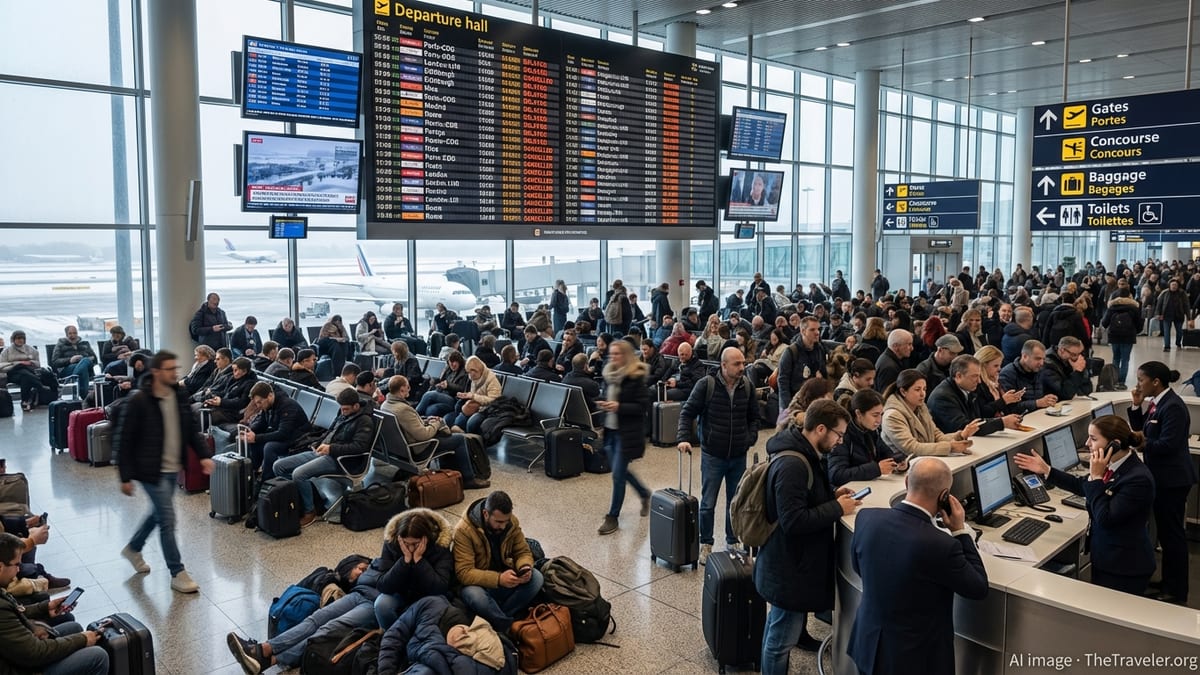
What happened on September 8, and why it spread nationwide
Published coverage and NATS’ preliminary findings describe a failure that started inside a specific part of the flight data infrastructure used to manage UK airspace. Even though the fault was tied to the London Area Control Centre’s en-route operation, the response required broader limits across the country to safely restart systems and reload flight data.
The disruption began during the morning of Tuesday, September 8. Reporting indicates the underlying technical issue was addressed within hours, but knock-on delays, aircraft and crew displacement, and airport congestion persisted well beyond the initial restoration window. That mismatch between a relatively short technical incident and a much longer operational recovery is a defining feature of modern airspace failures.
Early estimates of the day’s impact varied by hour and by methodology, with some reports initially tracking cancellations in the hundreds before the full-day figure became clear. Subsequent tallies cited by multiple outlets and industry data analysts converged on more than 2,000 cancellations across inbound and outbound UK schedules, including large volumes on September 8 itself and further cancellations as airlines attempted to reset rotations.
The “millisecond” defect: why a tiny software event can halt a big network
In its preliminary report dated September 18, 2026, NATS attributed the incident to a previously unknown software defect in a small subsection of code in its flight data system. Coverage of the report describes the triggering event as occurring within a millisecond and leading to corrupted data that interfered with flight data updates and processing.
While the error’s duration sounds trivial, aviation systems are designed around deterministic data integrity. If controllers and automation cannot reliably reconcile flight data updates, the system’s safest posture is to reduce traffic and re-establish a known-good picture of aircraft and flight plans. That is why a defect affecting a narrow slice of the system can still result in countrywide flow restrictions: the priority becomes preventing conflicting information from propagating during recovery.
NATS has emphasized that the September 2026 incident was not related to the high-profile disruption in August 2023, which also affected flight-plan processing but had different root causes. The new incident has also drawn attention to how “rare sequence” software problems, including timing-related conditions, can evade conventional testing and only surface under live operational concurrency.
How 2,000+ cancellations accumulated: airport bottlenecks and airline recovery math
Flight cancellations during an air traffic management event are typically an airline decision, but those decisions are shaped by slot availability, crew duty-time limits, aircraft location, and the need to protect the next day’s schedule. When departures are held or metered at multiple airports, the network effect can become self-reinforcing: delayed arrivals block gates, late turns create more delays, and crews time out, forcing cancellations even after the original technical issue is resolved.
Major London airports were among those most visibly affected, with reporting showing widespread departure disruption and subsequent terminal crowding. The event also touched airports well beyond the capital, reflecting how en-route constraints and system restart procedures can affect a national schedule, not just the immediate vicinity of the initial control center impacted.
Analysts tracking schedules described a particularly heavy cancellation day on September 8, followed by additional cancellations over the next two days as carriers repositioned aircraft and crews. For travelers, that translated into a longer window of risk: even passengers flying on September 9 or September 10 could be affected by aircraft arriving late, aircraft being out of place, or crews operating under revised rotations.
Passenger implications: refunds, rerouting, and where claims may succeed or fail
For UK and EU-style consumer protections, the cause of a cancellation matters. In general, air traffic control failures and airspace management disruptions are widely treated as outside an airline’s control, which can limit eligibility for fixed-sum compensation even when travelers are entitled to refunds or rerouting options. Separate obligations around care, including meals and accommodation during extended delays, may still apply depending on circumstances and carrier policies.
Public guidance shared in the wake of the disruption directed passengers to verify flight status with airlines and airports before traveling and to retain documentation of disruption-related expenses. Travelers were also reminded that rebooking timelines can be extended during systemic events, since seat availability tightens quickly across competing carriers when many routes are disrupted at once.
For transatlantic and multi-leg itineraries, the September 2026 incident underscored a common vulnerability: missed connections and downstream cancellations may originate in one country’s airspace restrictions but affect passengers far beyond the UK. When itineraries are booked on a single ticket, re-protection can be simpler, but when flights are booked separately, travelers often bear more rebooking risk.
System resilience questions after 2023 and 2026: mitigation now, scrutiny next
NATS has said mitigation is in place while a permanent fix is safety tested and deployed, and that the incident was not caused by incorrect actions. The preliminary report was requested by the UK’s Transport Secretary, and a fuller report is expected to follow with deeper technical detail, including how the defect was triggered and what safeguards will be strengthened.
The broader policy debate is likely to focus on resilience engineering, not only the specific bug. A recurring theme in recent UK disruptions is that rare defects can still produce large-scale outcomes when they intersect with peak schedules and tightly coupled airline networks. Improving resilience can involve software hardening, enhanced validation of edge-case messages, better isolation between subsystems, and faster restart procedures that reduce the duration and geographic scope of flow restrictions.
For travelers, the practical takeaway is that a “fixed” system status does not mean a “fixed” flight schedule. The September 8 incident demonstrated how quickly a short technical failure can cascade into multi-day disruption, particularly in the London aviation system where runway capacity is constrained and recovery options are limited once queues form.