

More news on this day
Major network announcements from Air France, Aeromexico, Delta Air Lines and Thai Airways are reshaping long-haul travel plans for 2026, with new and expanded routes positioning France as a central hub linking North America, Asia and wider Europe, and opening fresh opportunities for both holidaymakers and business travelers.
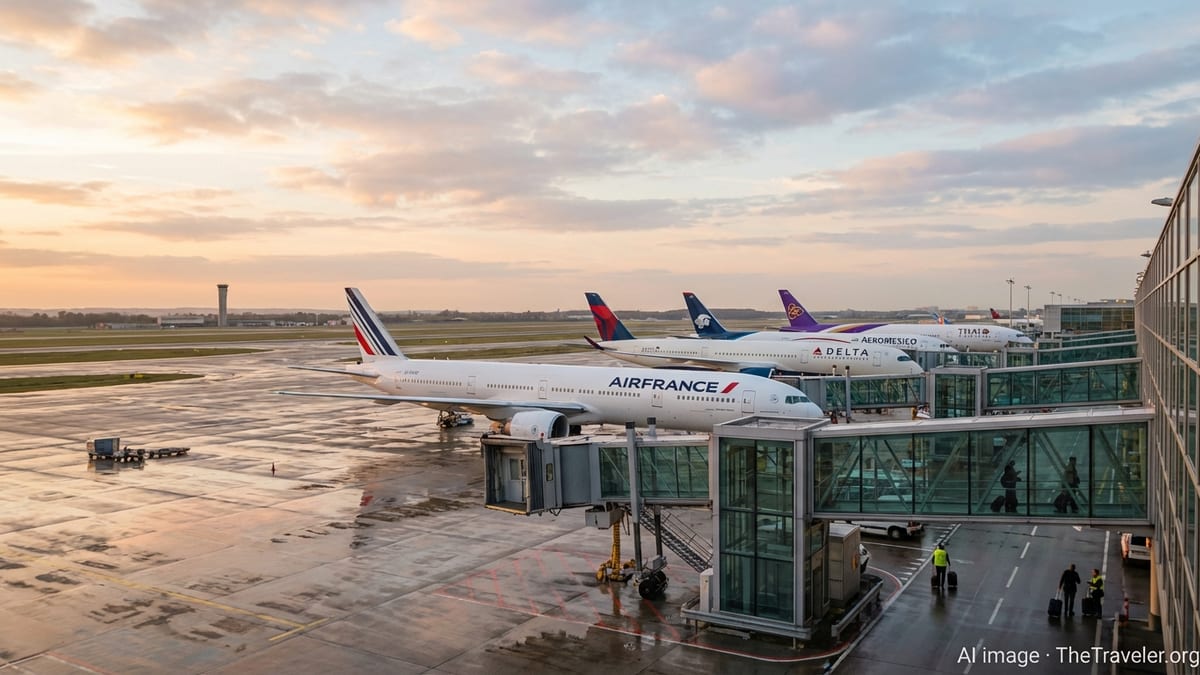
Air France Expands Transatlantic Reach From Paris
Air France is sharpening its focus on the North American market in 2026, with Paris Charles de Gaulle set to handle more flights than ever across the Atlantic. A standout addition is the launch of nonstop service between Paris and Las Vegas, scheduled to begin on April 15, 2026. Operated three times weekly with Airbus A350-900 aircraft configured in three cabins, the route taps into strong demand for leisure and convention traffic between France and the US Southwest.
The carrier is also reinforcing its presence in the New York area, traditionally one of its most important long-haul markets. For summer 2026, Air France and joint-venture partner Delta Air Lines plan to offer up to 11 daily flights between Paris Charles de Gaulle and the New York metro airports, split between John F. Kennedy and Newark Liberty. The move is designed to provide more departure choices throughout the day, improve same-day connectivity onward from Paris and increase resilience when disruption occurs.
These transatlantic moves underscore Paris’s role as a gateway not only for French travelers but also for passengers connecting from across Europe to North America. For travelers, the result is greater flexibility in schedules, more options across cabins and improved chances of securing competitive fares during peak summer travel periods.
Aeromexico Links Northern Mexico Directly to Paris
On the other side of the Atlantic, Aeromexico is preparing to plug a significant gap in northbound connectivity by adding new nonstop flights that put France directly within reach of northern Mexico. From April 13, 2026, the airline is due to launch a three-times-weekly service between Monterrey and Paris Charles de Gaulle, operated by Boeing 787 Dreamliner aircraft. It will be the first direct link from northern Mexico to France, eliminating the need for passengers to connect via Mexico City or a US hub.
The Monterrey to Paris route is part of a wider European build-out. From March 28, 2026, Aeromexico plans to restart flights between Mexico City and Barcelona, operating up to six times weekly, also using Dreamliner aircraft. Together, the Barcelona and Paris additions will increase the carrier’s available seats to Europe by an estimated double-digit percentage, marking Aeromexico’s strongest-ever presence on the continent.
For travelers in both directions, the new links are likely to simplify complex itineraries. Passengers from industrial hubs such as Monterrey will gain one-stop access via Paris to the broader Air France and SkyTeam network across Europe, North Africa and parts of Asia. Meanwhile, European business travelers and tourists bound for Mexico’s northern manufacturing centers will be able to fly with fewer connections and shorter total journey times.
Delta Builds New Gateways Between the US and France
Delta Air Lines is complementing Air France’s moves with its own network growth that strengthens the transatlantic bridge to France. From May 16 and 17, 2026, the carrier is scheduled to introduce new nonstop services from Boston to Madrid and from Boston to Nice. Both routes will be operated with Airbus A330-900neo aircraft, offering Delta One, premium economy and extra-legroom options alongside the main cabin, and are expected to run through late October 2026.
The Boston to Nice route, in particular, creates a new seasonal corridor between New England and the French Riviera. Local authorities on the Côte d’Azur have welcomed the service as a potential boost for inbound tourism, adding to a growing list of direct long-haul flights serving Nice. For US travelers, the new link offers a more direct path to the beaches, cruise ports and resorts of southern France without a connection at a larger European hub.
Delta’s transatlantic additions come as the airline also deepens its joint-venture strategy with Air France and other European partners. More nonstop options from secondary US gateways such as Boston support multi-city itineraries and give passengers additional choices when planning trips that combine France with neighboring countries.
Thai Airways Eyes Stronger France–Asia Flows
Thai Airways is also looking ahead to 2026 with plans that further integrate France into its long-haul Asian network. The Bangkok based carrier has been rebuilding its European footprint and has identified routes to and from France as key to capturing returning demand between Southeast Asia and Europe. Paris, already one of its core destinations, is expected to see increased capacity and improved connectivity with regional points in Thailand and beyond.
While detailed schedules for 2026 are still being finalized, the airline has signaled its intention to add frequencies and optimize connections over Bangkok to popular leisure destinations such as Phuket, Chiang Mai and resort islands, as well as onward links to countries including Vietnam, Cambodia and Australia. For French travelers, that should translate into more one-stop options across Asia on a single ticket, while Thai passengers gain smoother access to multiple cities in France and neighboring countries via partnerships.
Industry analysts note that Thailand’s continued popularity with European tourists, combined with a strong visiting-friends-and-relatives market, supports the case for additional capacity. Against this backdrop, Thai Airways’ alignment with France’s expanding transatlantic links gives travelers new opportunities to combine trips across continents in a single itinerary.
What the New Route Map Means for Travelers
Taken together, the route announcements from Air France, Aeromexico, Delta and Thai Airways are reshaping how passengers can move between France, North America, Asia and wider Europe in 2026. Paris Charles de Gaulle emerges as an even more powerful transfer hub, with increased transatlantic capacity dovetailing with added connectivity to Mexico and Asia. Secondary French gateways such as Nice also benefit from fresh long-haul links that disperse traffic beyond the capital.
For leisure travelers, the changes open up new city pairs that were previously more complex or time-consuming to reach, from Monterrey to Paris via a single overnight flight to seamless same-day connections from New England to the French Riviera. Business travelers gain from more frequency on core routes like Paris to New York, as well as new nonstop options that can shave hours off itineraries and reduce the risk of missed connections.
As airlines finalize their northern summer 2026 schedules, travelers considering long-haul trips involving France may find it worthwhile to monitor these developments closely. More competition and capacity on key intercontinental corridors often translate into sharper pricing, more cabin choices and greater flexibility, with France positioned firmly at the crossroads of these emerging global networks.